

An angel syndicate lets accredited investors back individual startups one deal at a time, alongside a lead investor who finds the company, negotiates terms and runs the investment through a single-purpose LLC. You see each company before you commit, you can invest $1,000 to $5,000 instead of $25,000 or more, and the startup gets one line on its cap table instead of dozens. In return you pay the lead a share of profits, usually 20%, plus your share of the vehicle's setup costs.
The structure is a genuinely good way to get access. Whether it is a good way to earn returns depends largely on the lead, the fees, and how many deals you are prepared to back. This guide to syndicate investing covers how syndicates work, what they really cost (with the arithmetic), how they compare with funds and solo angel investing, who can join, the risks, the taxes, including the 2025 changes to QSBS, and how to size and track positions inside a broader net worth.
Key Takeaways
- Deal by deal, not blind pool. Backers choose each deal individually; nothing is committed in advance.
- Carry is usually 20%, with no hurdle, and it is charged deal by deal. Winners are not netted against losers, so on the same outcomes you pay more carry than under a whole-fund waterfall.
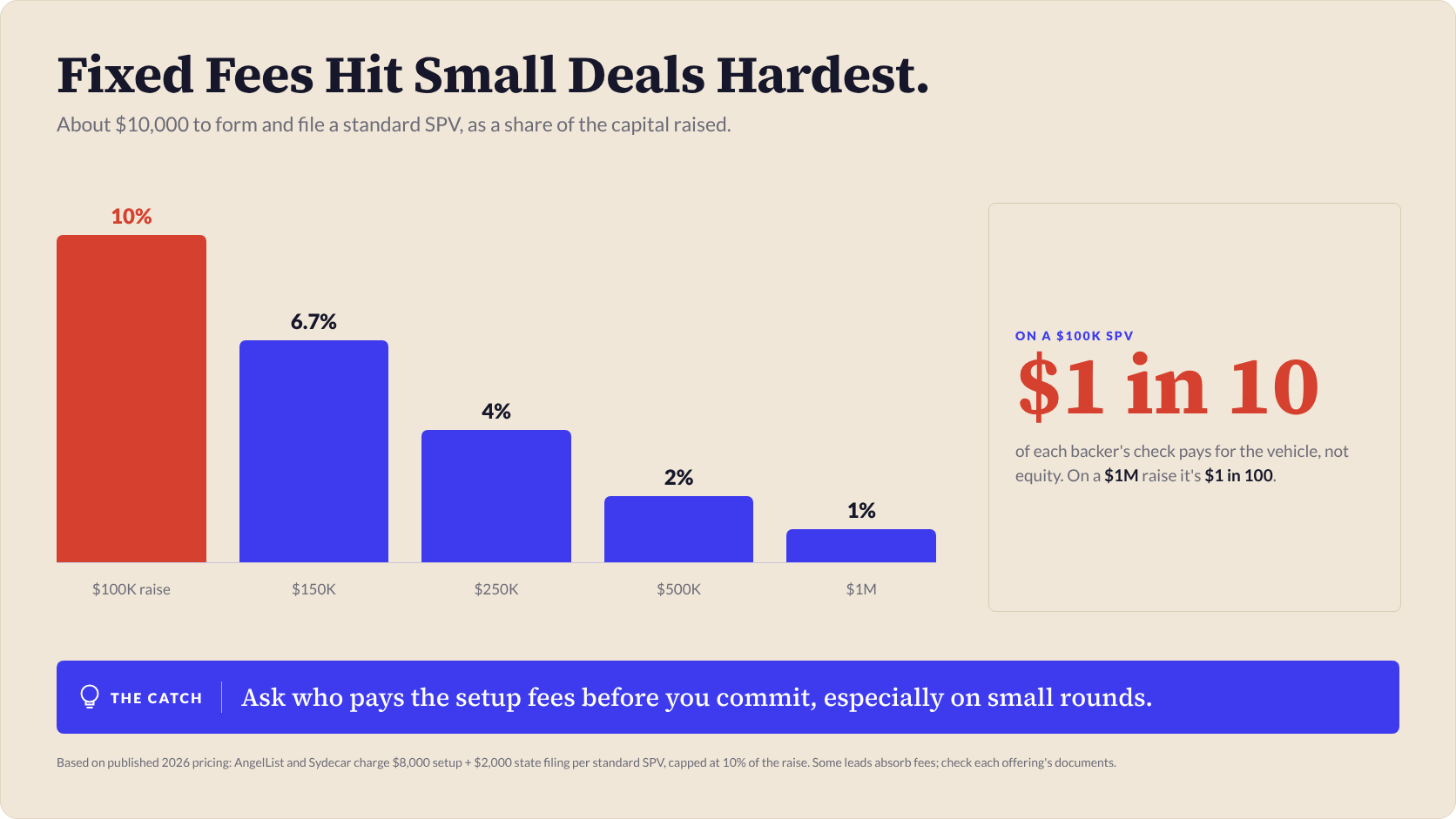
- SPV costs hit small deals hardest. About $10,000 of setup and filing costs, typical on AngelList, is 10% of a $100,000 SPV but 2% of a $500,000 one.
- You need to be accredited in almost all US syndicates: $200,000 income ($300,000 joint) or $1 million net worth excluding your home, or certain professional licenses.
- Expect most positions to lose money. Long-running research on angel investments finds that half to 70% return less than capital, and that about one exit in ten produces most of the gains. Twenty or more positions is a common rule of thumb for spreading that risk.
- Every SPV issues its own K-1, often late, sometimes after April 15. Ten syndicates means ten K-1s.
- QSBS got better. For stock issued after July 4, 2025, partial exclusions start at three years, and the cap rose to $15 million. Holding through an SPV can qualify, but only if specific conditions are met.
What Is an Angel Syndicate?
An angel syndicate is a group of accredited investors who pool money into a single startup deal behind a lead investor, using a special purpose vehicle (SPV) that holds the shares on everyone's behalf. Unlike a venture fund, capital is raised per deal, so each backer sees the company, terms and the lead's memo before deciding.
The SPV is usually a Delaware LLC created for one investment. It aggregates every backer's check, wires one combined investment to the company, and appears as a single line on the cap table. Founders like this because they deal with one lead and one entity rather than 40 individual angels.
The model scaled after the JOBS Act of 2012 and the rise of online SPV platforms. AngelList popularized it, and AngelList syndicates are still the best-known example; Sydecar, Allocations and Carta now provide similar legal and administrative rails. Large syndicates have hundreds of backers on their lists, though any single deal typically draws a fraction of them.
Syndicates are different from angel groups (members meet, diligence together and often invest individually), rolling funds (investors subscribe quarterly and the manager deploys across deals), and VC funds (investors commit upfront to a blind pool; see venture capital funds).
How a Syndicate Deal Works
Three parties are involved. The lead (sometimes called the GP) sources the deal, negotiates terms, runs diligence, writes the memo and manages the position after closing, and usually invests their own money too. The backers (LPs) read the memo and decide whether, and how much, to invest; they have no operational role. The founder deals with one lead and one entity.
- Sourcing. The lead finds the company through their network, reputation or inbound interest from founders.
- Diligence. The lead reviews the team, market, product, traction, terms and cap table, and decides whether to bring it to the group.
- The memo. Backers receive a deal memo: what the company does, the round size and valuation, the lead's thesis and risks, the carry and fees, and a deadline, often a week or two.
- Funding. Backers commit, sign the subscription documents and wire funds, usually into escrow. The SPV closes and makes one investment in the startup.
- Holding. The SPV holds the shares or SAFE. The lead handles updates, follow-on decisions and any exit. Backers wait, often for many years.
The Legal Structure Behind the SPV
The SPV is almost always an LLC governed by an operating agreement that sets out each member's rights, the carry, fees, voting and how proceeds are distributed. Each backer owns a membership interest in the LLC, not shares in the startup itself. That distinction matters for taxes, for information rights and for what you can do if something goes wrong. (For the general mechanics of investing through LLCs, see LLC for investing and LLC taxes.)
Syndicates raise money under Regulation D, either Rule 506(b), which bars general advertising and requires the issuer to reasonably believe each investor is accredited (usually based on your questionnaire answers), or Rule 506(c), which permits public marketing but requires the issuer to take reasonable steps to verify that every investor is accredited. As a pass-through entity, the LLC files a partnership return and passes gains and losses to its members, which is why you receive a Schedule K-1. Most deal SPVs also rely on an Investment Company Act exemption that generally caps them at 100 beneficial owners, or 250 for qualifying venture funds with $12 million or less of committed capital, which is one reason a popular deal can fill up.
What a Syndicate Really Costs
Syndicate economics have two parts: carried interest on profits, and the fixed costs of forming and running the SPV.
Carried interest
The lead earns carry, most commonly 20% of a deal's profits, though terms vary by lead. Backers get their capital back first, then split the profit 80/20 with the lead. Unlike many private equity funds, syndicates usually have no hurdle or preferred return: carry starts as soon as the deal returns more than 1.0x.
Two details move the number. First, carry basis: check whether carry is measured against everything you contributed or only against the capital left after SPV costs; the second quietly trims what backers receive. Second, platform carry: AngelList takes no platform carry on a lead's own investors. On backers who come through Meridian, its investor marketplace, it takes 5 points of the lead's carry, so a 20% carry is split 15% to the lead and 5% to AngelList.
SPV setup and administration fees
Forming and administering an SPV costs money, and in most syndicates that cost is deducted from the pooled capital, so part of every check pays for the vehicle rather than buying equity. Published 2026 pricing on the main platforms runs from about $4,500 to $14,500 per SPV:
| Platform | Standard SPV | Follow-on SPV | Platform carry |
|---|---|---|---|
| AngelList | $8,000 setup + $2,000 state filing fee; setup and filing capped at 10% of the raise | $5,000 + $2,000 | None on the lead's own LPs; 5 of the lead's carry points on Meridian-sourced LPs |
| Sydecar | 2% of the raise, between $2,500 and $12,500, plus a $2,000 regulatory fee | No separate published price | 0% |
| Allocations | $9,950 standard SPV for up to 35 investors ($100 each above that); distribution fees at exit | Varies | 0% |
From each platform's published pricing in 2026. Optional add-ons and platform policies change; check the offering documents for the fee your SPV actually charges.
AngelList's and Allocations' fees are roughly fixed, while Sydecar's scale with the raise within its floor and cap. With fixed costs of about $10,000, their weight depends on the size of the raise:
| SPV size | Fixed costs (~$10,000) as % of capital |
|---|---|
| $100,000 | 10% |
| $150,000 | 6.7% |
| $250,000 | 4% |
| $500,000 | 2% |
| $1,000,000 | 1% |
On a small SPV, a tenth of your check may never reach the startup. Some leads absorb fees themselves; ask.
Why deal-by-deal carry costs more than fund carry
This is the cost most backers miss. In a venture fund, carry is generally calculated on the profit of the whole portfolio: the losers reduce the profit on which the manager is paid. In a syndicate, carry is charged deal by deal. You pay 20% on every winner, and the failures, which are most deals, don't offset anything.
Consider a backer who puts $5,000 into each of 20 syndicate deals, $100,000 in total. Assume 5% of each check goes to SPV costs, so $4,750 is invested. Over time, one company returns 30x, two return 3x, and 17 fail.
| Deal-by-deal carry (syndicates) | Whole-portfolio carry (same outcomes) | |
|---|---|---|
| Capital contributed | $100,000 | $100,000 |
| Invested after 5% SPV costs | $95,000 | $95,000 |
| Gross proceeds | $171,000 | $171,000 |
| Carry paid to leads (20%) | $31,200 | $14,200 |
| Net to backer | $139,800 (1.40x) | $156,800 (1.57x) |
Illustrative. Carry is calculated after returning each backer's full contribution; no hurdle. Before fees and carry the same outcomes would be 1.80x. The whole-portfolio column excludes a fund's management fees.
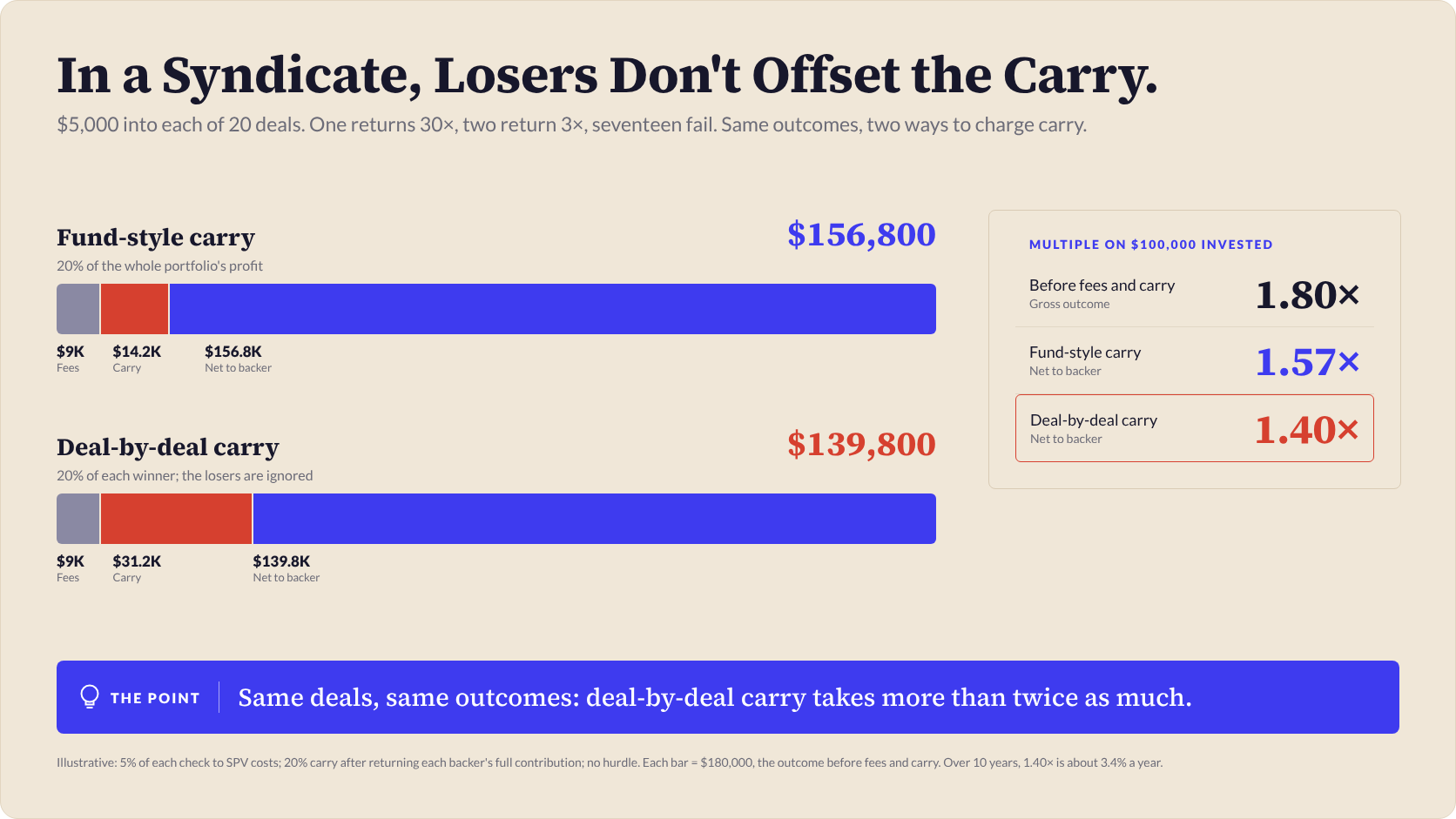
The same portfolio pays leads more than twice as much carry under deal-by-deal terms. A fund would also charge management fees, often about 2% a year, which can offset much or all of that gap. Fees and carry together take the result from 1.80x to 1.40x. If all $100,000 went in at the start and everything came back after ten years, 1.40x would be about 3.4% a year, which is the right frame for judging whether a lead is worth paying.
In a fund, losses offset gains before carry is paid. In a syndicate, they don't.
None of this makes syndicates a bad deal. A lead with genuine access can earn their carry many times over. But the cost is real, and it rises with every winner.
Syndicates vs VC Funds vs Solo Angel Investing
| Angel syndicate | VC fund | Solo angel | |
|---|---|---|---|
| Commitment | Deal by deal, after seeing the memo | Upfront commitment to a blind pool, drawn through capital calls | Every check is your own decision |
| Typical minimum | $1,000–$5,000 per deal (some higher) | Often $250,000+ for direct LPs; less through feeder platforms | $10,000–$100,000+ per company |
| Fees | SPV setup/admin, usually no management fee | Annual management fee, commonly ~2% | Legal and wire costs only |
| Carry | ~20% per deal, no netting | ~20% on fund-level profit | None |
| Diversification | Builds slowly, deal by deal | Built in across 20–50+ companies | Expensive to build |
| Workload | Read memos, decide | None after committing | All sourcing and diligence |
| Tax paperwork | One K-1 per SPV | One K-1 per fund | Direct shares, no K-1 |
A fund manager usually invests within a set mandate and fund life; a syndicate lead can follow any thesis deal to deal. Solo angels keep control and pay no carry but need far more capital: a 20–40 company portfolio built with $25,000 checks is $500,000 to $1 million over several years. Syndicates reach the same breadth with much less per position. For how funds draw capital over time, see capital calls; for another private-market entry point with very different minimums, see hedge fund minimums.
Backing a Syndicate vs Leading One
As a backer, you get curated, diligenced deals and proportional exposure with small checks, and you rely on the lead's judgment. You give up control: you can't change terms, and your only decision is in or out. Most syndicates let you choose each deal individually, but a few expect participation in a minimum number of deals; read the rules before joining.
As a lead, you earn carry on other people's capital while risking comparatively little of your own, but you take on sourcing, diligence, memo writing, investor relations, compliance and years of reporting. Strong leads usually come from networks where founders already seek their advice: repeat founders, domain operators and community builders who can show a record of picking before they scale a backer list.
Who Can Join: Accreditation and Deal Access
Because syndicates raise under Regulation D, backers generally must be accredited investors. For individuals that means income above $200,000 ($300,000 jointly) in each of the last two years with the same expected this year, or net worth above $1 million excluding your primary residence. Holders of certain securities licenses (Series 7, 65 or 82) also qualify. For how to document it, see our guides to the accredited investor letter and the qualified purchaser vs accredited investor distinction.
506(b) vs 506(c). A 506(b) syndicate can't advertise publicly and must reasonably believe you are accredited, usually based on your questionnaire answers. A 506(c) syndicate can market openly but must verify accreditation, usually with a letter from a CPA, attorney or adviser, or through income and asset documents. In March 2025, SEC staff said issuers can treat very large minimum investments ($200,000 for individuals, $1 million for entities), together with written representations, as reasonable verification, subject to the conditions in the staff's no-action letter. Most syndicate checks are far smaller, so verification still applies to them (see Rule 506(c) verification).
Change may be coming, but isn't here. The House passed the INVEST Act in December 2025, which would add new routes to accreditation, including an exam, and adjust some thresholds for inflation. As of November 2026 it has not passed the Senate, so the current definitions apply.
Access is the real gate. Accreditation lets you in the door; the best deal flow clusters around leads with proven judgment and relationships. Many strong syndicates cap their backer lists or prioritize investors who add value to founders.
Due Diligence: What the Lead Covers and What You Must Check
A good memo covers team quality and founder references, market size and timing, product and technology, competitive position, the round's valuation and terms, and the cap table. Read it as a thesis to test, not a conclusion to accept (our guide to writing an investment thesis is a useful lens).
The questions the memo rarely answers are about the lead and the deal, not the company:
- Realized track record. How many deals has the lead exited, and at what multiples? Paper markups and logos are not returns.
- Carry basis and fees. Is carry measured against your full contribution or only the capital invested after fees? What exactly comes out of your check, and does the lead cover any of it?
- Skin in the game. How much of the lead's own money is in this deal, on the same terms?
- How the deal arrived. Was the allocation scarce and won, or widely shopped? A widely shopped deal may be one stronger investors passed on, so ask why it is being offered to outside backers.
- Information rights. What updates will backers get, and how often?
- Follow-on plan. If the company raises again, will there be a follow-on SPV, and at what additional cost?
- Instrument. Is the SPV buying preferred stock, common stock or a SAFE? It affects your rights and, as covered below, your taxes.
The Risks of Angel Syndicates
Illiquidity. Expect capital to be locked up for seven to ten years or more, with no guaranteed exit. Operating agreements usually restrict transfers. A private secondary sale is sometimes possible, typically at a discount (see secondary market investing). Startup stakes are classic lumpy assets: valued rarely, and in large jumps.
Failure rates and concentration. The landmark study of angel-group exits by Robert Wiltbank and Warren Boeker, published in 2007 by the Kauffman Foundation and the Angel Capital Education Foundation, found that 52% of 1,137 exits returned less than the capital invested, while 7% of exits, those above 10x, produced 75% of the total dollar returns (study). A later Angel Resource Institute update put the share returning less than 1x at 70%, with 10% of exits generating 85% of the cash (report). With fewer than 20 or so positions, it is easy to miss the winners entirely by chance.
Adverse selection. The most sought-after rounds tend to go to established investors, so new backers, and newer leads, risk seeing a larger share of rounds that others declined. Access to genuinely strong deal flow is the hardest thing for a new backer to secure.
Limited control and information. Backers can't influence terms or the company, founder updates are selective, and problems often surface only when it's too late to act.
Fee drag and dilution. Carry and SPV costs compound against returns, as the worked example shows. Later rounds dilute early positions, and every follow-on SPV carries its own fees.
A syndicate sells access. Whether it delivers returns depends on the lead.
Taxes: K-1s, QSBS and Section 1244
Schedule K-1s
Each SPV files a partnership return (Form 1065) and sends each backer a Schedule K-1 showing their share of income, gains, losses and deductions. Most years there is nothing to report but a little expense; in an exit year there may be a large gain even if proceeds arrive in stages. K-1s often arrive late, sometimes after April 15, so investors with several syndicates commonly file for an extension. Back ten syndicates and you will reconcile ten K-1s every year until each SPV winds down.
QSBS inside an SPV
Section 1202 lets investors exclude some or all of the gain on qualified small business stock, original-issue stock in a domestic C corporation that meets size and business tests. The One Big Beautiful Bill Act made it more valuable for stock issued after July 4, 2025:
| Stock issued Sept. 28, 2010 to July 4, 2025 | Stock issued after July 4, 2025 | |
|---|---|---|
| Holding period for exclusion | 100% after 5 years | 50% after 3 years, 75% after 4, 100% after 5 |
| Per-issuer cap | Greater of $10M or 10x basis | Greater of $15M (indexed from 2027) or 10x basis |
| Company gross-asset limit at issuance | $50M | $75M |
Stock issued before September 28, 2010 qualifies for smaller exclusions (50% or 75%, depending on the date), and state tax treatment varies.
Gains from QSBS held through a partnership, such as an SPV taxed as one, can pass through to members, but generally only if you were a member when the SPV acquired the stock and remained one continuously, and only up to your share at that time. SAFEs and convertible notes complicate the picture, because the holding period is generally measured from when they convert into stock. Ask the lead whether the SPV tracks QSBS eligibility and reports it on the K-1. Our QSBS guide covers the underlying rules.
Section 1244: a better deduction for the losers
Most angel positions fail, so the treatment of losses matters. Section 1244 can turn up to $50,000 a year ($100,000 on a joint return) of loss on qualifying small business stock into an ordinary loss rather than a capital loss. A partnership can pass that treatment to individuals who were partners when it acquired the stock. The catch is that the company must have received $1 million or less in total for its stock and as contributed capital, counting earlier rounds, when the stock was issued, so it usually applies only to the earliest rounds, and it requires stock, not a SAFE. Confirm eligibility with your tax adviser.
Sizing and Tracking Angel Positions
The right question isn't whether a single deal is good. It's how much of your net worth sits in illiquid startup positions alongside your public equities, real estate and everything else, and whether you could lose all of it without changing your plans. Many investors keep total startup exposure to a small slice of investable assets; the right number depends on your liquidity and goals (see portfolio diversification).
Syndicate positions are also the hardest assets to keep track of. There is no live price, no standard statement and a new entity for every deal, so spreadsheets fall out of date almost immediately. Each SPV generates a stack of documents that belongs with the position: the subscription agreement, the operating agreement, wire confirmations and the annual K-1.
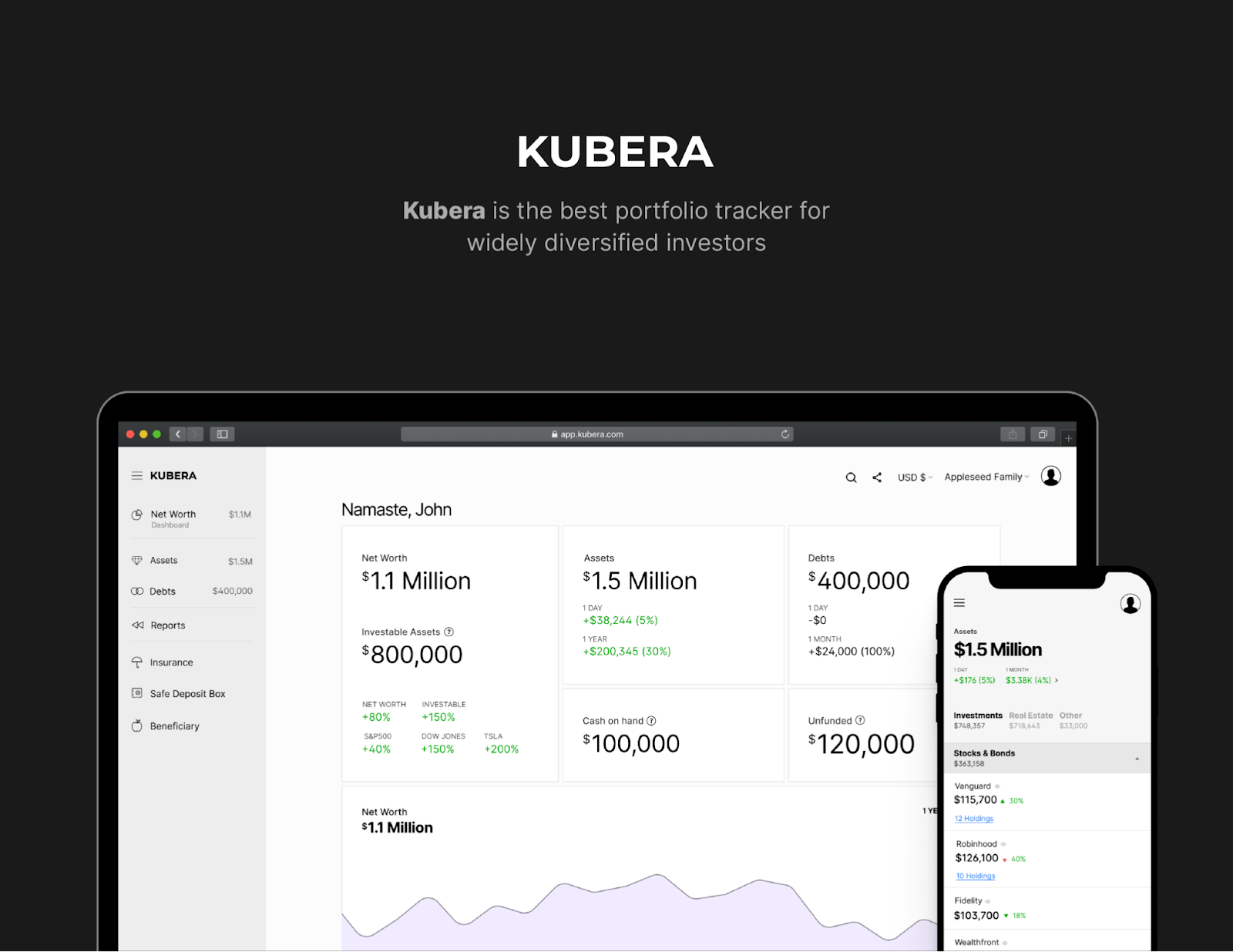
Kubera handles this kind of holding alongside connected bank, brokerage and crypto accounts. You can add each SPV position manually, attach its documents, and use File Import to turn uploaded statements and documents into tracked positions. Nested portfolios let you mirror how your investing is actually held, such as SPVs inside an investing LLC or a trust, so each layer rolls up into one net worth. When a deal marks up or exits, IRR tracking turns a raw multiple into an annualized, money-weighted return you can compare with the rest of your portfolio.
Frequently Asked Questions
What is an angel syndicate?
An angel syndicate is a group of accredited investors who back a single startup deal together behind a lead investor, pooling their money in an SPV that holds the shares. Backers decide deal by deal and typically pay the lead about 20% of profits.
Do you need to be accredited to join an angel syndicate?
In the US, almost always. Syndicates raise under Regulation D, which generally limits participation to accredited investors: $200,000 of income ($300,000 joint), $1 million of net worth excluding your home, or certain securities licenses.
How much money do you need to invest in a syndicate?
Per-deal minimums commonly run $1,000 to $5,000, with some deals higher. Building a diversified portfolio of 20 or more positions therefore takes $20,000 to $100,000 or more over several years.
What fees do angel syndicates charge?
Usually carry of about 20% of profits, charged deal by deal with no hurdle, plus SPV setup and filing costs that are often deducted from pooled capital. On major platforms those costs run from about $4,500 to $14,500 per SPV, and AngelList caps its fees at 10% of the raise.
How do syndicate leads make money?
Through carry on the deals they lead, typically 20% of profits above the return of capital, and sometimes a share of setup economics. Many leads also invest their own money in each deal.
Are angel syndicate investments liquid?
No. Expect your capital to be tied up for seven to ten years or more. Transfers are usually restricted, and secondary sales, where possible, tend to be at a discount.
Can syndicate investments qualify for QSBS?
They can. Gains on qualified small business stock held through an SPV can pass through to members who held their interest when the SPV bought the stock. For stock issued after July 4, 2025, 50% of gain can be excluded after three years, 75% after four and 100% after five.
What is the difference between a syndicate and a rolling fund?
A syndicate raises fresh money for each deal, and you choose each one. A rolling fund collects recurring subscriptions, often quarterly, and the manager invests them across deals on your behalf.
Conclusion
Angel syndicates solved a real problem: they gave accredited investors small-check access to deals once reserved for insiders, with a lead doing the sourcing and diligence. What they didn't remove is the arithmetic of early-stage investing. Most deals fail, a few carry the portfolio, fixed SPV costs weigh on small rounds, and deal-by-deal carry takes a larger cut than fund carry on the same outcomes. Back leads you can evaluate on realized results, build enough positions to give the winners a chance to show up, keep the paperwork attached to every position, and size the whole allocation against your full net worth.
Disclaimer
This article is general information as of November 2026 and is not investment, tax or legal advice. Startup investments are illiquid and high-risk, and you can lose your entire investment. Platform pricing and securities and tax rules change; verify terms in each offering's documents and consult qualified advisers before investing.


