
An investment thesis is a written, falsifiable argument for owning an investment. It states what must be true for the investment to work, why the opportunity exists, what evidence supports the view, and what evidence would weaken or invalidate it. It is not a prediction or a target price. A prediction says the price will rise. A thesis explains the mechanism, the possible mispricing, and the conditions under which you would admit you were wrong.
This article focuses on the version that matters most to individual investors and gets the least attention: the thesis that guides the whole portfolio, not only one stock or a venture fund. A thesis earns its keep when it changes behavior. It should shape how much you buy, where the position fits, when you review it, and when you sell. A thesis that is never revisited is a narrative with better formatting.
What Is an Investment Thesis?
An investment thesis is a documented argument that explains why a specific investment decision should produce an acceptable return and what would disprove it. A complete thesis identifies the claim, the reason the opportunity exists, the evidence, what other investors may be missing, the expected return mechanism, the time horizon, the main risks, and what would prove the view wrong.
The term is used at three altitudes, and confusing them causes most of the bad advice on this topic.
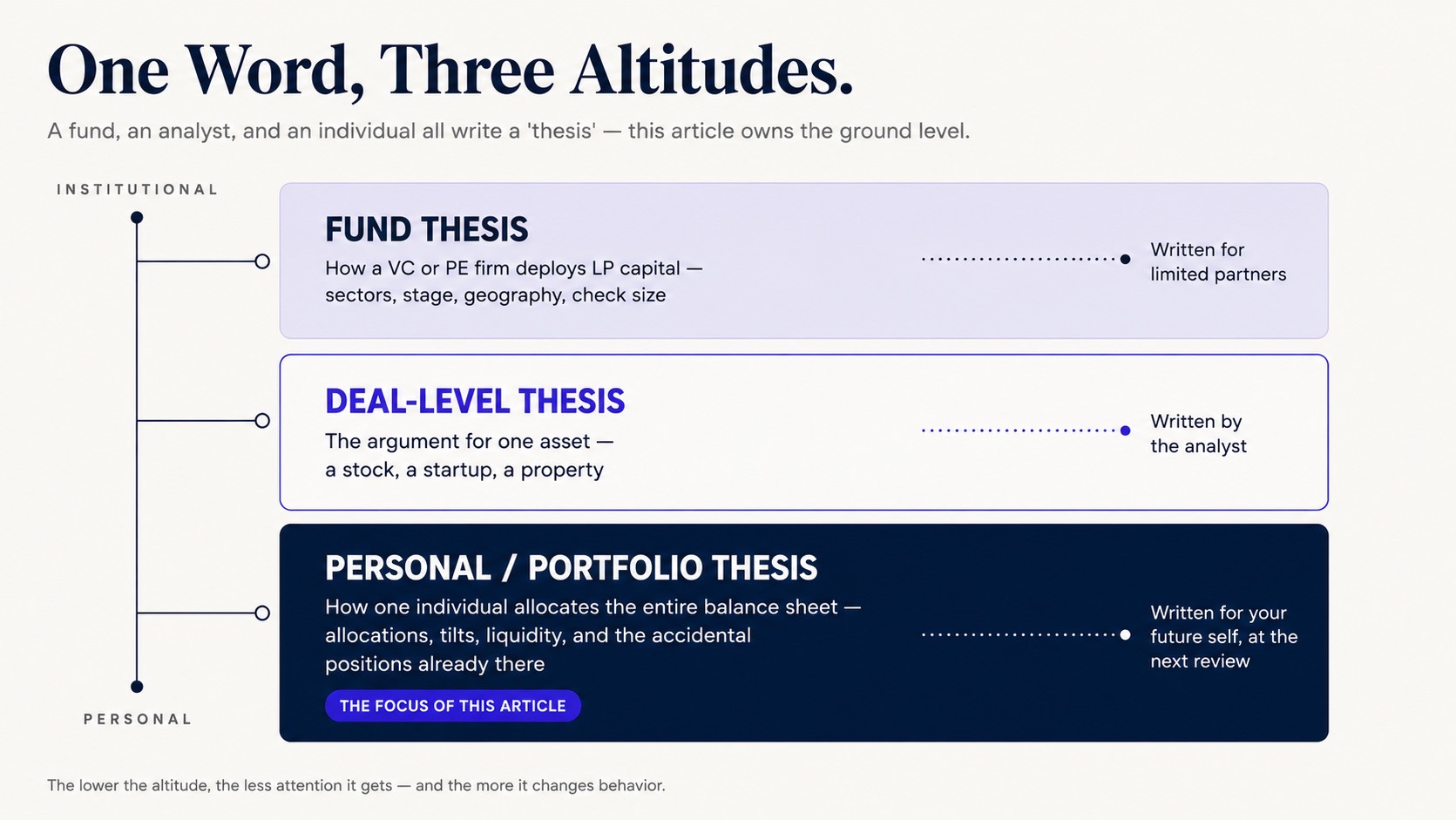
Fund thesis
A venture capital firm, private equity firm, or other fund manager writes a thesis to explain how it will deploy limited-partner capital: which sectors, which stage companies, what geography, what check sizes, and what return model. Venture capitalists use it to define which investment opportunities fit the fund and to let limited partners judge the manager against its stated approach and track record. Understanding venture capital funds covers this structure in depth.
Deal-level thesis
This is the argument for owning one specific asset: a stock, a startup, or a property, a private company. This is the form most investment thesis example articles cover, using the analyst's toolkit of valuation, competitive landscape, and management assessment.
Personal or portfolio investment thesis
This dictates how an individual allocates capital across the entire balance sheet, and how each position or sleeve serves broader investment goals. This is the level this article owns. It borrows the discipline of the deal-level thesis and applies it to allocations, tilts, liquidity, and the accidental positions most portfolios already contain.
Investment Thesis vs Investment Strategy, Philosophy, and Investment Policy Statement (IPS)
These terms answer different questions and change at different speeds. The comparison of investment philosophy vs thesis is the one investors mix up most: a philosophy is a belief about how markets generally work, while a thesis is a specific argument you could be proven wrong about within your holding period. The investment thesis vs investment strategy distinction is similar: a strategy is the repeatable method, a thesis the argument behind one application of it.
Why Written Theses Beat Mental Ones
The case for writing the thesis down is behavioral, not clerical. Investors systematically misremember and misjudge their own reasoning. Shefrin and Statman named the disposition effect in 1985, and Odean's study of 10,000 brokerage accounts found investors far more likely to sell winners than losers, a pattern that reduced after-tax returns. Kahneman and Tversky's prospect theory explains why: losses hurt more than equivalent gains feel good, so investors quietly reshape their reasons rather than realize a loss.
A written thesis converts each bias into a design requirement. A dated original document counters hindsight bias, because you cannot claim you always knew. Pre-written invalidation criteria counter confirmation bias, because the test was chosen before the outcome. A target allocation counters emotional sizing and anchoring. Review triggers counter the compulsion to react to every price move. A pre-committed sell rule counters sunk-cost thinking and loss aversion. A post-mortem counters narrative fallacy, selective memory, and performance chasing.
The document should be short enough to reread when the investment is down sharply and the original reasoning feels hardest to trust. This overview of behavioral investing treats these patterns in more depth.
How to Write an Investment Thesis
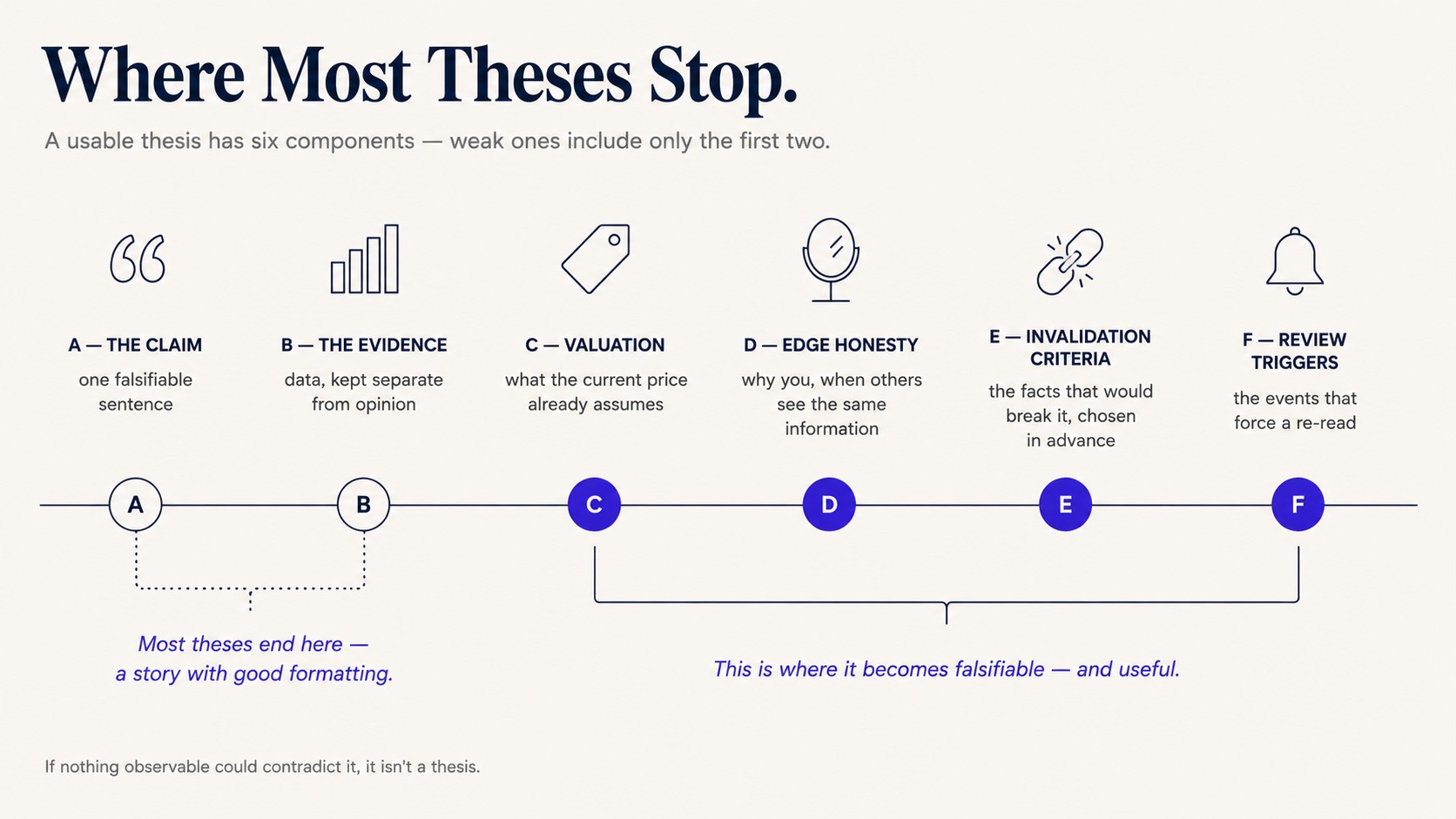
A usable thesis has six components. Most weak theses fail because they include only the first two.
A. The claim
One falsifiable sentence stating what you expect to happen, why, over what period, and through what payoff mechanism. "Strong company," "good management," "attractive sector," and "long-term growth story" are not claims; nothing observable could contradict them. "This company can hold net revenue retention above 110% for five years, supporting margins the current price does not reflect" is a claim.
B. The evidence
Market data, company data, competitive analysis, valuation work, management quality, industry trends, unit economics, and relevant historical comparisons. Keep evidence separate from opinion. "Gross margin has been above 75% for twelve quarters" is evidence. "Management is excellent" is an opinion until you attach the capital-allocation record behind it.
C. Valuation and what is already priced in
A thesis must address the current price, the expectations implied by it, the potential return, and the downside case. A strong business is not automatically an undervalued security; if the market already recognizes everything in your evidence section, the expected return may be ordinary.
D. Edge honesty
Every thesis should answer one uncomfortable question: why do I have a reasonable chance of being right when other investors have access to much of the same information? Edge can be informational, analytical, structural, or behavioral; it can come from operating expertise, sourcing networks, a liquidity advantage, or a genuinely longer time horizon. Most individual investors do not possess a durable informational advantage over professionals, and reading more public information does not create one. The more realistic edge for a self-directed investor is usually behavioral or structural: holding through temporary volatility, avoiding forced selling, working within a narrow area of deep expertise, accepting illiquidity inside a controlled allocation, or refusing to chase recent performance. If the honest answer is "no edge here," that is an argument for the index thesis below, not a failure.
E. Invalidation criteria
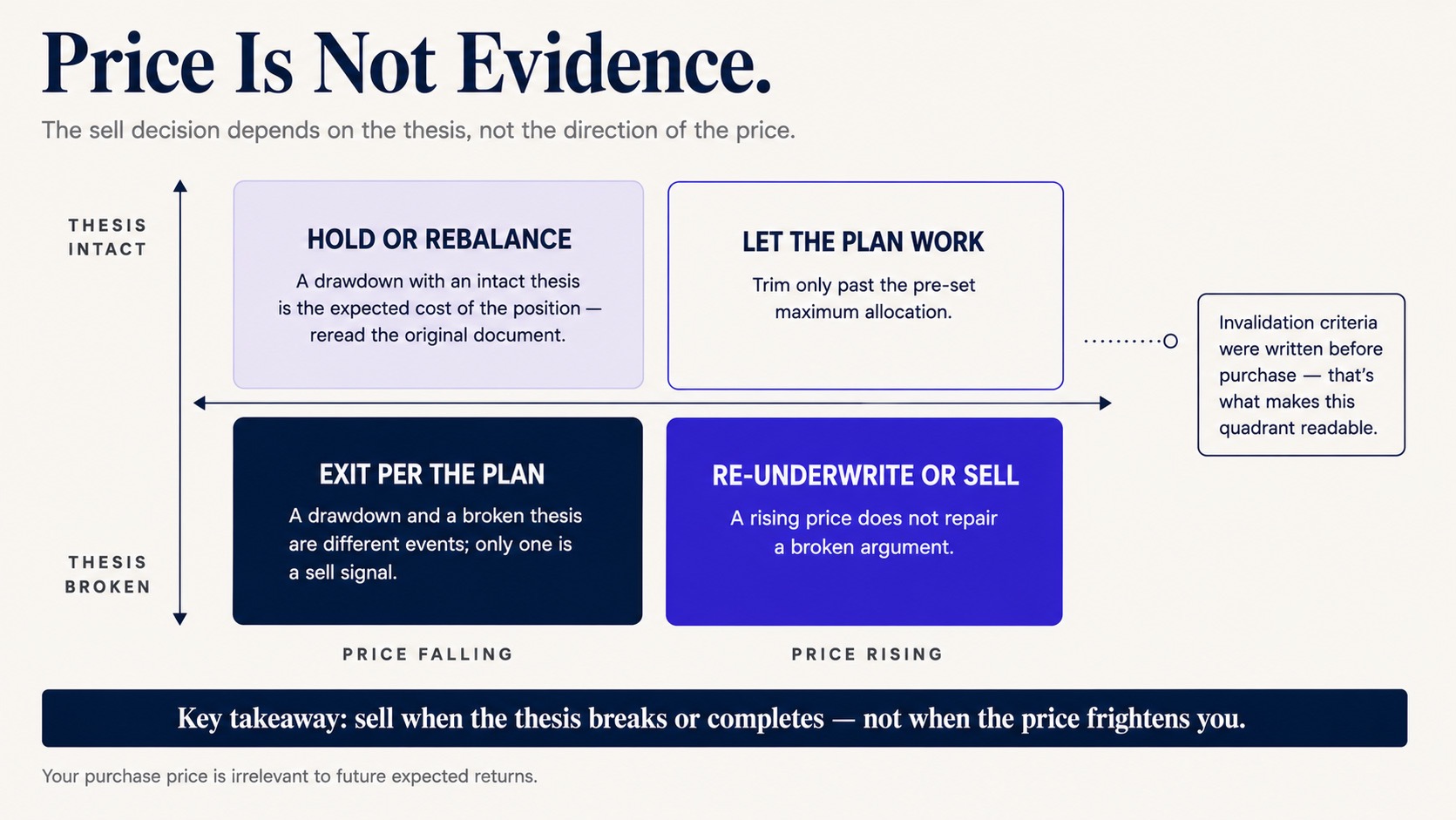
Define specific, observable events that would weaken or break the thesis before you invest: growth staying below an agreed threshold, margins deteriorating for several consecutive periods, management allocating capital inconsistently with the original case, a regulatory change, dilution that destroys the expected ownership economics, or erosion of the competitive advantage the claim depends on. Price decline alone is not invalidation. The price falling does not automatically break the thesis. The facts changing might.
F. Review triggers
Define the events that force a deliberate review: earnings or the annual report, a financing round, a management change, an acquisition, a major regulatory change, valuation crossing a pre-set level, the position exceeding its allocation limit, a liquidity event, or the original time horizon expiring.
The index thesis deserves the same treatment
None of this implies you should pick stocks. For many investors, the strongest personal investment thesis is a broad index fund thesis: markets have historically rewarded long-term ownership, consistently identifying future winners is difficult, costs and taxes compound against activity, and diversification reduces dependence on any single forecast. An index investor still has a thesis: markets compound over time, and consistently identifying future winners is difficult. Writing it down matters because the thesis is what you reread after a sharp decline, when the alternative is abandoning the plan or switching to whatever recently outperformed. Under this thesis, the investor's main job is to keep holding.
Investment Thesis Template
Copy the investment thesis template below for any position or sleeve. It doubles as an investment checklist and a decision tool, not a prediction form; several fields exist purely to make future reviews honest.
The one-page personal version. At the whole-portfolio level, a personal investment thesis is shorter and covers:
- Investment goals and time horizon
- Core market beliefs
- Strategic asset allocation
- Active tilts, and the argument for each
- Private or alternative allocation and its limits
- Liquidity reserve
- Concentration limits
- Rebalancing rules and review schedule
- Conditions that would justify changing the plan
Three Worked Investment Thesis Examples
All three examples are hypothetical and educational. They are not recommendations, and the companies and figures are invented to illustrate structure.
Example 1: A single-stock thesis (hypothetical)
Claim. "Meridian Workflow, a profitable vertical-software company, can sustain 12 to 15% revenue growth and expand margins over five years because switching costs keep net revenue retention above 110%, while the current price implies growth below 8%."
Evidence. Twelve quarters of retention above 110%; gross margins near 78%; a fragmented competitive landscape where the nearest rivals compete on price rather than product; a management team with a record of disciplined buybacks rather than empire-building.
Valuation and entry context. The stock trades at a free-cash-flow yield above its five-year average after a sector-wide derating. The growth potential in the claim is not reflected in implied expectations, which is the source of the potential return. Downside case: growth slows to 5%, the multiple compresses further, and the position loses roughly a third of its value.
Horizon, size, and rules. Five years. Target 3% of the portfolio, maximum 5%. Invalidation criteria: retention below 105% for two consecutive years, sustained margin deterioration, or capital allocation departing from the stated record. Review triggers: each annual report, any acquisition, any CEO or CFO change. Exit: sell if invalidated; trim above the maximum; reassess if the price implies the base case is fully realized.
Example 2: An asset-class tilt (hypothetical)
Claim. "International developed-market equities, at a historically wide valuation discount to U.S. equities, may offer higher expected returns over the next seven to ten years, so the portfolio will hold a 10% overweight relative to global market weights."
Evidence and role. A valuation spread wide relative to its own history; earnings expectations that appear undemanding; a diversification role, since the tilt reduces dependence on a single country, currency, and market regime. The edge claimed is not informational. It is the willingness to hold an uncomfortable position for a decade.
Sizing and rules. Maximum tilt 10 percentage points. Invalidation criteria: the valuation spread closing without price appreciation, meaning fundamentals deteriorated, or evidence that the earnings assumptions were wrong. Two years of underperformance would not invalidate the thesis, because the claim was explicitly made on a seven-to-ten-year horizon; underperformance is the expected cost of the position, not evidence against it. Review trigger: an annual check of the spread and the tilt's actual weight.
Example 3: An alternatives sleeve (hypothetical)
Claim. "A 5% angel-investing sleeve, deployed over four years into early stage companies in industrial software, where I have twenty years of operating expertise, may produce venture-style returns, and the portfolio can absorb the realistic outcome that the sleeve loses most of its value."
Structure. Maximum 5% of net worth; roughly 15 to 20 checks of equal size to diversify across companies and vintages; reserves for follow-on investments in companies that hit milestones; pro-rata rights negotiated where possible. Selection criteria: fit with the investor's sector expertise, credible management teams, and evidence of early traction, not just a plausible story about industry trends.
Honest expectations. Return distributions in early-stage investing are highly skewed: most positions may return little or nothing, and the sleeve's outcome likely depends on one or two winners. Total loss of any single check is a normal outcome. Liquidity is near zero for seven to twelve years, so the sleeve is capped at a size whose full loss would not change the investor's plans. Monitoring relies on company updates rather than prices, with a one-page thesis per company. The sleeve is inappropriate without deal flow, sector expertise, and the liquidity to leave capital untouched for a decade. This overview of alternative investments covers how such sleeves fit alongside public assets.
From Thesis to Position Size
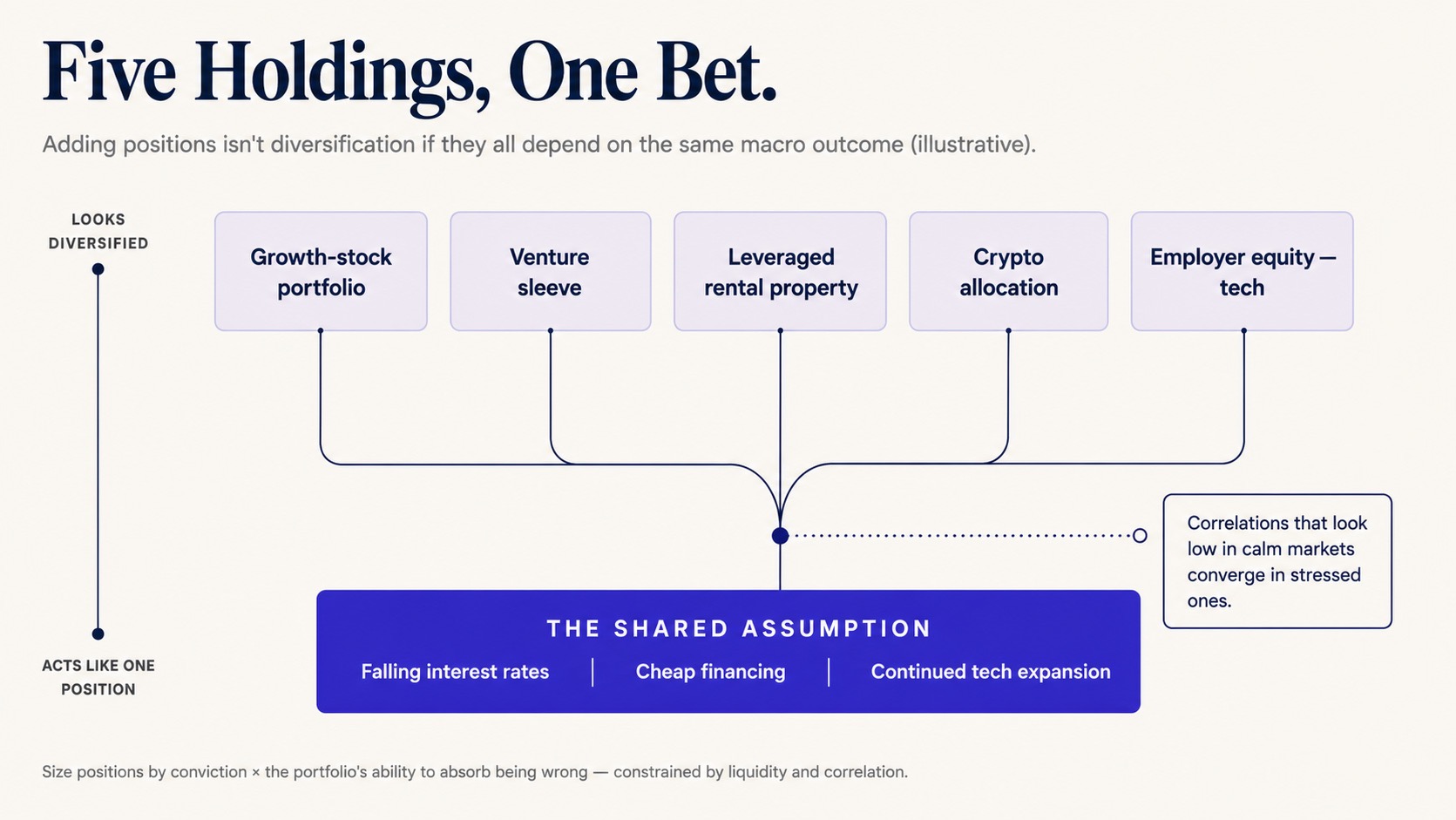
Conviction alone should not determine size. Position sizing should reflect confidence in the thesis, the consequence of being wrong, liquidity, volatility, correlation with everything else you own, time horizon, tax consequences, and any exposure carried through employment or concentration elsewhere on the balance sheet. As a conceptual framework, not a formula: position size reflects conviction, multiplied by the portfolio's ability to absorb being wrong, constrained by liquidity and correlation.
This separates conviction from consequence. A high-conviction illiquid investment may still deserve a small allocation, because the cost of being wrong includes years of trapped capital. A low-volatility, diversified index position can rationally be much larger than any single-company bet. Employer stock deserves special honesty: between vested shares, unvested grants, and the salary that depends on the same company, many executives already hold a large implicit position before making any deliberate investment decision.
Correlation is where sizing most often goes wrong. Adding positions does not create diversification if all of them rely on the same macro outcome. Five holdings can look diversified while expressing the same underlying bet. A growth-stock portfolio, a venture sleeve, a leveraged rental property, a crypto allocation, and employer equity at a technology company may all depend on falling interest rates, cheap financing, and continued technology-sector expansion. Assets that appear non-correlated in calm markets can converge in stressed ones.
The Maintenance Loop: Review Triggers and Thesis Drift
A thesis is a maintained hypothesis, not a one-time essay. The lifecycle is: write, size, invest, monitor, trigger, review, then hold, add, reduce, or exit, then post-mortem. Practically: scheduled annual or semiannual portfolio reviews plus event-driven reviews for individual positions; the original thesis kept unchanged in an archive, with dated amendments rather than rewritten history; realized results compared with the expected returns you wrote down; catalysts tracked against what actually occurred; and a note recording why any assumption changed. An investment journal built this way records your reasoning quality, not just your returns.
Thesis drift occurs when the investor quietly replaces the original reason for owning something after that reason fails. The classic hypothetical progression: a stock is bought on a growth thesis; when growth disappoints, it is reframed as a value thesis; when value fails to materialize, it becomes an income thesis; eventually it is defended only because selling would confirm a loss. The sequence is rationalization. Fund managers call the institutional version style drift; individuals face the same slide with no compliance department to flag it.
Legitimate revision looks different. New evidence is documented, the revised thesis stands on its own merits, position size is reconsidered rather than defended, the original assumptions remain visible, and invalidation criteria are updated prospectively. In rationalization, the reason changes only after bad news, no new evidence supports the new story, and the size stays anchored to the original cost. The test is simple: would you buy this position today, at this price, at this size, under the new thesis? If not, the new thesis is a defense, not an argument.
When the Investment Thesis Breaks
The question "when to sell a stock" has a cleaner answer once a thesis exists: sell when the thesis breaks or completes, not when the price frightens you. A falling price with an intact thesis is not automatically a reason to sell; a drawdown and a broken thesis are different events. Equally, a rising price with a broken thesis does not make the thesis correct. Your purchase price is irrelevant to whether future expected returns remain attractive. Taxes matter and belong in the exit decision, but tax avoidance should not keep you in a position whose thesis no longer supports ownership.
Close every exit with a five-line post-mortem:
- What did I originally believe?
- What happened?
- Which assumption was wrong?
- Was the error analytical, behavioral, or sizing-related?
- What rule should change before the next investment decision?
The Portfolio as a Thesis Stack
A portfolio is a collection of theses with weights, whether or not anyone wrote them down. Some are explicit: broad global equities, direct real estate, private credit, venture capital, crypto, a cash reserve. Others are accidental: inherited stock kept because selling feels disloyal, employer equity held because it vested, concentrated founder shares, legacy mutual funds, idle cash waiting years for a better entry point, or several private funds accumulated one deal at a time with overlapping portfolio companies and no sleeve-level limit. The portfolio should reflect the thesis you intended, not the collection of decisions you happened to make.
The accidental-thesis audit - a practical exercise for building a portfolio investment thesis from what already exists:
- List every meaningful holding and liability.
- Write one sentence explaining why each belongs.
- Label each as strategic, tactical, inherited, restricted, illiquid, or accidental.
- Identify the assumption driving each position.
- Group positions that depend on the same economic outcome.
- Compare actual allocation with intended allocation.
- Decide whether each orphan position needs a thesis, a target size, or an exit plan.
Broad index funds are not orphans when they sit under a clear index thesis; they are the deliberate core. The audit's real payoff is step five. Portfolios often carry unexamined assumptions about economic growth, inflation, interest rates, one employer, one country, one currency, one technology trend, private-market liquidity, or perpetual real estate appreciation. A personal investment thesis at this level is less about finding new investment opportunities and more about taking ownership of the bets already on the balance sheet.
Common Mistakes That Break Thesis Driven Investing
Thesis driven investing is not a synonym for active stock selection; the discipline applies equally to an index core, a tilt, or a private sleeve.
- Writing the thesis after buying, which is often rationalization, not analysis.
- Using vague language that cannot be disproved, or confusing a company description with an investment thesis.
- Ignoring valuation, as if a good business were automatically a good potential investment at any price.
- Overstating personal edge, or assuming more public information equals an advantage.
- Failing to define a downside case or a maximum acceptable loss.
- Sizing from conviction alone. A correct thesis held at an irresponsible size can still produce a poor portfolio outcome.
- Overlooking correlation across holdings that share one macro assumption.
- Treating price movement as evidence, in either direction.
- Rewriting the thesis after it fails, or never reviewing the document at all.
- Tracking the thesis separately from the actual portfolio, letting intended and real allocations diverge.
- Treating inherited or employer assets as if no active investment decision exists.
- Letting tax avoidance dominate investment judgment.
- Copying a venture capital firm's thesis without sharing its access, time horizon, or fund economics. Capital firms underwrite outcomes across many portfolio companies; an individual copying one deal does not.
From a Thesis on Paper to One You Can Actually Run
A thesis becomes operational only when you can compare it against reality: intended allocation against actual allocation, expected return against realized return, target position size against current size, expected liquidity against current liquidity, risk limits against current exposure, and each thesis against correlated theses elsewhere in the portfolio.

A consolidated balance-sheet view helps. Kubera, a net worth tracker built for people managing their own wealth, aggregates bank, brokerage, and crypto accounts alongside manually tracked private investments, real estate, and other alternatives, so public and private holdings appear in one view. Allocation charts and net-worth history make concentrated positions and portfolio drift visible, so you can check whether the real portfolio still matches the written thesis. Its IRR for investments is calculated from your actual cash flows and shown alongside the returns of familiar indices and tickers over the same period, which provides context, though a benchmark comparison does not determine whether a holding suits your plan. Fast Forward models rule-based scenarios for future net worth; these are projections under stated assumptions, not forecasts. Club benchmarks show anonymized peer medians, not targets. None of this writes the thesis. Kubera displays the thesis stack; the judgment, and where appropriate professional advice, remain yours.
Sign up for a trial to explore more.
Frequently Asked Questions
What is an investment thesis?
An investment thesis is a written, falsifiable argument for owning an investment. It states what must be true for the investment to work, why the opportunity exists, what evidence supports the view, the expected return mechanism and time horizon, and what observable facts would weaken or invalidate it. It differs from a prediction because it specifies the conditions under which you would admit being wrong.
How do you write an investment thesis?
Write six components before investing: a one-sentence falsifiable claim; supporting evidence, kept separate from opinion; a valuation view covering what is already priced in and the downside case; an honest statement of your edge, if any; invalidation criteria tied to facts rather than price; and review triggers that force periodic reassessment. Then set a target and maximum position size as part of the document.
What is the difference between an investment thesis and an investment strategy?
A strategy is the repeatable method you use, such as indexing, value investing, or a fixed asset allocation. A thesis is the specific, falsifiable argument behind one position, tilt, or allocation within that strategy. Strategies change rarely; a thesis changes whenever its facts change. A philosophy sits above both: your general beliefs about how markets and risk work.
What is a personal investment thesis?
A personal investment thesis, or portfolio investment thesis, is the written argument behind an individual's entire balance sheet: goals, time horizon, core market beliefs, strategic allocation, active tilts, alternative sleeves, liquidity reserves, concentration limits, and the conditions that would justify changing the plan. It also accounts for accidental positions such as employer stock, inherited shares, and idle cash.
What should an investment thesis template include?
A useful investment thesis template includes the date, time horizon, one-sentence claim, what must be true, why the opportunity exists, supporting evidence, what may already be priced in, your edge, base and downside cases, maximum acceptable loss, target and maximum allocation, liquidity constraints, catalysts, review triggers, invalidation criteria, exit conditions, tax considerations, and the next review date.
Do index investors need an investment thesis?
Yes, and theirs is often the strongest one available: markets have historically rewarded long-term ownership, future winners are hard to identify consistently, costs and behavior drive outcomes, and diversification reduces dependence on any single forecast. Writing it down matters because the document is what stops you abandoning the strategy after a decline or chasing recent winners.
How often should an investment thesis be reviewed?
Review on two clocks. Scheduled reviews, annually or semiannually, cover the whole portfolio against intended allocations. Event-driven reviews fire when a defined trigger occurs: earnings, a financing round, a management change, a regulatory shift, a valuation threshold, or a position exceeding its allocation limit. Daily price movement is deliberately not a trigger, because price alone is not evidence.
What happens when an investment thesis breaks?
When a pre-written invalidation criterion occurs, the appropriate response is to exit according to the plan, adjusted for taxes, liquidity, and legal restrictions, rather than to invent a new reason for holding. Quietly replacing the original rationale after it fails is thesis drift. A short post-mortem, recording which assumption failed, converts the loss into a process improvement.
Conclusion: An Investment Thesis Is a Discipline, Not a Document
An investment thesis is a falsifiable decision framework. It states what must be true and what would prove you wrong; it determines position size and portfolio fit; it is written before the investment decision, not after; and it is reviewed against evidence rather than daily price. The same discipline applies to the portfolio itself, audited as a stack of explicit and implicit theses, including the accidental ones. Index investors benefit from it as much as anyone. And a thesis only matters when you can measure your actual holdings against it, because until then it is a well-formatted opinion.
This article is educational and general in nature. It is not investment, tax, or legal advice, and the hypothetical examples illustrate structure, not recommendations. Investment decisions depend on individual goals, risk tolerance, liquidity needs, and tax and legal circumstances, and may warrant professional advice.


