
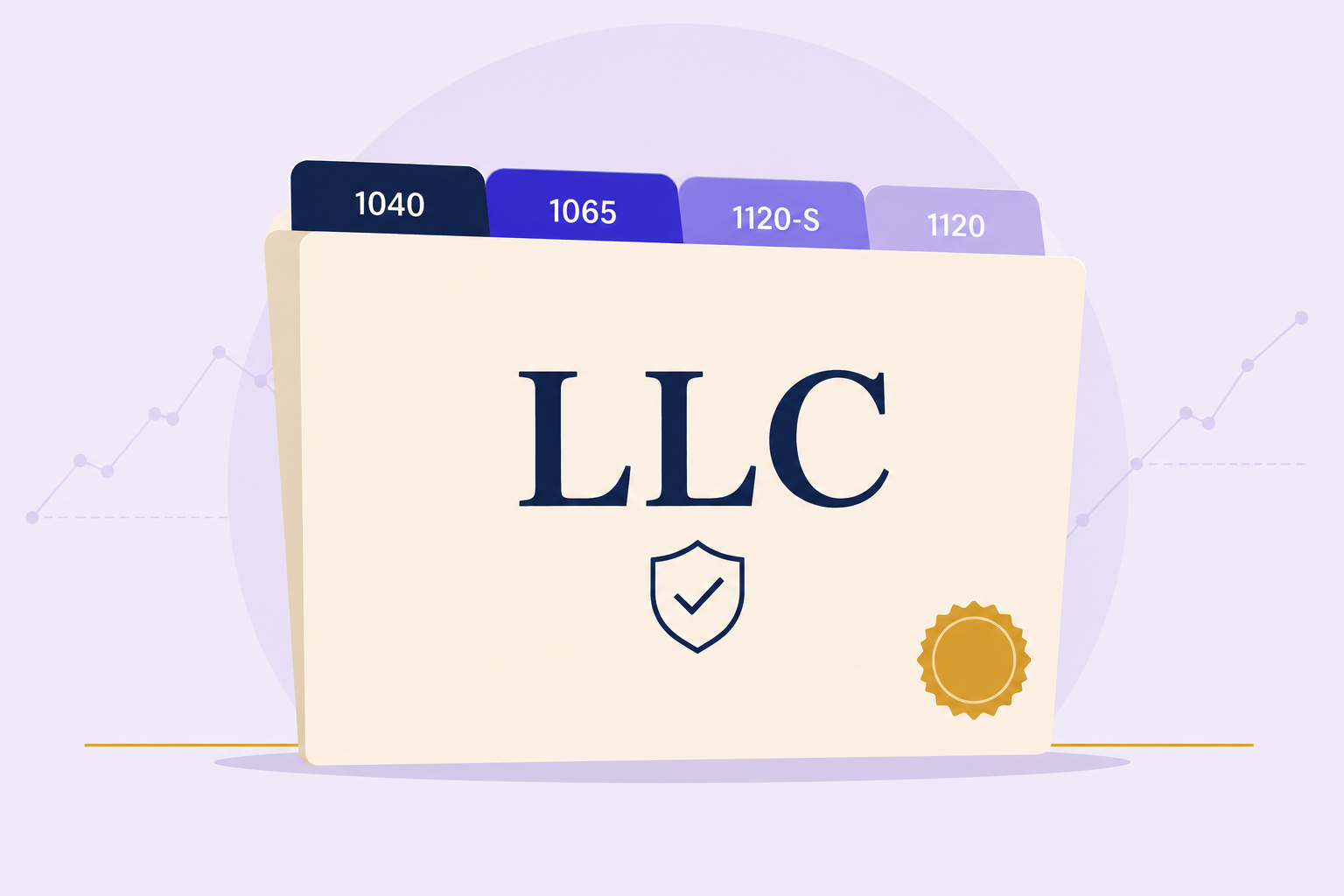
An LLC is not a federal tax classification. For federal income-tax purposes, a limited liability company is generally treated as a disregarded entity, a partnership, an S corporation, or a C corporation. The default turns on how many owners it has, and an eligible LLC may elect different treatment. There is no single LLC tax rate. The LLC is the legal wrapper; the classification and the income inside it determine the tax result.
Rental income, operating profit, dividends, and long-term capital gains do not become the same kind of income because they sit inside an LLC. The question is not "Do I have an LLC?" It is "What does it own, how is it classified, and what income does it earn?"
The Four Ways an LLC Can Be Taxed
Federal tax law has no "LLC" box. Under the entity-classification rules, a domestic unincorporated entity with two or more members defaults to partnership treatment, and one with a single member defaults to being disregarded. Either may elect corporate treatment, and one that qualifies may then elect S status.
The four federal tax classifications available to an LLC
Eligibility, timing, and revocation rules apply to every election.
An S corporation is a tax election, not a different state-law entity. An LLC that elects S treatment keeps the same operating agreement and liability shield. Only the tax reporting changes.
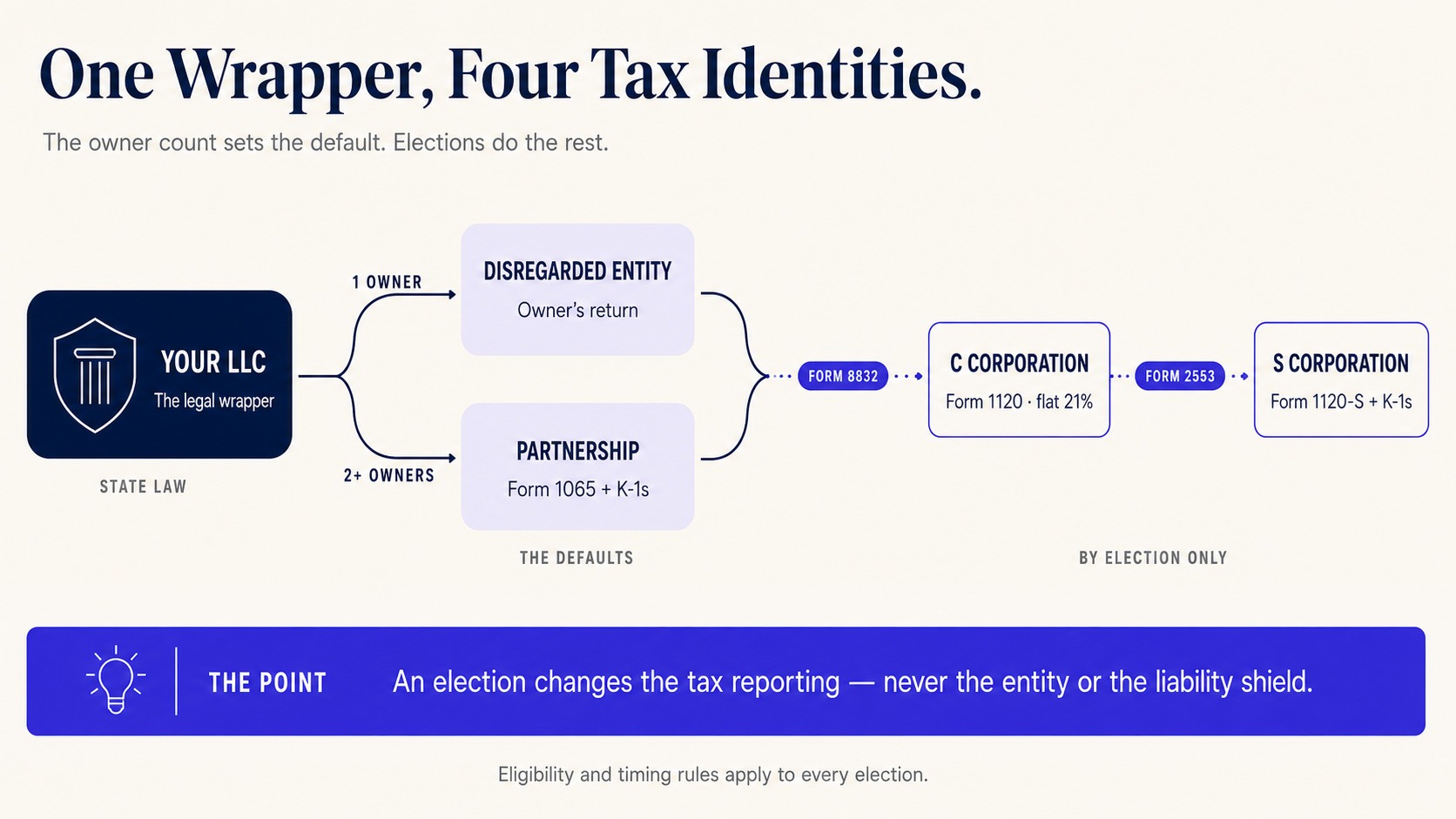
One Owner:
- Default → disregarded entity
- Elect C-corp taxation → Form 8832
- Elect S-corp taxation, if eligible → Form 2553
Two or More Owners:
- Default → partnership
- Elect C-corp taxation → Form 8832
- Elect S-corp taxation, if eligible → Form 2553
Single Member LLC Taxes: What Disregarded Entity Status Really Means
A disregarded entity is one the IRS ignores as separate from its owner for federal income-tax purposes. The shorthand that a single-member LLC is "taxed exactly like a sole proprietorship" fits only where the owner is an individual running an operating business; where the member is another entity, the subsidiary is generally treated as a division of that owner. Being disregarded says nothing about liability, and the LLC remains separate for federal employment taxes.
Single member LLC taxes are often summarized as "you just file a Schedule C," which is wrong for many owners, because the schedule follows the income: Schedule C for an operating business, Schedule E for rentals, Schedule B for interest and dividends, Schedule D for capital gains. An EIN is not always required either, though the LLC needs one if it has employees or elects corporate treatment. A disregarded LLC may still file California Form 568 and owe entity-level fees.
Multi-Member LLC Taxes: Partnership by Default
A domestic LLC with two or more members is generally taxed as a partnership unless it elects otherwise. It files Form 1065 and issues each member a Schedule K-1 reporting that member's allocated share of income, deductions, and credits. This is LLC pass-through taxation: the entity computes and characterizes the items, the owners pay the tax, subject to the centralized partnership audit regime.
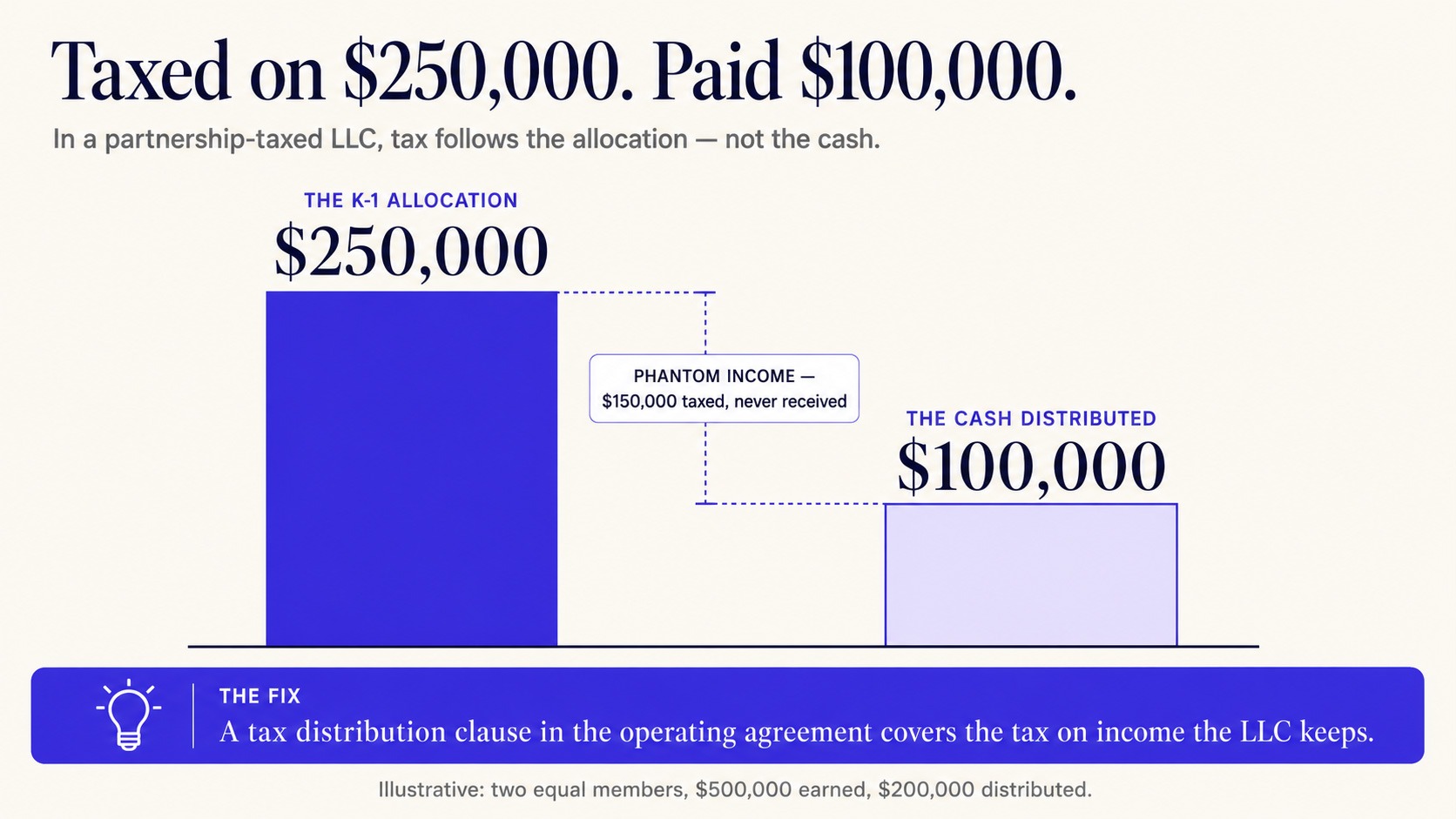
Allocation is not distribution
A member can owe tax on allocated income even when the LLC kept the cash. In a two-member LLC earning $500,000 and distributing $200,000 equally, each K-1 reports roughly $250,000 while each member receives $100,000. Tax follows the allocation; the distribution reduces basis and is generally not taxable unless it exceeds that basis. That gap is phantom income, and well-drafted operating agreements address it with a tax distribution provision.
Special allocations have limits
Members cannot simply assign income to whoever benefits most. An allocation that differs from the members' interests must have substantial economic effect under the Section 704(b) regulations, and failing allocations are recast. Guaranteed payments for services are deductible by the LLC and generally subject to self-employment tax.
Spouses are a genuine exception. An LLC wholly owned by a married couple as community property in a community-property state may, under longstanding IRS guidance, be treated as disregarded or as a partnership if applied consistently. Elsewhere a two-spouse LLC is generally a partnership.
Does an LLC Save Taxes? The Honest Answer
Forming an LLC by itself does not change the federal rate applied to income. The same rental profit, consulting fee, or dividend is taxed the same way inside an LLC or directly. Where planning genuinely arises, it comes from something other than formation:
- An S corporation election that reduces the base subject to payroll taxes on an active business.
- Depreciation, cost segregation, bonus depreciation, and Section 179, which attach to qualifying property in a qualifying activity.
- The Section 199A deduction, where the taxpayer has qualified business income from an eligible trade or business.
- Elective state pass-through entity taxes, C corporation treatment for a business reinvesting profit, and estate planning that uses transferable ownership units.
Those LLC tax benefits come from the activity, the property, the deduction, or the tax classification. They do not arise merely because "LLC" appears after the entity name. What the LLC reliably provides is a liability shield, a governance framework, and access to classification choices a sole proprietorship cannot make.
Self-Employment Tax on LLC Income
Self-employment tax applies to net earnings from self-employment, a defined term rather than a synonym for profit. For 2026, the Social Security component is 12.4% up to the $184,500 wage base and Medicare is 2.9% with no cap, plus 0.9% above $200,000 single and $250,000 joint. Net earnings are computed on 92.35% of net income and roughly half the tax is deductible, so the familiar 15.3% headline applies to a limited slice.
Exposure depends on the activity. Operating-business profit allocated to a participating member generally creates it, as do guaranteed payments for services. Rentals are generally excluded, with exceptions for dealers and for substantial services to occupants, which is where hotel-like short-term rentals draw scrutiny. Dividends, interest, and capital gains are not converted into self-employment income because an LLC received them. The exclusion for a limited partner's share predates LLCs and courts apply a functional analysis, so it is not settled planning.
LLC vs S Corp Taxes
Framing LLC vs. S corp taxes as a choice between two entity types is wrong at the start. An LLC can often elect S corporation taxation if eligible: a domestic entity, no more than 100 shareholders, only permitted owners such as individuals and certain trusts, and a single class of ownership interest.
An election can make sense where several conditions hold together: the LLC runs an operating business, profit is meaningful and recurring, the owner provides the services that generate it, a defensible salary can be documented, and the saving exceeds the added cost. Wages carry FICA; remaining profit distributed to the owner is generally outside FICA. The IRS challenges unreasonably low compensation.
Take a single-owner consulting LLC with $300,000 of profit and a documented salary of $150,000. Self-employment tax as a disregarded entity runs near $31,600; FICA on the salary under an S election is roughly $22,950, a difference of about $8,600. Payroll processing, a separate Form 1120-S, compensation documentation, and California's 1.5% entity-level tax each eat into that, which is why "pays off above $50,000 of profit" is not a rule at all.
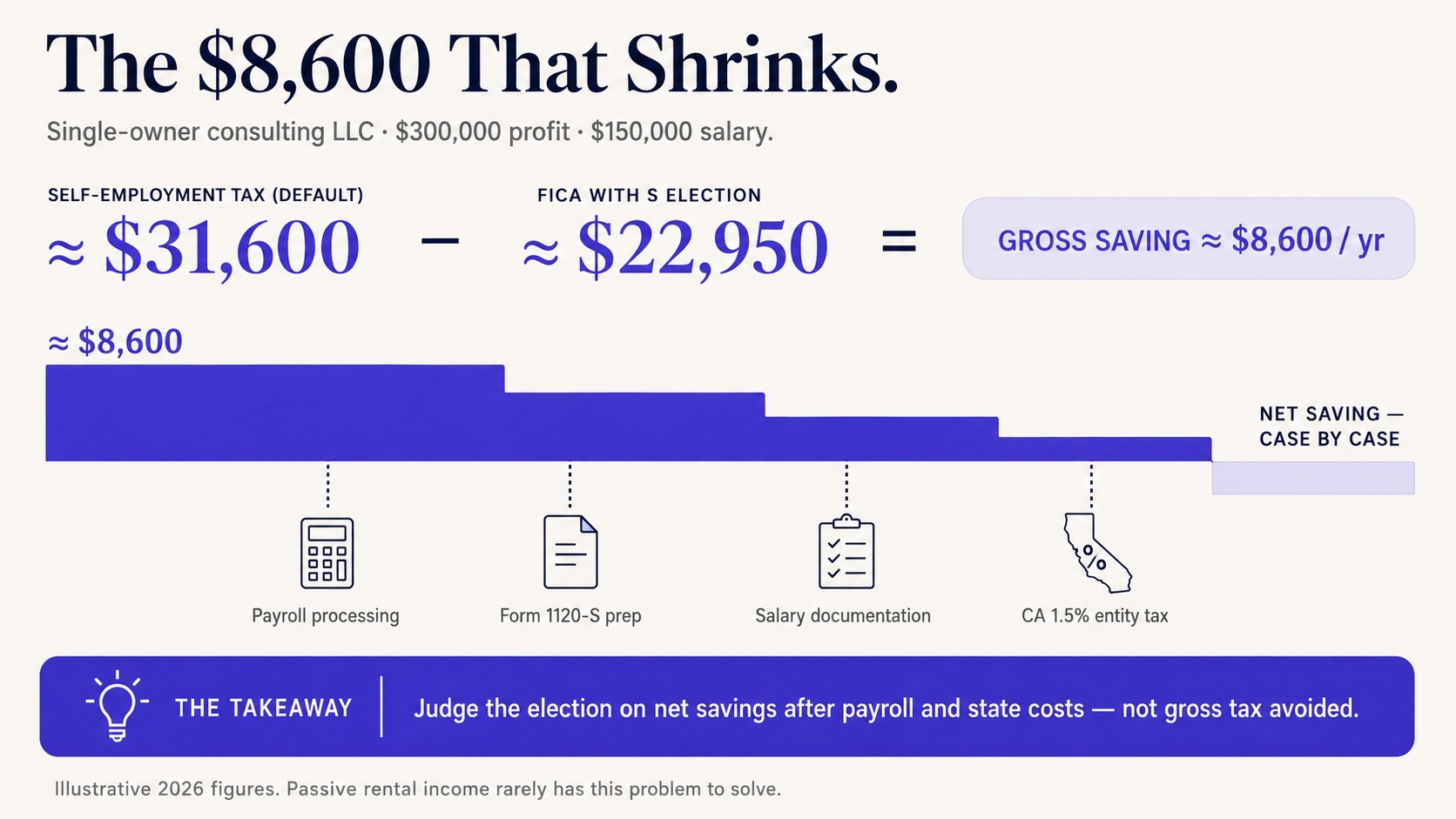
An S-corp election can solve a payroll-tax problem that a passive rental LLC may not have.
Why an S-Corp Election Is Often a Poor Fit for Passive Rental Real Estate
Rental income is generally already outside self-employment tax, so the headline benefit is absent before the analysis begins. What follows is cost.
- Appreciated property cannot leave an S corporation without tax. Distribution is generally treated as a sale at fair market value; a partnership can usually distribute property without immediate gain.
- Entity-level debt does not create shareholder basis. In a partnership, a member's share of liabilities including nonrecourse mortgage debt increases outside basis under Section 752, supporting loss deductions and refinancing distributions.
- Allocations become rigid and ownership is restricted. The single class of stock requirement rules out preferred returns and waterfalls, and partnerships, corporations, most nonresident aliens, and many trusts cannot hold the stock.
- Basis adjustments on transfer and death are unavailable. A partnership can make a Section 754 election so a transferee's inside basis reflects what was paid. An S corporation has no equivalent.
- Exit flexibility narrows. Section 1031 exchanges and partial redemptions that partnerships handle routinely are harder inside a corporation.
A tax election that saves payroll tax but creates a worse exit is not an optimization.
C-Corp Taxation and the Double-Tax Question
An LLC that elects corporate treatment without an S election is taxed as a C corporation. It files Form 1120 and pays federal income tax at a flat 21%, and shareholders are taxed again on dividends. Retaining earnings defers that second layer rather than eliminating it, because retained value shows up in the stock and is taxed on sale, and retention raises the accumulated earnings tax and the personal holding company tax. Losses are trapped at the entity level too.
C treatment is worth evaluating for a business raising institutional venture capital, one reinvesting nearly all profit, and for qualified small business stock planning. On that last point, electing C corporation treatment does not automatically produce QSBS. The stock must be acquired at original issuance, the gross assets test must be met at and immediately after issuance ($75 million for stock issued after July 4, 2025), at least 80% of assets must be used in a qualified active business, several industries are excluded, and the exclusion phases in at 50%, 75%, and 100% over three to five years, capped at the greater of $15 million or ten times basis. Timing matters, because the clock runs from issuance. See Section 1202 before converting ahead of an exit.
LLC Taxes for Investing, Real Estate, and Holding Companies
The same classification produces different results across these three use cases, which is why LLC rules of thumb travel so badly.
The same classification, three different activities
Illustrative patterns only. Test against the specific facts.
Investment LLC Taxes
Investment LLC taxes are mostly a question of character preservation. A disregarded or partnership-classified LLC holding stocks, funds, private placements, or crypto passes each item's character through: qualified dividends stay qualified, long-term gains stay long-term, municipal interest stays exempt. Wrapping securities in an LLC does not create a special lower capital-gains rate, and it does not defer gain. The underlying capital gains tax rules apply unchanged.
Two limits deserve attention. The 3.8% net investment income tax applies above modified adjusted gross income of $200,000 single and $250,000 joint, and the LLC changes nothing about it. Investment expenses are largely non-deductible after the repeal of miscellaneous itemized deductions, so routing advisory fees through an LLC does not revive a deduction that no longer exists. See using an LLC for investing.
Real Estate LLC Taxes
Real estate LLC taxes carry the most moving parts. Rentals report on Schedule E for a disregarded LLC, or through Form 1065 and K-1s for a partnership. Depreciation is central: 27.5 years for residential rental property, 39 for nonresidential, both straight line, and land is never depreciable. Cost segregation reclassifies components into shorter-lived property and can be combined with bonus depreciation, restored permanently at 100% for property placed in service after January 19, 2025.
None of that is automatic savings. Acceleration is timing: Section 1245 recapture on reclassified components is ordinary income on sale, and unrecaptured Section 1250 gain is taxed at up to 25%. Deductions may also be suspended before they help, since rentals are generally passive under Section 469, the $25,000 active-participation allowance phases out between $100,000 and $150,000 of modified adjusted gross income, and real estate professional status requires more than 750 hours and more than half of personal services in real property. A study producing a large suspended loss has changed a spreadsheet, not a tax bill.
Section 1031 adds a constraint partnership ownership makes harder. The taxpayer that sold must be the taxpayer that acquires, and where a partnership holds the property the partnership is that taxpayer; partnership interests are excluded outright. The workarounds raise questions about holding period and disguised sales, so that conversation belongs with counsel a year early.
Debt is where partnership treatment earns its place. A member's share of LLC liabilities increases outside basis, supporting loss deductions and allowing refinancing proceeds to be distributed without immediate gain in many cases. Add transfer taxes, nonresident withholding, and a separate annual fee per entity, and state and local taxes often exceed what the federal structure saved. See real estate holding company structure.
Holding Company LLC Taxes
Holding company LLC taxes turn on one question: how is every entity in the stack classified? If a parent LLC wholly owns a subsidiary that makes no election, the subsidiary is generally disregarded and reports through the parent. That is where "one holding company, one tax return" comes from, and it holds only when every subsidiary is wholly owned and disregarded. Add a second member and a Form 1065 appears; let a subsidiary elect S or C status and it files its own return. One holding company does not necessarily mean one tax return.
State cost multiplies faster than federal complexity. Each subsidiary registers, pays annual fees, and foreign-qualifies where it owns property, and intercompany fees and loans need written agreements because they affect apportionment and nexus. Risk isolation is a legal benefit with a cost attached, as the holding company overview sets out; series structures add uncertainty under series LLC tax treatment.
Family LLC Taxation
Family LLC taxation is an estate and investment topic wearing a small-business costume. A family LLC typically pools securities, private investments, and sometimes real estate under a manager-managed structure that separates voting control from economic participation. The income tax side is ordinary partnership taxation: Form 1065, K-1s, allocations whether or not cash moves, and the same phantom-income and basis obligations as any partnership. Tax distributions matter, because a junior member with a non-voting interest cannot force cash out.
The transfer tax side draws scrutiny. Transfers of non-controlling, non-marketable interests are commonly valued below a pro-rata share of net asset value for lack of control and marketability. No fixed discount percentage is available, and no article should suggest one. Valuation requires a qualified appraisal for the specific interest and date.
Estate inclusion is the risk that ends badly. Where a donor retains the enjoyment of transferred property, uses entity assets personally, or forms the entity near death with no purpose beyond discount generation, the IRS has successfully argued the full value belongs back in the estate. The defense is a real non-tax purpose, respect for formalities, and contemporaneous documentation.
Basis: The LLC Tax Concept Most Owners Ignore
Basis determines what is actually taxable, and almost nobody tracks it until the year it matters. In a partnership-classified LLC there are two. Outside basis is a member's basis in the LLC interest. Inside basis is the LLC's basis in its own assets. They start equal and drift apart.
Outside basis begins with contributed cash and the adjusted basis of contributed property. It increases with allocated income and the member's share of LLC liabilities, and decreases with distributions, allocated losses, and reductions in that share. Three consequences follow. Losses are deductible only to the extent of outside basis. Cash distributed above basis creates taxable gain. Gain on sale is measured against basis, not the capital account.
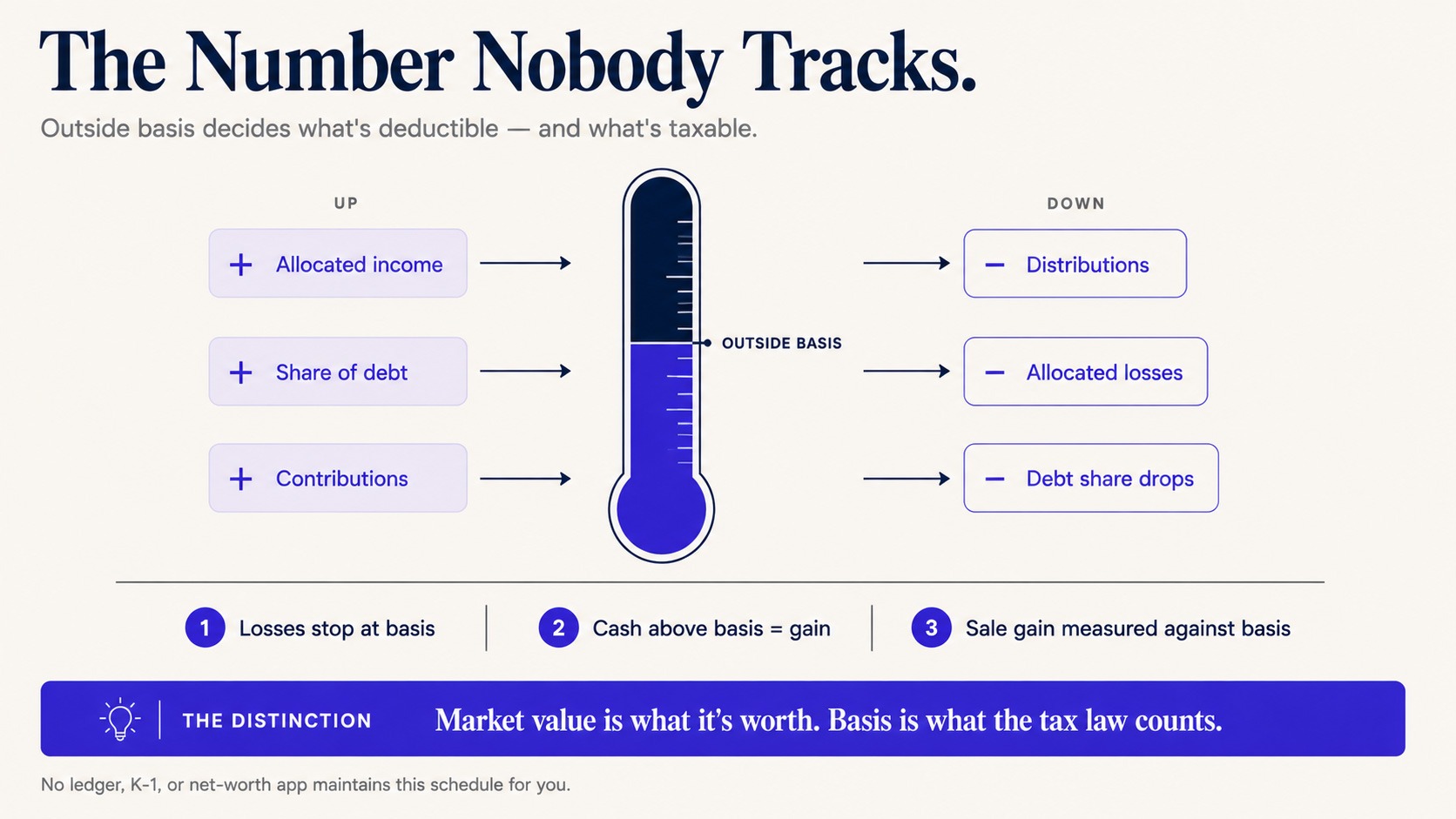
Market value tells you what an LLC interest may be worth. Tax basis tells you how much gain, loss, or deduction the tax law may recognize.
A Section 754 election, with the resulting Section 743(b) adjustment, lets the LLC adjust inside basis when an interest is sold or a member dies, and it must be in place for the correct tax year. The rest is administrative. A general ledger tracks the entity's books, a K-1 reports one year, and a net-worth application reports market value; none maintains an outside basis schedule. It should exist before a distribution, sale, gift, death, or refinancing.
Quarterly Estimated Taxes and Cash-Flow Planning
Pass-through income arrives without withholding. Owners generally must make estimated payments if they expect to owe $1,000 or more. Two safe harbors apply: 90% of the current year's tax, or 100% of the prior year's, rising to 110% where prior-year adjusted gross income exceeded $150,000. The penalty is computed period by period, so a large fourth-quarter gain can create one even when the year ends fully paid.
State Taxes: Where LLCs Quietly Get Expensive
Federal pass-through treatment does not make the entity free. Annual reports, franchise taxes, gross-receipts taxes, registered agent fees, and foreign qualification accrue whether or not the LLC earns anything. For an investor running eight property entities and a parent, the drag is a real line item.
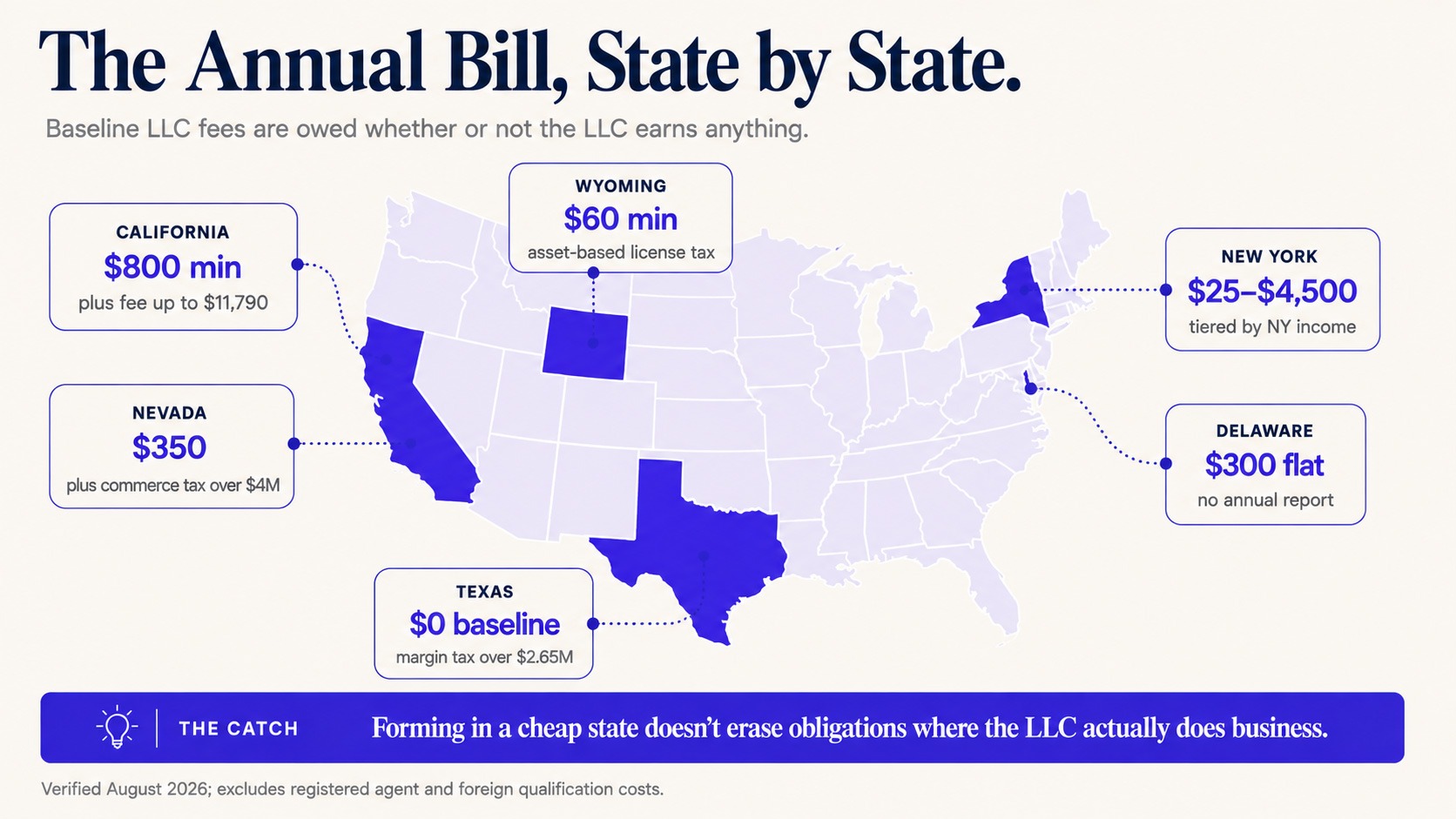
Selected state LLC taxes and recurring fees, verified August 2026
Amounts change. Verify with the state tax authority and secretary of state, and add registered agent and foreign qualification costs.
Two conclusions follow. First, forming an LLC in Wyoming or Delaware does not generally erase filing or tax obligations in the state where the LLC actually does business or owns property. An out-of-state entity owning California real estate must generally register, file, and pay there. Second, no state provides universal anonymity. Some do not require member names in the public record, which is not privacy: banks, lenders, title companies, and litigation discovery all reach ownership.
The 2026 Rules That Matter for LLC Owners
QBI deduction LLC 2026 rules
The Section 199A deduction of up to 20% of qualified business income was made permanent by the 2025 legislation. For 2026, the thresholds are $201,750 single and $403,500 joint, with phase-in ranges widened to $75,000 and $150,000, so limitations fully apply above roughly $276,750 and $553,500. A new $400 minimum deduction is available where the taxpayer has at least $1,000 of qualified business income from an active business in which they materially participate. Above the thresholds, non-service businesses face the W-2 wage and property limitation; service businesses phase out entirely.
The deduction belongs to an eligible taxpayer with qualified business income. It is not available simply because income passed through an LLC. Dividends, interest, and capital gains are not qualified business income. Rental activity qualifies only where it rises to a trade or business under Section 162, meets the rental real estate safe harbor, or is a qualifying self-rental, and many small portfolios do not clear that bar.
Depreciation, expensing, and other current items
Bonus depreciation is 100% and permanent for qualified property placed in service after January 19, 2025, and eligibility attaches to the property and the activity rather than the entity. For 2026, the Section 179 limit is $2,560,000, with phase-out from $4,090,000 and complete phase-out at $6,650,000. The corporate rate remains 21% and the Social Security wage base is $184,500. On beneficial ownership reporting, an August 2026 final rule permanently exempts entities created in the United States from filing with FinCEN, leaving only foreign registrants as reporting companies. FinCEN has also announced it will delete previously reported beneficial ownership information by U.S. persons from its database.
Choosing a Tax Classification: A Decision Framework
Work through the facts in order. The classification should fall out of the answers rather than being chosen first and justified afterward.
A classification decision framework
The patterns are recognizable. An operating service business with recurring profit and an owner who performs the work should evaluate default taxation against an S election, net of payroll and state cost. Rental real estate is usually better served by partnership or disregarded treatment, and a passive investment vehicle rarely benefits from a corporate election.
Every classification also carries a recurring bill: return preparation, payroll processing, bookkeeping, K-1 production, state returns and franchise taxes, registered agent fees, and basis schedules. A tax election should be evaluated on net savings after professional and administrative cost, not on gross tax avoided.
Tracking LLC Ownership Across the Family Balance Sheet
A family that has done this well may hold personal accounts, an investment LLC, several property LLCs, a parent holding company, trust interests, and private fund commitments. The household balance sheet often flattens that into one list of assets, losing what matters. Six things need to stay distinct: legal ownership, ownership percentage, market value, tax basis, entity-level debt, and entity-level cash.

This is where a purpose-built net worth tracker helps. Kubera supports nested portfolios, available on Kubera Black, so trusts, LLCs, and family ownership structures each hold a separate personal balance sheet that rolls up into a unified view, with granular access control for sharing specific portfolios with family or an accountant.
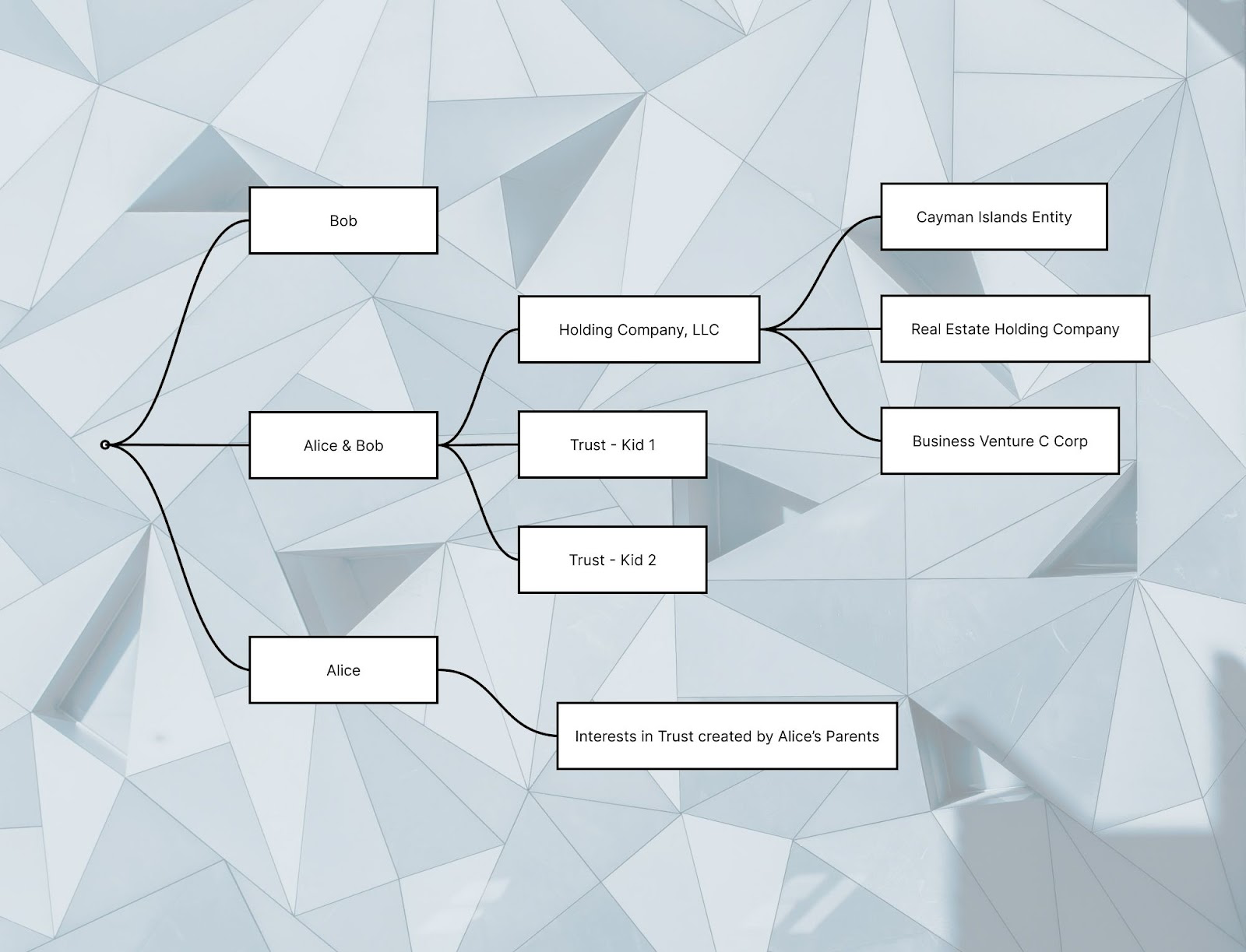
Connected accounts, manually tracked assets, and private positions with committed capital and distributions sit in the same structure, the discipline behind a well-built personal balance sheet. The boundary is worth stating plainly: Kubera organizes market values and ownership structure. It does not replace the LLC's accounting records, capital accounts, outside basis schedules, depreciation schedules, K-1s, tax returns, or CPA workpapers.
Sign up for a trial to explore more.
Frequently Asked Questions
How are LLCs taxed?
An LLC is taxed according to its federal classification, not its legal form. A single-member LLC is generally a disregarded entity by default, a multi-member LLC a partnership, and an eligible LLC may elect C or S corporation treatment.
What is the LLC tax rate?
There is no LLC tax rate. Under pass-through treatment, income is taxed at the owners' individual rates and keeps its character. An LLC taxed as a C corporation pays a flat 21%, with a second layer at the shareholder level.
How are single member LLC taxes reported?
A single-member LLC is generally disregarded, so the activity is reported on the owner's return, and the schedule follows the activity: Schedule C for an operating business, Schedule E for rentals, Schedule B for interest and dividends, Schedule D for capital gains.
Does an LLC save taxes?
Not by itself. Savings come from the underlying activity, from qualifying property and deductions, or from a classification election that fits the facts. The LLC provides access to those choices, not a deduction.
Is an S corporation good for rental real estate?
Usually not. Rental income is generally already excluded from self-employment tax, so the main benefit is absent. An S corporation also cannot distribute appreciated property without gain, entity-level debt does not create shareholder basis, and there is no Section 754 equivalent.
Do LLC owners pay self-employment tax?
It depends on the income. Operating-business profit allocated to a member who works in the business generally does pay self employment tax, as do guaranteed payments for services. Rentals, dividends, interest, and capital gains are generally excluded.
What is the QBI deduction for an LLC in 2026?
The Section 199A deduction of up to 20% of qualified business income is permanent. For 2026 the thresholds are $201,750 single and $403,500 joint, with phase-in ranges of $75,000 and $150,000, plus a new $400 minimum deduction.
The Principle Worth Keeping
LLC taxes reward specificity and punish rules of thumb. Classification determines the return, activity determines the character of the income, the state determines a recurring cost that pass-through treatment does nothing to remove, and basis determines what is actually taxable when cash moves. Decide on the activity first, choose the classification that fits it, and price the compliance before signing the election.
This article is general information, not tax or legal advice. Rates, thresholds, and state fees change; confirm current figures with the IRS, the relevant state authority, and a qualified adviser before acting.


