

Geographic arbitrage means earning in a high-wage, strong-currency market while living somewhere cheaper, and keeping the difference. Remote work made it practical; the FIRE movement made it popular. For a high earner, it can cut years off the path to financial independence. But most of the gain comes from lower spending, not lower taxes, and the tax side carries traps that cost-of-living calculators never show: equity compensation that stays taxable in your old state, residency audits timed to your liquidity event, foreign tax rates that replace the US state tax you escaped, and currency swings that quietly reprice your life.
This guide covers what geoarbitrage is, the four ways people do it, the real math on a $400,000 household, the 2026 tax rules at state and international level, residency and visas, healthcare, currency, reversibility, and how to tell whether a move actually made you wealthier.
Key Takeaways
- Spending is the big lever. In our worked example, a San Francisco household moving to Austin reaches financial independence in about 8 years instead of 16. Eliminating state income tax alone accounts for roughly 2 of those years.
- "No income tax" is not "low tax". Property tax, insurance, sales tax and, in Washington, taxes on large capital gains (and, from 2028, on income above $1 million) can offset much of the headline saving.
- Your equity follows you. States such as California tax the share of RSUs and options earned while you lived there, by workday allocation, even after you leave.
- The move year draws the most scrutiny. A large IPO, sale or vest soon after a move is exactly what a residency audit examines. A genuine, documented move is what makes the savings real.
- US citizens never leave the IRS. The Foreign Earned Income Exclusion ($132,900 for 2026) covers income from work performed abroad, not the dividends, gains and withdrawals that fund a retirement abroad.
- Currency is a live risk. The euro rose about 14% against the dollar in the first half of 2025, raising the dollar cost of a euro-denominated life by the same amount.
- Count the round trip. In our example, a domestic move's one-time costs take about 20 months to recover, and a move back resets the clock.
What Is Geographic Arbitrage?
Geographic arbitrage, also called geoarbitrage or geographical arbitrage, is the practice of earning income set by a high-cost, high-wage market while paying living costs set by a lower-cost location. The "spread" between what you earn and what you spend widens, so your savings rate rises without a raise.
The idea predates remote work; Tim Ferriss popularized the term, and FIRE (Financial Independence, Retire Early) writers made it a core strategy. What changed is that a paycheck no longer has to follow a ZIP code. It is not the same as locational arbitrage in trading, where an investor buys an asset in one market and sells it in another to capture a price gap. Here the asset is your own income, and the market you exploit is the cost of living.
There is also an employer-side version. Some companies set salaries by location, which means the spread you hoped to capture can shrink the day you change your address. Before you plan around a move, confirm in writing how your compensation responds to it.
The Four Types of Geographic Arbitrage
Geoarbitrage doesn't have to mean a new country. Domestic moves can capture much of the saving without the added complexity of moving abroad.
| Type | What it looks like | Where the saving comes from | Tax effect | Reversibility |
|---|---|---|---|---|
| Domestic, state to state | San Francisco to Austin, New York to Miami | Housing and state income tax | Can remove state income tax; may raise property tax | Moderate: home sale and purchase costs both ways |
| International relocation | US to Portugal, Mexico, Thailand, UAE | Housing, services, healthcare | US filing continues; local tax replaces state tax and may be higher | Low: visas, banking, schools, family |
| Remote-work arbitrage | Keep a high-cost-market salary, live anywhere | All living costs | Depends on where you are tax resident and your employer's state rules | Depends on your employer's policy |
| Partial arbitrage | One metro over, one state line over, or a second base for part of the year | A slice of housing and tax | Day counts and domicile matter; split years are audited | High |
Partial moves are underrated. Moving from Manhattan to a lower-cost part of the same region, or from the Bay Area to Sacramento, captures part of the housing spread with almost none of the tax or residency risk.
The Math: Spending Is the Big Lever, Tax the Smaller One
A financial-independence target is usually set at about 25 times annual spending, the inverse of a 4% withdrawal rate (see how to retire early and is $5 million enough to retire). That makes spending the most powerful number in the plan: every dollar of annual spending you remove lowers the target by $25 and raises what you save.
Consider a two-earner household in San Francisco: $400,000 of combined W-2 income, $1.2 million already invested, spending $180,000 a year. We assume a 5% real return and 2026 federal brackets.
| Scenario | After-tax income | Annual spending | Annual savings | Savings rate | FI target (25x) | Years to FI |
|---|---|---|---|---|---|---|
| Stay in San Francisco | ~$264,000 | $180,000 | ~$84,000 | 32% | $4.5M | ~16 |
| Move to Austin, same spending | ~$297,000 | $180,000 | ~$117,000 | 39% | $4.5M | ~14 |
| Move to Austin, lower spending | ~$297,000 | $130,000 | ~$167,000 | 56% | $3.25M | ~8 |
Illustrative. After-tax income reflects federal income tax, payroll tax and, in California, about $34,000 of state income tax and SDI. In California the household itemizes and deducts $40,400 of state and local taxes under the 2026 SALT cap; in Texas it takes the $32,200 standard deduction, so its federal tax rises by about $2,000. Both scenarios assume a 50/50 income split and no 401(k) contributions, and leave home equity aside; selling a pricier home to buy a cheaper one would free up capital and shorten the timeline further.
Two findings stand out. First, escaping state income tax is worth about two years. Second, the move only becomes transformative when housing and daily costs fall too, because lower spending both raises savings and lowers the finish line. The household that moves but keeps its San Francisco lifestyle captures barely a third of the available gain.
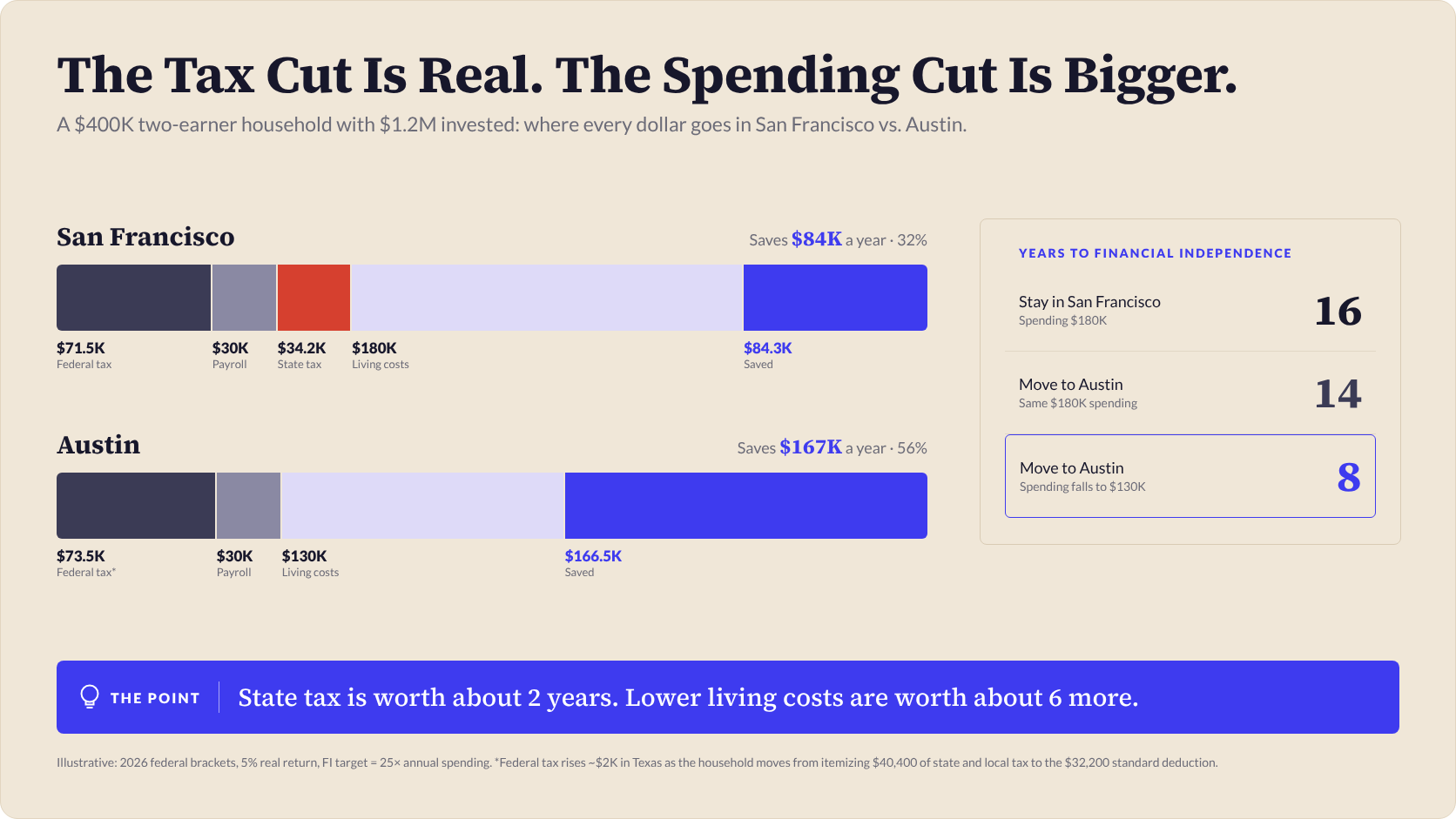
The tax saving gets the headlines. The spending cut does the work.
The same logic runs internationally, with larger spending gaps and messier tax. A household that could live on $80,000 a year in Lisbon instead of $180,000 in San Francisco needs a portfolio of about $2 million rather than $4.5 million, before accounting for the taxes discussed below. That is a real difference, but it should be modeled against your actual balance sheet, every account and currency included, not a cost-of-living website.
One more structural point: cutting spending by $1,500 to $3,000 a month saves $18,000 to $36,000 a year, which is worth more than a raise of the same size because it isn't taxed. For the household above, lower spending plus lower taxes add up to about $6,900 a month. The bigger your fixed costs, the bigger the arbitrage, and the bigger the cost of getting it wrong.
Domestic Tax Arbitrage: What the State List Leaves Out
Nine states levy no broad personal income tax on wages: Alaska, Florida, Nevada, New Hampshire, South Dakota, Tennessee, Texas, Washington and Wyoming. For a California household earning $400,000, moving to one of them removes roughly $34,000 a year of California income tax and disability insurance (SDI) payroll tax, before a small federal offset. For a household with a large capital gain, the number can be far bigger. That is the part every article covers. Four other things decide what you actually keep.
1. Total tax burden, not income tax. States without an income tax raise money elsewhere. Texas property taxes are among the highest in the country and vary by county, city and school district, so check the actual bill on a home you're considering, and Florida homeowners insurance has become one of the largest line items in a household budget. Sales taxes and local fees add up too.
2. Washington is no longer neutral for investors. Washington has no tax on wages, but it taxes long-term capital gains at 7% above an annual standard deduction ($278,000 for 2025, indexed each year), and since January 1, 2025, at 9.9% on taxable gains above $1 million. Its estate tax top rate, raised to 35% for deaths from July 2025, returned to 20% for deaths on or after July 1, 2026. And from 2028, a new 9.9% tax applies to household income above $1 million, wages included, though it faces a court challenge. Real estate and retirement accounts are excluded from the capital gains tax, but a founder or concentrated stockholder planning a large sale should not treat Washington as a zero-tax state.
3. The OBBBA changed the federal offset. Under the One Big Beautiful Bill Act, the cap on deducting state and local taxes rose to $40,000 for 2025 and $40,400 for 2026, then reverts to $10,000 in 2030. For households under $505,000 of modified adjusted gross income in 2026, staying in a high-tax state got slightly cheaper, because more of the state tax is deductible. Above about $606,000 the cap phases back down to $10,000, so for the highest earners the math is unchanged. Either way, leaving a high-tax state can raise your federal bill a little, as it does by about $2,000 in our example.
4. Remote work can leave you taxed by a state you left. A few states apply a "convenience of the employer" rule: if your assigned office is there and you work remotely by choice rather than because the employer requires it, your wages can still be treated as earned in that state. New York is the most aggressive enforcer; California does not apply the rule to employees. Lists of which states apply the rule differ between sources and change (Alabama reversed its position in 2026), so check the rule for your employer's state before you assume a move ends that state's claim.
| Moving from California to… | State tax on wages | Capital gains | Estate tax | Property tax (typical) | Watch for |
|---|---|---|---|---|---|
| Texas | None | None | None | High; varies by county and school district | Property tax and insurance offset part of the saving |
| Florida | None | None | None | Moderate, with homestead caps | Insurance costs, hurricane exposure |
| Nevada | None | None | None | Low to moderate | Fewer direct flights and services in some areas |
| Washington | None until 2028; 9.9% above $1M from 2028 | 7%, and 9.9% above $1M | Yes, top rate 20% from July 2026 | Moderate | Large-gain and estate planning |
Rates as of November 2026; property tax varies by county and assessment. Verify current figures before acting.
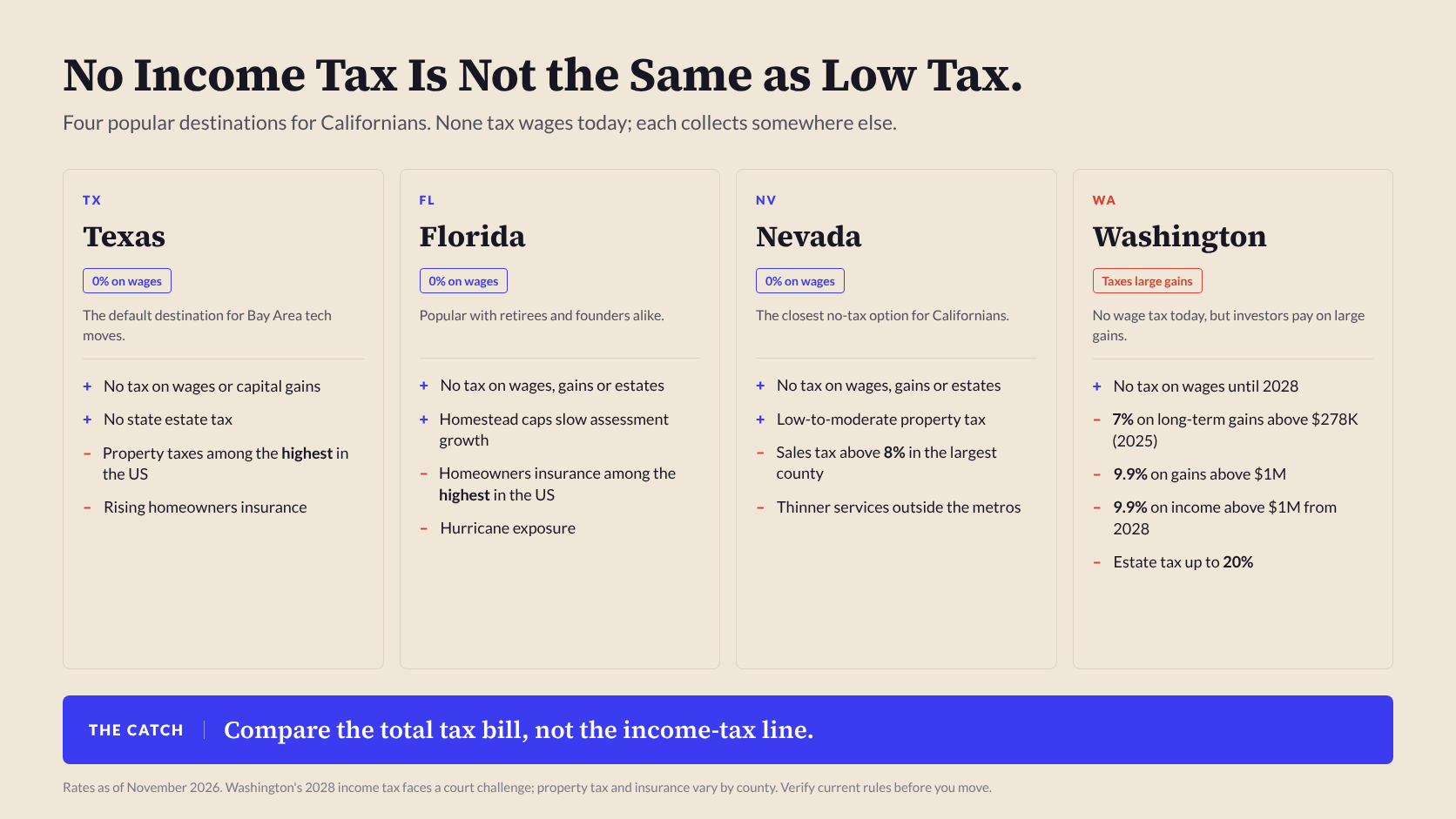
A no-income-tax state is not a low-tax state.
Residency versus domicile. Capturing any of this requires actually changing your tax home. Residency tests vary by state: New York counts days (more than 183) together with a home kept there, while California looks at why you are in or out of the state, not just a day count. Domicile is your permanent home, the place you intend to return to, judged by where your home, family, doctors, clubs, voter registration, driver's license and business ties are. Leaving a California home available to you, keeping the kids in a Bay Area school or seeing the same dentist every quarter are the kinds of facts auditors use to argue you never left. Most of the work of a domestic move is making the paper trail match the life.
Your Equity Compensation Follows You
This is where high earners lose the most money to a poorly timed move.
States such as California treat stock compensation as wages earned over time. For RSUs, the taxable share is generally the fraction of workdays between grant and vest that you worked in the state. For nonqualified stock options, the window typically runs from grant to exercise. Move to Texas six weeks before a large tranche vests and almost all of that tranche remains California income, because most of its earning period was spent there. Generally, only income from awards earned entirely after the move escapes California tax.
The stakes can be large. One California tax practice illustrates $4 million of RSU income recognized at a liquidity event: if the state treats the taxpayer as a full-year resident, applying the 13.3% top rate to all of it gives about $532,000 of California tax; if the move holds and 40% of grant-to-vest workdays were in California, about $212,800 is due. More than $300,000 turns on whether the residency change survives scrutiny.
Your RSUs remember where you lived.
Three practical rules follow. Move early, ideally before new grants or refreshers are issued, not before a vest. Keep a workday log (calendar, travel and expense records) from the moment you plan to move. And assume the year of a liquidity event is the year your departure will be examined. For more on structuring equity pay, see our guides to compensation strategy and how stock options are taxed.
International Arbitrage: US Citizens Never Leave the IRS
The United States taxes its citizens and green card holders on worldwide income wherever they live. Moving abroad changes where you also owe tax; it does not end what you owe at home. A proposal to let Americans abroad elect residence-based taxation has been introduced in Congress but is not law, and the One Big Beautiful Bill Act did not include it.
The Foreign Earned Income Exclusion (FEIE). If your tax home is abroad and you pass either the bona fide residence test or the physical presence test (330 full days in foreign countries during a 12-month period), Form 2555 lets you exclude up to $132,900 of foreign earned income for 2026, per qualifying person, plus a separate housing exclusion or deduction for qualifying costs between a base of $21,264 and a cap that is generally $39,870 (higher in some expensive cities), worth up to about $18,600.
| The FEIE covers | The FEIE does not cover |
|---|---|
| Wages and salary for work physically performed abroad | Dividends, interest and capital gains |
| Self-employment earnings for work performed abroad (for income tax) | Self-employment tax (Social Security and Medicare), unless a totalization agreement applies |
| Qualifying foreign housing costs, within limits | Rental income, pensions, IRA and 401(k) withdrawals |
| State income tax, a separate question that depends on whether you've cut ties with your former state |
Two consequences matter for high earners. First, if you live on portfolio income, which is what most early retirees abroad do, the FEIE is worth nothing; the Foreign Tax Credit and tax treaties are the tools that prevent double taxation. Second, a high salary earned abroad usually becomes taxable where you live. Many European countries tax residents' employment and investment income at rates at or above US rates, and the Foreign Tax Credit often leaves you paying roughly the higher of the two countries' rates on the same income, not the lower. For a high earner, international geoarbitrage is mostly a cost-of-living play; the tax win exists mainly in no-tax or territorial jurisdictions, or in time-limited special regimes for new residents (Italy's flat tax on foreign income rose to EUR 300,000 a year for those arriving from 2026).
Full cross-border planning also brings reporting: FBAR when foreign accounts together top $10,000 at any point in the year, Form 8938 at higher thresholds, and the PFIC rules that make most foreign mutual funds and ETFs punitive for Americans. These are covered in depth in our expat investing guide. A defensible position, and a clean handoff to a cross-border CPA, depends on seeing every account, entity and jurisdiction in one place rather than reconstructing it each April; see also tax havens for how jurisdictions differ.
Residency, Visas and the Move-Year Audit
An international move needs a legal right to live there, and the route you choose shapes your tax position.
- Digital nomad visas grant temporary residence to remote workers who meet an income threshold. Many are new, renewal terms are untested, and long stays can still make you a tax resident under local day-count rules.
- Retirement and passive-income visas require proof of steady pension or investment income rather than a capital investment.
- Residency by investment (golden visas) trades a qualifying investment for a residence permit. The 2026 map has shifted: Spain closed its program in 2025 and Portugal ended its real-estate routes in 2023. Our golden visas guide covers which programs remain and what they really cost.
Two cautions apply to every route. A residence permit is not tax residency; tax residency is set by each country's own rules, such as days present and home and family ties, and by tax treaties. And immigration rules change often, so a program that fits today may not exist, or may cost more, when you renew.
Domestically, the equivalent risk is the residency audit. State tax authorities pay closest attention when a departure coincides with a large one-time income event: an IPO, a business sale, a block of vesting equity. The defense is a move that is genuine and documented before the event: a new primary home, the old one sold or rented at arm's length, new licenses and registrations, day counts you can prove, and the center of family life visibly relocated.
Managing Healthcare Across Borders
Healthcare is the line item most often underestimated, in both directions.
Abroad, Medicare generally does not cover care outside the United States, and ACA marketplace plans require US residency. Most international movers buy local private insurance or an international expat plan, with premiums that vary widely by country, age, coverage and medical history. Care in many destinations is excellent and far cheaper, but specialty treatment can still mean travel. Budget a few thousand dollars in the first year to re-establish care and records.
At home, early retirees using domestic arbitrage face a 2026 change: the enhanced ACA premium tax credits expired on December 31, 2025, and the "subsidy cliff" returned. Households above 400% of the federal poverty level now receive no premium subsidy at all, which can mean five-figure annual premiums for a couple in their early 60s. A lower-cost state helps the spending side but does not fix this; managing taxable income does. For households that value access over insurance mechanics, concierge medicine is the domestic version of paying directly for the care you want.
Currency and Cross-Border Banking
If you earn in one currency and spend in another, the exchange rate is a line in your budget, not a footnote.
The first half of 2025 showed how fast it can move. The US dollar index fell 10.8%, its worst first half since 1973, while the euro rose about 13.8% against the dollar. An American spending EUR 5,000 a month in Lisbon saw that cost rise from roughly $5,175 to $5,895, about $720 a month or $8,600 a year, with no change in lifestyle. A strong home currency stretches spending abroad; a weakening one quietly reprices it. Our piece on de-dollarization discusses the longer-term argument.
A practical response is to hold a meaningful share of assets in the currency of your future spending, without giving up diversification. A household that will retire in the eurozone should hold a meaningful share of euro-linked assets, ideally through US-domiciled funds to avoid PFIC problems, and keep a cash buffer in the spending currency.
Banking adds friction. Most arbitrageurs keep home-country accounts for income and investments and open local accounts for daily spending. That means more transfers, more statements, more reporting, and, for Americans, US brokerages that may restrict accounts with foreign addresses. Choosing institutions that serve internationally mobile clients matters (see banks for high-net-worth clients), and so does choosing one reporting currency to judge results in. A move can look like a win in euros and a loss in dollars.
Reversibility: Count the Round Trip
Every move has one-time costs, and every move back has them again. Measure the arbitrage in months to break even.
| Item (Austin example) | Estimate |
|---|---|
| Selling a $1.6M California home (about 6%) | $96,000 |
| Buying a $900K Texas home (about 2%) | $18,000 |
| Movers, travel, setup, duplicate rent | $25,000 |
| One-time cost | ~$139,000 |
| Monthly gain (savings rise from ~$84K to ~$167K a year) | ~$6,900 |
| Break-even | ~20 months |
Illustrative. Excludes any change in home appreciation, which can work for or against you.
A household that moves back after three years pays a second set of costs: selling the $900,000 Texas home and buying back into California at $1.6 million costs about $111,000 more, for roughly $250,000 in total. That is about the same as the $250,000 of extra savings, so three years of geoarbitrage only breaks even. Internationally, add visa fees, shipping, school fees, and the cost of re-establishing US credit and insurance. If there is a real chance you'll return, renting first is usually the cheaper experiment.
When Geographic Arbitrage Doesn't Pay
- Your income won't travel. A remote salary that gets location-adjusted, or a career that depends on in-person networks, can shrink the spread faster than costs fall.
- A liquidity event is close and the move isn't genuine. Moving weeks before an IPO or sale invites an audit and may change little for equity already earned.
- You plan to live on investments abroad in a high-tax country. The FEIE won't help, and local rates on investment income may exceed what you paid at home.
- You'll likely move back within two to three years. Transaction costs can consume most of the gain.
- The real cost is family. Distance from aging parents, children or grandchildren is the cost that never appears in a spreadsheet, and the one people most often cite when they return.
How to Tell Whether It Worked
The hardest part of geographic arbitrage is not the move; it's knowing whether it made you wealthier. Savings rate is only part of the answer. A move also changes home equity, currency exposure, tax liabilities and the value of illiquid assets you leave behind. If those are scattered across banks, brokerages, a foreign property and a spreadsheet, there is no baseline to compare against.
The discipline is simple: record a full balance sheet before you move, in one reporting currency, and model the move as a scenario against it rather than against a rent comparison. Then track the actual result over time.
This is where a tool like Kubera fits. It brings bank and brokerage accounts, crypto, real estate and manually tracked private holdings into one net worth view, connecting to institutions worldwide and converting automatically across currencies while still showing what you hold in each. You can set a reporting currency, organize assets by country, and use its scenario planning to compare staying put with moving before you commit. It is read-only and built for exactly this kind of multi-country balance sheet; see the multi-currency portfolio tracker guide for how that works in practice.

Frequently Asked Questions
What is geographic arbitrage?
Geographic arbitrage (geoarbitrage) is earning income set by a high-wage market while living in a lower-cost place, so the gap between earnings and spending widens. It can be domestic, such as moving states, or international.
Is geoarbitrage worth it for high earners?
Often yes, but mostly through lower spending. In our example, removing state income tax cut about 2 years from a 16-year path to financial independence; lower living costs cut about 6 more. Equity compensation, audits and reversibility can erode the gain if handled poorly.
Which states have no income tax?
Alaska, Florida, Nevada, New Hampshire, South Dakota, Tennessee, Texas, Washington and Wyoming do not tax wages. Washington does tax large long-term capital gains (7%, and 9.9% above $1 million), and from 2028 it will tax household income above $1 million, wages included. Property taxes in several of these states are high.
If I move to Texas, do I still owe California tax on my RSUs?
Possibly. California generally taxes the share of RSU income tied to California workdays between grant and vest, even after you move. Grants made after the move and earned entirely outside California are generally not California-source.
Does the Foreign Earned Income Exclusion cover investment income?
No. For 2026 the FEIE excludes up to $132,900 of foreign earned income per qualifying person. It does not cover dividends, interest, capital gains, rent, pensions or retirement withdrawals, and it does not remove self-employment tax.
Do US citizens pay US tax if they live abroad?
Yes. The US taxes citizens on worldwide income regardless of residence. The FEIE, the Foreign Tax Credit and tax treaties reduce double taxation but do not end the obligation to file.
What are the best countries for geoarbitrage?
The best fit depends on the goal: lowest cost of living, healthcare quality, time zone, visa access, tax regime or proximity to family. Portugal, Mexico, Thailand, Colombia and the UAE are common choices for very different reasons. Choose on the full balance sheet, not on cost-of-living rankings.
How do I calculate my geographic arbitrage number?
Estimate annual spending in each location, multiply by 25 to get a financial-independence target, then compare after-tax savings and years to reach that target from your current portfolio. Add one-time moving costs and divide by the monthly gain to find your break-even.
Conclusion
Geographic arbitrage works because spending sets the finish line and location sets spending. For a high earner, the payoff can be measured in years. But the parts that decide whether it works are the ones the cost-of-living tables leave out: where your equity was earned, whether your residency change will hold, what tax replaces the one you escaped, which currency you'll spend in, and what it costs to undo the move. Model it against your whole balance sheet, document it properly, and judge it by what happens to your net worth, not your rent.
Disclaimer
This article is general information, reflects rules reported as of November 2026, and is not tax, legal or immigration advice. State and international rules change frequently; confirm your situation with a qualified cross-border tax professional before acting.


