

Investing as an expat is ordinary investing with three extra problems: two tax systems that both want a say, several currencies that move against each other, and a shrinking list of institutions willing to hold your money. For Americans abroad, a fourth problem dominates: the United States taxes citizens on worldwide income wherever they live, so ordinary local products, such as a foreign mutual fund, can carry extraordinary US tax. Many of the most expensive mistakes come not from bad markets but from buying the wrong wrapper, in the wrong place, for the wrong passport.
This guide covers keeping a US brokerage account from abroad, the PFIC trap with a worked example, the FEIE and Foreign Tax Credit for investors, FBAR and FATCA reporting, treaties, currency, retirement accounts, where to hold assets, how the rules flip if you're not American, cross-border estates, and how to choose help.
Key Takeaways
- Keep a US custodian if you're American. A US brokerage holding US-domiciled funds is the simplest, cheapest and most tax-efficient default for most Americans abroad.
- Many US brokerages restrict foreign-address accounts. Schwab International ($0 minimum, but only some countries) and Interactive Brokers (most countries) are the main self-directed options in 2026.
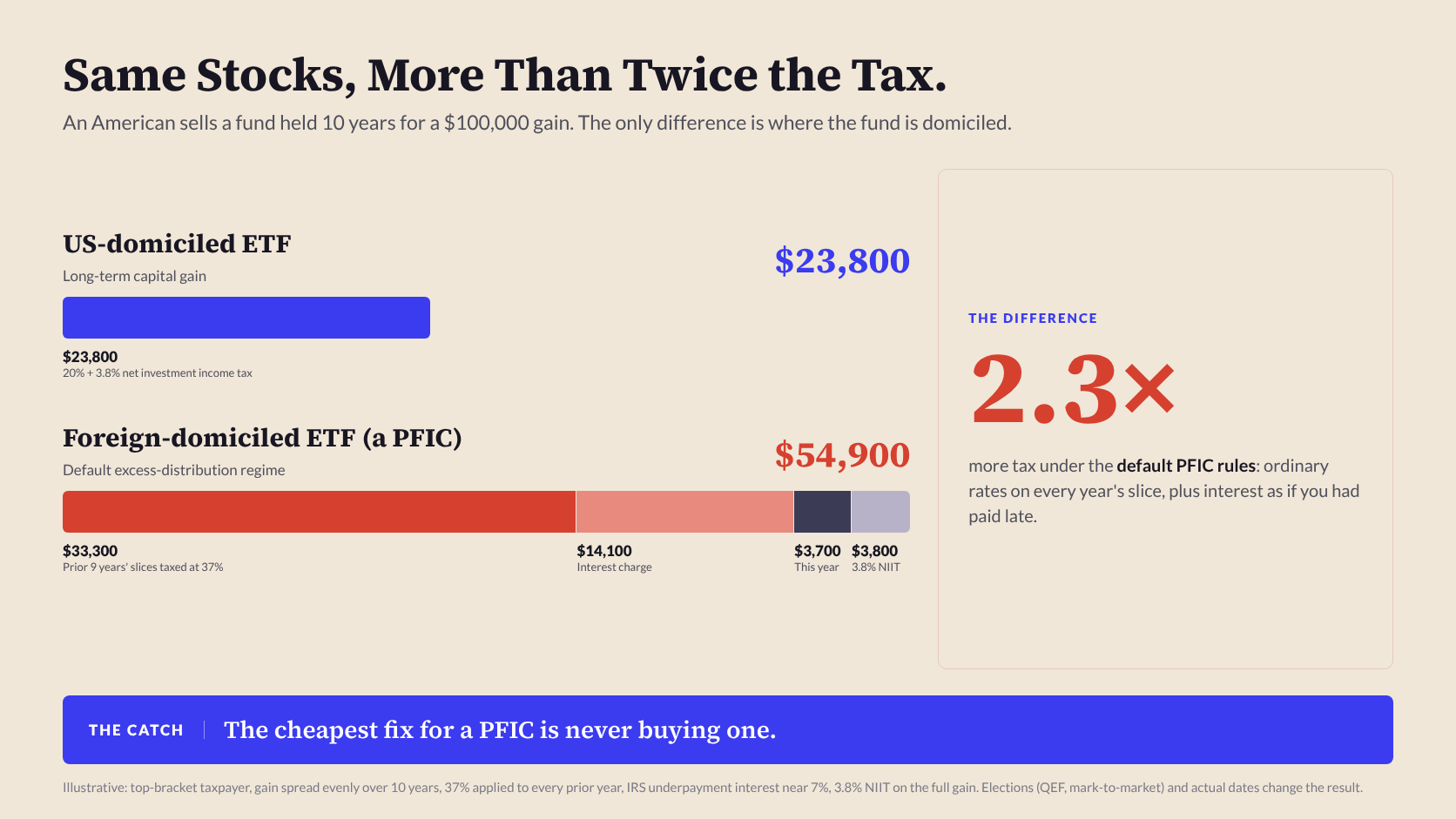
- Avoid PFICs. Most foreign-domiciled funds and ETFs are PFICs for US taxpayers. In our example, the default PFIC regime more than doubles the tax on a $100,000 gain.
- The FEIE ($132,900 for 2026) doesn't cover investment income. The Foreign Tax Credit and treaties do that work, and the FEIE can leave you unable to fund an IRA.
- Reporting is separate from tax. FBAR applies above $10,000 in aggregate foreign accounts; Form 8938 applies at higher thresholds. Penalties are out of proportion to balances.
- Match currencies to future spending. In the first half of 2025 the dollar index fell 10.8% and the euro rose about 13.8% against the dollar, so a euro retirement cost about 14% more in dollars.
- If you're not American, the rules flip. Many non-US expats prefer Irish-domiciled UCITS funds to limit US estate-tax and withholding exposure.
Why Investing as an Expat Is a Different Game
The United States is almost alone in taxing its citizens on worldwide income based on citizenship rather than residence. A US passport holder who has lived in Singapore for 20 years generally still files a Form 1040, reports foreign accounts above modest thresholds, and can owe US tax on investment income that foreign tax credits don't cover. Green-card holders are in the same position until they formally give up their status. A proposal to let Americans abroad elect residence-based taxation has circulated in Congress, but it is not law, and it was left out of the One Big Beautiful Bill Act.
On top of that, every cross-border investor faces overlapping tax systems, multiple currencies, duplicate reporting regimes and institutions that would rather not deal with non-residents. These problems compound with wealth. A founder with $3 million spread across a US brokerage, a foreign pension, crypto and property in two countries multiplies every currency, tax and reporting decision at once.
Non-US expats, British, Indian, Australian or other nationals living abroad, face a lighter version of the same puzzle: multi-currency exposure, fragmented accounts and home-country rules, without citizenship-based taxation. Most of this guide is written for Americans; a later section covers what changes if you're not one. If you're still deciding whether and where to move, our guide to geographic arbitrage covers the cost-of-living and tax math.
Keeping a US Brokerage Account as a Non-Resident
Why US brokerages restrict expat accounts
No US law requires a brokerage to close an American's account because they moved abroad. But serving clients in other countries brings local securities licensing, know-your-customer and anti-money-laundering obligations, and FATCA reporting, so many firms have chosen not to. From late 2024 through 2025, reporting described closures or restrictions at firms including Morgan Stanley, Fidelity, Merrill Lynch, Ameriprise, TIAA, Edward Jones, USAA and UBS. In practice "restricted" ranges from a full closure to an account you can hold and sell from but not buy new mutual funds in.
Brokers that still serve Americans abroad (2026)
| Broker | Who it accepts | Minimum | Notes |
|---|---|---|---|
| Schwab One International | US expats and non-US residents in eligible countries; its online application accepted 51 countries and regions in October 2026 (not Canada, France, Italy, Japan or the Philippines) | $0 (the old $25,000 minimum was removed) | USD account, US tax reporting; confirm your country before relying on it |
| Interactive Brokers | Residents of almost all countries except sanctioned or high-risk ones | $0 | Multi-currency cash, global market access, IRAs for US citizens abroad except residents of Australia, Canada, Hong Kong, India, Japan and Singapore |
| Advisor-custodied accounts | Clients of cross-border advisory firms with institutional custodian arrangements | Advisory fees apply | A route if you want advice anyway |
Country eligibility changes often. Check each firm's own international page before you move.
Living in the EU adds a product restriction. EU rules (PRIIPs) require a key information document, or KID, before a fund can be sold to retail investors, and US-domiciled ETFs don't publish one. EU-regulated brokers therefore usually block retail purchases of US ETFs, though you can generally keep and sell what you already own, and individual US stocks aren't affected. The UK has a similar rule under its own retail disclosure regime, and some brokers allow purchases only for clients who qualify as professional investors. For Americans in Europe that is a real squeeze: local funds are PFICs and US ETFs may be blocked, so check what a broker will actually let you buy before you open the account.
What to do if your account is restricted or closed
- Act before you move. Update your address honestly, ask the firm in writing what will happen, and open a backup account at an expat-friendly custodian while you still have a US address.
- Transfer in kind, don't liquidate. An ACATS transfer (the standard system for moving accounts between US brokers) moves positions without selling them, though some proprietary mutual funds can't be held at the receiving firm. A forced liquidation can trigger a large taxable gain at a bad time.
- Don't fake residency. A friend's US mailing address is not a workaround. Firms verify where you actually live, and misrepresenting it is itself grounds for closure.
A US mailing address is not a residency strategy.
Keeping a US account keeps you inside US-domiciled, non-PFIC investments and dramatically simplifies your annual reporting. It also keeps one more account visible alongside the rest of your balance sheet rather than lost in a tangle of statements; see our guide to banks for high-net-worth clients for the banking side.
The PFIC Trap: Why Foreign Funds Punish Americans
What a PFIC is
A Passive Foreign Investment Company is a non-US entity that meets either of two tests: at least 75% of its income is passive, or at least 50% of its assets produce passive income. Almost every foreign pooled investment qualifies: mutual funds, ETFs, closed-end funds, many money-market funds and investment-linked insurance products. An Irish- or Luxembourg-domiciled ETF holding exactly the same stocks as a US ETF is a PFIC; the US-domiciled ETF is not. Domicile, not the exchange where a fund trades, is what matters.
Why the default treatment is punitive
Unless you make an election, a PFIC sale or large distribution falls under the "excess distribution" regime. The gain is spread evenly across every year you held the fund; the slice for prior years is taxed at the highest ordinary income rate in effect for each of those years, plus an interest charge as if you had paid late. The slice for the current year is ordinary income. Capital gains rates never apply.
| $100,000 gain on a fund held 10 years | US-domiciled ETF | Foreign ETF (PFIC, default regime) |
|---|---|---|
| Tax treatment | Long-term capital gain | Ordinary income, spread over 10 years, plus interest |
| Tax on prior-year slices (9 × $10,000 at 37%) | n/a | $33,300 |
| Interest charge on deferred tax (~7% a year) | n/a | ~$14,100 |
| Tax on current-year slice ($10,000 at 37%) | n/a | $3,700 |
| 3.8% net investment income tax on the gain | Included in total | $3,800 |
| Total | ~$23,800 (20% + 3.8% NIIT) | ~$54,900 |
Illustrative: assumes a top-bracket taxpayer, a gain spread evenly, today's 37% top rate for every prior year (the real calculation uses each year's top rate), interest of about 7% a year (the IRS underpayment rate compounds daily and has varied over time), and the 3.8% net investment income tax, which applies to the full PFIC gain. Actual results depend on purchase dates, distributions and rates in each year.
Each PFIC also requires its own Form 8621, generally every year, per fund. A small exception exists: if the total value of your PFICs is $25,000 or less ($50,000 on a joint return) and you received no excess distribution (a sale at a gain counts as one) and made no election, annual filing may not be required. Confirm the conditions with your preparer.
The three regimes
| Regime | How gains are taxed | When it's available | Catch |
|---|---|---|---|
| Excess distribution (default) | Ordinary rates plus interest, spread over the holding period | Always, if you do nothing | The worst outcome on most gains |
| Mark-to-market | Annual unrealized gains taxed as ordinary income each year | Funds with marketable stock, generally those regularly traded on a qualifying exchange | Tax on paper gains, no capital gains rates |
| Qualified Electing Fund (QEF) | Your share of the fund's ordinary earnings and capital gains each year | Only if the fund provides a PFIC annual information statement; generally elect in the first year you hold it | Few foreign funds provide the statement; miss the first year and a later election generally needs a purging election to clean up the earlier years |
Hidden PFICs
PFICs often arrive without anyone using the word. A local bank's "savings plan", a money-market sweep in a foreign brokerage, an investment-linked life policy, or the funds inside some foreign pension wrappers can be, or can hold, PFICs. The fix is not abandoning global exposure; it's holding US-domiciled funds that invest internationally.
The cheapest fix for a PFIC is never buying one.
Still Filing US Taxes Abroad: FEIE, the Foreign Tax Credit and Investment Income
The Foreign Earned Income Exclusion covers earned income only. For 2026, qualifying Americans abroad can exclude up to $132,900 of foreign earned income each on Form 2555. It never covers dividends, interest, rent or capital gains, so an investor living on a portfolio gets no benefit from it.
The Foreign Tax Credit is the tool for investment income. It gives a dollar-for-dollar credit, on Form 1116, for foreign income tax paid on the same income, subject to limits by category. Unused credits can generally be carried back one year and forward ten. In high-tax countries such as the UK, Germany or France, the FTC often eliminates US tax on wages and much of investment income, though the credit is limited by income category and generally can't offset the 3.8% net investment income tax.
The FEIE can quietly cost you retirement contributions. IRA contributions require taxable compensation. If the FEIE excludes all of your earned income, you have none left, so you can't contribute to an IRA that year unless you have other compensation, or a spouse with compensation who can fund a spousal IRA on a joint return. Using the FTC instead of the FEIE keeps the compensation on your return.
| Your situation | Often better | Why |
|---|---|---|
| Low- or no-tax country (e.g. UAE) | FEIE, with FTC on any excess | Little foreign tax to credit |
| High-tax country (e.g. UK, Germany, France) | FTC | Foreign tax already exceeds US tax; keeps IRA eligibility; credits carry forward |
| Earnings above the FEIE cap in a moderate-tax country | FEIE up to the cap, FTC above it | You can't claim the FTC on income you excluded |
| Living on investment income | FTC and treaty | FEIE doesn't apply |
Revoking the FEIE generally bars you from claiming it again for five years without IRS consent, so model several years before choosing. See capital gains tax for the US rates that apply once foreign credits are used.
FBAR and FATCA: The Reporting Overlap
Reporting obligations exist even when no tax is due, and the penalties for missing them can far exceed the balances involved.
| Requirement | Threshold (2026) | Covers | Filed with | Deadline | Penalty range |
|---|---|---|---|---|---|
| FBAR (FinCEN 114) | Foreign financial accounts above $10,000 in aggregate at any point in the year | Bank, brokerage, pension and other financial accounts, including signature authority | FinCEN BSA E-Filing, not the tax return | April 15, automatic extension to October 15 | Non-willful: up to a five-figure amount per report (inflation-adjusted); willful: up to the greater of a six-figure amount or 50% of the balance |
| Form 8938 (FATCA) | Living abroad (if you meet the IRS presence or residence test): over $200,000 at year-end or $300,000 at any time (single or married filing separately); $400,000 / $600,000 (joint) | Financial accounts plus other foreign assets, such as directly held foreign stock and partnership interests | With Form 1040 | Tax-return deadline | $10,000, plus up to $50,000 more if not filed after IRS notice |
| Form 8621 | Each PFIC (subject to the small exception above) | Foreign funds | With Form 1040 | Tax-return deadline | Can keep the whole return open to IRS assessment |
The same account often goes on both FBAR and Form 8938. If you've fallen behind and the failure was non-willful, you may qualify for the IRS Streamlined Foreign Offshore Procedures, which are far gentler than the penalty table suggests. Eligibility rules apply, so get cross-border tax advice before you file. The practical defense is a live inventory of every account and its highest balance during the year.
Tax Treaties, Withholding and Double Taxation
Bilateral tax treaties allocate taxing rights between countries and set how double taxation is relieved, by credit or exemption. Without that analysis, the same dividend or pension payment can be taxed twice. For US citizens, a "saving clause" in most treaties preserves the US right to tax its citizens, so treaties help mainly through credits and specific carve-outs, such as some pension provisions.
Withholding is where the theory meets your cash. Foreign tax withheld on foreign dividends can often be reduced to a treaty rate or offset through the FTC, within the credit limits, but only if you claim it. Americans abroad give US brokerages a Form W-9 and generally see no US withholding on US dividends; retirement distributions delivered to a foreign address carry federal withholding that US citizens generally can't opt out of. Non-US persons file a W-8BEN and face 30% US withholding on US dividends unless a treaty reduces it.
Currency Risk and Multi-Currency Portfolios
Currency is a return driver, not a footnote. In the first half of 2025 the US dollar index fell 10.8%, its worst first half since 1973, while the euro rose about 13.8% against the dollar. For an American funding a eurozone retirement from a $2 million dollar portfolio and spending EUR 80,000 a year, the cost in dollars rose from about $82,800 to $94,300. The withdrawal rate moved from 4.1% to 4.7% without any change in lifestyle.
Match assets to liabilities. Align the currency of your portfolio with the currency of your future spending. A family planning to retire in the US should hold mostly dollar assets; one settling permanently in the eurozone should hold a meaningful share in euro-linked assets and keep a cash buffer in euros.
Build currency exposure inside a US account. Unhedged US-domiciled international ETFs carry foreign-currency exposure without leaving dollar custody or creating PFICs. Currency-hedged versions strip most of that exposure out, so use them only if you want less of it. Hold local-currency cash for spending in local bank accounts, which are not PFICs.
See your real allocation. Converting everything into one reporting currency hides concentration. A portfolio that looks balanced in dollars may be 60% exposed to sterling once a UK pension and a London flat are counted. This is where native multi-currency tracking earns its keep; see our multi-currency portfolio tracker guide and portfolio diversification.
Retirement Accounts Across Borders
Your 401(k) and IRA survive the move. Millions of Americans keep US retirement accounts from abroad. Some administrators restrict accounts with foreign addresses, so confirm your plan's policy and consider consolidating into an IRA at an expat-friendly custodian before you leave.
Contributions get harder. You need taxable compensation to contribute to an IRA. If the FEIE excludes all your earnings, there's nothing to contribute from; the FTC route preserves it. A 401(k) generally requires a US employer and payroll, though self-employed Americans abroad may be able to use a SEP IRA or solo 401(k) on earnings they don't exclude.
Distributions can be taxed twice in principle; treaties and credits usually relieve most of it. Traditional 401(k) and IRA withdrawals are US ordinary income and may also be taxable in your country of residence; the treaty and foreign tax credits determine who taxes first and how much relief you get.
The Roth recognition problem. A Roth's tax-free status is a US concept. Some countries, including the UK and Canada, can respect it under their treaties, often only if specific conditions or elections are met; others tax the growth or the withdrawals. Check before you make large Roth contributions or conversions (see our mega backdoor Roth guide for the US side).
Foreign pensions bring their own US treatment. A UK SIPP, Australian superannuation or Singapore CPF may be treated by the US as a foreign trust, may hold PFICs, and may need reporting on FBAR or Form 8938. Many tax-favored foreign retirement plans are exempt from Form 3520 under Revenue Procedure 2020-17, though not every plan meets its contribution and withdrawal tests. Where a treaty defers US tax on a pension's income until it is paid out, as the US-UK treaty generally does, Form 8621 isn't required for the funds inside it. The "tax-advantaged" wrapper abroad is not automatically tax-advantaged at home.
Where Expats Should Actually Hold Their Assets
The default for most Americans: US-domiciled investments in a US custodial account. Lower costs, cleaner reporting, no PFIC exposure and strong investor protections.
When local or third-country holdings make sense:
- Property you live in, or plan to.
- Local-currency cash and high-quality bonds for known local expenses, such as school fees or a home purchase.
- Accounts needed to maintain residency, meet visa conditions or qualify for a residency-by-investment program (see golden visas).
- Employer pension schemes you're required to join.
What to be wary of: offshore portfolio bonds and investment-linked insurance plans sold to expats. Many layer platform, fund and adviser charges, and lock you in with surrender penalties for years. For an American they usually hold PFICs as well. If you're offered one, ask for the total annual cost in one number and the exit cost in each year.
One of the most expensive expat mistakes is concentration: too much in one home market, one currency or one property. Diversify across asset classes, not only geographies.
If You're Not American: The Rules Flip
Non-US expats escape citizenship-based taxation, but two US rules can still reach them, and they point to the opposite fund choice.
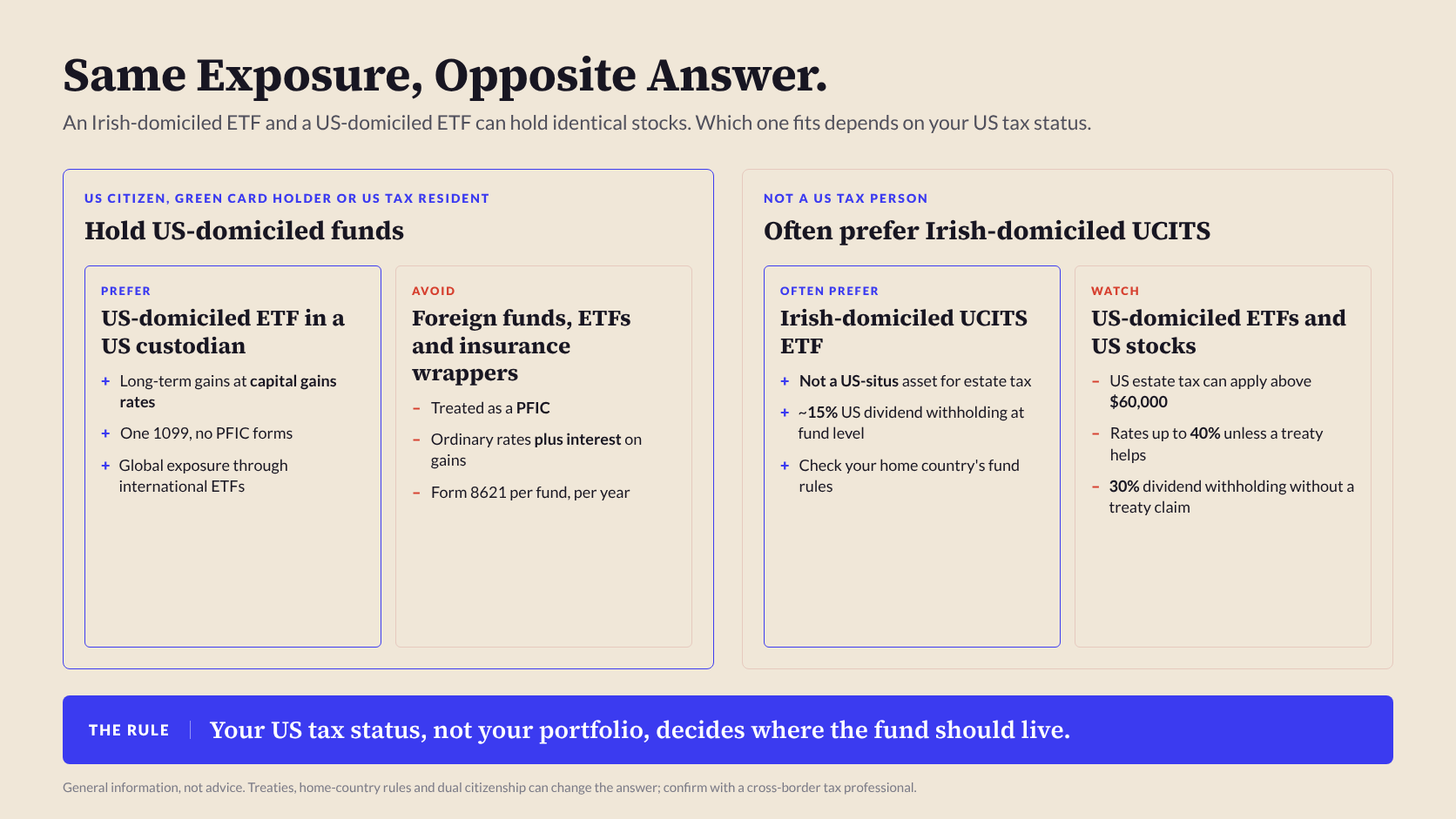
- US estate tax on US-situs assets. A nonresident alien who holds US stocks or US-domiciled ETFs has only a $60,000 US estate-tax exemption on those assets, unless a treaty provides more. Above that, rates reach 40%. Irish-domiciled UCITS ETFs holding the same US stocks are not US-situs assets.
- Dividend withholding. Non-US investors typically face 30% US withholding on US dividends, reduced by treaty with a Form W-8BEN. Irish-domiciled funds generally suffer 15% at the fund level under the US-Ireland treaty.
So while Americans should avoid foreign funds, many non-Americans prefer them. Home-country rules matter too: British expats need to watch UK reporting-fund status if they return, and the UK abolished the non-dom regime from April 2025, replacing it with a four-year foreign income and gains regime for new arrivals who were not UK resident in the previous 10 years. Indian, Australian and other nationals have their own residency and remittance rules.
Estate Planning and Succession Across Borders
Cross-border estates can face several inheritance regimes at once, including forced-heirship rules in many civil-law countries, with no single map of where the assets are. For Americans, the federal basic exclusion is $15 million for 2026 under the One Big Beautiful Bill Act, but mixed-nationality couples face two specific issues:
- No unlimited marital deduction for a non-citizen spouse. Assets left to a non-US-citizen spouse don't qualify for the unlimited marital deduction unless they pass through a Qualified Domestic Trust (QDOT) or a treaty provides relief.
- Gift limits. Gifts to a non-citizen spouse get an annual exclusion of $194,000 for 2026 instead of the unlimited marital deduction; larger gifts use up your lifetime exemption.
US planning tools, such as spousal lifetime access trusts and generation-skipping trusts, can still play a role, but they need to be coordinated with the law of your country of residence. Above all, keep a shareable, current inventory of every account and asset so heirs and advisers can act if something happens to you (see estate planning).
Working With a Cross-Border Adviser
Local advisers rarely understand PFICs, FBAR or US treaty positions; US advisers rarely understand your country's tax code. Look for:
- Fee-only compensation, with no commissions on products.
- Experience with your specific country pair, such as US–UK or US–Singapore, and the ability to advise legally where you live.
- Coordination with a cross-border tax preparer, or the preparation done in-house.
- Read-only access instead of spreadsheets. Give your adviser and accountant a live, read-only view of your accounts rather than emailing statements back and forth.
Red flags: commission-based offshore bonds, pressure to transfer a pension, and "tax-free" claims that ignore your US filing.
Common Expat Investing Mistakes
- Buying a local mutual fund, ETF or savings plan without realizing it's a PFIC.
- Assuming the FEIE shelters investment income. It never does.
- Letting a US brokerage close the account instead of transferring it in kind ahead of time.
- Ignoring the gap between the currency you invest in and the one you'll spend in.
- Missing an FBAR or Form 8621 and triggering penalties out of proportion to the balance.
- Running everything in a spreadsheet that breaks when a new currency, account or country is added.
Seeing the Whole Picture in One Place
Spread across a US brokerage, a foreign pension, crypto and property in two countries, most expats can't easily answer "what am I worth, and where?" That question sits underneath almost every decision above: your FBAR balances, your currency mix, your estate inventory, what your adviser should see.
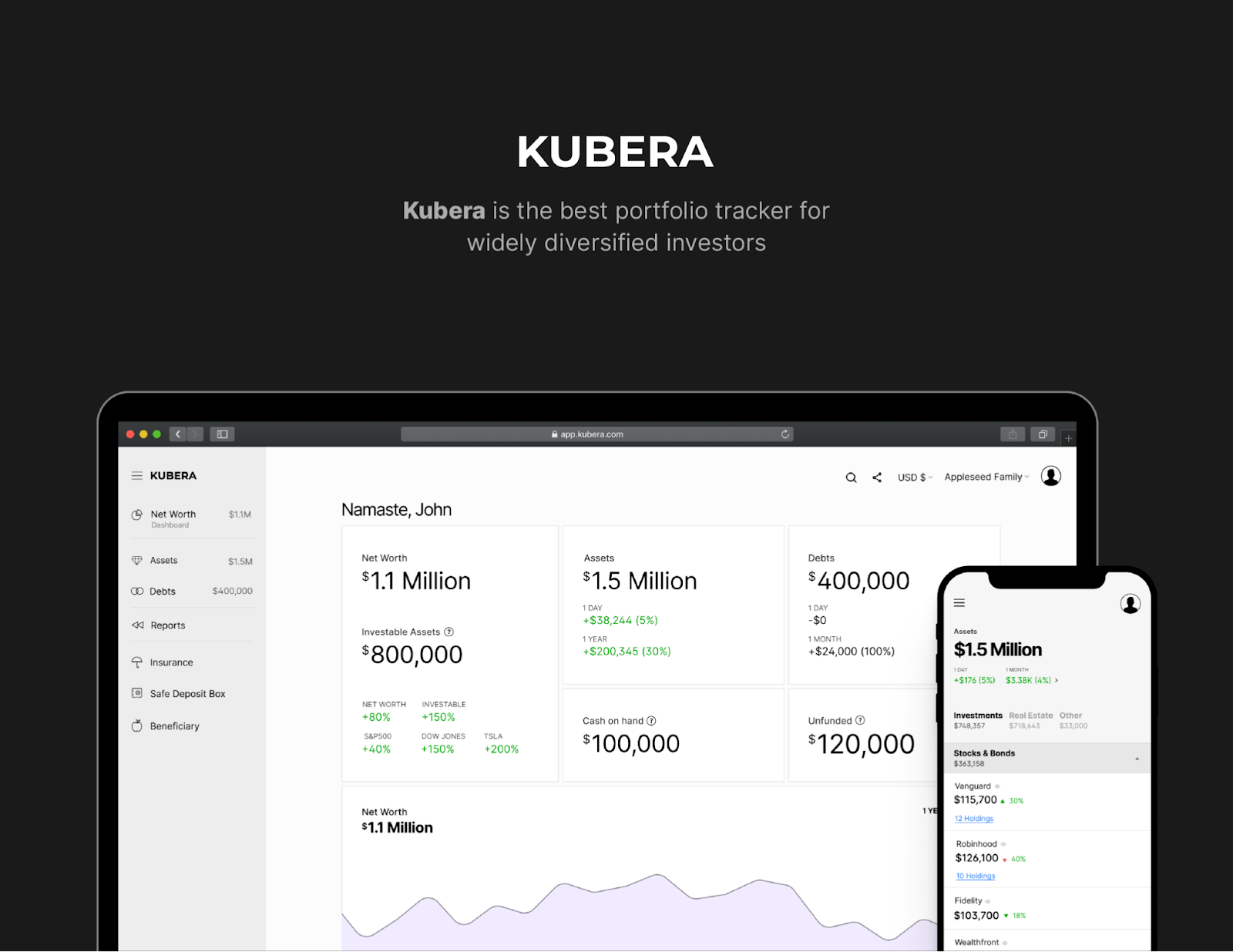
Kubera is built for this kind of balance sheet. It connects to banks, brokerages and crypto accounts worldwide through several aggregation partners, lets you add property, pensions and private holdings manually, and converts everything into the reporting currency you choose while still showing what you hold in each currency. You can share a read-only view with an adviser or family member, and keep documents next to the assets they belong to. It doesn't sell investments or advice, and it doesn't prepare your FBAR or tax forms; it shows you where everything is, which makes those filings easier to get right. For a closer look, see the net worth tracker for expats.
Frequently Asked Questions
Can a US citizen living abroad keep a US brokerage account?
Often yes, but not at every firm. Many major US brokerages restrict or close accounts with foreign addresses. Schwab One International (in eligible countries) and Interactive Brokers are the main self-directed options in 2026.
What is a PFIC and why should American expats avoid them?
A Passive Foreign Investment Company is a foreign pooled investment, such as most non-US mutual funds and ETFs. Without an election, gains are taxed at the highest ordinary rates plus an interest charge, and each fund needs an annual Form 8621.
Does the Foreign Earned Income Exclusion cover dividends and capital gains?
No. The FEIE ($132,900 for 2026) covers only earned income. Investment income is handled through the Foreign Tax Credit and tax treaties.
Do I need to file an FBAR if my money is in a US brokerage?
No. FBAR covers foreign financial accounts. A US account at a US broker is generally not reportable on FBAR, though its income still goes on your Form 1040. Your local bank and brokerage accounts abroad count toward the $10,000 aggregate threshold.
Should expats invest in their home currency or local currency?
Match the currency of your assets to the currency of your future spending. If you'll retire in the US, hold mostly dollars; if you'll stay in the eurozone, hold a meaningful share in euro-linked assets.
Can I contribute to an IRA while living abroad?
Only if you have taxable compensation. If the FEIE excludes all your earned income, you can't contribute that year unless you have other compensation or a spouse with compensation for a spousal IRA. Using the Foreign Tax Credit instead keeps compensation on your return.
Are Roth IRA withdrawals tax-free abroad?
Qualified withdrawals remain tax-free in the US, but your country of residence may tax them. Some countries, including the UK and Canada, can respect Roth treatment under their treaties, often with conditions.
Should non-US expats use US-domiciled ETFs?
Often not. Nonresident aliens have only a $60,000 US estate-tax exemption on US-situs assets, and US-domiciled ETFs count. Many non-Americans prefer Irish-domiciled UCITS funds for that reason and for lower dividend withholding.
Conclusion
Expat investing rewards simplicity and punishes improvisation. For Americans abroad, the durable formula is a US custodian, US-domiciled funds, currency matched to future spending, a tax strategy chosen for your country's rates, and filings tracked like any other bill. For non-Americans, the same discipline applies with a different fund domicile. Most of the damage in this field comes from products sold for their convenience and from accounts no one is watching. Keep the structure boring, keep the inventory current, and get advice from someone who understands both of your tax systems.
Disclaimer
This article is general information as of November 2026 and is not tax, legal or investment advice. Cross-border rules depend on citizenship, residence, treaties and account type, and brokerage policies change without notice. Confirm your situation with a qualified cross-border tax professional before acting.


