
.jpg)
A spousal lifetime access trust (SLAT) is an irrevocable trust that one spouse, the grantor, creates for the benefit of the other spouse, the beneficiary spouse, and usually their children or descendants. The grantor transfers assets into the trust as a completed gift, so those assets and their future appreciation generally leave the grantor’s taxable estate. The family can still reach that wealth indirectly, because the trustee may make distributions to the beneficiary spouse. That access is conditional: it can disappear if the marriage ends in divorce or if the beneficiary spouse dies. With the federal exemption at $15 million per person in 2026, the planning question has shifted from beating a deadline to weighing long-term growth against permanence.
A SLAT solves a difficult estate-planning problem: how to remove appreciating assets from one spouse’s estate without cutting the family off from every possible source of support. The access is indirect, conditional, and dependent on the marriage, and most of the decision turns on that distinction.
At a Glance
- What it is: A SLAT is an irrevocable trust funded by one spouse for the other spouse and descendants. The gift is complete, so the assets and their growth generally sit outside the grantor’s taxable estate.
- The 2026 backdrop: The federal basic exclusion amount is $15 million per individual, roughly $30 million per couple, indexed for inflation after 2026, with a 40% top rate above the available exemption.
- Access is indirect, not guaranteed: The grantor never has a legal right to the assets. The family benefits only if the trustee distributes to the beneficiary spouse, and only while the marriage lasts and that spouse is alive.
- The core benefit: Future appreciation compounds outside the estate, and because a SLAT is usually a grantor trust, the grantor pays the income tax, which is generally not an added gift.
- The largest risks: Irrevocability, the reciprocal trust doctrine when both spouses plan, divorce, death of the beneficiary spouse, and loss of a stepped-up basis at the grantor’s death.
What Is a Spousal Lifetime Access Trust?
Start with the roles:
- The grantor spouse creates and funds the trust.
- The beneficiary spouse is a current beneficiary who can receive distributions.
- Remainder beneficiaries, usually the couple’s children and grandchildren, take what is left under the timeline the trust documents set.

The transfer is a completed gift. Because the grantor gives up dominion and control, the assets, along with everything they later earn or appreciate into, are generally removed from the grantor’s gross estate. A trustee, ideally independent of the grantor, controls investments and decides distributions under the standard written into the instrument. For income tax purposes, most SLATs are grantor trusts, so the grantor stays liable for the tax on trust earnings even though the assets are no longer theirs.
The family’s practical access runs through the beneficiary spouse: when the trustee distributes to that spouse, the money enters the marital household, and the grantor benefits in an everyday sense while never holding a legal claim. That access carries a strict condition. There can be no agreement, express or implied, that distributions will loop back to the grantor; if the arrangement looks like a disguised way to retain the property, the estate-tax benefit is at risk. Note too that a SLAT does not automatically terminate when the beneficiary spouse dies. Many continue for descendants, so the design choice matters as much as the label.
SLAT vs Irrevocable Trust: A Comparison
“SLAT vs irrevocable trust” is a false distinction. A SLAT is an irrevocable trust; its defining feature is a spouse named as a current beneficiary. The useful comparison is with other revocable or irrevocable structures.
| Structure | Main purpose | Grantor retains access? | Typical assets | Key limitation |
|---|---|---|---|---|
| SLAT | Remove assets and future growth from the estate while preserving indirect family access[cite: 3] | No legal access; only indirect, through the beneficiary spouse[cite: 3] | High-growth securities, business interests, real estate, alternatives[cite: 3] | Irrevocable; access ends on divorce or the beneficiary spouse's death[cite: 3] |
| Revocable living trust | Probate avoidance and incapacity management[cite: 3] | Full control; fully revocable[cite: 3] | Most personal assets[cite: 3] | No estate-tax reduction; assets stay in the estate[cite: 3] |
| ILIT | Hold life insurance outside the estate[cite: 3] | None[cite: 3] | Life insurance policies[cite: 3] | Narrow purpose; funding and Crummey mechanics required[cite: 3] |
| GRAT | Transfer appreciation with little or no gift-tax cost[cite: 3] | Retained annuity for a term[cite: 3] | Assets expected to outperform the IRS rate[cite: 3] | Grantor must survive the term; annuity must be paid[cite: 3] |
| Conventional irrevocable gift trust | Remove assets from the estate for children or others[cite: 3] | None[cite: 3] | Varied[cite: 3] | No spousal access channel; family gives up more current benefit[cite: 3] |
SLAT 2026 Exemption: Why the Strategy Still Matters
The rules changed on July 4, 2025, when the One Big Beautiful Bill Act was signed into law. Effective January 1, 2026, the federal basic exclusion amount is $15 million per individual, allowing a married couple up to roughly $30 million of combined federal exemption, subject to prior gifts and other facts. The generation-skipping transfer (GST) exemption is also $15 million for 2026. Both amounts are indexed for inflation after 2026, and the top federal transfer-tax rate above the available exemption remains 40%.
Two features distinguish current law. There is no TCJA-style scheduled sunset in the statute, so the exemption is not set to fall automatically at a fixed date. But that does not make it permanent, because a future Congress can still change it.
The old urgency centered on using an exemption before it was expected to be cut roughly in half. That deadline is gone, but the planning case for moving high-growth assets is not. The 2026 question is different: does moving appreciating property out of your estate now make sense despite the higher exemption, given future growth, state estate taxes, legislative uncertainty, basis consequences, and your family’s need for access?
Consider a couple with a $40 million estate and unused exemptions. If one spouse transfers $15 million of high-growth assets into a SLAT, everything that stake becomes over the coming decades compounds outside both estates; if both spouses fund separate, differentiated trusts, they can put substantially more to work the same way. The lever is not the dollars moved today, it is the growth those dollars would otherwise have added to a taxable estate.
Resist the tidy “$12 million guaranteed savings” math. The real outcome depends on prior exemption use, who actually owns the property, valuation, estate growth, mortality, portability, state taxes, the basis tradeoff, and correct drafting and administration. Any one of those can move the result materially.
How a SLAT Works Step by Step
Setting up a SLAT is a sequence, not a single signing.
- Confirm suitability and available exemption. Run the cash-flow analysis first and confirm how much exemption each spouse has left.
- Identify which spouse owns the assets. Only the true owner can transfer property, which is where community-property and titling questions surface.
- Draft the trust with qualified counsel. The distribution standard, beneficiary classes, powers of appointment, and trustee provisions are decided here.
- Select the trustee and distribution standard. Choose between a HEMS standard (health, education, maintenance, support) and a broader discretionary standard, and decide who holds discretion.
- Transfer properly titled assets. An incomplete gift does not achieve the goal.
- Obtain valuations where required. Closely held interests, real estate, and other hard-to-value assets need defensible appraisals.
- File Form 709 and allocate GST exemption. Report the gift and make GST elections deliberately, not by default.
- Administer the trust separately over the long term. Separate accounts, records, and decisions keep the structure intact.
The distribution standard shapes both control and tax exposure. A HEMS standard limits the trustee to defined categories of support; a fully discretionary standard gives more flexibility but is usually better placed with an independent trustee. Grantor-trust status means the grantor reports trust income on their own return, letting the trust grow untaxed, and Form 709 is where the exemption is formally used and GST exemption allocated.
Two disciplines protect the plan: keep separate accounts and records with no commingling, and never rely on any informal understanding that distributions will return to the grantor. An independent or corporate trustee is not legally mandatory, but naming one often reduces tax friction, control concerns, and fiduciary risk. Couples new to this can start with our primer on how to set up a family trust.
SLAT Trust Pros and Cons
A balanced read on SLAT trust pros and cons matters more than a sales pitch; the downsides are permanent.
Benefits
The central advantage is removing assets and their future appreciation from the taxable estate. The beneficiary spouse also provides an indirect access channel if circumstances tighten. Because the grantor generally pays the income tax on a grantor trust, the trust compounds without that drag. A SLAT can offer some asset protection, subject to state law and fraudulent-transfer rules, accepts a broad range of assets, carries GST and dynasty-planning potential, and requires no annuity payment.
Limitations
The transfer is irrevocable and the grantor gives up control. The access channel depends entirely on the marriage and on the beneficiary spouse staying alive and willing to share. Assets excluded from the estate generally lose the step-up in basis at death, raising future capital-gains tax. Trustee fees, tax preparation, and administration add ongoing cost, and multi-state families face state income-tax questions. Distributions to the beneficiary spouse can also be exposed to that spouse’s creditors or to division in a divorce, and aggressive valuations invite audit.
A word on the grantor paying income tax: That payment is generally not an added gift, but a clause letting the trust reimburse the grantor for those taxes requires care. Under Rev. Rul. 2004-64, a mandatory reimbursement provision pulls the full trust value back into the grantor’s estate, while a purely discretionary one held by an independent trustee generally does not, standing alone. Even a discretionary clause can cause inclusion when combined with other facts, such as a pre-existing understanding that the trustee will reimburse. Do not treat asset protection or tax neutrality here as automatic.
Risks Every Couple Should Evaluate
This is where a technically sound plan most often runs into trouble.
1. The Reciprocal Trust Doctrine
When both spouses want access, the natural move is for each to create a trust for the other. The reciprocal trust doctrine is the trap. If spouses create substantially similar trusts for one another, the IRS may “uncross” them and treat each spouse as having created a trust for their own benefit. When that happens, the assets are pulled back into each grantor’s estate under Section 2036, and the entire tax benefit collapses.
The governing authority is United States v. Estate of Grace, 395 U.S. 316 (1969). There, spouses executed nearly identical trusts about two weeks apart, and the Supreme Court held that the doctrine applies where the trusts are interrelated and the arrangement leaves the settlors in approximately the same economic position as if each had created a trust for themselves. Motive and quid pro quo do not have to be proven; economic substance controls.
The reciprocal trust doctrine is not defeated by waiting a particular number of days or changing one paragraph in the documents. None of the following, standing alone, is a safe harbor: waiting a certain number of days, varying funding by 10% or 20%, appointing different trustees, or rewriting a single distribution clause. Courts look at the whole economic arrangement. Meaningful differences in timing, funding, assets, trustees, distribution standards, beneficiaries, and powers, taken together and backed by how the trusts are actually administered, reduce the risk. No checklist eliminates it.
2. SLAT Divorce Risk
SLAT divorce risk depends heavily on how the trust documents define “spouse.” Three drafting choices lead to very different outcomes:
- A named beneficiary stays a beneficiary after divorce, so the grantor could spend years funding a trust that continues to benefit a former spouse.
- A trust that defines the beneficiary as the grantor’s current spouse cuts off the ex-spouse on divorce, which usually also severs the grantor’s indirect access.
- A floating spouse clause defines the beneficiary as whomever the grantor is married to from time to time, so a future spouse could become the beneficiary.
Floating-spouse provisions are sometimes presented as a fix, but they raise their own tax, drafting, family, and public-policy questions and are not a standard solution. The honest planning point is that SLATs are built for stable marriages. Couples seriously contemplating divorce are not good candidates.
3. Death of the Beneficiary Spouse
When the beneficiary spouse dies, the grantor may lose the family’s indirect access channel entirely, even though the estate-tax benefit continues. Plan for that in advance. Retain enough assets outside the trust to live on. Consider life insurance to replace access or liquidity. Think carefully about successor-beneficiary design and whether the trust continues for descendants. And build liquidity so no one is forced to unwind good long-term positions at a bad time. Because this risk is real, couples often name the spouse least likely to die first as the beneficiary. Our guidance on family wealth protection speaks to this coordination.
4. Irrevocability and Overfunding
Because the transfer is permanent, setting up a SLAT demands a candid cash-flow and liquidity analysis before anything is signed. Imagine a couple who move most of their liquid wealth and a large concentrated stock position into a SLAT, then face a tax bill, a health event, and a business downturn in the same stretch, with too little left in their own names to cover it. The trust worked exactly as designed and still left them squeezed. Fund from surplus, not from the assets you may need.
5. SLAT Step Up Basis
The basis tradeoff is frequently underweighted. Assets excluded from the grantor’s estate generally do not receive a basis adjustment at the grantor’s death, so heirs may carry the grantor’s original basis and face larger capital-gains tax on sale. The estate-tax saving has to be weighed against that potential income-tax cost. Low-basis appreciated assets can be poor funding candidates for exactly this reason. Some trusts include a carefully drafted power to substitute or “swap” assets of equal value, which can let the grantor pull low-basis assets back into their estate later for a step-up while adding cash or high-basis property to the trust. That planning around SLAT step up basis is powerful but not guaranteed; exercising a swap power requires accurate valuation, documentation, and current tax advice.
Dual SLAT Planning and the Reciprocal Trust Doctrine

A dual SLAT arrangement is simply both spouses each creating a SLAT, so the couple can use both exemptions while, ideally, preserving an indirect access path for each. The appeal is obvious, but so is the danger: two mirror-image trusts are precisely what the reciprocal trust doctrine targets. The goal in dual SLAT estate planning is genuine, durable difference between the two trusts, created at formation and maintained through administration.
| Design element | SLAT created by Spouse A | SLAT created by Spouse B | Why the difference may matter |
|---|---|---|---|
| Creation date | Earlier[cite: 3] | Later, with meaningful separation[cite: 3] | Reduces the appearance of a single prearranged exchange[cite: 3] |
| Funding date and amount | One amount, one schedule[cite: 3] | A different amount and schedule[cite: 3] | Cuts against “same economic position”[cite: 3] |
| Asset type | One asset class[cite: 3] | A distinct asset class[cite: 3] | Weakens the interrelated-transfer inference[cite: 3] |
| Trustee | One independent trustee[cite: 3] | A different independent trustee[cite: 3] | Separates control and decision-making[cite: 3] |
| Distribution standard | HEMS[cite: 3] | Broader discretionary, or vice versa[cite: 3] | Alters each spouse’s actual economic benefit[cite: 3] |
| Beneficiaries | One class[cite: 3] | A modified class[cite: 3] | Distinguishes who truly benefits[cite: 3] |
| Withdrawal or appointment powers | Present in one form[cite: 3] | Absent or different[cite: 3] | Changes retained economic rights[cite: 3] |
| Termination provisions | One timeline[cite: 3] | A different timeline[cite: 3] | Differentiates long-term disposition[cite: 3] |
| Governing state law | One situs[cite: 3] | A different situs[cite: 3] | Can change creditor and income-tax treatment[cite: 3] |
No single difference, timing gap, funding percentage, or checklist guarantees protection from the reciprocal trust doctrine. The overall economic substance controls. Because the analysis is fact-specific, each spouse’s trust deserves separate legal review. Two documents generated from the same template do not become safe through cosmetic edits, and differences added only to defeat the doctrine can quietly change who actually benefits.
What Assets Should Fund a SLAT?
The best SLAT candidates share a profile: strong expected growth, manageable basis and valuation issues, and assets the grantor will not personally need. That points to high-growth public securities, founder or pre-IPO equity, closely held business interests, investment real estate, private equity and other alternatives assets, life insurance where appropriate, and, with proper custody and valuation, cryptocurrency and other digital assets.
Approach some assets with caution. Low-basis appreciated assets carry the step-up problem noted above. Assets throwing off large taxable income raise the grantor’s burden under grantor-trust treatment. Anything the grantor may actually need should stay in their own name. Difficult-to-value interests, debt-encumbered property, and assets with transfer restrictions add cost and audit risk. Retirement accounts generally cannot be assigned into a trust without triggering income tax, so they are rarely funded into a SLAT.
Community-property couples face an added step. Confirm that the funding spouse actually owns the property being transferred, since community-property assets may need to be divided or retitled first, and that retitling can carry its own state-law, basis, creditor, and marital-property consequences. Do not assume one spouse can transfer the other’s interest. Coordinate with local counsel before moving anything, and see our broader notes on protecting your assets.
SLAT Cost, Setup, and Ongoing Administration
Setup cost is driven by complexity, not a single sticker price. The main inputs are attorney drafting, tax counsel, appraisals, any entity restructuring, trustee selection, state-law analysis, dual-SLAT coordination, and transferring businesses or real estate. As an illustrative benchmark, complex tax-planning trusts can reach $7,000 or more, with differentiated dual-SLAT plans running higher. Treat any national figure as illustrative, since the real number depends on your facts and jurisdiction.
Ongoing costs continue for the life of the trust: trustee compensation, tax preparation, accounting, investment management, periodic appraisals, legal review, state filings, entity administration, and insurance servicing. Corporate trustees commonly charge in the range of 1% to 2% of trust assets per year.
Administration is what keeps the structure defensible. Maintain separate trust accounts with no commingling, keep written distribution records, document trustee decisions where appropriate, review the trust annually, and keep beneficiary and ownership records accurate. Tax reporting depends on structure: a grantor trust may report under a grantor-trust method tied to the grantor’s return, while other trusts file Form 1041, so do not assume every grantor trust files the same way. State income-tax filing needs its own analysis based on situs and beneficiary residence.
Tracking SLAT Assets Within the Family Balance Sheet
Once assets move into a SLAT, they no longer belong to the grantor, yet they remain relevant to family liquidity, investment exposure, trustee oversight, tax obligations, and long-term planning. That creates a visibility problem: the wealth still shapes the family’s decisions, but it sits in a separate legal container that a personal net-worth view can distort.
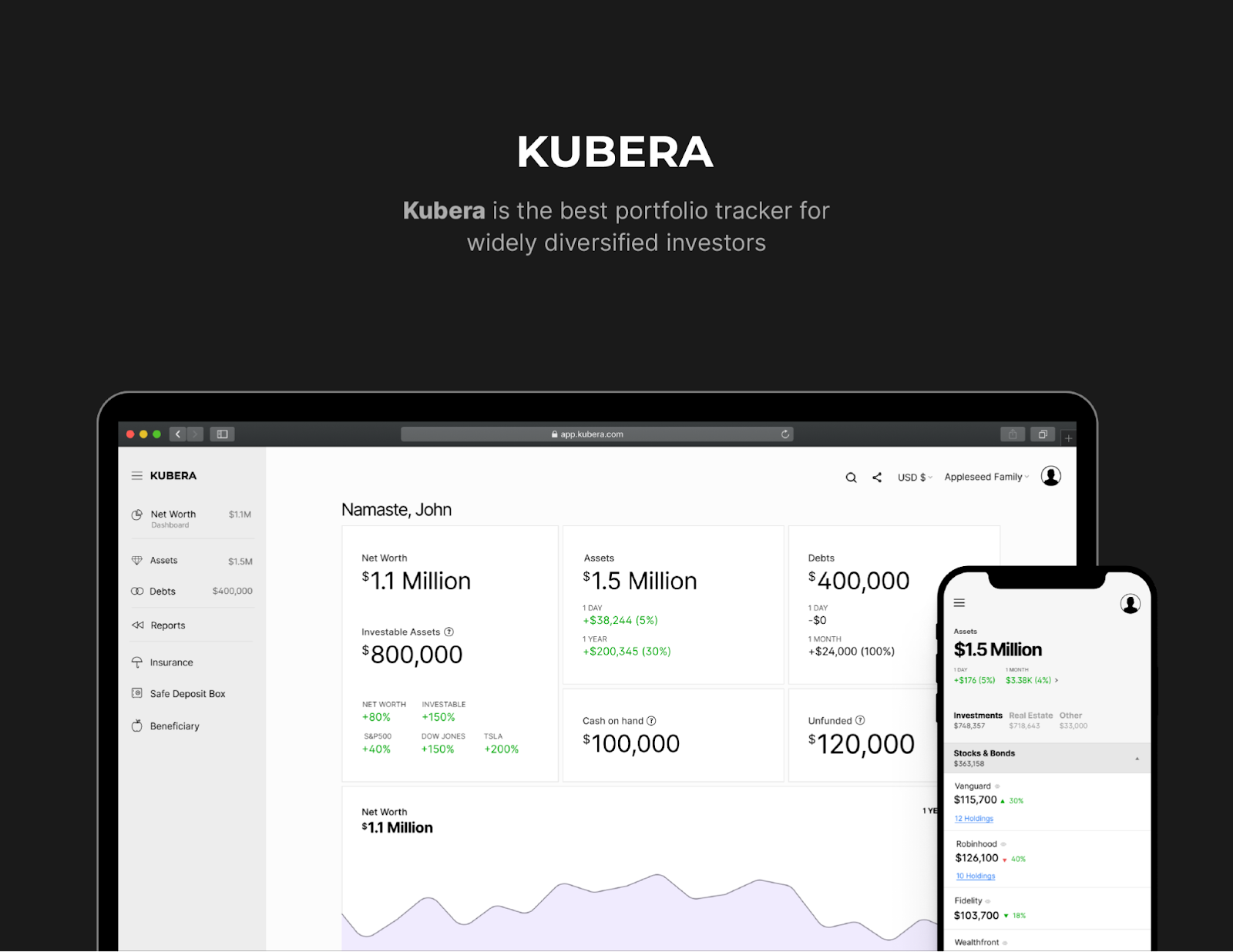
A tool like Kubera can help hold that distinction cleanly. Using nested portfolios, a family can maintain a separate balance sheet for each trust or entity, then view those trusts alongside personal assets without confusing legal ownership. That supports tracking liquid and illiquid holdings, organizing valuations and records, and sharing view-only access with trustees, attorneys, and advisors under granular controls. That is what Kubera’s wealth tracker is for: one balance sheet per trust or entity, and one consolidated view for the family.
The point is to keep four things separate that are easy to blur: legal ownership, taxable-estate inclusion, beneficial interests, and consolidated family reporting. SLAT assets are not part of the grantor’s personal balance sheet, but seeing them beside personal assets, correctly labeled, gives the family an honest picture. For the underlying concepts, our estate planning resources go deeper.
How a SLAT Fits Into a Broader Estate Plan
A SLAT is one tool, not a complete estate plan. Most families still need a revocable living trust for probate avoidance and incapacity, and many pair a SLAT with an ILIT for liquidity, GRATs for additional appreciation transfer, and family LLCs, holding companies, or limited partnerships to hold and value closely held interests. Charitable trusts, direct lifetime gifts, portability elections, life insurance, and GST and dynasty planning all interact with the SLAT decision.

Federal exemption planning does not resolve everything. As of 2026, roughly a dozen states plus the District of Columbia impose an estate tax, and five states impose an inheritance tax, with Maryland imposing both. Several of those state exemptions sit far below the federal level, so a family well under $15 million federally can still face state estate tax. State trust income tax, trust situs, marital-property law, creditor law, and beneficiary residence each require their own analysis.
Frequently Asked Questions
What is a spousal lifetime access trust?
A spousal lifetime access trust is an irrevocable trust one spouse creates for the other spouse and usually their descendants. The grantor makes a completed gift, so the assets and their future growth generally leave the grantor’s taxable estate, while the family keeps indirect access through distributions the trustee may make to the beneficiary spouse.
Is a SLAT an irrevocable trust?
Yes. A SLAT is a type of irrevocable trust, distinguished by naming a spouse as a current beneficiary. The grantor gives up control and cannot revoke it. That permanence is what removes the assets from the estate, and it is also the main reason the decision deserves careful analysis before funding.
What is the SLAT 2026 exemption?
For 2026, the federal basic exclusion amount is $15 million per individual, roughly $30 million for a married couple, with a matching $15 million GST exemption. The One, Big, Beautiful Bill Act removed the prior scheduled sunset and indexes the amount for inflation after 2026, though a future Congress could still change it.
Can both spouses create a SLAT?
Yes, through a dual SLAT arrangement, but it must avoid the reciprocal trust doctrine. If the two trusts are too similar, the IRS may uncross them and pull the assets back into each spouse’s estate. Meaningful, well-documented differences in timing, funding, trustees, and terms reduce, but never eliminate, that risk.
What is the reciprocal trust doctrine?
It is a rule, confirmed in United States v. Estate of Grace, that lets the IRS treat two interrelated, substantially similar spousal trusts as if each spouse created a trust for themselves. The result is estate inclusion for both. No fixed waiting period or single drafting change defeats it; the overall economic substance controls.
What happens to a SLAT after divorce?
It depends on how the trust defines “spouse.” A named ex-spouse can remain a beneficiary, meaning the grantor keeps funding a trust for a former partner. A trust tied to the “current spouse” cuts the ex off but usually ends the grantor’s indirect access. Floating-spouse clauses add complexity and are not a standard fix.
What happens when the beneficiary spouse dies?
The estate-tax benefit continues, but the grantor typically loses the indirect access channel that ran through that spouse. Planning ahead matters: keep assets outside the trust, consider life insurance, design successor beneficiaries thoughtfully, and build liquidity so the family is not forced into poorly timed sales.
Do SLAT assets receive a step-up in basis?
Generally no. Because the assets are excluded from the grantor’s estate, they usually do not get a basis adjustment at the grantor’s death, so heirs may face larger capital-gains tax. The estate-tax saving must be weighed against that. A carefully drafted swap power can sometimes allow later basis management, but not in every case.
Conclusion
The higher exemption changed the timing conversation, not the underlying analysis. With no scheduled sunset and a $15 million per-person exemption for 2026, the pressure to act by a deadline has eased, but appreciation moving outside the estate, uncertain future law, state estate taxes, and family goals can still justify creating a spousal lifetime access trust. What has not changed is the central caution: indirect access through a spouse is not the same as retained ownership, and divorce, the death of the beneficiary spouse, low basis, and overfunding can each undermine a plan that looks flawless on paper. A SLAT rewards coordinated legal, tax, investment, and administrative work. Decide based on whether the structure fits your family, not on tax savings alone.
This article is educational and not legal or tax advice. Consult qualified estate-planning and tax professionals before acting.


