

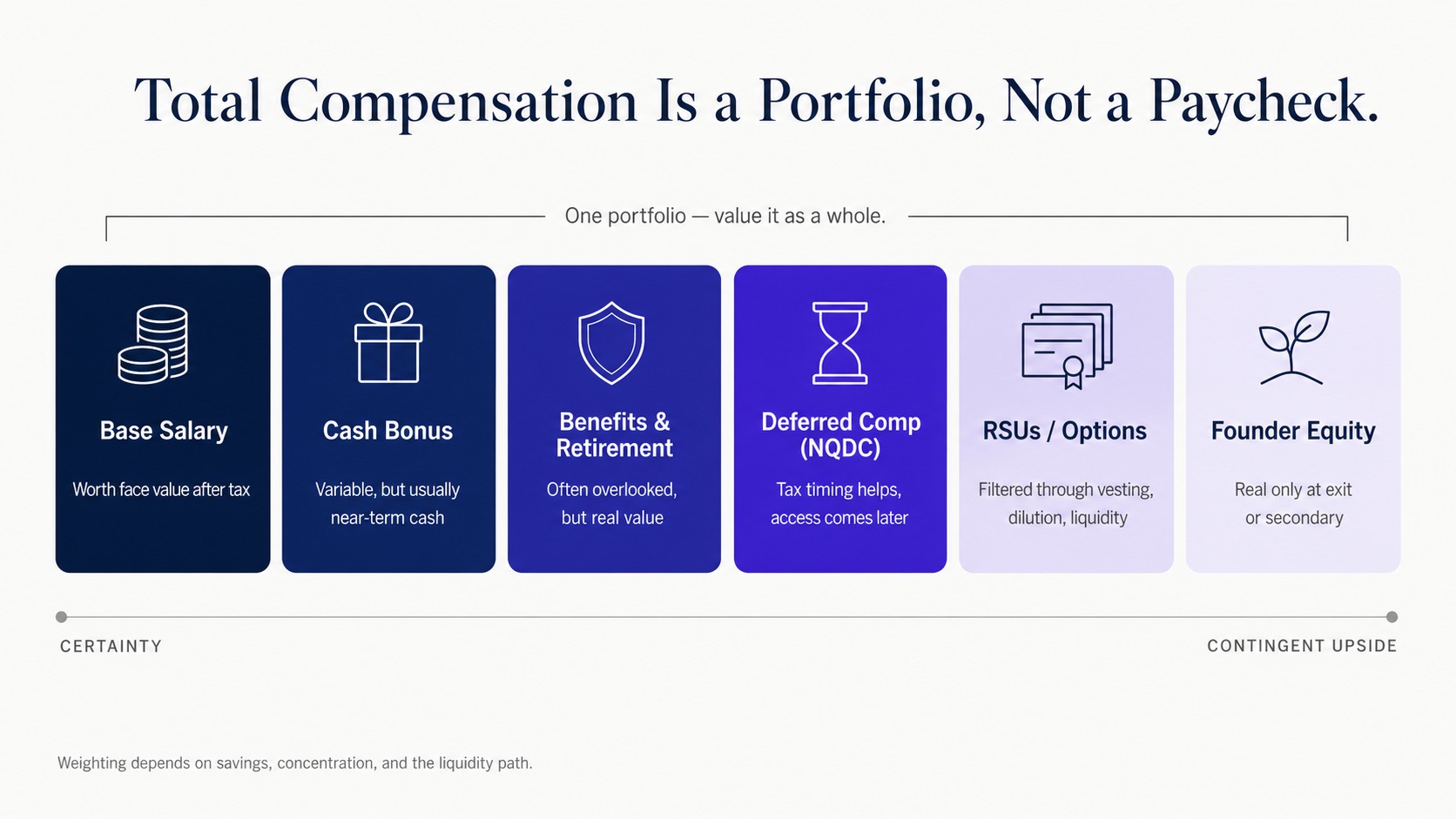
A compensation strategy is a deliberate plan for how you earn, structure, and eventually convert pay into durable personal wealth. It treats a total compensation package as a portfolio: base salary, cash bonus, equity, employee benefits, deferred pay, severance, and the terms that govern when any of it becomes liquid. The headline salary is often not the largest source of long-term value. For many founders, executives, and senior employees, equity and deferred awards dwarf cash over several years, yet they carry vesting conditions, tax exposure, and liquidity risk that cash does not. Each of those three groups also faces different decisions with different leverage. This article works through the whole portfolio: cash, equity, taxes, negotiation, liquidity, concentration, and how to track it all.
Founders usually hold common stock from incorporation. Their questions revolve around dilution, control, tax basis, and whether their shares qualify as QSBS founder stock. Many accept below-market base pay to preserve company cash, which is defensible only if they stop treating the latest company valuation as personal liquidity. Founder wealth stays contingent until a sale, a secondary transaction, or an IPO makes it real, and departure or removal before full vesting can erase much of it.
Executives receive layered packages: salary, an annual cash bonus, RSUs or options, performance awards, deferred compensation, and severance. Their hardest negotiation is rarely salary. It is the structure of equity, acceleration, clawbacks, and post-employment terms, often under public disclosure and insider-trading restrictions. Executive compensation planning means modeling what the package pays in a termination, an acquisition, and a long tenure, not just in the offer-letter scenario.
Senior employees have the least control over plan design but more room than most assume. Initial grant size, level, signing bonus, refresh grants, and post-termination exercise windows are all negotiable at the right moments. Their central discipline is comparing offers with realistic rather than optimistic equity assumptions, because they usually cannot influence the liquidity path they are betting on.
Cash vs Equity Compensation
Every package allocates value between certainty and possibility. Base pay, cash bonus, and a signing bonus fund your life now and are worth close to face value after tax. An equity award is a claim on a future that may not arrive, filtered through vesting schedules, dilution, liquidation preferences, and a liquidity event you do not control. Benefits and deferred pay sit in between, conditional on tenure, plan terms, and employer solvency. The right mix protects current cash flow without ignoring long-term upside.
Weight cash more heavily when savings are thin, near-term expenses are large, the employer's outlook is uncertain, your net worth is already concentrated in this employer, an option exercise would be expensive, or no credible liquidity path exists. High living costs and existing golden handcuffs argue the same way; both reduce your capacity to wait.
Equity deserves more weight when you hold sufficient liquidity outside the company, the business shows credible growth at a reasonable valuation, the strike price is attractive, the fully diluted picture is visible, your horizon is long, and the resulting concentration stays manageable. Notice what is missing from that list: company stage by itself. Earlier equity can carry more upside, but it also deserves a larger uncertainty discount, not automatic preference. Kubera's guide to equity vs cash compensation treats this tradeoff at length.
How to Value a Total Compensation Package
Total compensation optimization starts with honest valuation, meaning probability-adjusted and liquidity-adjusted. Build the package bottom-up: guaranteed cash, target bonus discounted by realistic payout history, employer retirement contributions, benefits, and sign-on payments, then equity. Spread the equity's value across the vesting period, weight it by scenarios rather than a single price, subtract exercise cost and expected taxes, and discount for how long you must wait and how concentrated you become. Then subtract whatever you forfeit by leaving your current employer. Unvested awards never belong on this ledger at full headline value; Kubera's piece on the value of unvested stock options explains why.
A labeled hypothetical shows how assumptions can reverse an apparent winner. A senior engineering leader compares two offers. Offer A, from a public company: $340,000 base pay, a 20% target bonus, and $600,000 of restricted stock units (RSUs) vesting over four years. Offer B, from a Series C private company: $270,000 base pay, a 15% target bonus, and options on 0.15% of the company on a fully diluted basis, notionally worth $1,200,000 at the latest preferred price.
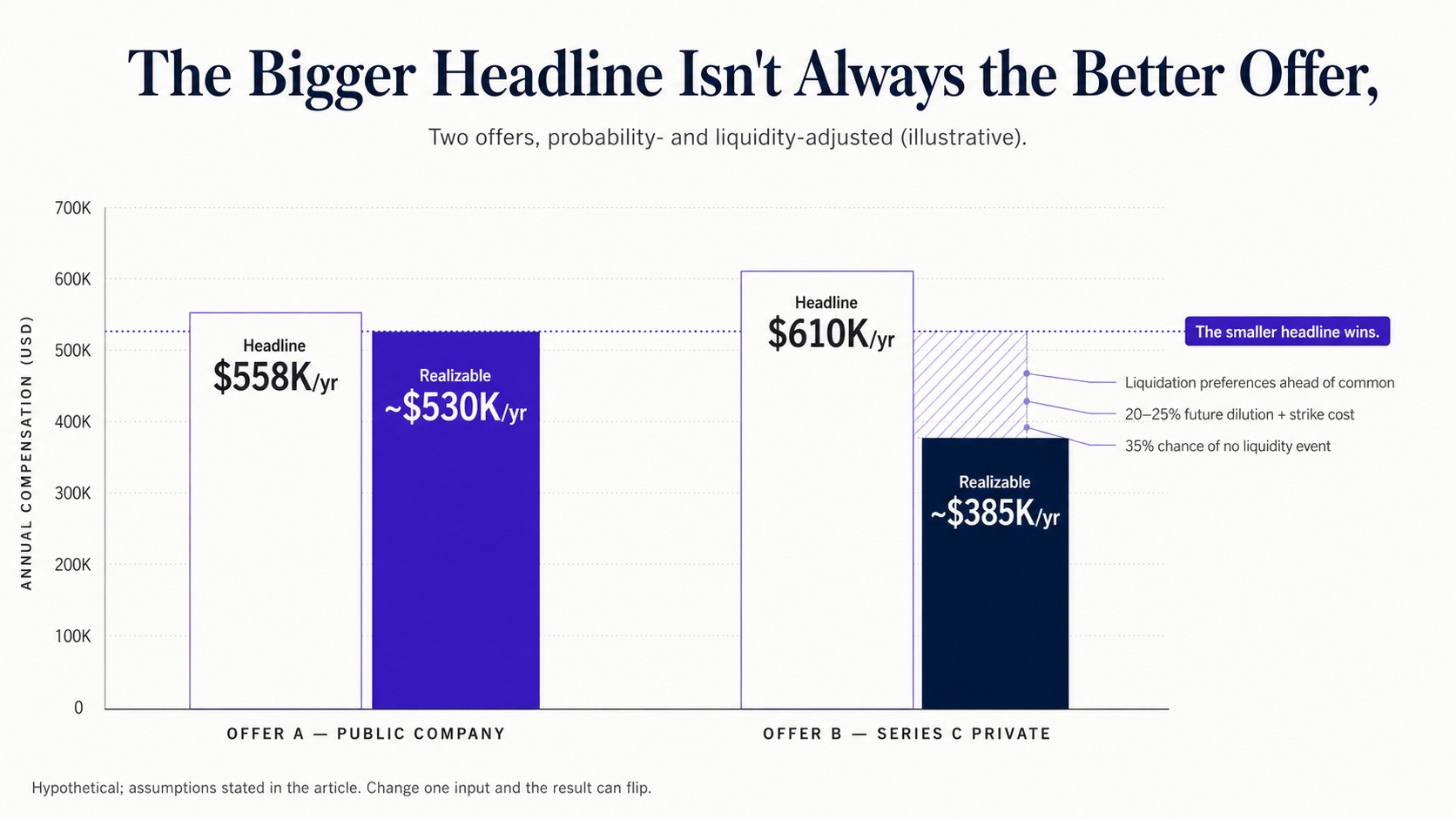
The stated assumptions do the work. The option row assumes the notional figure uses the preferred price while employees hold common stock behind liquidation preferences, that another 20% to 25% of dilution arrives before exit, that the strike price consumes part of any gain, and that exit probability is genuinely uncertain. Under those assumptions, Offer A wins even though Offer B's headline is nearly $100,000 a year larger. Change one input, say a credible near-term tender offer or a much lower strike, and Offer B can win. The point is not which offer wins. It is that a larger equity grant can be the worse offer, and only explicit assumptions reveal it.
Types of Equity Compensation
The main types of equity compensation differ in who can receive them, when they create tax, and how they behave at a private company versus a public one. The tax implications drive most of the planning. A fuller catalog lives in Kubera's overview of the different types of equity compensation; what follows is the decision-relevant core.
Incentive stock options (ISOs)
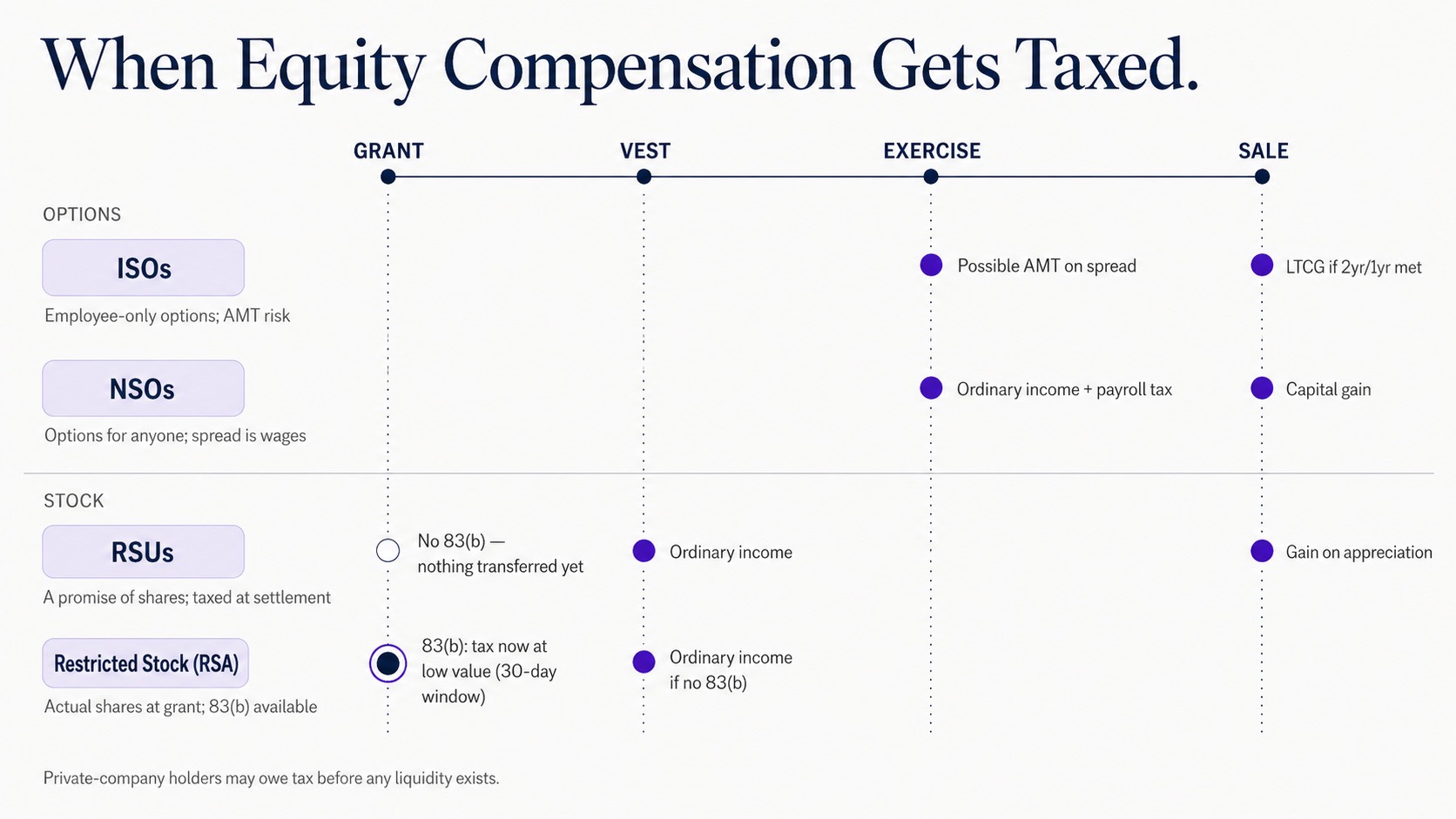
Incentive stock options ISO awards go only to employees. Exercising generally creates no regular taxable income, but the spread between the strike price, also called the exercise price, and fair market value is an alternative minimum tax (AMT) adjustment, so a large exercise can trigger AMT with no cash received. Sell at least two years from grant and one year from exercise and the gain is long-term capital gain; sell earlier and the spread becomes ordinary income. ISO treatment is capped at $100,000 of underlying value vesting per year, and it typically survives only about 90 days after termination, after which options usually convert to nonqualified status even if the window is extended. At a private company, exercising means paying real cash, and possibly AMT, for shares you may not be able to sell for years.
Nonqualified stock options (NSOs)
NSOs can go to anyone. The spread at exercise is ordinary income subject to payroll tax and withholding; later appreciation is capital gain. Public-company holders can often exercise and sell in one cashless transaction. Private-company holders frequently cannot, which makes expiration dates and exercise funding real planning problems rather than paperwork.
Restricted stock units (RSUs)
An RSU is a promise of shares, taxed as ordinary income when it vests and settles. At public companies vesting and settlement usually coincide, and sell-to-cover arrangements handle part of the withholding automatically. At a private company, RSUs are often double-trigger: they require both service vesting and a liquidity event before they settle, so the tax date and the payout date can arrive years after the service condition is met. RSUs are not guaranteed value. They can be forfeited, settlement conditions can fail, and the employer can fail. Once shares settle, holding them is a fresh investment decision, not a continuation of compensation.
Restricted stock and RSAs
Restricted stock awards deliver actual shares subject to vesting and forfeiture. Because real property changes hands, an 83(b) election is available, which is why restricted stock dominates for founders and very early employees while the share value is still low.
Employee stock purchase plans (ESPPs)
A qualified Section 423 employee stock purchase plan lets employees buy stock at a discount, often up to 15%, sometimes with a lookback to the lower of two prices, subject to a $25,000 annual limit and holding-period rules for favorable tax treatment. The discount is real money. But if you already hold significant employer equity, every purchase deepens concentration, and the discount only stays close to free if your plan and trading policy let you sell promptly.
Other awards
Performance stock units pay on metrics rather than time. Stock appreciation rights and phantom equity deliver value without issuing shares. Profits interests and carried interest apply in partnership structures with their own tax regime, and deferred stock and restricted cash appear mostly in executive packages. Each deserves a read of the actual award agreement before you assign it value.
The 83(b) Election and the 409A Valuation
These two terms cause more confusion than any others, partly because Section 409A of the Internal Revenue Code and a 409A valuation are entirely different things.
A Section 83(b) election applies to substantially nonvested property such as restricted stock, not to ordinary RSUs, which are unfunded promises rather than transferred property. The election generally must be filed within 30 days of the transfer, with no extensions. It lets the holder pay ordinary income tax on the value at grant, often near zero at a new company, and starts the capital gains holding period, including the QSBS clock. The risks are concrete: you pay tax on shares you may later forfeit, and no deduction recovers it. Keep proof of timely filing permanently. A hypothetical founder who buys shares at incorporation for a nominal price and files within the window pays almost nothing today and converts future appreciation into long term capital gains. Miss the deadline and she recognizes ordinary income at each vesting date at whatever the shares are then worth. Kubera's 83(b) election guide covers the mechanics.
A 409A valuation is an independent appraisal of a private company's common stock, used to set option strike prices at fair market value. It is not the preferred price, not what the company would fetch in a sale, and not a promise of liquidity. It changes after financings and major events, and it determines both your exercise cost and the taxable spread when you exercise. Companies move from options to RSUs for many reasons, including maturity, retention strategy, a share price that makes strike prices burdensome, dilution management, and employee risk tolerance, not rising valuations alone. Kubera's 409A valuation explainer goes deeper.
Equity Compensation Tax Planning
Equity compensation tax planning is mostly about timing and character: when income is recognized, whether it lands as ordinary income or long-term capital gains, and what actually gets withheld versus what is owed. NSO spreads, RSU settlements, and disqualifying dispositions are wages, which means Social Security tax up to the 2026 wage base of $184,500, Medicare tax with no cap, and an additional 0.9% Medicare tax above $200,000 of wages for single filers. Withholding is the quiet trap: supplemental wage withholding often runs below a high earner's marginal bracket, so a large RSU vest can leave a five-figure gap for April. Project the year and pay estimated tax rather than discovering the shortfall later.
What changed for 2026, and what did not
IRS Revenue Procedure 2025-32 sets the 2026 numbers, and the 2025 tax law (the One Big Beautiful Bill Act) made the underlying structure permanent. The seven ordinary brackets still run from 10% to 37%. The AMT exemption is $90,100 for single filers and $140,200 for joint filers, phasing out at 50 cents per dollar above $500,000 and $1,000,000 of AMT income, a faster phaseout than before, which matters directly when sizing an ISO exercise. Long-term capital gains breakpoints move to $49,450 and $545,500 of taxable income for single filers ($98,900 and $613,700 joint) between the 0%, 15%, and 20% rates, and the 3.8% net investment income tax still begins at $200,000 single and $250,000 joint modified AGI, thresholds fixed since 2013. None of this is a recommendation; it is the terrain. A multi-year ISO exercise plan may keep AMT income under the phaseout, but only a projection with your numbers confirms it. And holding shares a year does not guarantee a 15% rate: the rate depends on taxable income, asset type, and stacked taxes like the NIIT.
State sourcing deserves equal respect. States generally tax equity compensation where it was earned, not where you live when it pays out, so moving before a vest or sale does not erase the origin state's claim on income allocated to work performed there, and states audit exactly this. Washington cautions against shorthand: it has no general income tax, yet imposes a capital gains excise tax on large long term gains allocated to the state, at two tiers above an annual exemption.
QSBS founder stock after the 2025 changes
Section 1202 now runs two regimes. QSBS founder stock issued on or before July 4, 2025 keeps the old rules: a more-than-five-year holding period, an exclusion capped at the greater of $10 million or ten times basis, and a $50 million gross asset test at issuance. Stock issued after that date gets tiered exclusions of 50%, 75%, and 100% after three, four, and five years, a cap of the greater of $15 million or ten times basis, and a $75 million gross asset test, indexed after 2026. Eligibility still requires original issuance from a qualifying C corporation running an active qualified business throughout the holding period, and non-excluded QSBS gain is taxed at 28%. Being a founder proves none of this. Documentation across the holding period does, and a Section 1045 rollover can preserve the benefit when shares are sold early.
Nonqualified Deferred Compensation (NQDC)
Nonqualified Deferred Compensation (NQDC) lets executives push income into future years, but the tradeoffs are structural. Elections generally must be made before the year the compensation is earned, payout schedules are locked in under Section 409A with severe penalties for violations, and deferred balances are unsecured claims against the employer, so solvency risk is real. Deferring into a lower future bracket is a forecast, not a fact, and state taxation of deferrals adds another layer. Kubera's deferred compensation overview walks through the election mechanics.
How to Negotiate Executive Compensation
Negotiation has two dimensions, amount and structure, and structure compounds longer. Companies design packages to attract and retain top talent, so the retention tool features, vesting, cliffs, and forfeiture terms, are exactly where negotiation adds the most value. Benchmarks and industry standards anchor the amount conversation, and leverage varies with role, company stage, replacement cost, and hiring urgency. Structure is where judgment lives.
Acceleration deserves precision because change-of-control language varies materially. Single-trigger acceleration vests equity on the deal itself. Double-trigger requires both a deal and a qualifying termination, usually without cause or for good reason, within a protection window. Partial acceleration, board discretion, and narrow good reason definitions all change outcomes. The definitions matter more than the label, and tax gross-ups on golden parachute excise taxes are now rare enough that requesting one needs a realistic basis.
Equity Refresh Grant Negotiation
Initial grants decay: vesting runs down, and at a growing company your unvested value can fall below what a new hire at your level receives. Equity refresh grant negotiation is about timing and structure. Annual, promotion, retention, and performance grants each layer differently onto existing schedules, so ask whether a refresh stacks on top of remaining vesting or effectively restarts your commitment. Raise it before review cycles and before your unvested balance stops being a reason to stay, and evaluate any refresh as you did the initial grant: by fully diluted ownership and expected realizable value, not share count.
Ten questions to ask before accepting an equity offer:
- What percentage of the company does the grant represent on a fully diluted basis?
- What is the strike price or current common-share value?
- What was the latest preferred financing price?
- What liquidation preferences sit ahead of common stock?
- What is the vesting schedule?
- Is early exercise permitted?
- What happens after termination?
- Is acceleration available?
- What is the expected liquidity path?
- What documentation will confirm these answers?
Golden Handcuffs, Retention, and Career Decisions
Golden handcuffs are any compensation you forfeit by leaving: unvested equity, deferred bonuses, NQDC balances, retention grants, pension features, and acquisition payouts tied to cliff dates. They are deliberate. Equity can create wealth and golden handcuffs at the same time, and the planning question is what staying actually costs.
A labeled hypothetical: an executive wants to leave and would forfeit, within twelve months, an RSU tranche with a $400,000 headline value, a $150,000 target bonus, and a $100,000 deferred compensation installment. The analysis is not the $650,000 headline. Weight the RSUs by the chance the stock holds its price through vesting, the bonus by realistic payout history, and the deferral by plan terms and employer health, then take everything after tax. Perhaps the adjusted forfeiture is closer to $330,000. A new employer can bridge that with a signing bonus and a make-whole grant, and frequently will. Against it, weigh the career cost of waiting and the risk that stock prices decline before the tranche vests anyway. Staying until the cliff is sometimes right. It is never automatically right.
When to Exercise, Sell, or Diversify
Three risks govern these decisions: tax risk, liquidity risk, and concentration risk, and they rarely point the same way. Early exercise can start capital gains clocks and limit AMT but spends cash on illiquid stock. Waiting preserves cash and optionality but can build a spread that becomes expensive to exercise later. Same-day sales and cashless exercises convert options to cash at ordinary rates with no lingering concentration. Tender offers and secondary sales provide private-company liquidity when offered, on the company's terms. After an IPO, lockups restrict selling for a period set by the underwriting agreement, commonly measured in months but not universal in length.
Public-company insiders should understand Rule 10b5-1 plans. A properly structured plan can provide an affirmative defense to insider-trading claims, not blanket protection. Under the SEC's 2022 amendments, directors and officers face a cooling-off period ending at the later of 90 days after adopting or modifying a plan or two business days after the next quarterly financial filing, capped at 120 days; other insiders wait 30 days. Directors and officers must certify in writing that they hold no material nonpublic information and are acting in good faith. Overlapping plans are restricted, single-trade plans are generally limited to one per twelve months, companies must disclose plan adoptions and terminations, and sell-to-cover arrangements for tax withholding are carved out of the overlap limits.
On selling generally, one question cuts through most hesitation about vested shares: would you use cash today to buy this much employer stock? If not, holding is a choice, not a default. Kubera's discussion of whether to sell RSUs when they vest works through the mechanics. There is no universal concentration percentage. The right exposure depends on net worth, outside liquidity, the fact that your paycheck already depends on the same company, tax basis, risk tolerance, career stage, and whether you are even permitted to sell. Donating appreciated long-held shares and harvesting losses elsewhere can lower the tax cost of diversifying.
Building a Compensation Strategy That Compounds
A compensation strategy works when it repeats. Once a year, and after any financing, promotion, job change, or liquidity event:
- Calculate guaranteed and contingent compensation separately.
- Assign probability and liquidity discounts to every equity award.
- Map vesting dates and exercise deadlines on a calendar.
- Forecast taxes and withholding gaps for the year.
- Set a minimum personal cash-flow requirement that cash compensation must cover.
- Measure employer concentration across vested and unvested equity.
- Review negotiation opportunities before review cycles and promotions.
- Set decision rules for exercising and selling in advance.
- Reassess after financing rounds, promotions, job changes, or liquidity events.
- Coordinate with tax, legal, and financial professionals where the stakes justify it.
Score recurring decisions on three axes: liquidity, concentration, and tax. Taking more cash improves liquidity and concentration but is taxed now. More options defer tax but deepen concentration and raise future exercise costs. Exercising early spends liquidity to improve tax character. Holding vested RSUs keeps concentration and gains nothing on tax, while selling at vest maximizes liquidity at minimal extra tax cost. Deferring compensation trades liquidity and credit exposure for possible bracket benefits, negotiated acceleration protects contingent value without spending cash, and donating appreciated shares reduces concentration and tax together, at the cost of the asset. A compensation strategy is successful only when the package improves both career opportunity and personal financial resilience.
Tracking Total Compensation and Net Worth
Compensation data is fragmented by design: payroll in one system, grants in a cap-table platform, vested shares at a broker, deferrals and an ESPP in separate portals, benefits with an administrator, and the controlling terms in offer letters and grant documents. Fragmentation is why people overvalue unvested equity, miss expiration dates, discover withholding gaps in April, understate concentration, and compare offers on headline numbers.
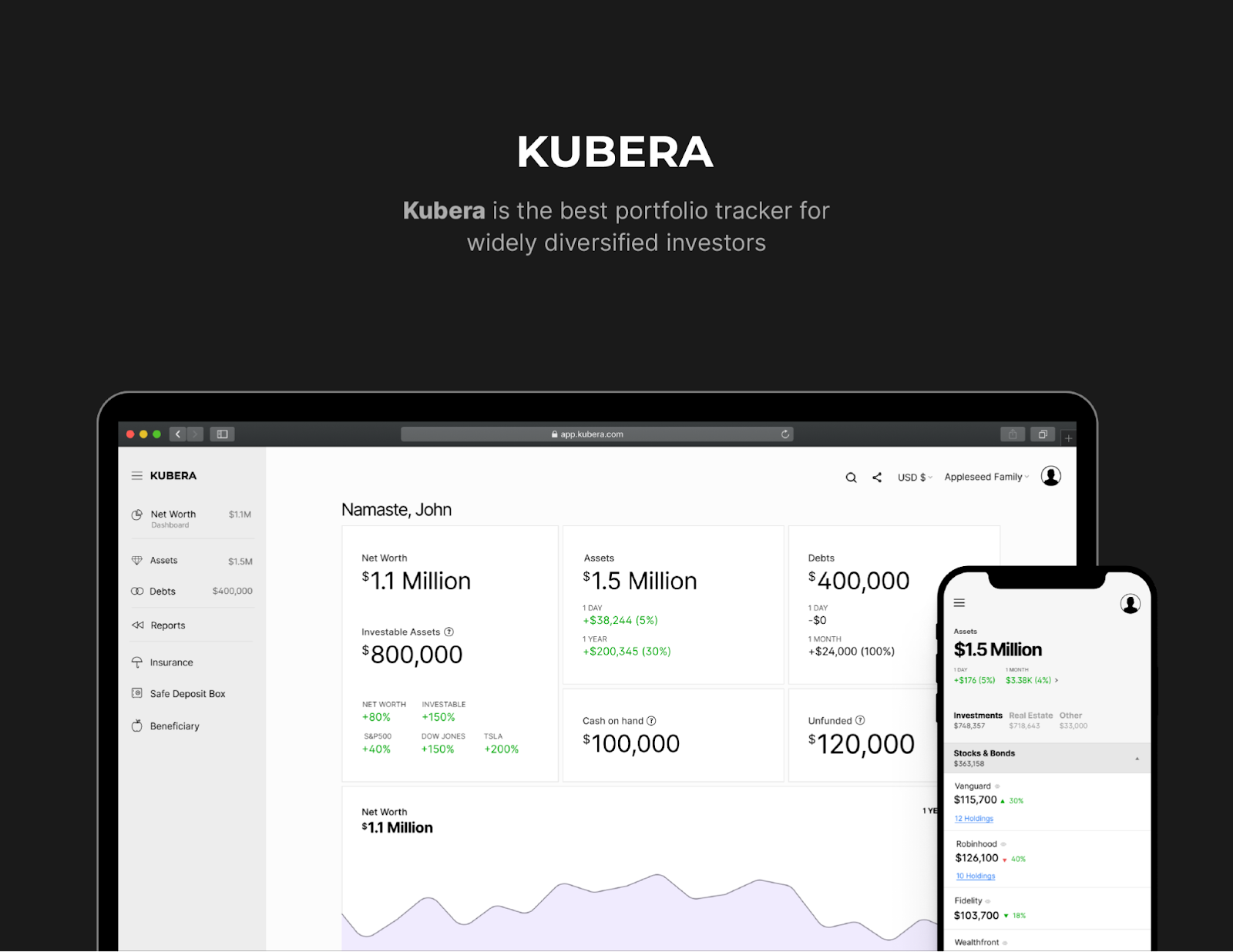
The fix is a single view with honest values. Kubera, a net worth tracking platform, connects to banks and brokerages and offers a Carta integration that brings supported Carta holdings, currently including option grants, RSUs, RSAs, certificates, and convertible notes, into the same dashboard as everything else. For portals without usable connections or with connections that break frequently, Kubera's AI Sync lets you seamlessly import and review the data held there. Additionally, Kubera's Fast Forward feature lets users simulate different compensation strategy scenarios and tax implications accurately to help make better decisions.
Sign up for a trial to explore more.
Frequently Asked Questions
What is a compensation strategy?
A compensation strategy is a plan for structuring, negotiating, and converting total pay, meaning salary, bonus, equity, benefits, deferred compensation, and severance, into durable wealth. It treats compensation as a multi-year portfolio, separates guaranteed from contingent value, and coordinates negotiation, tax timing, liquidity, and concentration decisions rather than optimizing any single number.
How should I compare cash vs equity compensation?
Convert both to probability-adjusted, after-tax, annualized value. Cash is worth close to face value. Equity must be discounted for vesting, dilution, liquidation preferences, strike price, taxes, and the odds of liquidity ever arriving. Weight cash more heavily when savings are thin or the liquidity path is unclear; weight equity more when you can afford both the wait and the concentration.
How do I calculate the value of a total compensation package?
Sum guaranteed cash, a discounted bonus, retirement contributions, benefits, and sign-on payments. Then add scenario-weighted, annualized equity value net of exercise costs and expected taxes, apply a liquidity discount, and subtract anything you forfeit by leaving your current employer. Never count unvested awards at full headline value.
How do I negotiate executive compensation?
Negotiate structure as hard as amount. Beyond base salary and bonus target, focus on the initial grant, refresh grants, vesting terms, double-trigger acceleration, severance with a strong good reason definition, post-termination exercise windows, and clawback scope. Model outcomes across termination, acquisition, and long-tenure scenarios before signing, and get every term in writing.
What is an equity refresh grant?
A refresh grant is additional equity awarded after hire, typically as an annual, promotion, retention, or performance grant. Evaluate it the way you would an initial grant, by fully diluted ownership and expected realizable value, and ask whether it layers on top of existing vesting or effectively restarts it. Negotiate before your unvested balance decays to the point where it no longer retains you.
Should I sell RSUs when they vest?
RSUs are taxed as ordinary income at settlement whether or not you sell, so selling at vest usually adds little incremental tax. The real question is whether you would use cash today to buy that much employer stock. Many holders sell most shares at vest and diversify. Insiders must also respect trading windows and, often, Rule 10b5-1 plans.
When should I exercise incentive stock options?
When the AMT projection, your cash reserve, and the liquidity outlook all support it. Exercising in measured annual amounts can manage AMT exposure and start the long term capital gains clock, but at a private company it means paying real cash for illiquid shares that could become worthless. Run a projection with a tax professional before exercising at scale.
What are golden handcuffs?
Golden handcuffs are compensation you forfeit by leaving: unvested equity, deferred bonuses, NQDC balances, retention grants, and payouts tied to cliff dates. Calculate the probability-adjusted, after-tax forfeiture, then compare it against what a new employer could bridge with a signing bonus and against the career cost of waiting. Sometimes walking away from contingent pay is the right decision.
The Bottom Line
A compensation strategy treats pay as a portfolio of cash, equity, benefits, taxes, and career risk, and manages it with the discipline of any other portfolio. Founders, executives, and senior employees hold different assets in that portfolio and need different playbooks. Across all three, structure often matters more than size, tax planning and liquidity determine what is realized, and employer equity has to be judged against the whole balance sheet rather than admired in isolation. Negotiate vesting, acceleration, exercise windows, and refresh grants, not just the headline number. Then revisit the strategy whenever the company, the role, or the household balance sheet changes.


