

Your startup just offered you 10,000 stock options. You feel excited about your potential windfall. But here's the question most employees never ask: what are those options actually worth today?
The answer lives in a document called a 409A valuation. This independent appraisal determines the fair market value of your company's common stock and establishes the exercise price for stock options your company grants. Over 90% of U.S. startups issuing stock options rely on 409A valuations to stay compliant with IRS regulations, according to Sofer Advisors.
The 409A valuation services market hit $2.58 billion in 2024 and is projected to reach $5.66 billion by 2032. That growth reflects one truth: startup equity valuation has become a critical component of employee compensation packages.
What Is a 409A Valuation?
A 409A valuation provides an independent appraisal of a private company's common stock fair market value. The name comes from Section 409A of the Internal Revenue Code, enacted in 2004 partially in response to the Enron scandal.
Before 409A rules existed, executives could price their stock options artificially low. They paid minimal exercise prices and captured enormous gains while deferring taxes. The IRS created Section 409A to close this loophole.
Here's what you need to know: the 409A valuation sets the minimum allowable strike price for stock options. This strike price represents what you pay to exercise your options and buy actual shares.
A qualified independent appraiser must conduct the valuation. The IRS provides "safe harbor" protection when companies follow proper procedures. Safe harbor means the IRS will accept the valuation as valid unless it proves "grossly unreasonable."
Why Your 409A Valuation Matters (Even If You're Not the Founder)
Most employees view stock options as lottery tickets. They accept them and forget about them until exit day. This approach leaves money on the table and creates tax surprises.
How Does 409A Affect Your Strike Price?
Your 409A strike price equals the price you pay to exercise stock options. The 409A valuation for stock options establishes this number at the time your company grants you options.
Lower strike price means greater potential upside. If your strike price sits at $1 per share and the company sells for $10, you capture $9 per share in value. The same shares with a $5 strike price yield only $5 per share.
IRS regulations require the strike price to equal or exceed fair market value at the grant date. Companies cannot compliantly offer you below-market options without triggering severe penalties.
What Are the Tax Consequences of Incorrect Valuations?
Incorrect 409A valuations create immediate tax consequences for employees. The penalties fall on you, not the company.
The IRS imposes these penalties for non-compliant options:
- Immediate taxation of all vested options as ordinary income
- An additional 20% federal penalty on the deferred compensation
- Interest accrued from the date options should have been taxed
- State penalties adding extra levies (California adds a 5% penalty tax on top of regular income tax)
These penalties compound quickly. An employee with $100,000 in option value could face $20,000 in federal penalties alone before interest and state taxes.
Why Does 409A Matter for Your Net Worth?
Startup employees struggle to calculate their true net worth. Bank accounts and brokerage statements show clear numbers. Stock options remain a mystery.
Your startup equity valuation provides a defensible value for your largest asset. For early employees at successful startups, equity often represents 60-80% of total net worth.
Without tracking this value, you make major financial decisions blind. Home purchases, retirement planning, and career moves all depend on understanding your complete financial picture.
When Do Companies Get 409A Valuations?
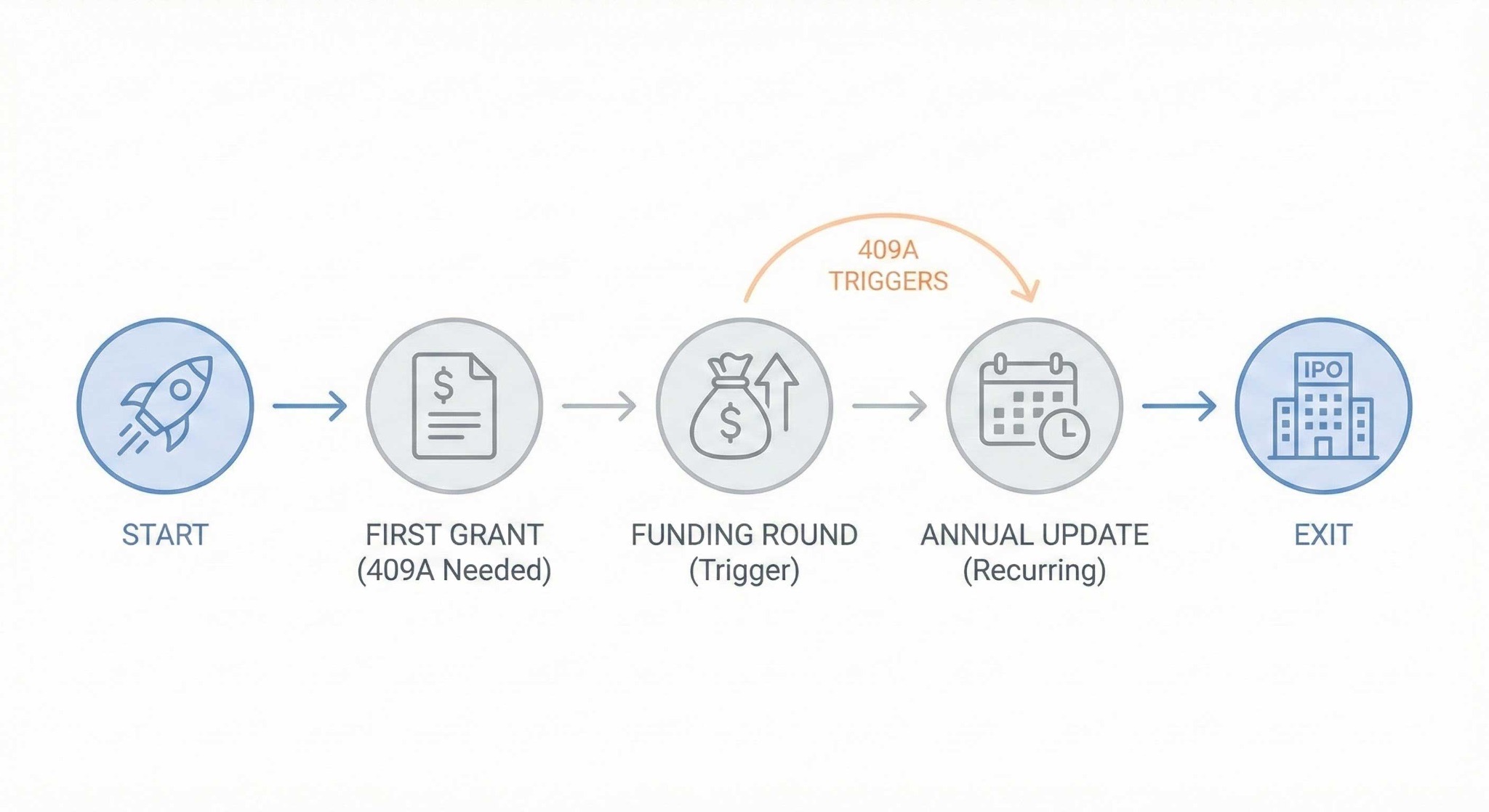
Companies must obtain 409A valuations at specific intervals. Understanding this timing helps you predict when your 409A strike price might change.
Before Issuing First Stock Options
Every company needs a 409A valuation for stock options before granting any equity to employees. This initial valuation establishes safe harbor protection with the IRS.
Early-stage startups usually complete their first 409A valuation shortly after incorporation or an initial external financing. For most early companies, the cost typically ranges from $2,000 to $5,000, while later-stage or more complex startups may pay significantly more, with fees sometimes climbing to $10,000–$25,000.
Annual Refresh Requirements
IRS rules require companies to update 409A valuations at least every 12 months. The clock starts from the previous valuation date.
Annual refreshes mean your strike price may change significantly between option grants. An employee joining in January might receive options at $2 per share. Another employee joining in December could see $4 per share after the annual update.
Material Events That Trigger New Valuations
Material events require immediate valuation updates regardless of timing. Venture-backed startups often need valuations two to three times annually due to frequent funding rounds.
Common material events include:
- Closing a new funding round (most common trigger)
- Significant changes in business model or operations
- Major contract wins or losses affecting revenue
- Acquisition offers or merger discussions
- Regulatory approvals or significant milestones
Current IRS interpretation defines these triggers broadly to include substantial customer changes and operational pivots.
How to Interpret Your 409A Valuation
Understanding how appraisers calculate your common stock value helps you evaluate your equity compensation. The startup equity valuation process follows three distinct steps.
The Three-Step Valuation Process
Step 1: Determine Enterprise Value
Appraisers first calculate the total company value using one or more approaches. According to Sofer Advisors, the market approach accounts for 45% of valuations, while income and asset approaches represent 35% and 20% respectively.
- Market Approach: Compares your company to similar public companies or recent financing transactions
- Income Approach: Projects future cash flows using discounted cash flow analysis
- Asset Approach: Values the company based on net asset value
Step 2: Allocate Value to Common Stock
Enterprise value must be divided among different share classes. Early-stage companies typically use the Option Pricing Model (OPM). Later-stage companies may use the Probability-Weighted Expected Return Method (PWERM).
These models account for liquidation preferences that favor preferred shareholders. Investors usually receive their money back before common shareholders receive anything in many exit scenarios.
Step 3: Apply Discount for Lack of Marketability
Private company shares cannot be sold easily like public stocks. Appraisers apply a Discount for Lack of Marketability to reflect this illiquidity. DLOM typically ranges from 15% to 40% depending on company-specific factors.
Higher discounts indicate longer expected time to exit. A company projecting a five-year IPO timeline might see a 35% discount. A company expecting acquisition within two years might see only 20%.
Why Does 409A Differ from Your Fundraising Valuation?
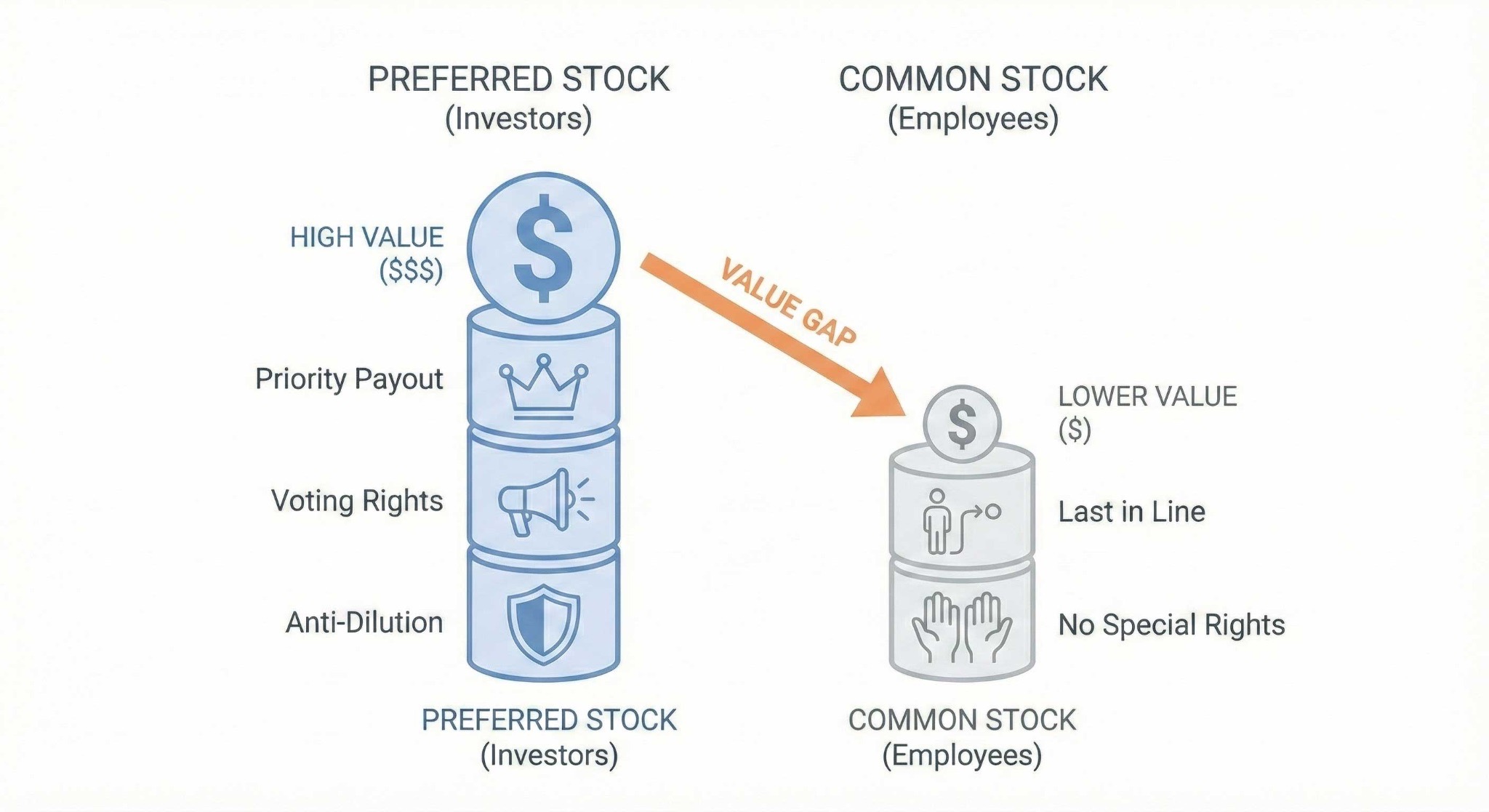
Employees often confuse their 409A valuation with the company's fundraising valuation. These numbers measure different things. Understanding pre-IPO stock valuation helps you set realistic expectations.
Your common stock almost always carries a lower value than preferred stock. The difference reflects real economic disadvantages, not accounting tricks. This gap explains why pre-IPO stock valuation confuses many employees expecting their equity to match headline fundraising numbers.
What Happens If Your Company Gets the Valuation Wrong?
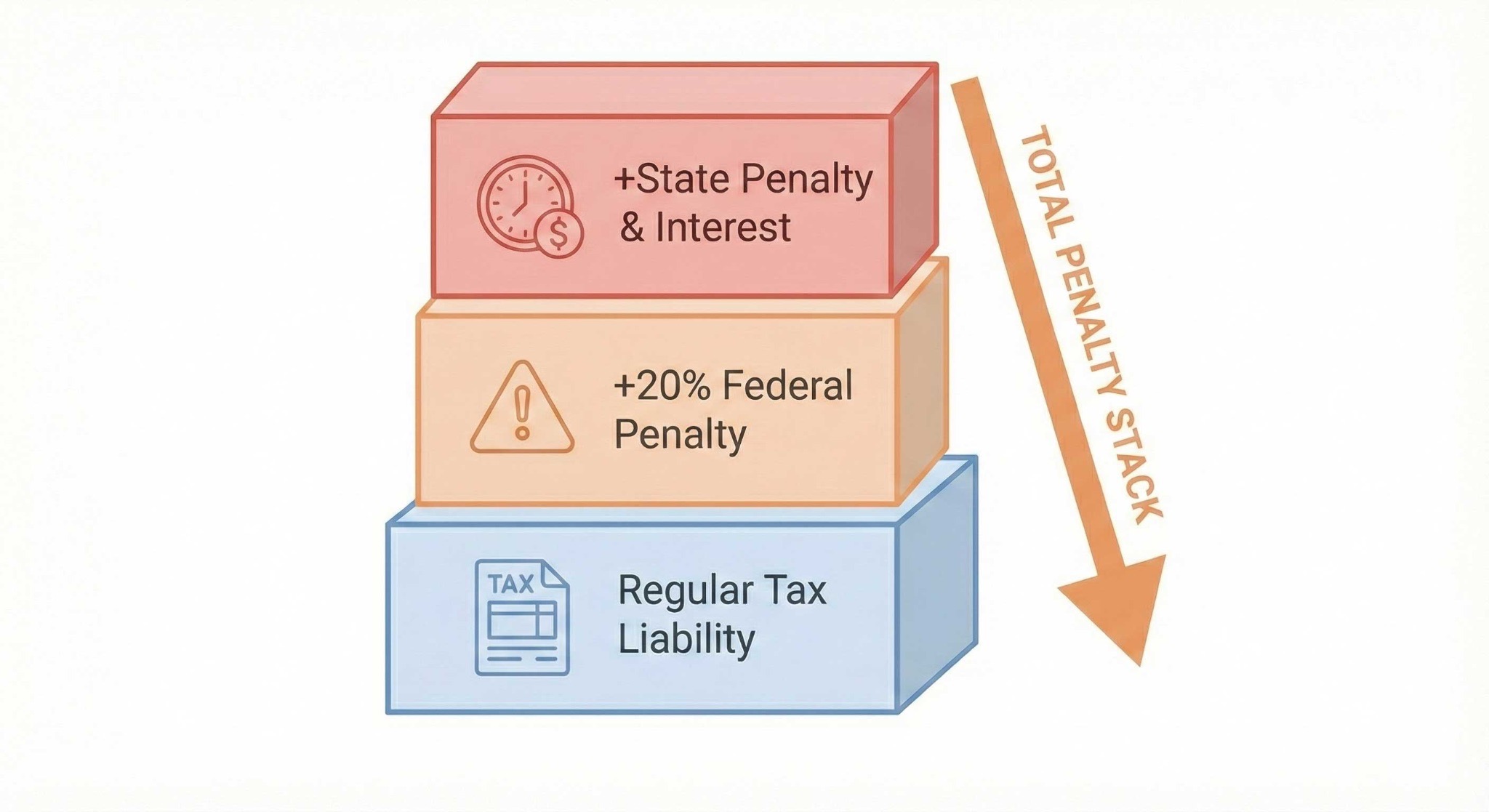
The penalties for incorrect 409A valuations fall primarily on employees. This creates a painful irony: workers face tax consequences for decisions made entirely by their employer.
How Do Penalties Affect Employees?
When the IRS determines stock options were priced below fair market value, employees face immediate consequences. An incorrect 409A valuation for stock options can devastate your finances.
- All vested options become taxable immediately as ordinary income
- IRS applies a 20% additional federal penalty on the deferred compensation
- Interest accrues from the original grant date
- State tax authorities may add their own penalties
The March 2024 IRS audit technique guide expanded scrutiny methods. Auditors are now instructed to compare 409A valuations against financial statement disclosures and secondary market prices to identify discrepancies.
What Are the Company Consequences?
Companies face indirect but significant consequences for valuation failures.
- M&A complications: Buyers may alter deal terms or require indemnification for potential tax liabilities
- IPO delays: SEC may require "cheap stock" accounting charges during the pre-IPO review
- Investor concerns: Due diligence flags damage credibility with future investors
- Employee lawsuits: Workers may sue for negligence if they face unexpected tax penalties
Common Myths That Could Cost You Money
Misinformation about 409A valuations leads employees to make costly mistakes. These myths persist despite clear regulatory guidance.
Myth 1: Lower Strike Price Is Always Better
Reality: The goal is the lowest defensible 409A strike price, not simply the lowest price. Artificially low valuations create personal IRS audit risk for every employee holding affected options.
A company offering suspiciously low strike prices might seem generous. In truth, they may be exposing you to future tax penalties and legal complications.
Myth 2: Common Stock Equals 10-20% of Preferred Price
Reality: This outdated rule of thumb no longer applies. Actual startup equity valuation depends on complex factors including liquidation preferences, option pricing models, and marketability discounts.
Early-stage common stock often trades at 30-70% below preferred prices. Some pre-revenue startups see even larger discounts when liquidation preferences heavily favor investors.
Myth 3: I Don't Need to Track Equity Until IPO
Reality: Your options may represent your largest asset right now. Carta data shows that only 32% of vested, in-the-money options were exercised in late 2024, down from 54% in previous years.
Without tracking your pre-IPO stock valuation, you cannot make informed decisions about exercising options, holding through vesting periods, or broader financial planning.
Track Your Startup Equity Alongside Your Entire Portfolio
The Problem: Your Largest Asset Is Invisible
Your 409A-valued equity might represent the majority of your net worth. Traditional wealth tracking tools only display liquid assets. This creates a blind spot in your financial planning.
You make major decisions about home purchases, career moves, and retirement without understanding your true financial position. Spreadsheets break down when tracking cryptocurrency, traditional investments, bank accounts, and illiquid startup equity valuation together.
The Solution: Purpose-Built Portfolio Tracking
Kubera provides the only portfolio tracker designed for investors with complex, multi-asset portfolios including both liquid and illiquid holdings.
Kubera lets you connect to your options platforms like Carta, Shareworks, and more for automated tracking.

What you can track in Kubera:
- Pre-IPO equity with custom 409A valuations
- Vested and unvested stock options with current 409A strike price
- Cryptocurrency across all wallets and exchanges
- Traditional investment and retirement accounts
- Real estate and alternative investments
- Bank accounts and cash positions
Why Startup Employees and Founders Choose Kubera
Manually add custom assets like pre-IPO stock valuation with your latest 409A numbers. Update your equity value as new 409A reports come out. See your complete net worth in one unified dashboard.
- Share portfolio views with your spouse or financial advisor
- Bank-level security protects your financial data
- Track both liquid and illiquid assets in one place
Your Equity Deserves Better Than a Spreadsheet
You spent years building value in your startup. Your equity compensation could reach hundreds of thousands or millions at exit.
Track it with the same sophistication you use for your brokerage accounts and cryptocurrency portfolio. Get started with Kubera today and see your complete financial picture.
Start tracking your equity: app.kubera.com/signup
Frequently Asked Questions About 409A Valuations
How much does a 409A valuation cost?
Most startups pay between $1,500 and $5,000 for 409A valuations. Pre-IPO and later-stage companies often pay significantly more due to complexity and frequency requirements.
How long does a 409A valuation take?
Standard 409A valuations complete in about 10 business days. Expedited options can deliver results in one to three days for additional fees.
Can my company perform its own 409A valuation for stock options?
No. IRS safe harbor protection requires an independent third-party appraiser. Internal valuations leave companies vulnerable to IRS challenges and potential penalties for employees.
What happens if I exercise options priced below fair market value?
You face immediate taxation on the difference between the 409A strike price and fair market value, plus a 20% federal penalty and interest. State penalties may add additional liability.
Does a 409A valuation expire?
Yes. Companies must obtain new valuations at least every 12 months to maintain safe harbor protection. Material events require immediate updates regardless of timing.
Why is my startup equity valuation lower than the fundraising price?
Common stock lacks liquidation preferences and anti-dilution protection that preferred stock carries. Appraisers also apply marketability discounts of 15-40% to reflect illiquidity.
How do I track my pre-IPO stock valuation?
Ask your company for the current 409A fair market value per share and valuation date. Use a portfolio tracker like Kubera to monitor your equity alongside other assets.


