
Last reviewed November 24, 2026, against the text of Rule 144 (17 CFR 230.144), the SEC's Compliance and Disclosure Interpretations, Rule 701, and the SEC's guidance on electronic Form 144 filing and EDGAR Next.
Rule 144 is the SEC's safe harbor for reselling restricted stock and stock held by company insiders: founder shares, stock from exercised options, a stake from an angel round, shares paid out in an acquisition, and any stock, however it was bought, owned by a company's executives, directors or controlling shareholders. Meet its conditions and you aren't treated as an underwriter, so you can sell without registering the sale with the SEC.
For an engineer at a company that went public last spring, Rule 144 is mostly a formality by now. For the CFO of the same company, it caps how many shares she can sell every three months and puts her larger planned sales on the public record. The difference comes from her status as an insider. How the shares were acquired, when they were paid for and whether the company reports to the SEC settle most of the rest. After a recent IPO, the lock-up usually sets the actual date.
What Rule 144 Does
The Securities Act of 1933 requires every sale of securities to be registered unless an exemption applies. Ordinary investors selling stock they bought on an exchange rely on the exemption for transactions by anyone other than "an issuer, underwriter, or dealer." For anyone holding stock bought privately, the problem is the word underwriter. If you buy shares from a company in a private deal and resell them to the public, the SEC can treat you as having bought them in order to distribute them, which would make you an underwriter and the resale an unregistered offering.
Meeting Rule 144's conditions removes that risk, though it isn't the only route: some private resales rely on other exemptions, such as Section 4(a)(7) for sales to accredited investors, and some affiliates sell through a registered offering. But it's the standard route for selling restricted or insider stock into the public market, and it's the rule your broker and the company's transfer agent will check you against.
Rule 144 also applies to restricted stock in companies that don't report to the SEC, including private companies, once the one-year holding period has passed. It's rarely how private-company shares actually change hands. Those sales go through the company's transfer restrictions (rights of first refusal, board consent, tender offers) and usually rely on other exemptions. Our guide to the secondary market explains how they work.
Restricted Securities and Control Securities
Rule 144 covers two kinds of stock, and the same shares can be both.
Restricted securities are shares acquired from the company, or from an affiliate of the company, in a transaction that didn't involve a public offering. Founder stock, shares from options exercised before an IPO, stock bought in a Regulation D round and shares received in an unregistered acquisition all qualify. Restricted shares usually carry a legend, a notice on the certificate or brokerage record saying they can't be resold without registration or an exemption.
Control securities are any shares held by an affiliate, however the affiliate got them. A director who buys stock on the Nasdaq holds control securities. There's no holding period for shares an affiliate bought in the market, but the other Rule 144 conditions apply when they sell under the rule.
Are You an Affiliate?
The rule defines an affiliate as a person who directly or indirectly controls, is controlled by, or is under common control with the company. Executive officers and directors are usually treated as affiliates, and so are large shareholders, especially those with a board seat or 10% or more of the voting stock. Securities lawyers use 10% as a rough guide; the rule itself has no number. A 6% holder who appoints two directors can be an affiliate, and a passive fund holding 11% sometimes argues it isn't. Company counsel makes the call for its insiders, usually when someone asks to sell.
Being an affiliate under Rule 144 isn't the same as being a Section 16 insider, who files Form 4 reports. The two groups overlap heavily, but Section 16 uses fixed tests (officers, directors and holders of more than 10%) where Rule 144 asks who has control.
Rule 144 also treats certain people and entities as you. Sales by a spouse or relative (yours or your spouse's) who shares your home count toward your volume limit. So do sales by trusts and estates in which you and those people together hold 10% or more or one of you is trustee or executor, and by companies other than the issuer in which you together own 10% or more of the equity. And you're treated as an affiliate for three months after you stop being one. That clock starts when you lose control, which isn't necessarily the day you leave a job: a former CEO who stays on the board, or keeps a large stake, may still be an affiliate long after.
The Holding Period, and When It Starts
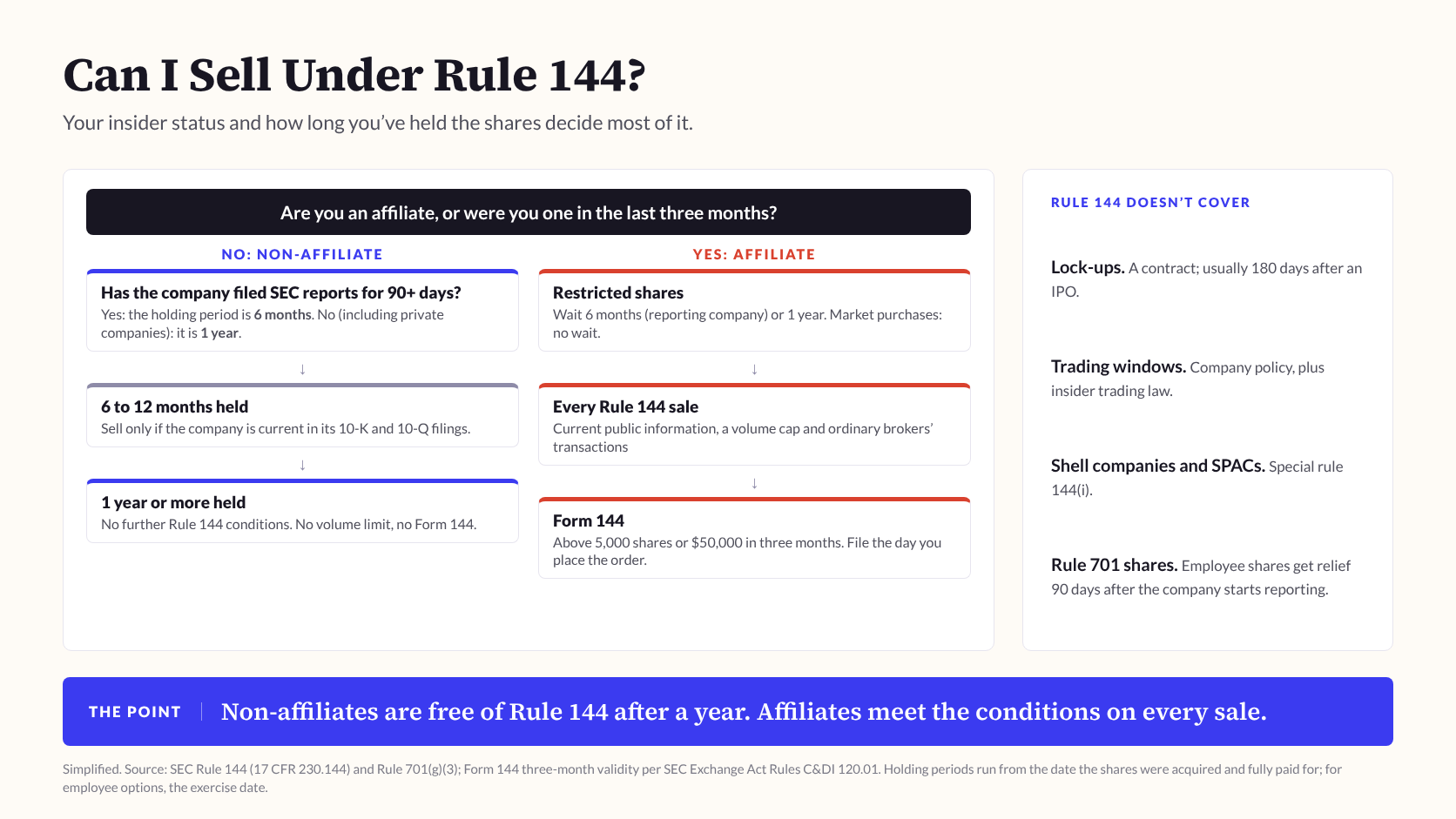
If you hold restricted securities, the standard wait before selling under Rule 144 is:
- Six months if the company has been subject to SEC reporting for at least 90 days before the sale
- One year if it hasn't, which covers almost every private company
The clock starts on the later of the date you acquired the shares from the company or from an affiliate, and only once you've paid in full. A promissory note counts as payment only if it's full recourse, secured by collateral other than the shares themselves worth at least the purchase price, and paid off before you sell.
Some holders can add an earlier holder's time to their own, which lawyers call tacking. If you bought restricted shares from someone who wasn't an affiliate, you generally take over their start date. Buying from an affiliate generally starts a new clock.
The option rule trips up employees who assume the clock started at grant. Take someone granted options in March 2019 that vested by 2023 and that they exercised in January 2026. Their holding period began in January 2026, because the SEC doesn't count time before you've put money at risk. A broker-assisted "cashless exercise," where some of the shares are sold on the spot to pay the exercise price, is a different thing from the net exercise in the table and doesn't move the start date back.
The Other Four Conditions
Current public information
For a reporting company, this means it has been reporting for at least 90 days and has filed every report it was required to file in the past 12 months (for most US companies, the 10-Ks and 10-Qs and the related interactive data files). Form 8-Ks don't count. You can usually rely on the company's statement on the cover of its latest annual or quarterly report that it has filed all required reports, unless you know or have reason to believe otherwise. For a company that doesn't report to the SEC, specific information about its business and finances, defined by reference to Exchange Act Rule 15c2-11, has to be publicly available.
Volume limit
In any three-month period, an affiliate selling under Rule 144 can sell no more than the greater of:
- 1% of the outstanding shares of the class being sold, as shown in the company's most recent published report, or
- The average weekly trading volume during the four calendar weeks before the Form 144 is filed (or, if no Form 144 is needed, before the broker receives the order)
Stocks quoted only over the counter can use only the 1% test. The three months roll, so the test applies to any three-month stretch, not to calendar quarters. Your related persons' sales count toward your limit, and so do sales by anyone acting in concert with you and, for a period after a gift, sales by the people you gave shares to. For companies with two share classes, the math uses the class you're selling.
Manner of sale
Affiliates selling stock under Rule 144 have to use brokers' transactions, sell directly to a market maker, or use a riskless principal trade. Neither the seller nor the broker may solicit buyers, apart from limited exceptions in the rule, and the broker can receive only its usual commission.
Form 144
Affiliates file a Form 144 notice when the shares they plan to sell under Rule 144 in any three months exceed 5,000 shares or $50,000. The next section covers how it works.
Form 144
Form 144 is a notice of a planned sale. Nobody approves it and there's no waiting period: it's filed at the same time as the sell order goes to a broker, or the sale is made directly with a market maker, which the SEC staff reads as the same day. The seller is responsible for it. Restricted-stock desks at the large brokerages often prepare and file them for clients, and some discount brokers won't handle legended shares at all.
- It's electronic and public. For stock of companies that report to the SEC, Form 144 has been filed on EDGAR since April 13, 2023. Notices for companies that don't report are still filed on paper.
- It lasts up to three months. A notice covers sales for a maximum of three months. An executive selling over a longer stretch, including under a 10b5-1 plan, files a new Form 144 for each period.
- Filing hours are 6 a.m. to 10 p.m. Eastern on SEC business days.
- You need EDGAR access, or someone to file for you. Under EDGAR Next, mandatory since September 15, 2025, every person who logs in to file needs individual Login.gov credentials with multi-factor sign-in, and each filer's account is run by named administrators. An insider can authorize a broker or law firm to file on their behalf. Someone who has never filed should set this up well before a planned sale.
- You need a genuine intention to sell. If you file and then don't sell, the SEC staff says you don't need to amend the notice. If you switch brokers, you do, and the switch doesn't reset your volume calculation.
- Brokers want time. Most brokerage compliance desks ask for the paperwork, and proof of EDGAR access, days before the trade.
Anyone can read the electronic notices. On the SEC's EDGAR search, look up the company and filter for form type 144 to see the seller's name and relationship to the company, the broker, the number of shares, the approximate sale date, how and when the shares were acquired, and the seller's sales over the past three months. Form 144 is often confused with Form 4, which reports what an insider actually traded.
Rule 701 and Selling After an IPO
Private companies issue most employee equity (stock options, restricted stock, RSUs) under Rule 701, an exemption from registration for compensation plans. It also caps what a company can sell under it in any 12 months at the greatest of $1 million, 15% of its total assets or 15% of the outstanding securities of the class. If sales go above $10 million in 12 months, the company has to give everyone who received equity in that period financial statements, risk factors and a summary of the plan. Our guide to advisory shares covers how those limits apply to consultants and advisors.
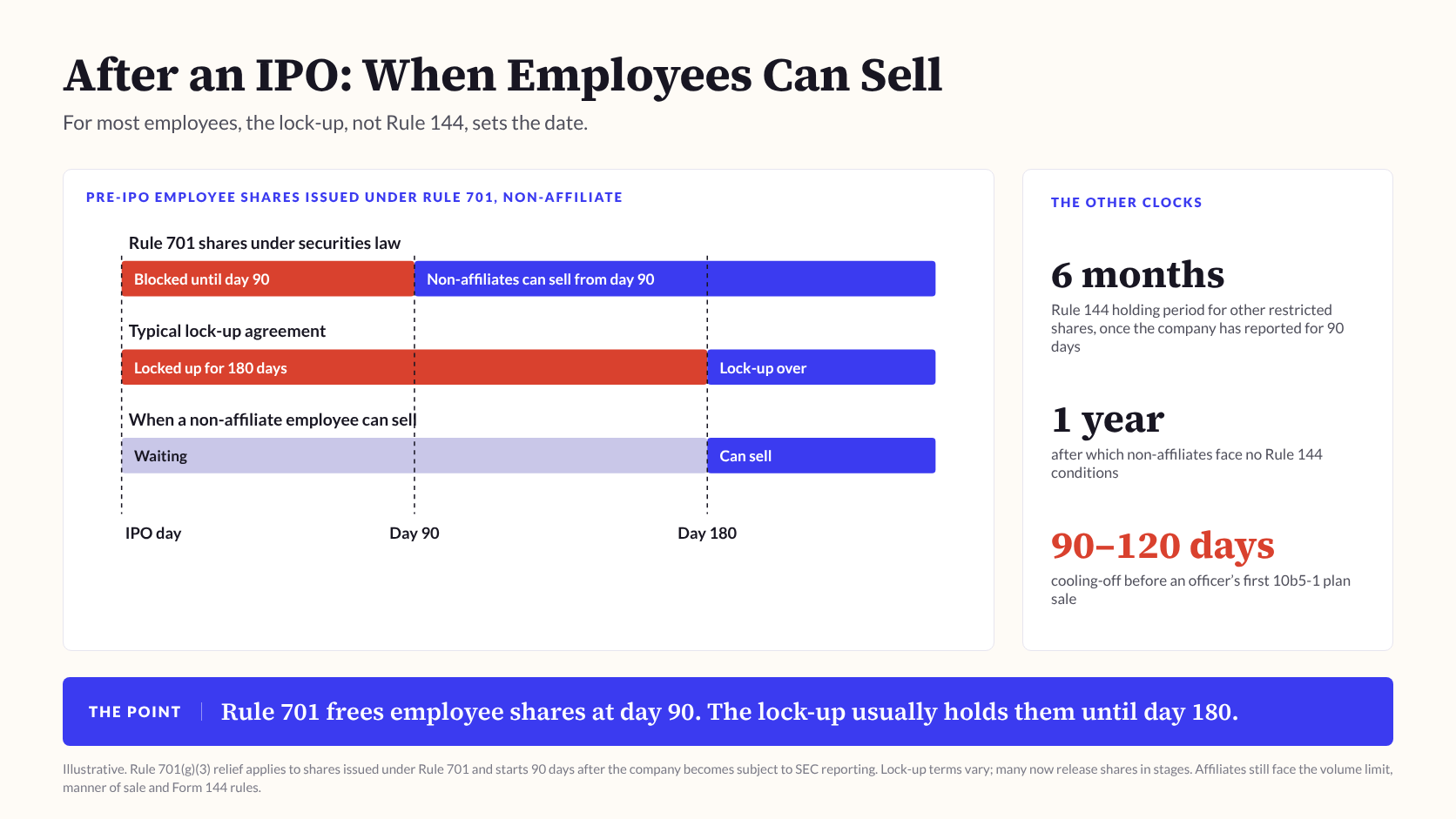
Shares issued under Rule 701 are restricted securities, but Rule 701 eases the Rule 144 conditions once the company goes public. Starting 90 days after the company becomes subject to SEC reporting, which usually means 90 days after the IPO:
- Non-affiliates can resell Rule 701 shares under Rule 144 without a holding period and without the current information condition. The volume limit, manner of sale rules and Form 144 never applied to them.
- Affiliates skip the holding period but must meet every other condition.
The relief only covers shares issued under Rule 701. An employee who also bought stock in a funding round has to apply the ordinary holding period to those shares, though if they were bought years ago it may already have run.
Equity granted after the IPO is usually registered on Form S-8. Non-affiliates can sell S-8 shares once they actually own them, meaning after vesting and, for options, exercise. Affiliates generally sell S-8 shares under Rule 144's other conditions, unless the company has filed a resale prospectus for them.
Lock-Ups, Trading Windows and 10b5-1 Plans
Before an IPO, underwriters ask existing shareholders, including employees, to sign lock-up agreements promising not to sell for a period, usually 180 days. A lock-up is a contract, and only its own terms, exceptions or a waiver from the underwriters end it early. Staged releases are now common. SpaceX, which listed in June 2026, let holders sell up to 7% more of their locked-up shares at each of the 70, 90, 105, 120 and 135-day marks, with further releases tied to earnings reports and to the stock trading at least 30% above the IPO price, before the standard 180-day period ends in early December 2026. Some insiders, including Elon Musk, agreed to longer lock-ups that run into 2027.
Most public companies also limit when employees can trade. A typical window opens a day or two after an earnings release and closes a few weeks before the quarter ends, and many companies make insiders clear each trade with the legal team first. An open window isn't a defense if you're aware of material nonpublic information: trading on it can be illegal insider trading whatever Rule 144 or the company's policy would otherwise allow.
Insiders who want to sell on a schedule often use a Rule 10b5-1 plan, set up at a time when they aren't aware of material nonpublic information. A plan that meets the rule's conditions gives an affirmative defense to insider trading claims. Since February 27, 2023, those conditions include a cooling-off period before the first trade: for directors and officers, the later of 90 days after adopting the plan or two business days after the company files its 10-Q or 10-K for the quarter the plan was adopted, capped at 120 days; for other people, 30 days. Changing the amount, price or timing of trades counts as a new plan and restarts the cooling-off period, and anyone other than the company generally can't run overlapping plans or use more than one single-trade plan in 12 months. A 10b5-1 plan doesn't replace Rule 144: an affiliate's sales under the plan still have to meet the volume limit and Form 144 rules.
Shell Companies and SPACs
With narrow exceptions, Rule 144 isn't available for shares issued by a current shell company. For a former shell, which includes many companies that went public by merging with a SPAC, it becomes available only after the company has stopped being a shell, is filing its SEC reports, has filed the detailed "Form 10 information" about its business, and a full year has passed since that filing. Even then, every sale requires the company to be current in its filings, for non-affiliates as well as affiliates, however long they've held. If you hold restricted shares in a company that went public through a SPAC, check this before counting the usual six months.
Getting the Legend Removed
Qualifying under Rule 144 doesn't remove the restrictive legend from your shares, and your broker won't sell them until it's gone. Only the transfer agent can remove it, and it does so with the company's consent. The steps usually look like this:
- You tell your broker which shares you want to sell, when you acquired them and how you paid.
- The broker asks for a seller's representation letter and sometimes for proof of payment or exercise dates.
- A lawyer provides an opinion that the sale qualifies under Rule 144, if the transfer agent requires one. Company counsel often does this for employees; outside investors sometimes need their own.
- The transfer agent removes the legend.
Non-affiliates who have held for more than a year can often have the legend removed outright, without a pending sale, so the shares sit in the brokerage account ready to trade. The SEC doesn't normally intervene in disputes over legend removal, which are mostly a matter of state law and your agreements with the company. The legal opinion is usually the slow step, especially for former employees, so start before you need the cash.
Three Worked Examples
An engineer who exercised just before the IPO. She exercised her options in mid-January 2026, and the company listed on March 2, 2026. She isn't an affiliate. Under the ordinary rule she'd wait six months from exercise, until mid-July. Because the shares were issued under Rule 701, securities law lets her sell from May 31, 90 days after the company began reporting. Her 180-day lock-up runs to the end of August, so that's her real date, and she files nothing with the SEC.
An angel paid in acquirer stock. A listed company bought a startup he'd backed on April 1, 2026, paying him in shares issued privately rather than registered. As a non-affiliate of the buyer, his clock starts at the closing; nothing in the deal let him carry over his years in the startup. He can sell from October 1, 2026, if the buyer is current in its filings, and without conditions from April 1, 2027. Had the deal been registered on Form S-4, as many stock-for-stock acquisitions are, he could generally have sold right away.
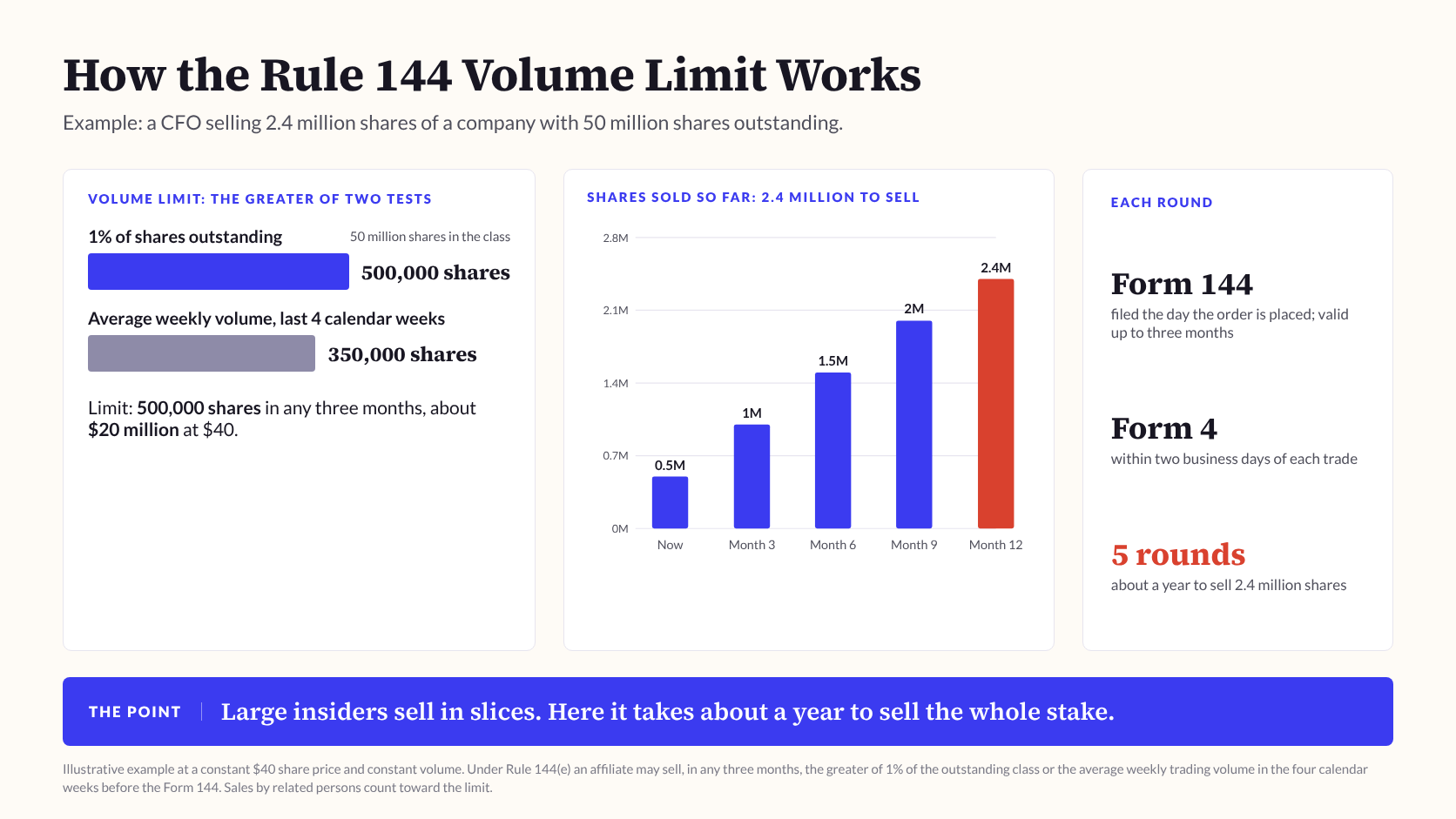
A CFO selling a large stake. She's CFO of a listed company with 50 million shares outstanding, all one class, and owns 2.4 million of them, held for years and worth $96 million at $40 a share. Trading averaged 350,000 shares a week over the last four calendar weeks.
- Her limit is the greater of 1% of shares outstanding (500,000) or the weekly average (350,000), so 500,000 shares, about $20 million, in any three months.
- If the limit stayed the same and she sold the maximum each time, she'd need five rounds: 500,000 shares now, and the same again roughly every three months, with the last 400,000 about a year after the first. If trading volume rose above 500,000 shares a week, her limit would rise with it.
- Each round needs a new Form 144, since a notice lasts three months, plus Form 4 reports within two business days of each trade.
- If she sets up a 10b5-1 plan, the first sale waits 90 to 120 days, and the company will likely have to disclose the plan in its next quarterly report.
- She also has to watch Section 16's short-swing rule: profit from a non-exempt purchase and sale (or sale and purchase) less than six months apart can be claimed back by the company. Most equity grants and vesting events are exempt.
Taxes Run on a Separate Clock
Rule 144's holding period has no bearing on tax.
Gains on shares held more than a year are long-term, and qualifying long-term gains are taxed at lower federal rates. For shares from exercised options, the tax holding period generally starts at exercise. If you exercise early, before the shares vest, it starts at vesting unless you file an 83(b) election, which starts it at exercise. Incentive stock options get their best treatment only if you hold the shares more than two years from grant and more than one year from exercise; selling sooner generally turns part of the gain into ordinary income, and exercising can trigger alternative minimum tax even if you don't sell. Our guides to stock option taxes and capital gains tax go further.
For founders and early employees, the bigger tax question is often qualified small business stock (QSBS). For qualifying C corporation stock acquired after July 4, 2025, you can exclude 50% of the gain after at least three years, 75% after four and 100% after five, on cumulative gains per company up to the greater of $15 million ($15.48 million for 2027, after inflation indexing) or ten times your basis. Stock acquired earlier needs more than five years and uses a $10 million limit (or ten times basis). On a $2 million gain in stock acquired after July 4, 2025, selling at 35 months instead of 36 gives up a $1 million exclusion. Our QSBS guide covers who qualifies.
If you're thinking of hedging a concentrated position with options, or borrowing against it, read your company's insider trading policy first: many ban insiders from hedging or pledging company shares. See managing a concentrated stock position and whether to sell RSUs when they vest.
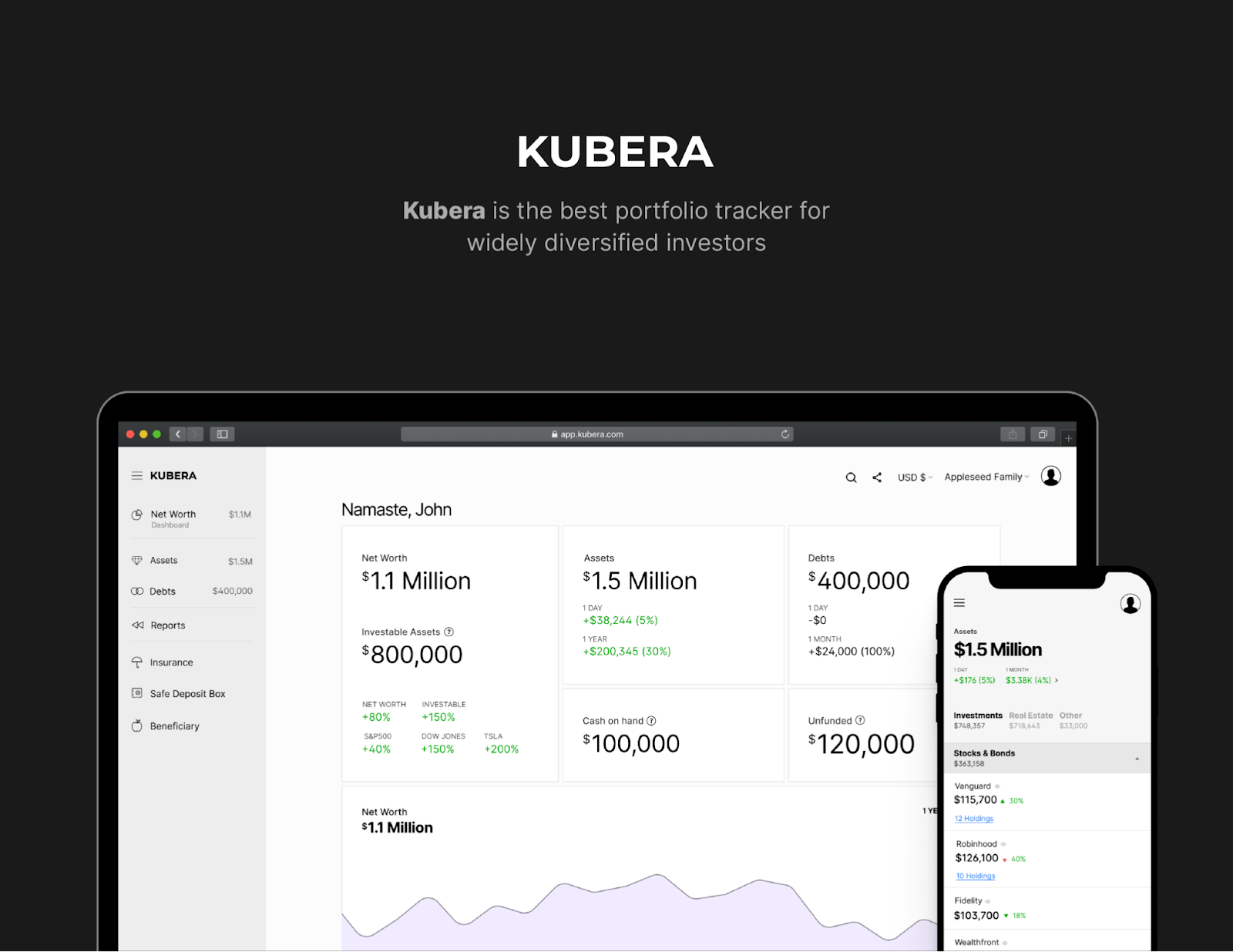
Tracking Restricted Shares in Kubera
Say the engineer holds 20,000 shares. Her brokerage statement shows them all with the same ticker and price, but in August only the ones out of lock-up can be sold, and any she bought in a funding round run on their own dates. In Kubera each block can be its own holding with its own date.
- Enter freely tradable, locked-up and restricted shares as separate holdings in the same stock, with a note on when each becomes sellable, so you can see how much you could sell today.
- The Carta integration syncs options, RSUs, certificates and convertible notes with read-only access. See also how to track pre-IPO stock.
- Once the company lists, public holdings update from market data alongside your bank, brokerage, real estate and crypto accounts.
- Fast Forward projects how a selling schedule affects your future net worth.
- Give a financial planner or tax adviser access while you decide how much to sell and when.
Try it for 14 days.
Frequently Asked Questions
What is Rule 144 in simple terms?
An SEC safe harbor that lets you resell restricted stock, or stock you own as a company insider, without registering the sale. Non-affiliates mainly have to wait out a holding period. Affiliates also have to limit how much they sell, sell through ordinary brokers' trades and file a Form 144 above certain amounts.
How long is the Rule 144 holding period?
Six months if the company has been an SEC reporting company for at least 90 days, and one year if it hasn't. It starts when you acquired the shares and paid for them in full, which for employee stock options is the exercise date.
Does the holding period restart when the company goes public?
No. The start date stays the date you acquired and paid for the shares. The IPO changes which holding period applies (six months instead of one year, once the company has been reporting for 90 days) and, for Rule 701 shares, can remove the holding period after 90 days.
Who has to file Form 144?
Affiliates, and people who were affiliates in the last three months, when the shares they plan to sell under Rule 144 in any three months exceed 5,000 shares or $50,000. Non-affiliates never file it.
Does a Form 144 filing mean an insider sold?
No. It's a notice that a sale is planned. The insider may sell less or nothing at all. Completed trades by directors, officers and large holders show up on Form 4.
Does Rule 144 apply to private company stock?
Yes, for restricted shares, after the one-year holding period, but it's rarely how private shares are sold. Private secondary sales usually go through the company's transfer process and other exemptions.
Can I sell under Rule 144 during an IPO lock-up?
Meeting Rule 144 doesn't release you from a lock-up. You can sell only when both the securities rules and the lock-up agreement allow it.
What is the difference between Rule 144 and Rule 144A?
Rule 144 covers resales of restricted and control securities to the public. Rule 144A is a separate safe harbor for resales to qualified institutional buyers, which generally means institutions with at least $100 million invested in securities. Individual holders almost always use Rule 144.
What is Rule 701?
The SEC exemption private companies use to issue stock options and other equity to employees, consultants and advisors. Starting 90 days after the company begins SEC reporting, non-affiliates can resell Rule 701 shares without the Rule 144 holding period or current information condition, and affiliates can sell them without the holding period.
Disclaimer
This article is general information as of November 24, 2026 and is not legal, tax or investment advice. Rule 144 has exceptions and conditions not covered here, including special rules for debt securities, business combinations and estates, and your lock-up agreement and company policy may impose further limits. Examples are illustrative and simplified. Talk to a securities lawyer, your company's legal team and a tax professional before selling restricted or control securities.


