

Last reviewed November 20, 2026, against the Founder Institute's FAST agreement, Carta data, IRS guidance on Section 83(b) and Form 15620, SEC Rule 701 and the 2025 changes to Section 1202.
Advisory shares are equity a startup gives to outside advisors in exchange for guidance, introductions or credibility, instead of cash. They aren't a special class of stock. In practice, they're almost always non-qualified stock options or restricted stock, granted in small amounts and vested over a year or two.
For founders, the questions are how much to give and on what terms. For advisors, they're what the grant is worth, how it's taxed and what to file. This guide covers both sides: typical percentages by stage, the Founder Institute's FAST agreement (updated to version 3 in July 2026), vesting and cliffs, how options and restricted stock are taxed, the 83(b) election, the 2025 changes to the qualified small business stock (QSBS) exclusion, and how to keep track of grants across several companies.
What Are Advisory Shares?
Advisory shares are equity compensation for people who help a company without working there full time: an experienced operator, an industry expert, an investor who opens doors, or a well-known name whose involvement helps with recruiting and fundraising. The advisor is betting on the company's future value instead of taking a fee now. For more on that trade-off, see equity vs. cash compensation. Advisors aren't directors: an advisory board has no fiduciary duties or votes on company decisions, and its members usually aren't covered by the company's directors' and officers' insurance.
"Advisory shares" is a description, not a legal category. Advisors usually receive one of two instruments:
- Non-qualified stock options (NSOs): the right to buy a set number of shares later at a fixed exercise price, usually the stock's fair market value on the grant date.
- Restricted stock awards (RSAs): actual shares issued up front, which the company can take back or buy back if the advisor leaves before they vest.
Advisors can't receive incentive stock options (ISOs), which have more favorable tax treatment, because tax law reserves ISOs for employees. Restricted stock units (RSUs) are uncommon for advisors at early-stage companies, though some later-stage private companies use them. For an overview of each type, see different types of equity compensation.
Private companies usually issue advisor equity under SEC Rule 701, which exempts compensatory grants from registration. To qualify, consultants and advisors must be individuals providing genuine services to the company, not services connected with selling the company's securities in a capital-raising transaction, so equity paid for introducing investors to a financing generally doesn't qualify. Rule 701 also caps what a company can issue in any 12 months (the greatest of $1 million, 15% of total assets or 15% of the outstanding class) and requires extra disclosure above $10 million. Paying for successful introductions can raise broker-dealer issues of its own, and state securities laws may require their own filings.
How Much Equity Do Advisors Get?
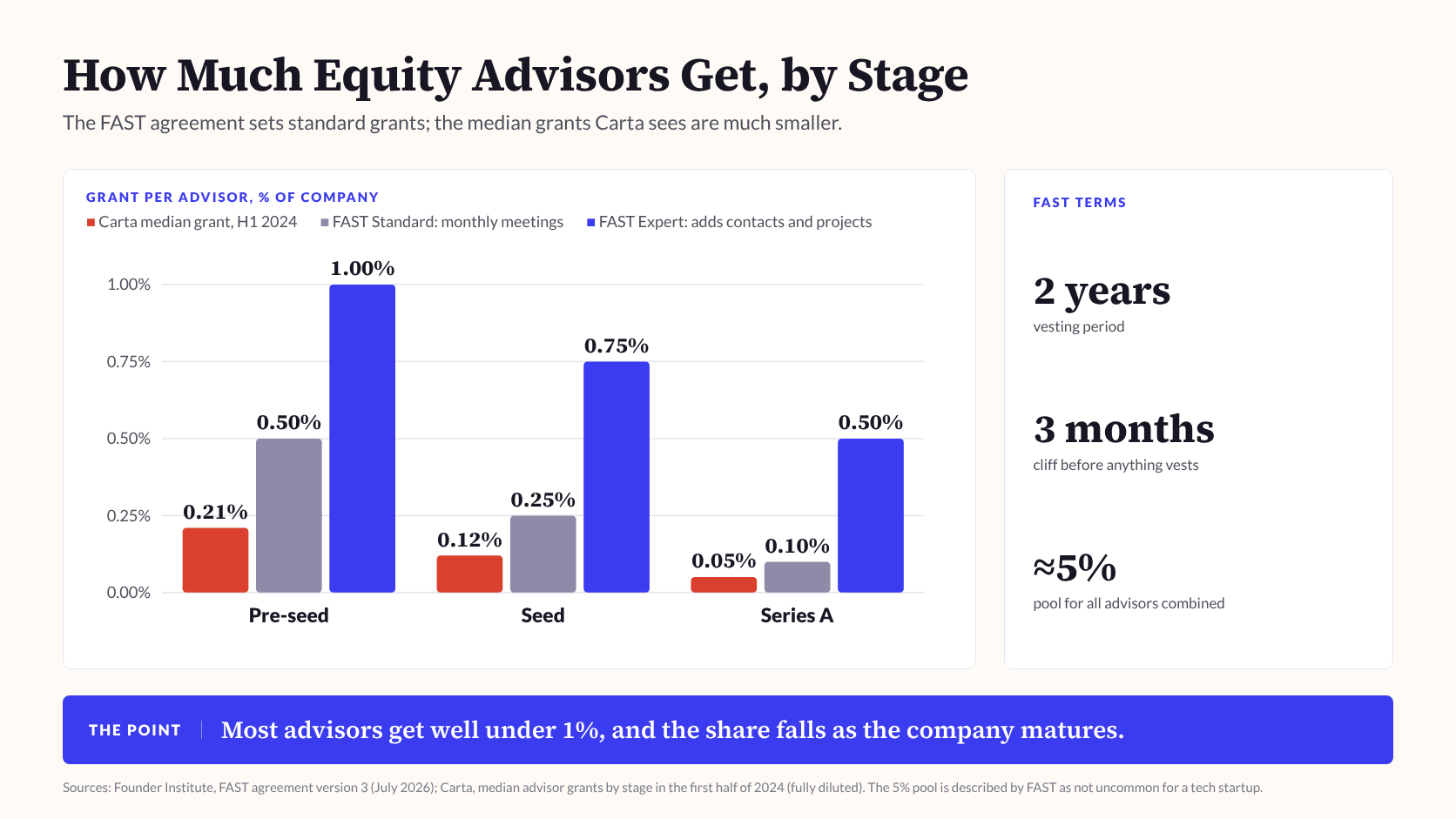
Most advisors receive between about 0.05% and 1.00% of the company. The share falls as the company matures, because each percentage point is worth more later, and it rises with how much the advisor actually does.
The Founder Institute's FAST agreement sets standard amounts by stage and engagement level:
Source: Founder Institute, FAST agreement version 3, July 2026.
Real-world grants tend to be smaller. In the first half of 2024, the median advisor grant was 0.21% of fully diluted shares at pre-seed, 0.12% at seed and 0.05% at Series A, according to Carta, and only 10% of pre-seed advisors received 1% or more. For full-year 2025, Carta put the pre-seed median at 0.24%, with 64% of advisors receiving less than 0.3%.
For all advisors combined, FAST notes that it is not uncommon for a technology startup to set aside a pool of about 5% for strategic advisors or an advisory board. Many companies use much less.
What a 1% grant becomes after dilution
A percentage at grant isn't a percentage at exit. Each new funding round issues new shares and dilutes existing holders. If a pre-seed company raises a seed round that sells 20% of the company, a Series A that sells another 20%, and a Series B that sells 15%, a 1.00% advisor stake falls to about 0.54%. If the company later sells for $300 million and common shareholders receive their full pro-rata share, that stake is worth about $1.63 million before tax.
Liquidation preferences can reduce what common stock receives in a modest exit, and many startups fail. The expected value of most advisor grants is far lower than the headline percentage suggests.
The FAST Agreement
The Founder/Advisor Standard Template (FAST) is a free, short agreement the Founder Institute released in 2011 so founders and advisors could agree on terms without lengthy negotiation. The Founder Institute says it is used by tens of thousands of entrepreneurs and advisors each year.
Version 3, released in July 2026, made several changes:
- It can be localized for any jurisdiction whose corporate law supports options or restricted stock.
- It simplified the advisor levels to two: Standard (monthly meetings) and Expert (adds contacts and projects). Earlier versions had three.
- It simplified signing and improved enforceability.
Key terms:
- Equity only. FAST is designed for strategic advisors paid in equity, not for consultants doing paid project work.
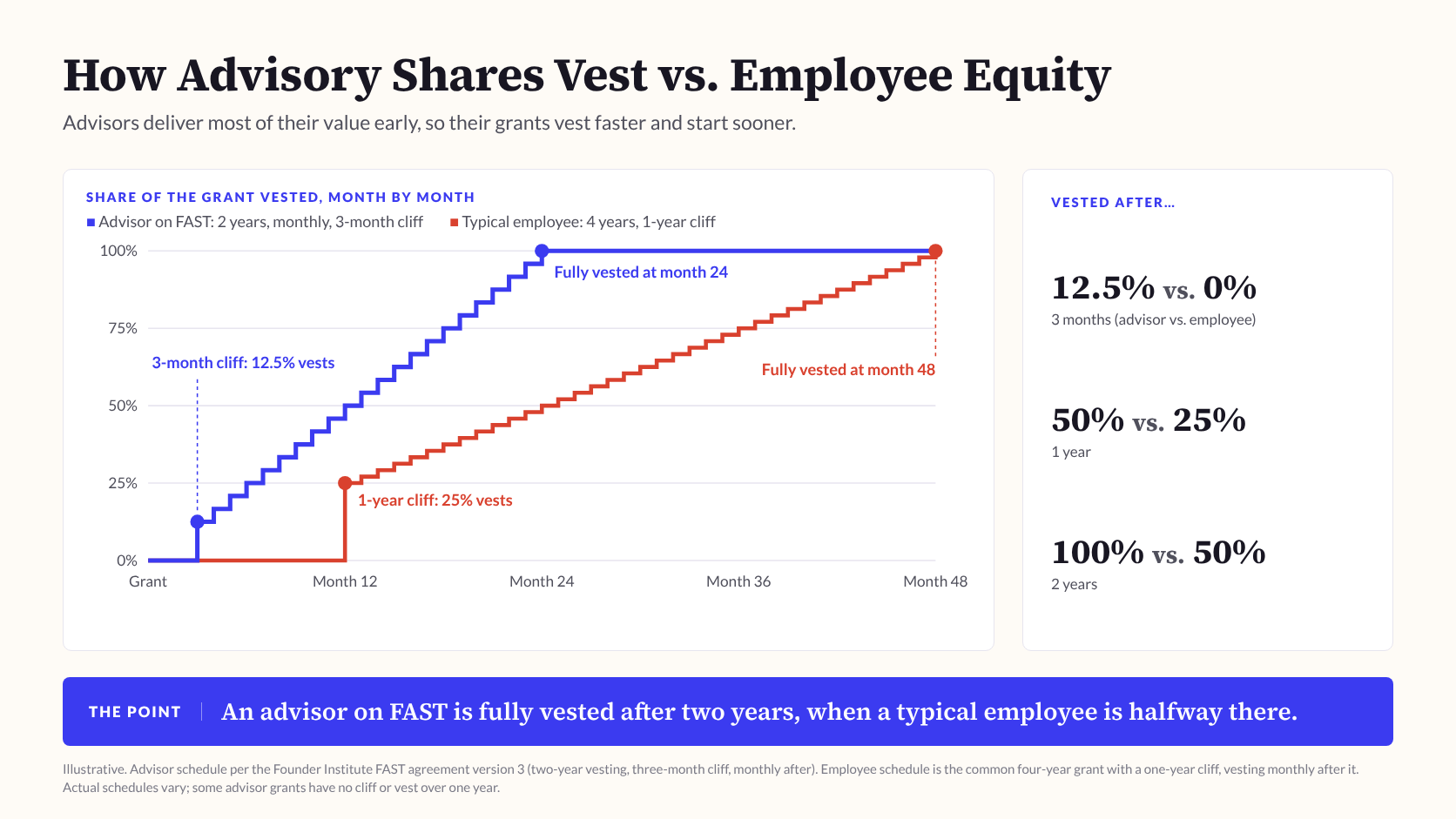
- Two-year vesting with a three-month cliff. If the relationship doesn't work in the first three months, it can end with no equity granted.
- Options or restricted stock, with the exercise price set at issuance.
- Purchase usually at an exit. The Founder Institute says advisors typically pay for their shares at an acquisition or IPO. If the engagement ends earlier, they may need to buy vested shares within a set period, such as 90 days. The actual terms depend on the option or stock purchase agreement, and waiting until a sale to exercise options usually means the whole gain is taxed as ordinary income (see below).
- A trial period first. FAST recommends working together for at least a month, and making a small request of the advisor to test the relationship, before discussing equity.
FAST is a starting point, not the grant itself. The equity still has to be issued through a stock option or restricted stock agreement, priced and approved by the board. Founders and advisors often add their own scope, meeting cadence, confidentiality, intellectual property assignment and termination terms. Have a lawyer review the final version.
How Advisory Shares Are Structured
The exercise price of an option is usually set by the company's most recent 409A valuation, an independent estimate of the fair market value of common stock. An independent appraisal generally protects the price for up to 12 months unless something material changes. Options granted below fair market value can be taxed early under Section 409A, with an extra 20% tax and interest, so companies keep the 409A current.
The governing document is the advisor agreement. It should define the role, the time expected, the equity and instrument, vesting, what happens on termination or a sale, confidentiality and assignment of intellectual property.
Vesting, Cliffs and Acceleration
Advisor grants vest faster than employee grants because advisors usually deliver most of their value early, through introductions, strategy and credibility.
- Schedule: two years, vesting monthly, is common, according to Carta. Some grants vest over one year.
- Cliff: often none, or a short three-month cliff like FAST's. Employees typically have a one-year cliff on a four-year schedule.
- Milestones: some grants vest on outcomes, such as closing a round or landing a key customer, or combine time and milestones.
- Acceleration: many advisors negotiate single-trigger acceleration, so all unvested shares vest if the company is sold, according to Carta. It isn't automatic.
- Termination: unvested equity is usually forfeited when the relationship ends, and the company can typically buy back unvested restricted stock at the lower of what the advisor paid or its current value. Vested options typically must be exercised within a set window, often 90 days, or they expire. Some agreements also let the company cancel equity if the advisor breaches confidentiality or IP terms.
How Advisory Shares Are Taxed
The tax rules for advisors differ in one important way from those for employees: an advisor is not an employee, so there is no payroll withholding. Income from advisory equity is generally reported to the advisor on Form 1099-NEC, and if advising is part of the advisor's trade or business, it may also be subject to self-employment tax: 15.3% on 92.35% of net earnings, with the 12.4% Social Security part stopping once wages and self-employment earnings together reach $184,500 in 2026, plus a 0.9% additional Medicare tax at higher incomes. An advisor whose salary already exceeds the wage base pays only the Medicare part. Advisors may need to make estimated tax payments.
Non-qualified stock options
- At grant: no tax, as long as the exercise price is at least fair market value.
- At exercise: the difference between the stock's fair market value and the exercise price, the "spread," is ordinary income. The company generally reports it on Form 1099-NEC.
- At sale: any further gain or loss is a capital gain or loss, long-term if you held the shares more than a year after exercise.
Exercising early, while the spread is small, reduces ordinary income and starts the capital gains clock sooner, but it means paying the exercise price and tax on shares that could become worthless. If the plan lets you exercise before the options vest, you receive restricted shares and need an 83(b) election within 30 days to lock in that result. See stock options tax for more detail.
Restricted stock and the 83(b) election
Without an election, restricted stock is taxed as it vests: each month, the value of the newly vested shares, minus anything you paid for them, is ordinary income. If the company's value is rising, that can mean tax bills on illiquid shares you can't sell.
An 83(b) election lets you pay tax on the shares' value at grant instead, when it is often close to zero, and nothing at all if you paid full fair market value for them. Later growth is taxed as a capital gain when you sell, and the holding period starts at grant. You must file within 30 days of receiving the shares. The deadline can't be extended, though if day 30 falls on a weekend or federal holiday, the next business day counts.
Since 2025, the IRS has let taxpayers file Form 15620, the 83(b) election form, online through an IRS Online Account, which requires identity verification through ID.me, with immediate confirmation that it was received (not that the election is valid). Paper filing is still allowed. Either way, give the company a copy and keep proof of filing. See 83(b) election.
The risk of an 83(b) election is paying tax on shares you later forfeit or that turn out to be worthless. When the value at grant is tiny, that risk is small.
QSBS: the potential tax-free exit
Stock in a qualifying C corporation received for services can be qualified small business stock under Section 1202. For stock acquired after July 4, 2025, the 2025 tax law allows holders to exclude 50% of the gain after three years, 75% after four and 100% after five, up to the greater of $15 million or 10 times basis per company, and raised the company asset limit to $75 million, according to Cooley.
The cap applies per taxpayer for each company, and the asset limit measures the company's gross assets, not its valuation. The company must be a C corporation running an active business, and many service businesses, such as consulting, law, health and financial services, don't qualify. For advisors, timing matters:
- Restricted stock with an 83(b) election: the holding period generally starts at grant.
- Restricted stock without an election: it starts as shares vest.
- Options: it starts only when you exercise, and the company's asset test is applied when the shares are issued at exercise.
That's another reason early exercise or an 83(b) election can be valuable. See QSBS for the full rules.
Worked example: one grant, four outcomes
An expert advisor joins a pre-seed company and receives 1.00%, or 100,000 of its 10 million fully diluted shares, under FAST. The 409A value is $0.05 a share, so the shares are worth $5,000 at grant. After three rounds of dilution, the stake is about 0.54%. The company sells seven years later for $300 million, or $16.32 a share, so the shares are worth $1,632,000.
Assumptions: 37% ordinary income rate; 23.8% long-term capital gains rate including net investment income tax; the advisor pays the $5,000 exercise price where options are exercised; common stock receives its full pro-rata share of the sale; no state tax or self-employment tax. If the company qualifies and the advisor holds the year-2 exercise for five years, QSBS could also eliminate the sale tax in the second row. Illustrative only.
The same 1% leaves the advisor anywhere from about $1.03 million to $1.63 million, depending on structure and timing.
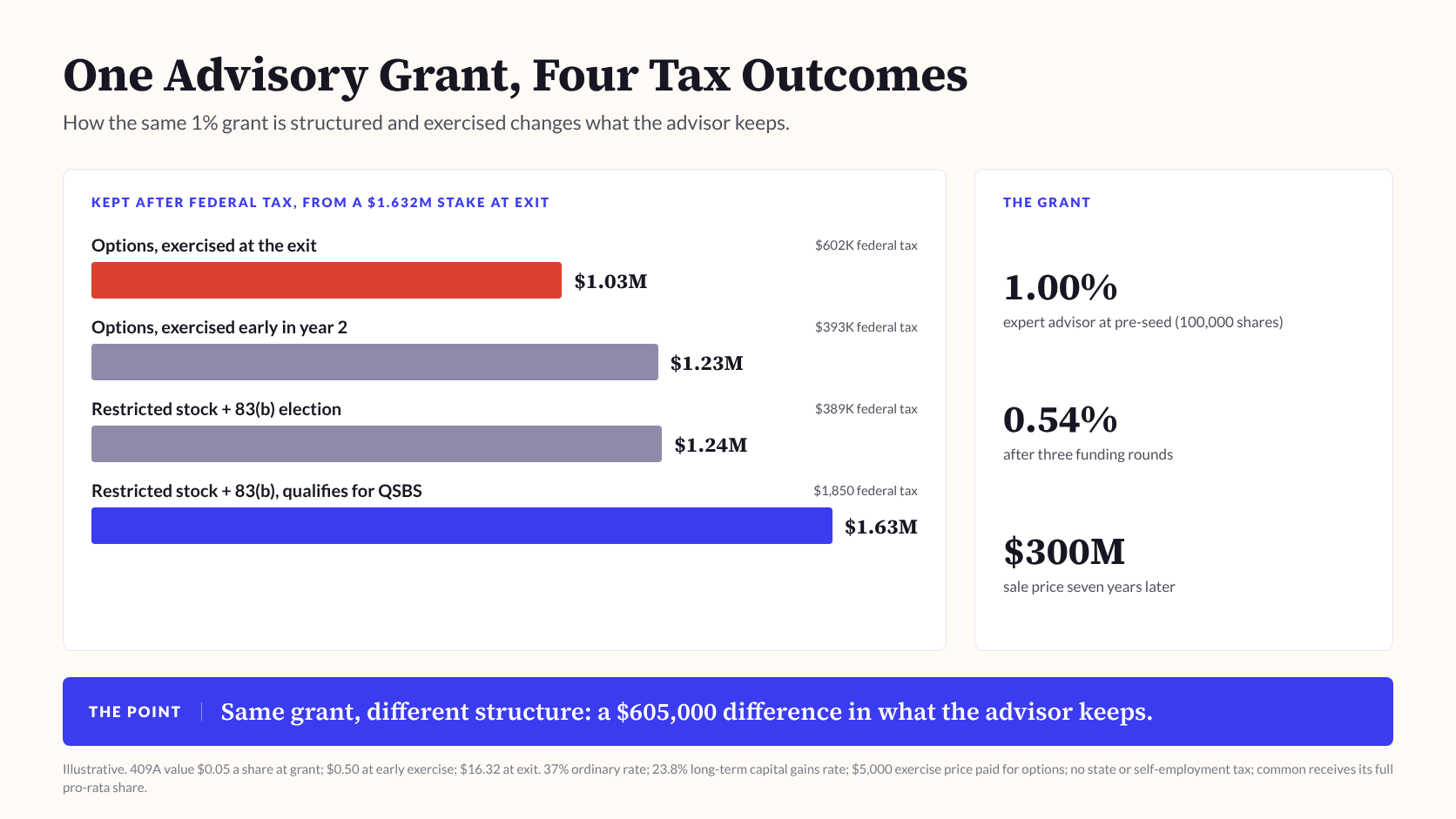
The same 1% advisory grant can be worth $1.03 million or $1.63 million after tax, depending on how it was structured.
Advisory Shares vs. Employee Equity
Advisory Shares on Shark Tank
Viewers of Shark Tank often hear investors ask for "advisory shares" on top of a regular stake. On the show, it usually means an extra slice of equity for the shark's ongoing help, beyond the shares bought with cash. For example, Mark Cuban and guest shark Emma Grede offered Richualist founder Dawn Myers $150,000 for 15% of the company plus another 5% in advisory shares, according to Beauty Independent.
TV deals are negotiated on camera and can change before closing, and they tend to be far larger than typical advisor grants. A 5% advisory stake is five times the largest grant the FAST template suggests for a single advisor.
The Pros and Cons
How to Grant Advisory Shares: A Founder's Checklist
- Define the role and test the fit. Write down what the advisor will do, how often you'll meet and for how long, and work together for a month or so before granting equity.
- Choose the size and instrument. Use FAST or Carta's data as a benchmark, and convert the percentage into a share count using fully diluted shares. Grant a fixed number of shares, not a percentage that is promised to stay the same through future rounds. Restricted stock suits the very earliest stage; options usually work better after a priced round.
- Get a current 409A valuation so the exercise or purchase price is defensible.
- Sign an advisor agreement. Cover vesting, a cliff, acceleration, termination, confidentiality and IP assignment.
- Get board approval and issue under your equity plan in compliance with Rule 701.
- Record the grant on your cap table and tell the advisor about the 30-day 83(b) deadline for restricted stock.
Tracking Advisory Shares Across a Portfolio
An active advisor or angel can hold small grants in five, ten or more startups, each on a different cap-table platform or in a PDF in an old email. Each has its own grant date, instrument, exercise price, vesting schedule and tax deadline. Without one record, it's easy to miss an exercise window after leaving an advisory role, or to lose track of what the positions are worth.
A few habits help:
- Record every grant in one place, with the instrument, share count, exercise price, vesting schedule and any 83(b) filing.
- Value each position conservatively. There's no market price. Use the latest 409A for common stock, not the preferred price from the last funding round, and update after each new round. See how to value pre-IPO stock and the value of unvested stock options.
- Look at the total. Ten 0.25% stakes can add up to a meaningful share of your net worth, or a meaningful concentration in one sector.
- Make sure someone else can find them. Advisory grants don't appear on any brokerage statement, so heirs can easily miss them.
Tracking Advisory Shares in Kubera
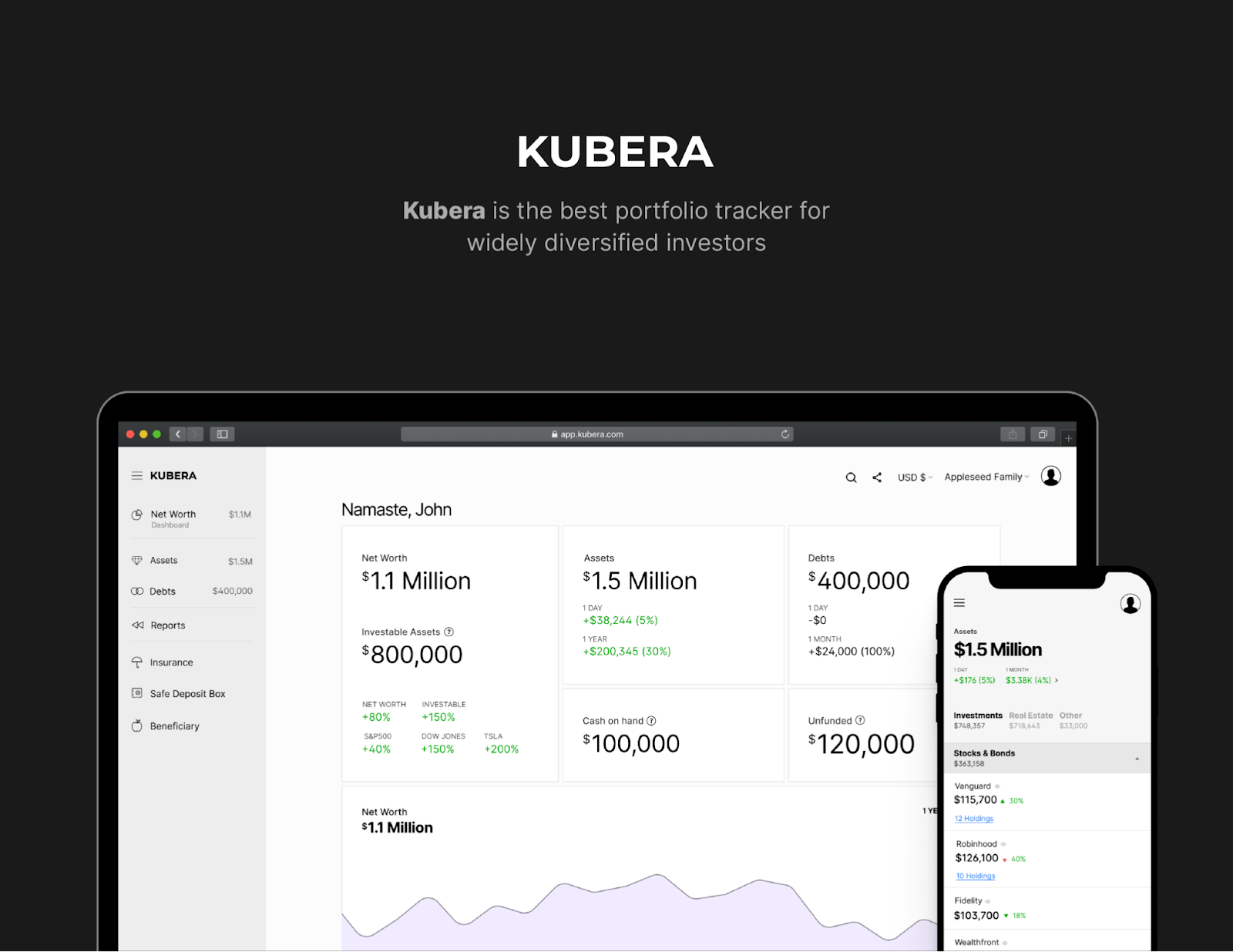
Kubera brings illiquid startup equity onto the same balance sheet as your public investments, cash, real estate and crypto. It doesn't value private companies for you or give tax advice.
- Sync equity from Carta. The Carta integration brings in RSAs, RSUs, option grants, certificates and convertible notes with read-only access. See Kubera's Carta integration.
- Add grants that live elsewhere. File Import reads grant letters, FAST agreements and cap-table screenshots, so positions on other platforms or in PDFs don't need to be typed in by hand.
- Keep your own valuations. Enter and update a value for each private position as new 409A reports or funding rounds come in, and see advisory equity as a share of your total net worth.
- Measure returns. Record exercise payments and proceeds as cash flows, and Kubera calculates IRR on positions held longer than a year, and ROI on newer ones.
- Protect what heirs can't see. The Dead Man's Switch sends your portfolio, including every private grant, to the people you choose if you go silent for too long.
Try it with a 14-day free trial.
Conclusion
Advisory shares let startups pay for expertise with equity instead of cash. Typical grants are about 0.05% to 1.00%, usually as options or restricted stock that vest over about two years with little or no cliff. The FAST agreement, updated in July 2026, is a sensible starting point for both sides.
For advisors, the structure matters as much as the percentage. Restricted stock with a timely 83(b) election, or an early option exercise, can turn most of a future gain into a long-term capital gain and may start the clock for QSBS treatment. Waiting to exercise at a sale usually means paying ordinary income tax on the whole gain. Keep a record of every grant, its deadlines and its value, and get tax advice before exercising or filing an 83(b).
Frequently Asked Questions
What are advisory shares?
Equity a startup grants to outside advisors for their guidance, introductions or credibility. They're usually non-qualified stock options or restricted stock in common stock, not a separate class of shares, and carry none of the preferred rights that investors get.
How much equity should an advisor get?
Usually 0.05% to 1.00%. The FAST template suggests 0.50% to 1.00% at pre-seed, 0.25% to 0.75% at seed and 0.10% to 0.50% at Series A, depending on involvement. Carta's medians are lower: 0.24% at pre-seed in 2025, and 0.12% at seed and 0.05% at Series A in early 2024.
What is a FAST agreement?
The Founder/Advisor Standard Template, a free agreement from the Founder Institute that sets standard advisor equity, two-year vesting and a three-month cliff. Version 3, released in July 2026, can be localized for other jurisdictions and uses two advisor levels.
Do advisory shares have voting rights?
Restricted stock usually carries the same voting rights as other common stock. Options carry no voting rights until they're exercised.
How are advisory shares taxed?
For options, the spread at exercise is ordinary income, generally reported on Form 1099-NEC, and later gains are capital gains. For restricted stock, the value is ordinary income as it vests, unless you file an 83(b) election within 30 days to be taxed on the value at grant.
Should an advisor file an 83(b) election?
Often yes, for restricted stock granted when the company's value is very low, because the tax at grant is small and later growth can be taxed as a long-term capital gain. The election must be filed within 30 days, and you can't get the tax back if the shares become worthless.
Can advisory shares qualify for QSBS?
Yes, if the company is a qualifying C corporation and the stock was received for services. For stock acquired after July 4, 2025, 50% to 100% of the gain can be excluded after three to five years. For options, the holding period starts at exercise.
What happens to advisory shares if the company is acquired?
It depends on the grant and the deal. Vested shares or options are usually bought out, cashed out or converted into the buyer's equity. Unvested awards may be assumed, replaced, accelerated or cancelled; advisors who negotiated acceleration vest in full.
Do advisory shares get diluted?
Yes. Like all common stock and options, advisory grants are diluted each time the company issues new shares in a funding round or expands its option pool. In our example, a 1.00% grant falls to about 0.54% after three rounds. Grants are usually a fixed number of shares, not a percentage protected from dilution.
Disclaimer
This article is general information as of November 20, 2026 and is not legal, tax or investment advice. Equity terms, valuations and tax outcomes vary by company and individual. Figures in the examples are illustrative and use simplified assumptions. Consult a startup lawyer and a qualified tax professional before granting, accepting, exercising or filing elections for advisory equity.


