Kubera vs Monarch Money
A budgeting app with net worth attached, against a balance sheet with no budget. Most people need one of them, not both.


ASK AI
about kubera
about kubera
Monarch is the best-known of the post-Mint budgeting apps: transactions, categories, a shared household budget, and a net-worth number on top. Kubera is the opposite shape: no budget, every asset and debt you own in one daily balance sheet, including the ones no budgeting app can hold. Most people who ask this question need one of them, not both. Here is how to tell which.
Facts checked on 5 October 2026. Competitor prices and limits come from their own sites and help centres where they publish them; where they do not, the page says who reported the figure.
| Kubera | Monarch | |
|---|---|---|
| Price | Essentials $250 a year. Black $2,500 a year for multi-entity wealth. 14-day free trial, no card. | $14.99 a month or $99.99 a year (Core); Monarch Plus $199 a year, billed annually. 7-day free trial, no free tier. |
| What it is | A net-worth tracker: every asset and debt, one daily balance sheet, performance and forecasts. | A budgeting and cash-flow app: budget, transactions, goals, with a net-worth view on top. |
| Budgeting | None, on purpose. | The core of the product. |
| Countries and currencies | Institutions in 40+ countries; any asset in any currency; rates refreshed every two hours. | US and Canada. USD and CAD only, with no conversion: a foreign-currency amount is added as if it were dollars. |
| Investments | Ticker, quantity, cost basis where the broker provides it; IRR per position; benchmark against the S&P 500 or any ticker; non-US exchanges priced. | Holdings with time-weighted returns and allocation; only US-listed securities are priced; no historical performance for non-public holdings. |
| Crypto | 20+ exchanges, hardware wallets, 18 chains by address, DeFi, NFTs. | Coinbase, including staked and DeFi-yield balances. Other exchanges and self-custody wallets are not documented. |
| Private investments | Commitments, capital calls and distributions on a schedule; IRR; documents. | A manual account with a value. |
| Connections | Nine aggregators plus in-house connections; support can move a failing connection to another aggregator; Web Sync for banks none of them reach. | Plaid, Finicity and MX; you can switch provider per institution. |
| Household | Collaborators on every plan; nested portfolios with per-portfolio access on Black. | One subscription for a household with Admin, Member and Professional roles; members cannot hide accounts from each other. |
| AI | Connect to ChatGPT, Claude, Grok and other assistants. | An in-app assistant for transactions. |
| If you die | Dead Man’s Switch sends your data to the person you named. | Plus includes a free couple’s will through Trust & Will. |
| Privacy | No ads, no data sales. | No ads; says it never sells financial data. |
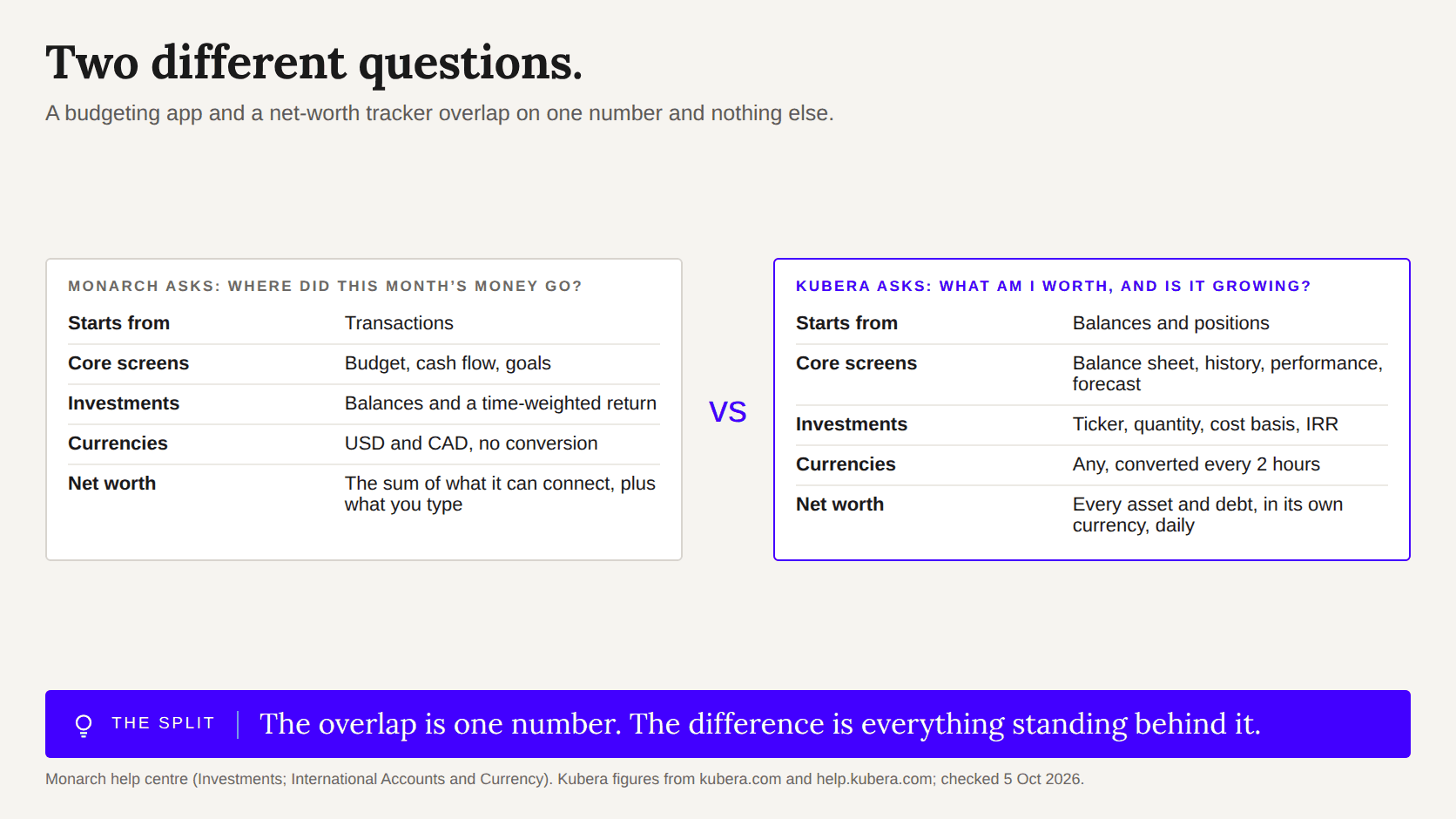
A budgeting app starts from transactions: it pulls in every card swipe, sorts it into a category, and tells you whether you are under or over this month. A net-worth tracker starts from balances: what each account, property, position and loan is worth today, and what the total was every day before. Monarch is a very good example of the first. Kubera is built only for the second.
The overlap is the net-worth number both will show you. The difference is what stands behind it. Monarch’s number is the sum of the accounts it can connect to, in dollars, plus whatever you type. Kubera’s is the sum of every asset you own in its own currency, with its own cost basis, documents and history, whether or not an aggregator can see it.
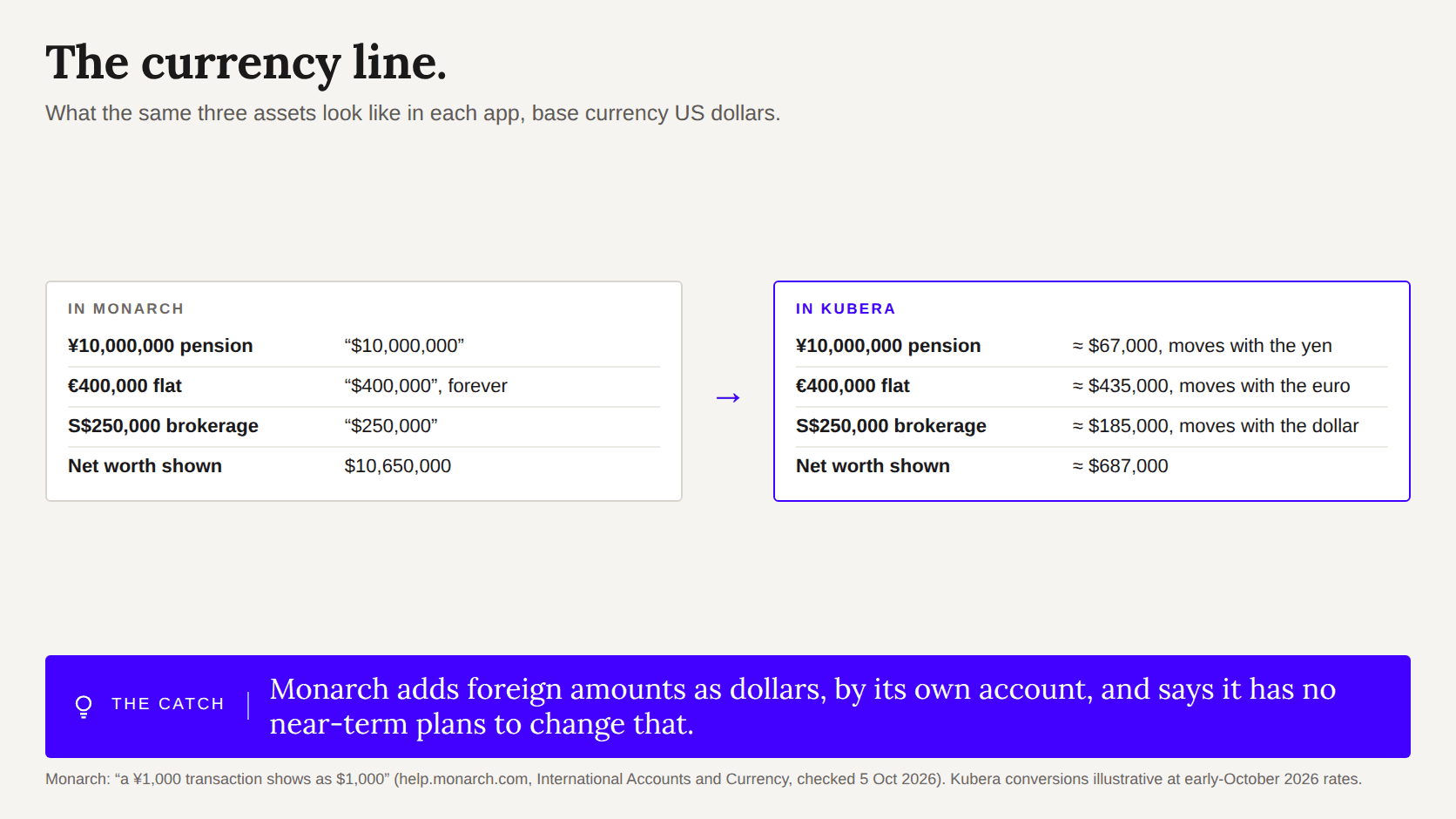
Monarch supports US dollars and Canadian dollars and performs no conversion. In its own words, a ¥1,000 transaction shows as “$1,000”, and the company says it has no near-term plans to change this. If you have a pension in sterling, an apartment in Lisbon or a brokerage account in Singapore, Monarch will show them at the wrong number or not at all.
Kubera holds any asset in any currency and converts to your base currency at rates refreshed every two hours. It also connects to banks outside North America through Salt Edge, Lean, Akahu and others. Customers who have lived in three countries are the people who write Kubera its longest reviews.
Monarch shows holdings and a time-weighted return for US-listed securities, which covers most 401(k)s and brokerage accounts. It does not price non-US exchanges, and it says it cannot show historical performance for non-public holdings.
Kubera pulls ticker, share quantity and cost basis where the broker provides them, prices US, Canadian, UK, European and Asian exchanges, computes an IRR for every position (including private ones, from dated cash flows), and benchmarks against the S&P 500 or any ticker you choose. For a fund commitment it holds the schedule of calls and distributions and feeds it into a forecast of your cash.
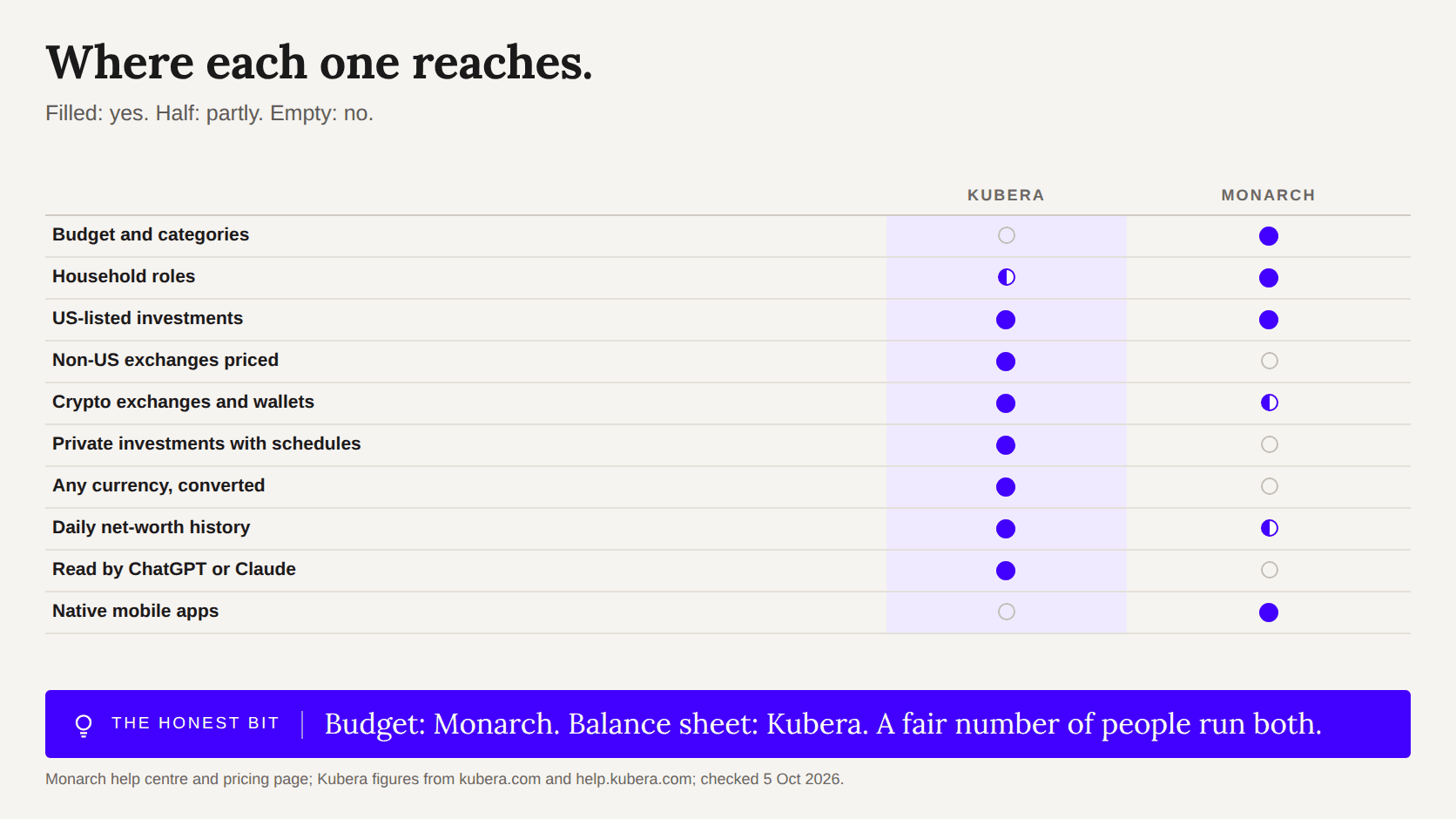
If you want a budget, Monarch wins outright: Kubera does not have one and is not going to add one. Monarch’s household model, with roles for a partner and an adviser, is more developed than Kubera’s collaborator sharing on the Essentials plan. Monarch is cheaper, has native mobile apps where Kubera has a mobile web app built for viewing, and lets you pick which aggregator connects each bank. Several Kubera customers pair the two: Monarch for the month, Kubera for the net worth.
Nothing exports between them, and nothing needs to. Connect your institutions in Kubera, add what does not connect, and the daily history starts that day. Keep Monarch if you still want the budget; many people do. The 14-day trial is the full product and needs no card.
“I have previously tried products such as Monarch, but while they do better on budgeting, they're terrible at investments.”
“As a former Mint user, I tried Monarch and several other options, but found most were geared toward budgeting, cluttered with ads, or plagued by unreliable connections.”
“Budgeting apps are great for managing day to day behavior, but they rarely capture the bigger picture. Kubera fills that gap by focusing purely on net worth, asset allocation, and long term tracking.”


