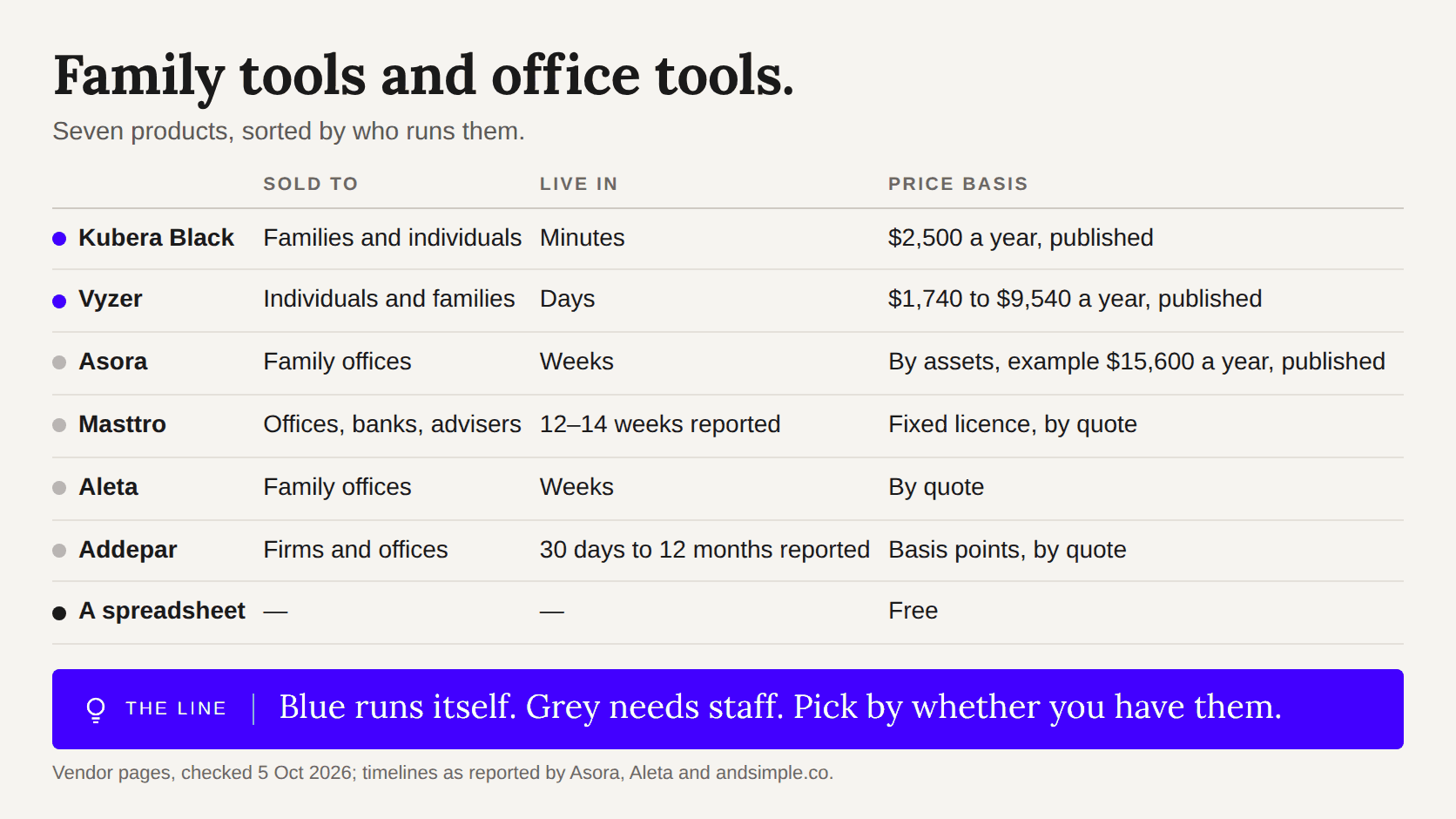
Once wealth is held through a trust, an LLC, a holding company and two or three people, the ordinary tracker breaks: it has one owner, one portfolio and no idea that the beach house is 50% yours. The tools that handle this range from an app a family runs itself for $2,500 a year to platforms a family office buys by quote and implements over months. Here is who each one is for.
The features that matter: a portfolio per person and per entity, rolled up into one family view; ownership percentages, so a shared asset counts correctly in each person’s number; access control, so a child sees the trust and not the parents’ brokerage; a record that reaches the right person if the principal dies; and, for the ones with staff, document processing and custodian feeds at scale.

Nested portfolios: each person, trust or entity has its own portfolio, which appears as one asset row and one debt row in the parent, with access set per portfolio. Ownership tags by person or irrevocable trust at portfolio, sheet, section or asset level. Everything connected: 20,000+ institutions in 40+ countries, crypto, property, private investments with capital-call schedules, documents. Dead Man’s Switch sends the whole record to a named contact. Guided onboarding and 1:1 Zoom support.
Portfolios structured by entity (LLCs, trusts, IRAs), co-investments and ownership stakes, roles and permissions from the Premium tier, with alternatives tooling and K-1 extraction.
Family-office software for offices from about $30M, with unlimited users and add-on fees for custodians and fund holdings.
Enterprise wealth-tech for UHNW families and the offices, banks and advisers that serve them: 700+ custodian feeds, documents AI, an entity map, Swiss-hosted private cloud. Onboarding reported at 12–14 weeks.
Consolidation across entities and currencies with full look-through, aimed at single family offices.
The institutional standard for advisers and large family offices: entity and partnership structures, deep alternatives data, custodian feeds at scale.
A tab per entity and a roll-up formula. Fully flexible; no syncing, no access control, no succession.
Facts checked on 5 October 2026. Competitor prices and limits come from their own sites where they publish them; where they do not, the page says who reported the figure.
| Kubera Black | Vyzer | Asora | Masttro | Aleta | Addepar | Spreadsheet | |
|---|---|---|---|---|---|---|---|
| Price | $2,500 / yr | $1,740–$9,540 / yr | From ~$15,600 / yr | Quote, ~$50K+ | Quote | Quote, ~$50K+ | Free |
| Sold to | Families, individuals | Individuals, families | Family offices | Offices, banks, advisers | Family offices | Firms, offices | — |
| Live in | Minutes | Days | Weeks | 12–14 weeks reported | Weeks | 30 days–12 months reported | — |
| Portfolio per entity | Nested portfolios | Yes | Yes | Entity map | Look-through | Yes | Tabs |
| Ownership % | Tags, set by hand | Stakes | Yes | Yes | Yes | Yes | Formulas |
| Access per person | Per portfolio | From Premium | Unlimited users | Yes | Yes | Yes | All or nothing |
| Succession | Dead Man’s Switch | No | Office | Office | Office | Office | None |

The products split cleanly on one question: is there an office? Asora, Masttro, Aleta and Addepar are bought by a family office and run by its staff; the implementation timelines, the custodian feeds and the document pipelines all assume people whose job this is. Kubera Black, Vyzer and the spreadsheet are run by the family. Nested portfolios in Kubera do the structural work: a portfolio for each child, each trust and each company, each rolled up as a single line in the family’s balance sheet, with access set so each person sees their own and the principal sees all. Ownership tags split the shared assets. The Dead Man’s Switch is the succession plan the office would otherwise be.
Ownership percentages are set by hand, not calculated from a cap table, so an entity owned 40/35/25 by three people is three tags you maintain. There is no document pipeline that turns a K-1 into a ledger entry. There is no partnership accounting. A family with thirty entities and a bookkeeper will outgrow it, and should look at Asora first, then Masttro or Addepar. Several families run both: a platform for the office’s books and Kubera for what each family member actually sees.
“I have a semi complex estate with various entities and have been very pleased with Kubera's features and ease of navigating.”
“After Mint shut down, I went many years tracking accounts manually. As my financial life became more complex with trusts and additional accounts, the problem only got worse. Kubera has been a blessing.”
“What truly sets Kubera apart for me is the Dead Man's Switch—a feature that ensures my wealth is smoothly transferred to my family if something ever happens to me.”