
"Family office software" is three different products wearing one name. One keeps the books. One reconciles custodians and computes performance. One shows the family what it owns. Vendors in each category describe themselves with the same words, which is why a search for the best family office software returns a dozen platforms that do not compete with each other and prices from $32 a month to $300,000 a year. This guide separates the layers, sets out what a multi-family or virtual family office actually has to track, compares the platforms by reported price and implementation time, and works the cost per family at 10, 25 and 50 families.
The Three Layers of Family Office Software
The first job in choosing family office software is deciding which layer you are buying. Each answers a different question, is used by a different person, and is priced on a different basis.
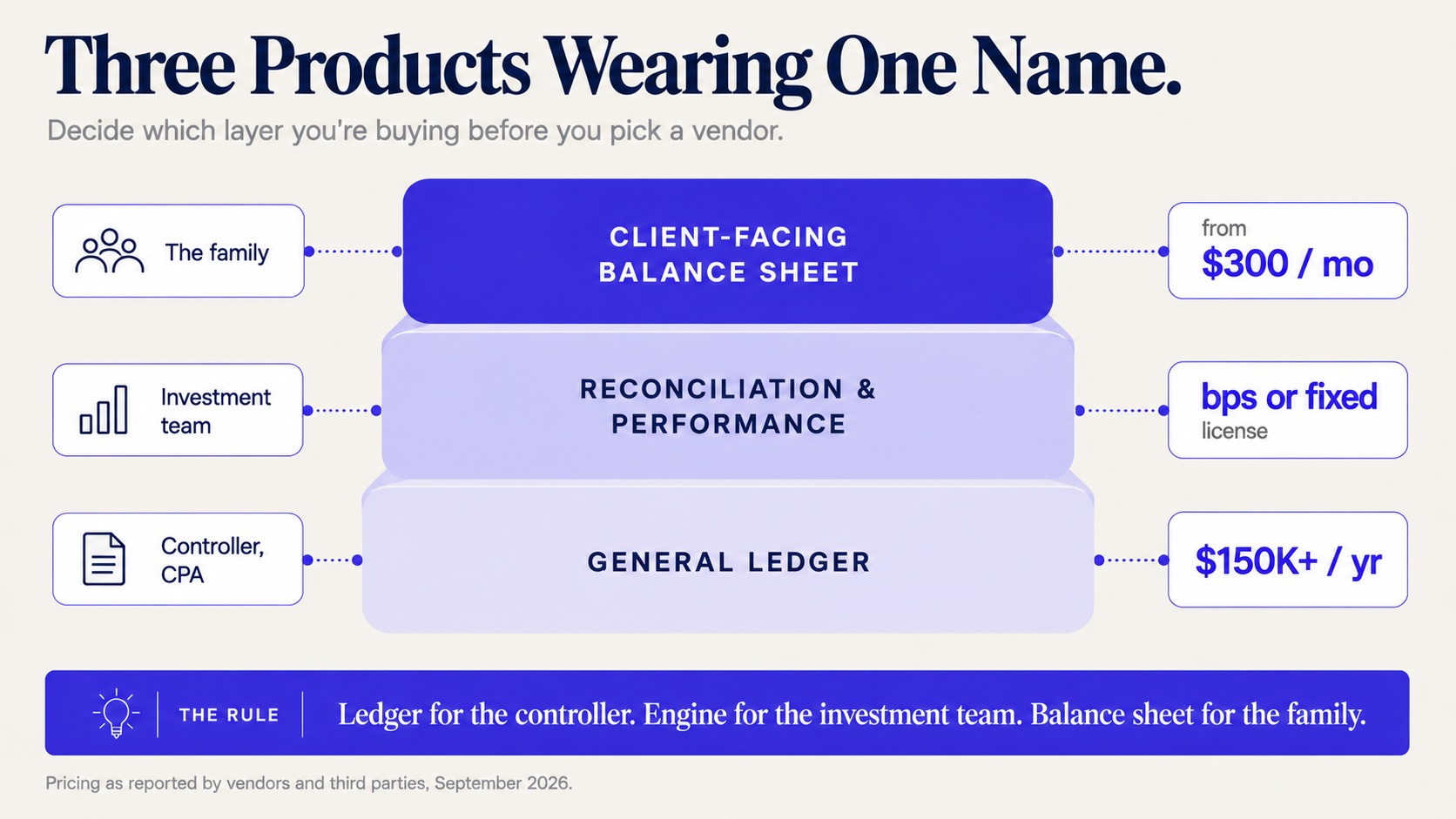
The three layers compared
The confusion comes from the middle row. Reconciliation platforms all ship a portal, so they present themselves as the family-facing layer too. The portal is not why anyone buys them, and it is rarely why anyone opens them. Attribution reports are for the investment committee. The family wants the balance sheet.
Buy the ledger for the controller, the engine for the investment team, and the balance sheet for the family. Nobody should have to log into a general ledger to find out what they own.
What a Family Office Actually Has to Track
The list is longer than "the portfolio," and the part that is hardest to track is the part that matters most. The UBS Global Family Office Report 2025, surveying 317 offices, puts the average allocation at 56% traditional assets and 44% alternatives, led by private equity, direct investments and real estate. Two-thirds of offices perform most functions in-house. In practice that means an office is tracking, at minimum:
- Entities and ownership. Holding companies, family LLCs, trusts (revocable, irrevocable, generation-skipping, SLATs), partnerships and foundations, each owning slices of the others. See family trusts and holding companies.
- Multiple custodians and banks. Three to ten institutions per family is normal; more across a multi-family office.
- Fund commitments. PE, VC, real estate and hedge fund interests with unfunded commitments, capital calls, distributions and K-1s, and a secondary market position or two.
- Direct investments and operating businesses. Founder stock, co-investments, angel positions, the company that made the money in the first place.
- Real assets. Primary and secondary homes, rentals, land, aircraft, boats, art, watches and wine, several of which are in other countries and mortgaged in other currencies.
- Crypto. Increasingly held directly, on exchanges and in self-custody, and increasingly omitted from reports because nothing connects to it.
- Cash, everywhere. Operating accounts per entity, reserves for calls, and the deposits a principal keeps at a bank the office does not see.
- Currencies. A family with a London flat, a Lisbon mortgage and a Singapore account needs one base currency and live conversion through every layer.
A general ledger records all of this correctly and shows none of it usefully to the family. A reconciliation engine handles the custodian rows well and the rest with manual entry. The family-facing layer is the only one whose job is to show everything, at today's value, to the person who owns it.
What Family Offices Spend, and Where Software Fits
Cost context keeps the software decision proportionate. Per J.P. Morgan's Global Family Office Report 2026, a single family office spends about $3 million a year on average, roughly $6.6 million above $1 billion in assets, and 40% of offices spend under $1 million. Annual operating cost "typically falls between 30 and 120 basis points" of assets. UBS puts personnel at 60 to 70% of the total.
Two conclusions follow. First, software is a modest line next to people, so the right question about a platform is how much staff time it removes, not what it costs in isolation. Second, the offices under $1 million a year, which is most of them, cannot absorb a six-figure platform plus a nine-month implementation plus a hire to run it. That is the segment where the multi-family and virtual family office models have grown, and where the pricing model of the software matters as much as its features.
Multi-family offices charge families in basis points or fixed retainers. Greenlock describes typical MFO pricing between $100,000 and $300,000 a year per family, and the general guidance is that the MFO model suits families with $25 million to $100 million in assets (Aleta). A virtual family office, which coordinates outside providers rather than employing staff, is described as cutting staffing and infrastructure costs by 40% or more and as viable from about $10 million. For both, the technology bill is paid by the office, spread across the families, and visible in the margin.
Family Office Software Platforms Compared
The table groups the most-shortlisted platforms by layer, with pricing as reported by the linked sources. Only Kubera, Aleta and Asora publish an entry price; the rest quote per office. Full pricing detail for the AUM-priced leader is in Addepar pricing.
Family office software compared, September 2026
Eton, SumIt, Landytech, Archway, Black Diamond, Addepar and Masttro do not publish pricing; figures are as reported by X1 Wealth, Aleta, andsimple.co and Sacra and will vary by office. Kubera, Aleta and Asora prices are as published.
Cost Per Family at 10, 25 and 50 Families
For a multi-family office the platform bill is a per-family cost, and the pricing model decides how it behaves as the office grows. The table works three models against a hypothetical office where the average family has $50 million on the platform. The AUM rate is 1.5 bps, the figure third parties most often cite for AUM-priced platforms; the fixed license is $100,000, in the middle of the Masttro and Eton ranges reported above.
Annual platform cost per family, three pricing models
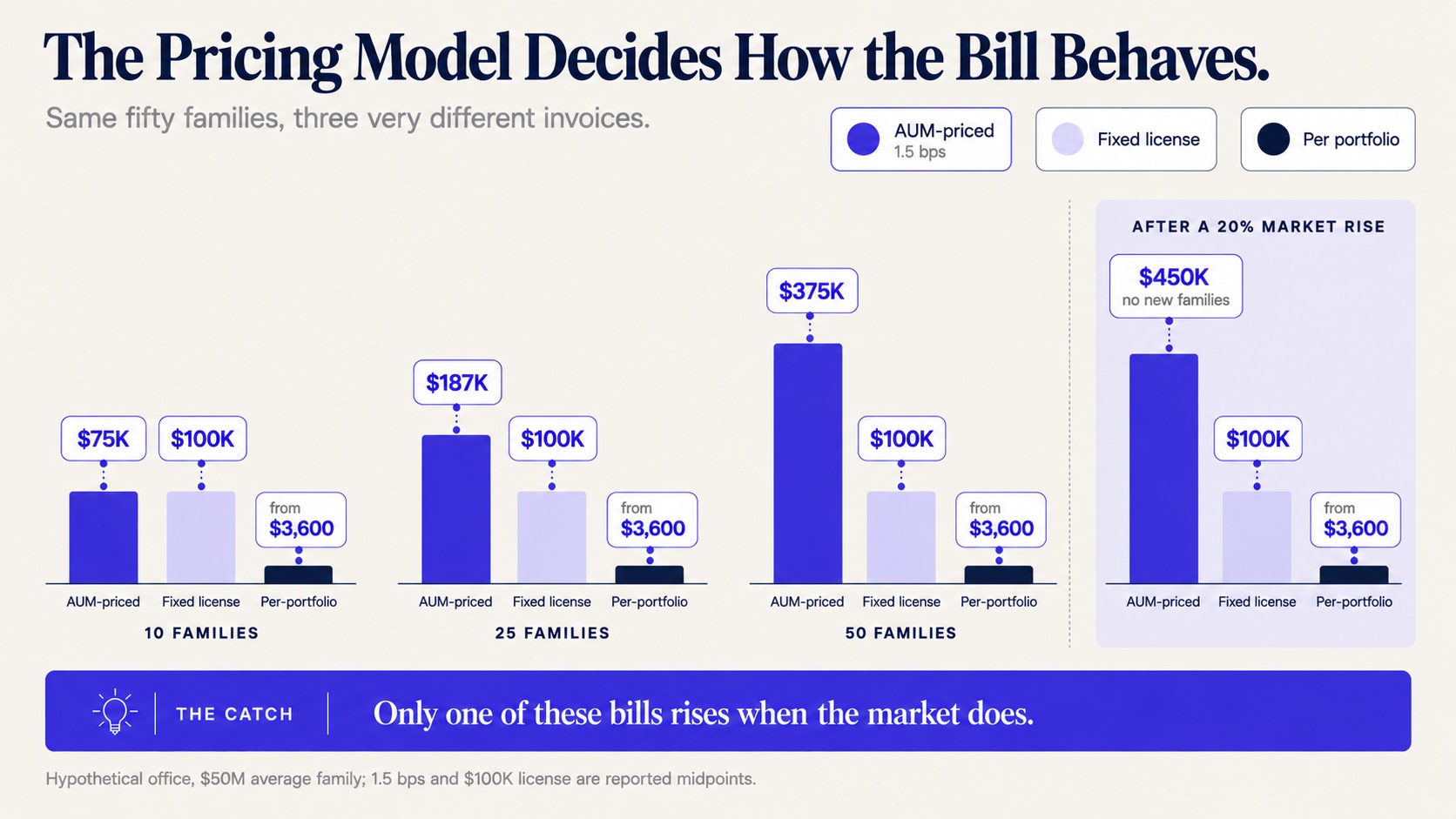
The AUM model charges the same per family however many families the office serves and rises when markets do; the fixed license gets cheaper per family with scale but sets a high floor for a ten-family office; the per-portfolio model starts low and moves only with the number of families. None of the three is wrong. They suit different offices, and the right one depends on which layer is being bought. The mistake is paying the reconciliation engine's price for the balance sheet's job.
Implementation: 24 Hours to Nine Months
Implementation time is a cost that rarely appears in the comparison. It is the months during which the office pays for two systems, the staff time spent on migration, and the delay before any family sees anything.
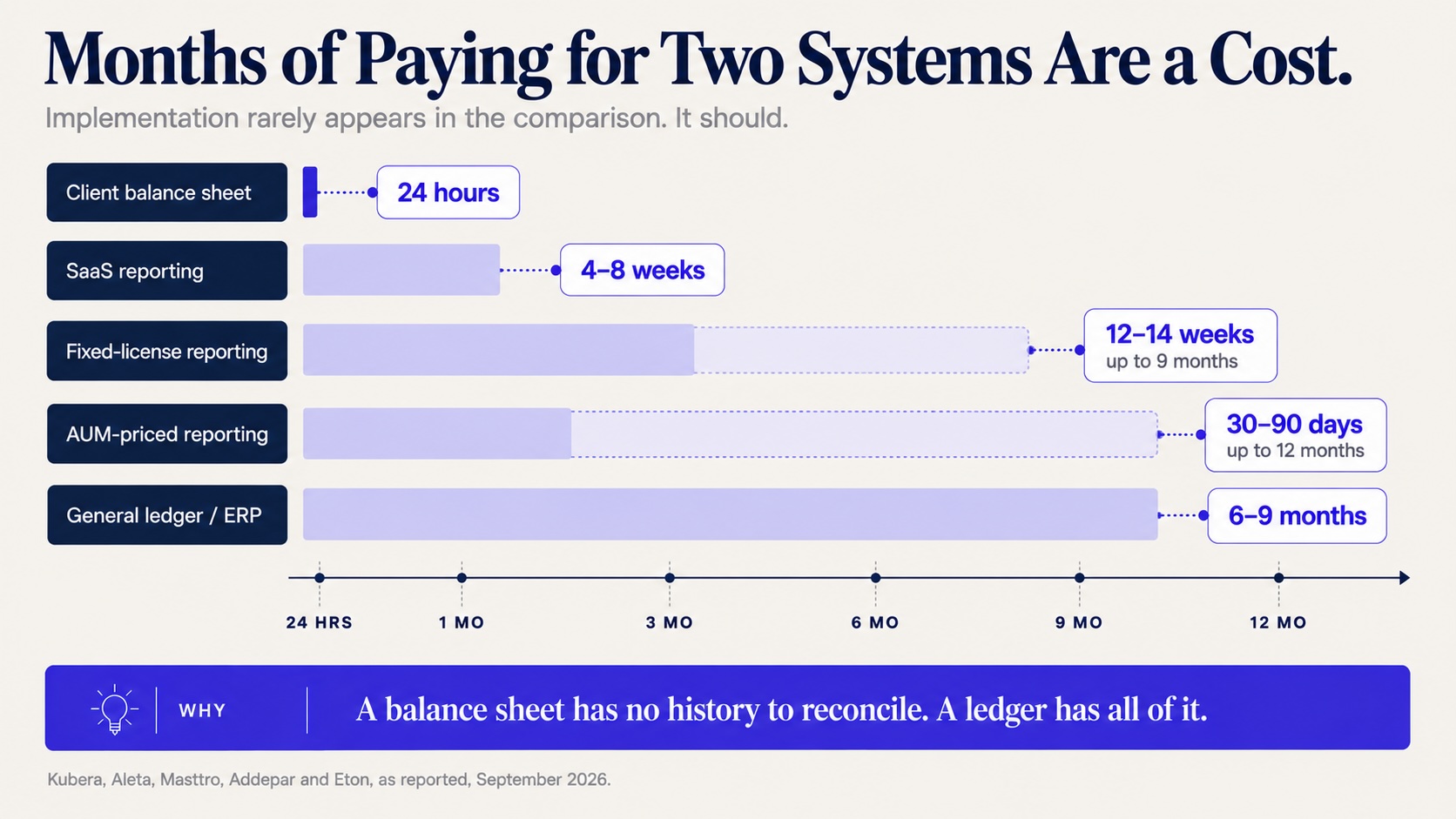
The reported ranges are wide for a reason. A general ledger migration means re-keying opening balances for every entity and reconciling history, so six to nine months for Eton is a reasonable expectation. A reconciliation platform must connect every custodian feed and load historical transactions to produce performance, which is why Addepar reports 60 to 90 days on a clean book and third parties report six to twelve months on a complicated one. A family-facing balance sheet has no history to reconcile: the family links accounts on the institution's own screens, private positions come from a cap table or a statement, and the office adds branding and a domain. That is why Kubera's setup starts within 24 hours of signing, with no project manager on either side.
Do You Need a General Ledger? A Decision Framework
Most offices overbuy at one layer and underbuy at another. Work through the questions in order.
Which layers does your office actually need?
Multi-Family Offices: Ten to Fifty Families, Hundreds of Entities
The multi-family office has the family office's problem multiplied by the number of families, plus one the single family office never faces: every family must see only its own. The office needs all of it, on one screen, to run the business. Each family needs its own balance sheet, with the trustee seeing the trust, the founder seeing everything, and the next generation seeing what the parents have chosen to show them.
That is an access-control problem before it is a reporting problem, and it is where nested portfolios earn their place: each entity holds its own balance sheet, entities roll up into the family, families roll up into the office, and every person is granted the layer they are entitled to. It is also where the pricing model bites. An MFO adding its eleventh family should not see the platform bill move by that family's assets.
The other MFO-specific requirement is the held-away half. Families arrive with accounts at institutions the office does not custody with, foreign accounts the aggregators do not reach, and a spreadsheet somebody prays over every quarter. The office that can put all of that on a live balance sheet in the first week is the office that wins the family.
Virtual Family Offices: The Software Is the Office
A virtual family office coordinates outside providers, typically an advisor, a CPA, an attorney and a bookkeeper, around a family with $10 million to $100 million, instead of employing them. It has no controller and no reporting analyst, which means the software stack is not a support function; it is the office. Three things matter more here than anywhere else: the family, not staff, must be able to link and maintain accounts; the advisor coordinating the VFO must see everything without holding a credential; and the price must be a software price, because there is no operating budget to absorb a license.
For most VFOs the stack is an outside CPA on standard accounting software, the advisor's existing system of record for managed assets, and a family-facing balance sheet that covers the rest. The balance sheet is also what the family's AI assistant reads from when they ask, at 2 am, where they are over-concentrated.
Security and Vendor Due Diligence
Every layer handles the family's most sensitive data, and for offices that are also registered advisers, the 2024 amendments to Regulation S-P now require written oversight of service providers, with compliance dates of December 3, 2025 for larger advisers and June 3, 2026 for smaller ones (Baker Donelson). The questions to put to any platform are the same across layers: a SOC 2 Type II report the office can read, not a badge; no storage of client credentials, with the client authenticating on the institution's own screen; feeds that cannot move money by architecture; encryption at rest and in transit, with a plain statement of what is and is not end-to-end; a 72-hour breach-notification commitment; immediate deletion with a stated backup window; and no training of AI models on client data. Kubera's answers are on its security page, and the SOC 2 Type II report is available under NDA before signing.
Where Kubera White Label Fits
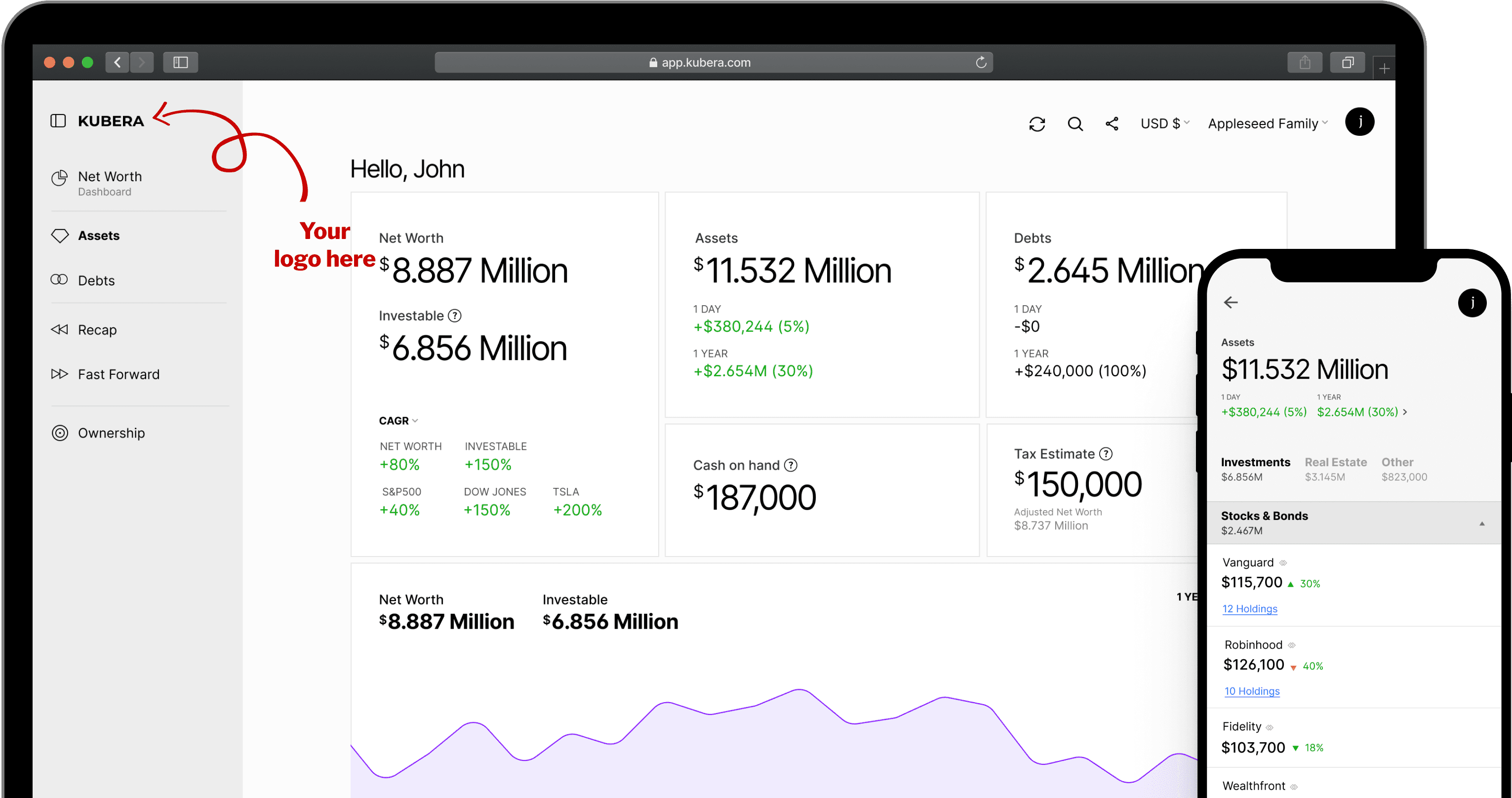
Kubera White Label is the family-facing layer: the client's whole balance sheet, under the office's logo and domain, on web and mobile. It is the app serious money already picks for itself, which is why so many offices hear about it from a family first. Coverage runs through nine aggregator networks (Plaid, Mastercard, MX, Yodlee, Akoya, SnapTrade, Lean, Akahu and Salt Edge) for bank and brokerage, and through Web Sync for institutions that connect to nothing. Private stakes and LP positions carry commitments, calls, distributions, unfunded balances and IRR. Crypto and DeFi connect by public address. Homes, cars, gold, watches and art carry live price feeds and an AI appraiser for the rest. Holding companies, trusts and partnerships are nested portfolios with per-person access control. Any base currency runs through every layer. Drop in a statement, a screenshot or a capital-call notice and it becomes line items; Recap shows what moved.
Every family can connect its balance sheet to Claude, ChatGPT, Gemini, Grok, Perplexity or anything else that speaks MCP, for reports, Monte Carlo runs, concentration analysis and liquidity plans in the office's own template, and the office can turn that off firm-wide. Pricing starts at $300 a month and moves with client portfolios, not assets; there is no implementation fee; setup starts within 24 hours. Kubera is not a general ledger, custodian reconciliation, fee billing, trading, GIPS composites or a CRM. It runs alongside Eton, Addepar, Masttro, Orion, Black Diamond, Tamarac, eMoney and RightCapital, and shows each family the part of its wealth those systems cannot.
Request a demo, or take the 14-day trial and set up one family as a client would.
Frequently Asked Questions
What is family office software?
A general term for three kinds of platform: general ledger and accounting systems that keep the office's books, reconciliation and performance engines that consolidate custodian data and compute returns, and client-facing balance sheets that show each family everything it owns. Most offices need one or two layers, rarely all three from one vendor.
What is the best family office software?
It depends on the layer. For the general ledger, Eton Solutions, SumIt and FundCount are the family-office-specific options. For reconciliation and performance, Addepar and Masttro lead for complex offices, with Aleta and Asora as SaaS-priced alternatives. For the family-facing balance sheet across every asset class, entity and currency, Kubera White Label is the purpose-built option, from $300 a month.
How much does family office software cost?
Reported ranges run from about $870 to $1,000 a month for SaaS reporting (Asora, Aleta), $50,000 to $150,000+ a year for fixed-license reconciliation platforms (Masttro), $50,000 to $300,000+ a year for AUM-priced platforms (Addepar, with a $229,000 reported average contract), and $150,000+ a year for a family-office ERP (Eton). Kubera White Label starts at $300 a month with no implementation fee.
What software does a multi-family office need?
A general ledger if it keeps entity books in-house, a system of record for managed assets if it is also an RIA, and a family-facing balance sheet with per-family access control so each family sees only its own while the office sees all. The pricing model should not charge the office more for adding a family with more assets.
What is a virtual family office and what software does it use?
A virtual family office coordinates outside providers (advisor, CPA, attorney) around a family, typically with $10 million to $100 million, instead of employing staff. Its stack is usually an outside CPA on standard accounting software, the advisor's system of record, and a family-facing balance sheet the family maintains itself.
How long does family office software take to implement?
Reported ranges: 24 hours to start for a family-facing balance sheet (Kubera), 4 to 8 weeks for SaaS reporting (Aleta), 12 to 14 weeks to 6 to 9 months for reconciliation platforms (Masttro, Addepar on complex books), and 6 to 9 months for a general ledger migration (Eton).
Does Kubera replace a family office general ledger or Addepar?
No. Kubera is the family-facing balance sheet and runs alongside the ledger and the reconciliation engine. It does not do partnership accounting, custodian reconciliation, billing or trading.
Is family office software secure enough for a compliance review?
Ask for the SOC 2 Type II report itself, confirm the platform never stores client credentials and cannot move money, check encryption and breach-notification terms against the amended Regulation S-P, and confirm client data is not used to train AI models. Kubera provides its report under NDA before signing.
The Principle Worth Keeping
Decide the layer before the vendor. The ledger is for the controller, the engine is for the investment team, and the balance sheet is for the family. Price each on its own basis, count the implementation months as cost, and do not pay a reconciliation engine's price for the job of showing a family what it owns.
Pricing and implementation figures for third-party platforms are as reported by the sources linked above in September 2026 and have not been confirmed by the vendors. Kubera pricing is as published on kubera.com. Verify current terms with each vendor.


