

A custodian feed shows what the custodian holds. It does not show the 401(k) at a former employer, the founder shares, the LP commitment, the rental in another state, the crypto wallet, or the cash sitting in three banks because the client never got around to moving it. Held-away assets are everything a client owns that is not in an account the advisor manages, and for most high-net-worth clients they are not a rounding error. They are the majority of the balance sheet.
This guide covers what counts as held-away, how large the blind spot is, the three ways an RIA can handle it and where the compliance line sits for each, how account aggregation interacts with the custody rule and the 2024 Regulation S-P amendments, how the tracking options compare, and how to put a complete balance sheet in front of a client without adding an hour to every review.
What Counts as Held-Away
The phrase is broader than the 401(k) it usually brings to mind. Anything the advisor cannot see on the custodian statement is held away, and for a founder, an executive, a real estate investor or a family with entities, that is most of what they own.
Categories of held-away assets and how they are typically tracked
The last two rows are where planning software gives up. A box for "other assets" cannot hold a trust that owns an LLC that owns a building with a EUR mortgage, and it cannot show the trustee the trust while showing the founder everything.
How Big the Blind Spot Is
Three numbers frame the problem. The first is the size of the assets that sit outside advisory custody by design. The Investment Company Institute reports total US retirement assets of $49.1 trillion at December 31, 2025, of which defined-contribution plans held $14.2 trillion and 401(k) plans $10.1 trillion. For a working executive the 401(k) is often the largest liquid account they have, and it is invisible to the advisor unless someone types it in.
The second is how badly advisors misjudge what they cannot see. In a 2024 survey of independent RIAs by Flourish and Wealth Management IQ, advisors believed clients held about 7% of net worth in cash, while the high-net-worth clients surveyed held more than 30%. Ninety-five percent of the advisors agreed that cash advice was their responsibility; five percent said they consistently asked about it. That is not a cash problem. It is a held-away problem that happens to be easiest to measure in cash.
The third is what wealthy clients actually own. The UBS Global Family Office Report 2025 puts family office portfolios at 44% alternatives, led by private equity, direct investments and real estate, none of which arrive on a custodian feed. Cerulli reports that 35% of high-net-worth individuals chose their primary advisor for services or client experience rather than investment performance, and that demand for alternatives selection and estate planning has grown fastest. The advisor who can see the whole picture is the one who gets to be primary.
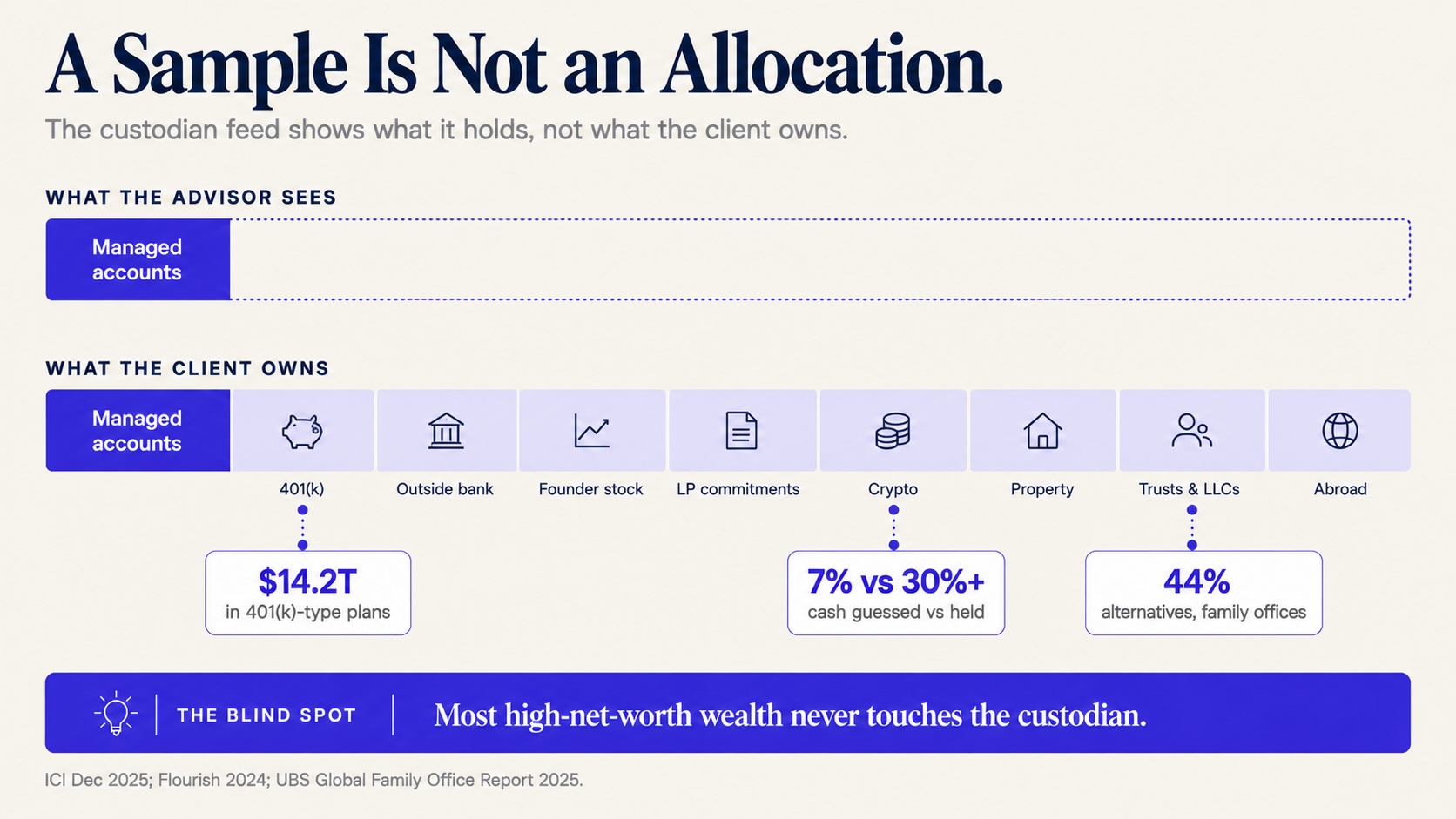
An asset allocation built on managed accounts alone is not an allocation. It is a sample.
Why It Matters to the Firm, Not Just the Client
The fiduciary case is obvious: a recommendation to hold 60% equities is a different recommendation when the client also has $6 million of founder stock and a $2 million rental portfolio the advisor did not know about. Concentration, liquidity, tax location and estate exposure are all balance-sheet questions, and they are answered wrongly when the balance sheet is a third of the size it should be.
The business case is just as direct. Held-away assets are the pipeline for consolidation, and the client who shares them is signalling that the relationship is the primary one. They are also billable: many firms charge for advice on held-away accounts through a flat fee, a retainer, or an assets-under-advisement schedule disclosed in Form ADV, which is discussed below. And they drive retention. A client whose complete picture lives under the firm's brand has a reason to open the app that a quarterly performance PDF never gave them.
Three Ways to Handle Held-Away Assets, and Where the Line Sits
Every approach to held-away assets is one of three postures. They carry different operational burdens and, more importantly, different regulatory consequences.
Report, advise, or manage: the three postures compared
Most of the value for most clients sits in the first two rows. A client whose advisor can see the founder shares, the LP commitments, the wallet and the foreign property, and who builds the plan around all of it, has an advisor who knows something no one else does. Managing a 401(k) is a narrower benefit with a wider set of questions attached.
Account Aggregation and the Custody Rule
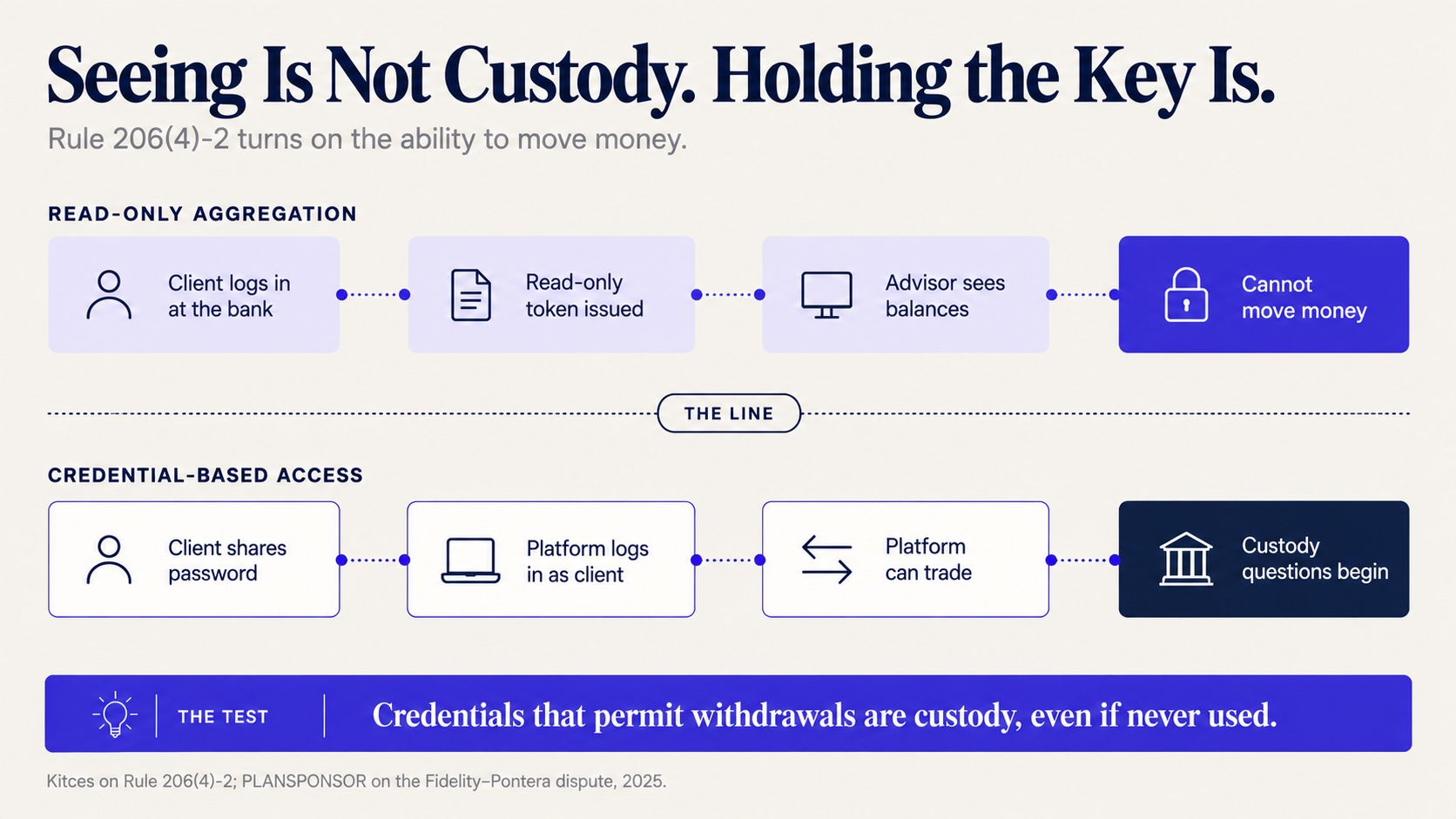
The custody rule, Rule 206(4)-2 under the Advisers Act, is triggered by the ability to move client money, not by seeing it. As Kitces summarizes the SEC's position, when an adviser "holds or controls login credentials that allow for the movement of funds or securities out of the account," that is custody even if the authority is never exercised. Custody brings a surprise examination by a PCAOB-registered accountant, qualified custodian requirements and Form ADV disclosure, and the surprise exam alone typically costs $15,000 to $50,000 a year.
Two design choices keep held-away reporting on the right side of that line. The first is that the client links the account, on the institution's own screen, and the firm never handles the credential. Modern aggregation networks (Plaid, Mastercard, MX, Yodlee, Akoya, SnapTrade and their equivalents abroad) authenticate the client directly with the bank or brokerage and return a read-only token; the advisor sees balances and positions and cannot initiate anything. The second is that the feed is read-only by architecture, not by policy. An aggregator that cannot move money cannot be used to move money, which is a cleaner answer to an examiner than "we have a rule against it."
Credential-based trading access is a different matter. In 2025 Fidelity restricted online access to 401(k) accounts linked to third-party platforms, arguing that shared credentials expose "all accounts, not just 401(k)" and fall outside its security controls, while Charles Schwab chose to reset credentials instead (PLANSPONSOR). Firms that want to manage held-away retirement assets should expect recordkeeper terms, plan-sponsor positions and state regulator guidance to keep moving, and should separate that decision from the much simpler one of seeing the account.
The 2024 Regulation S-P Amendments: Vendor Oversight Is Now Required
The other rule that touches every held-away tool is Regulation S-P, amended in May 2024. Per Baker Donelson, advisers must now maintain a written incident response program, notify affected individuals of a breach of sensitive customer information within 30 days, and, critically for aggregation, maintain written policies for overseeing service providers: due diligence at selection, ongoing monitoring, and a contractual requirement that the provider notify the adviser within 72 hours of discovering unauthorized access to customer information. Larger advisers ($1.5 billion or more in assets) had to comply by December 3, 2025; smaller advisers by June 3, 2026. The SEC's 2026 examination priorities name Reg S-P compliance and oversight of third-party vendors explicitly.
In practice that means an aggregation or balance-sheet vendor is a service provider the firm must be able to document. The questions a CCO will ask are predictable.
Vendor due diligence questions for held-away tools
Kubera's answers to each of these are on its security page and in its SOC 2 Type II report, available under NDA.
How the Tracking Options Compare
There is no single held-away tool, because the assets are not a single kind of thing. The table compares the approaches firms actually use by the categories they cover.
Held-away coverage by approach
The last column is the one that decides whether a held-away program survives contact with a busy practice. When the advisor does the data entry, held-away tracking is a quarterly chore that gets skipped in a good quarter and forgotten in a bad one. When the client links their own accounts once and the values update on their own, the balance sheet is current every time either of them opens it.
Putting Held-Away Assets Into a Review Meeting
The output of all of this is not a bigger report. It is a shorter one. A complete balance sheet lets the review open with the page that matters: everything the client owns, on one screen, in the client's base currency, with what moved since last time.
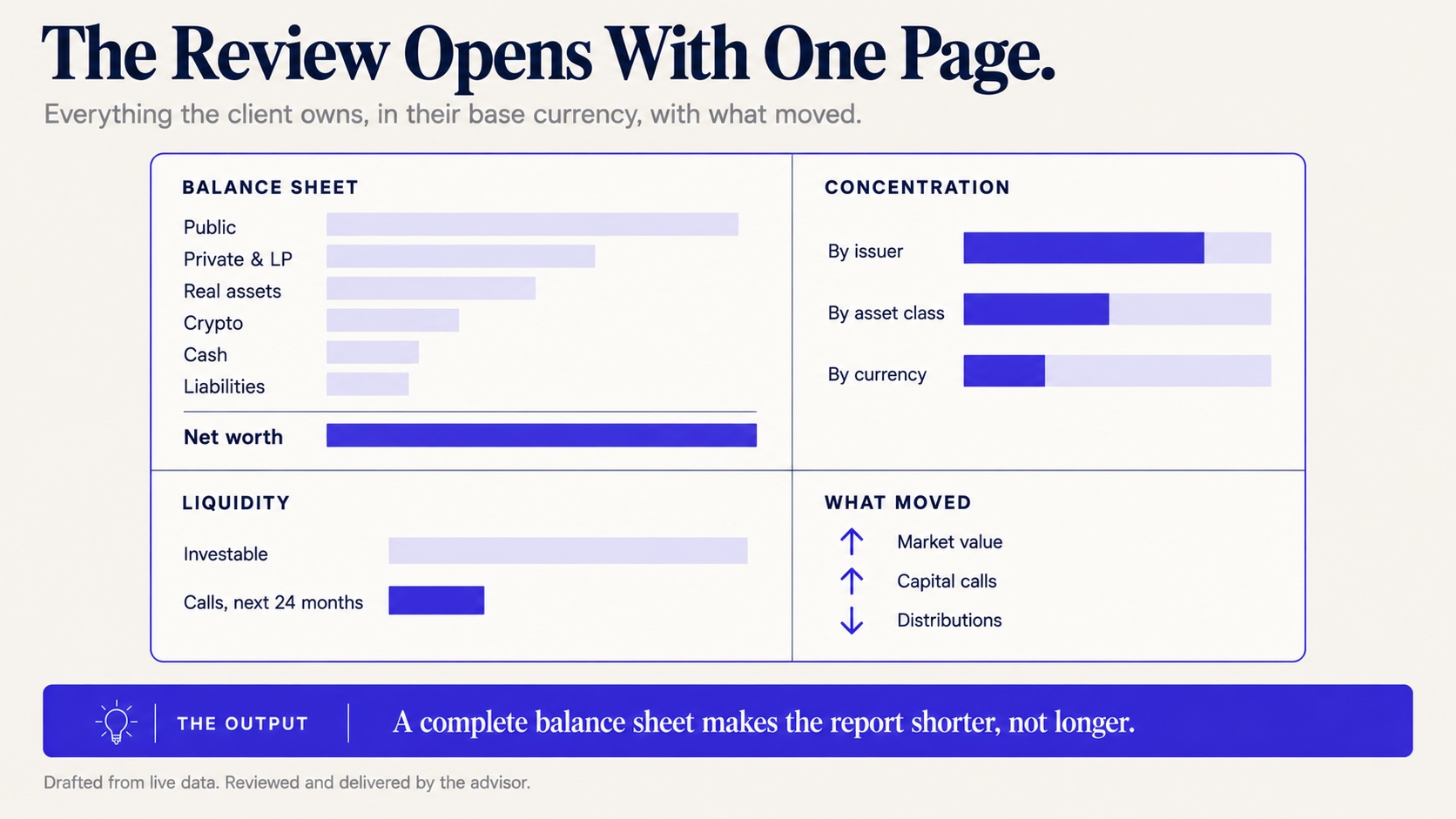
Four things belong on that page, and they are all impossible without the held-away half. Concentration by issuer, asset class and currency, which is where founder stock and a single property usually dominate. Liquidity against commitments, meaning investable assets set against unfunded capital calls over the next 24 months. Return on the whole, not just the managed sleeve, which requires IRR across private positions with irregular cash flows. And what changed, so the meeting starts with the three lines that moved instead of a page-by-page walk through everything that did not. Kubera's Recap does that last part automatically, and the client's AI assistant can draft the first three from live data in the firm's own template.
Getting Clients to Share Held-Away Accounts
Clients do not withhold held-away accounts out of secrecy. They withhold them because sharing has always meant a stack of statements and a form. Two changes fix most of it. The first is to ask for a link, not a document: "connect it once and it stays current" is a different request from "send me your statements every quarter." The second is to give the client something they want to open. Advisor portals are famous for one thing, which is that nobody logs in. A balance sheet the client uses for their own reasons, that happens to carry the firm's name, gets opened on a phone on a Sunday, and the held-away data comes with it.
It also runs in reverse. A growing number of clients already run their own money on a personal balance sheet, decide it is the only place that shows all of it, and ask their advisor to get on it. For those firms the held-away problem has already been solved by the client; the firm just needs to put its name on the solution.
How Kubera White Label Handles Held-Away Assets
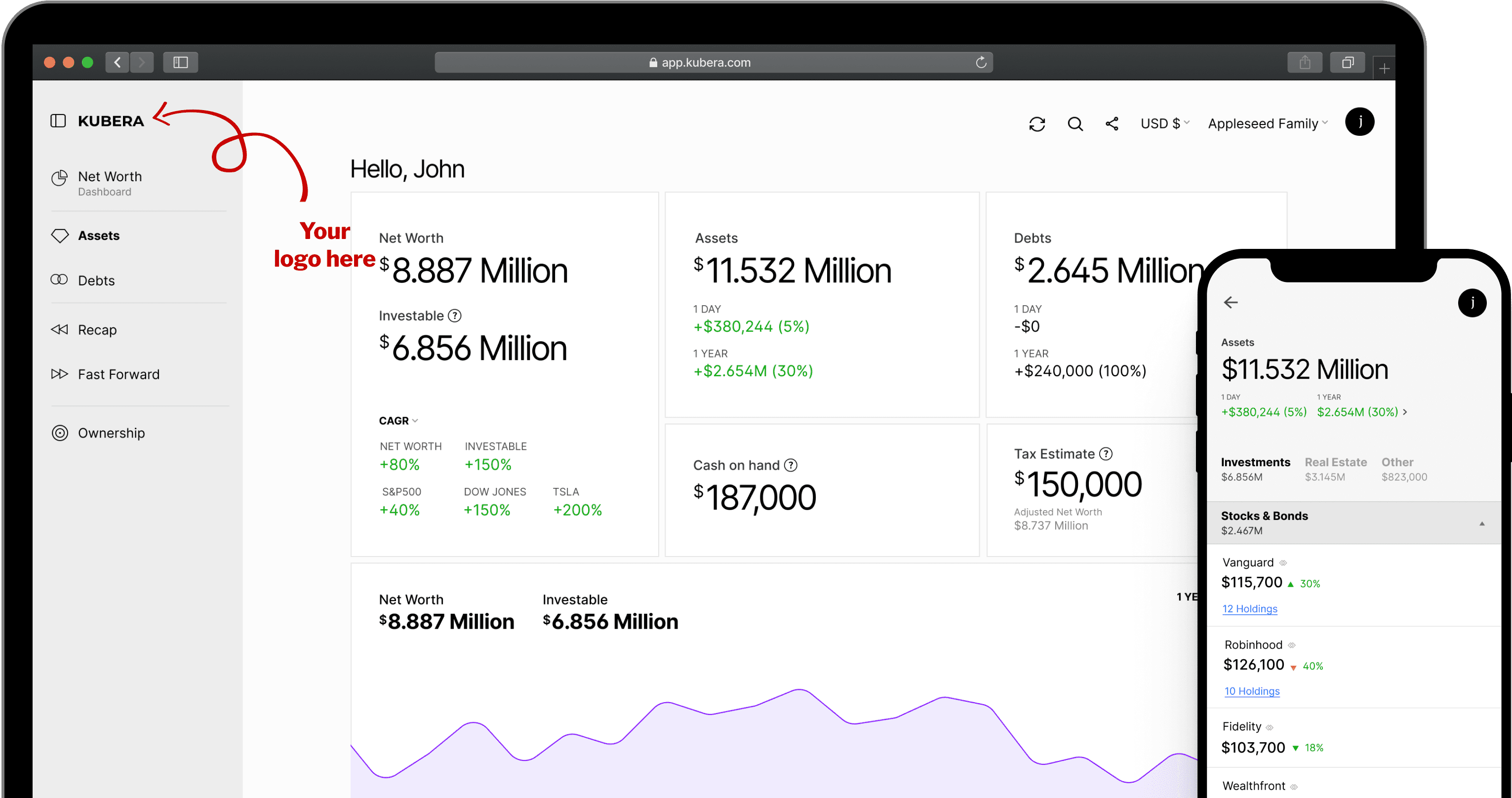
Kubera White Label is the client-facing balance sheet under the firm's own brand and domain, on web and mobile. It covers the whole held-away table above: bank and brokerage through nine aggregator networks, read-only, with the client authenticating on the institution's own screen; employer plans and institutions with no feed at all through Web Sync; private stakes and LP positions with commitments, calls, distributions, unfunded balances and IRR; crypto and DeFi by public address; homes, cars and collectibles with live price feeds and an AI appraiser for the rest; holding companies, trusts and partnerships as nested portfolios with per-person access control, so the trustee sees the trust and the founder sees everything; and any base currency, with multi-currency running through every layer. Statements, screenshots and capital-call notices dropped in become line items.
On the compliance side, the firm holds no credentials, the feeds cannot move money, the SOC 2 Type II report is available under NDA before signing, and the client's AI connection can be turned off firm-wide. Pricing starts at $300 a month and moves with client portfolios rather than assets, with no implementation fee, and setup starts within 24 hours. Kubera is not custodian reconciliation, billing, trading or a CRM; it runs alongside Orion, Black Diamond, Tamarac, Addepar, eMoney and RightCapital and shows the client the part of their wealth those systems cannot.
Request a demo, or take the 14-day trial as a client first and connect your own held-away accounts.
Frequently Asked Questions
What are held-away assets?
Held-away assets are a client's holdings outside the accounts an advisor manages: employer retirement plans, outside brokerage and bank accounts, private company equity, fund commitments, crypto, real estate and collectibles, trusts and entities, and accounts in other countries. For many high-net-worth clients they are the majority of net worth.
Can financial advisors charge fees on held-away assets?
Many do, through a flat fee, a retainer, or an assets-under-advisement schedule for advice on accounts they do not manage, disclosed in Form ADV Part 2. Charging an AUM fee for managing a held-away account, such as a 401(k), depends on how the account is accessed and on the plan's and recordkeeper's terms. Consult compliance counsel on the fee structure.
Does account aggregation create custody?
Not by itself. The custody rule turns on the ability to withdraw funds or securities. Read-only aggregation where the client authenticates on the institution's site and the advisor never holds a credential that can move money does not confer custody. Holding credentials that permit withdrawals does, even if never used.
What is the difference between held-away and unmanaged assets?
The terms overlap. "Held-away" describes where the asset sits (outside advisory custody); "unmanaged" describes the advisor's role (no discretion). A 401(k) is both. A managed account at a second custodian is held away from the primary custodian but not unmanaged.
How do advisors track a client's 401(k)?
Three ways: a balance the client reports, a read-only aggregator link the client establishes, or a credential-based platform that also allows trading. Read-only linking keeps the account current for planning without the custody, recordkeeper and plan-sponsor questions that trading access raises.
Can held-away assets be included in performance reporting?
Yes for planning and balance-sheet purposes, with clear labelling. Including them in advertised or composite performance is a Marketing Rule question, and GIPS composites exclude assets the firm does not manage. Most firms show the whole balance sheet with return on the whole, and keep advertised performance to managed assets.
What should an RIA ask a held-away or aggregation vendor?
Whether a SOC 2 Type II report is available to read, who holds credentials, whether the platform can move money, how data is encrypted, the breach-notification commitment (72 hours under amended Reg S-P), deletion and backup policy, and whether client data is used to train AI models.
Does Kubera replace my portfolio accounting or planning software?
No. It sits beside them and covers what they cannot: held-away, private, crypto, real assets, entities and currencies, in a balance sheet the client actually opens.
The Principle Worth Keeping
The custodian feed is a sample. The balance sheet is the population. Report on everything, advise on what the client will act on, and be deliberate about managing anything that requires holding a credential. Let the client link their own accounts once, give them a reason to open the result, and the held-away problem stops being a quarterly chore and becomes the reason the firm is the primary advisor.
This article is general information, not legal or compliance advice. Custody, fee and privacy rules are applied to specific facts; confirm your firm's approach with compliance counsel.


