

Addepar does not publish its prices. Neither do most of the platforms it is compared with. That leaves a firm evaluating portfolio reporting software with a demo, a quote that arrives after the demo, and no way to know whether the number is typical. This guide assembles what is publicly reported about Addepar pricing, explains how the model works, shows what the same bill looks like as a book grows, and sets out what smaller RIAs and family offices pay instead.
Every figure below is either from Addepar's own materials or from a named third party, with the date. Where sources disagree, both numbers are shown, because the disagreement is itself useful: it tells you how wide the quoting range really is.
How Addepar Pricing Works
Addepar sells a platform license to a firm, not seats to individuals. Per andsimple.co's 2026 review, contracts are "quoted per client and typically scale with assets on platform," with basis-point pricing as the default and flat-fee options available, and the price also moves with the number of entities, the number of data feeds, and which modules the firm takes. Sacra's analysis puts the rate between 0.008% and 0.03% of assets, which is 0.8 to 3 basis points, and notes that Addepar "charges 10% to 80% more than rivals for firms with modest AUM." Aleta narrows the commonly reported band to 1.2 to 1.5 bps.
Three consequences follow from that structure. First, the bill grows with the market and with every client the firm wins, whether or not the firm uses the platform any differently. Second, two firms with the same number of clients can pay very different amounts, because a $2 billion book and a $400 million book are priced on the assets, not the work. Third, the number a firm is quoted is negotiable in a way a published price is not, which is why third-party ranges are so wide.
An AUM-priced platform is a partner in the firm's growth. The bill goes up every year the firm does.
What Third Parties Report Addepar Costs
No single source is authoritative, so the table shows each one with its date. The spread is real: a small family office with a handful of custodians and a single-family-office starting configuration sits at the bottom; a multi-billion-dollar RIA with alternatives data services and multiple modules sits well above the average.
Reported Addepar pricing, by source
Addepar has not confirmed any of these figures. Treat them as the range a firm should expect to be quoted within, not as a price list.
The context behind those numbers matters. Sacra reports Addepar revenue of $275 million in 2024, up 31% from $210 million in 2023, across roughly 1,200 client firms, with about half of the client base made up of RIAs. andsimple.co reports the platform now tracks more than $9 trillion in assets across 1,400+ firms in about 60 countries as of the first quarter of 2026. Divide revenue by firms and the average contract lands in the low six figures, which is consistent with the $229,000 average contract value Sacra reports. That is the number a prospective customer should keep in mind when a first quote looks low: the average client pays a great deal more than the entry point.
The Basis-Point Bill as a Book Grows
Basis points sound small. The arithmetic does not stay small. The table uses 1.5 bps, the upper end of Aleta's reported band and the rate third parties most often cite for AUM-priced reporting platforms, and shows the annual platform fee at each level of assets on the platform.
Annual platform fee at 1.5 basis points
Illustrative. Real contracts include minimums at the low end and negotiated rates at the high end, so a $250 million firm is unlikely to pay only $20,000 and a $5 billion firm is unlikely to pay the full undiscounted rate.
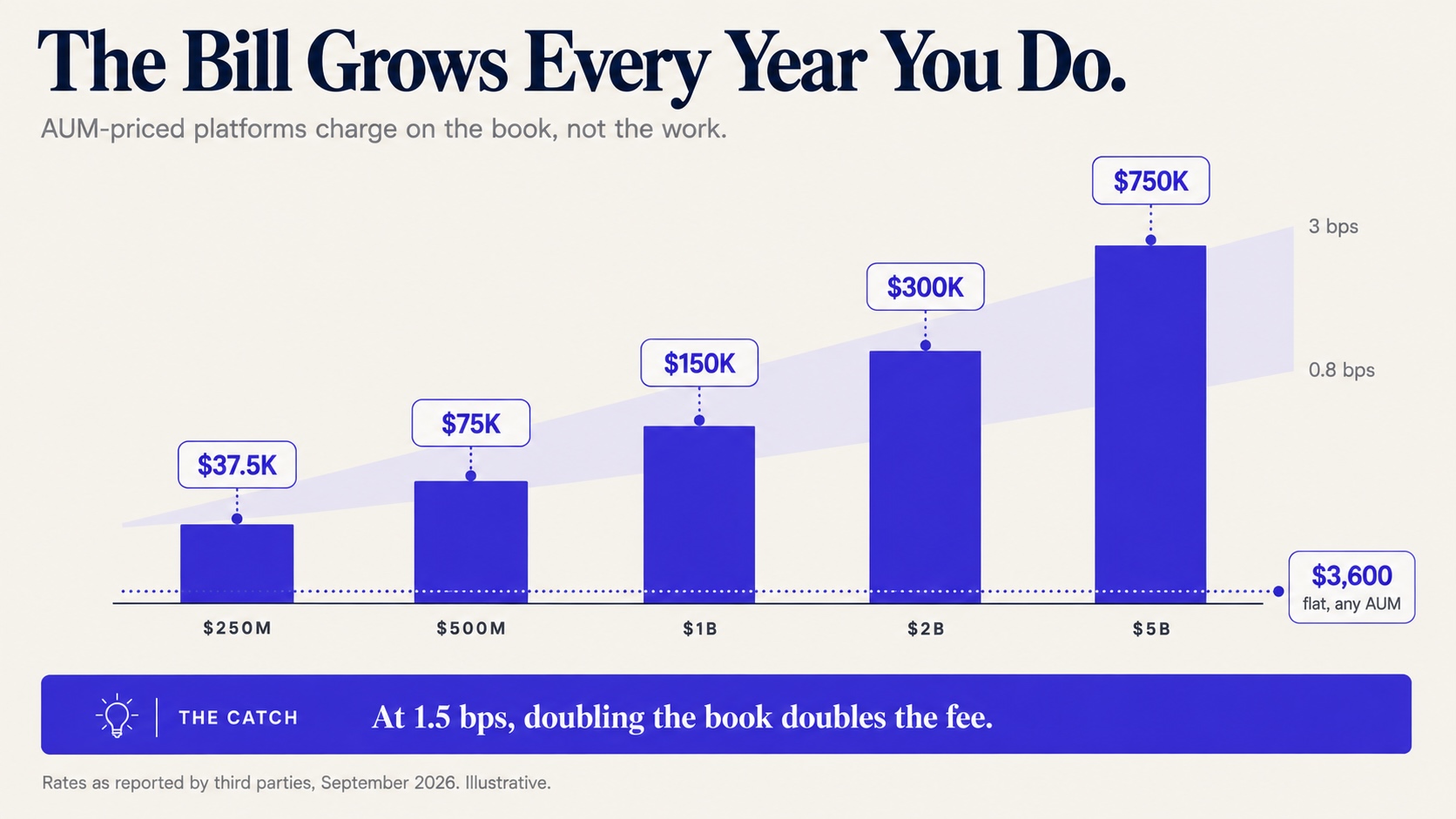
Two things are visible in that table. The first is the reason Addepar is priced this way: a $5 billion firm that gets institutional-grade reporting for $750,000 is paying a small fraction of one basis point of the fees it earns. For that firm, the pricing model is sensible. The second is the reason smaller firms feel the pinch. A $400 million RIA pays roughly the same per dollar of assets as a $4 billion one, but its revenue is a tenth the size and its reporting needs are usually simpler. Sacra's note that Addepar charges a premium for "firms with modest AUM" is the same point from the vendor's side.
The Total Cost Stack: What Sits Under the License
The license is the largest line, not the only one. A firm budgeting for Addepar should price the whole stack.
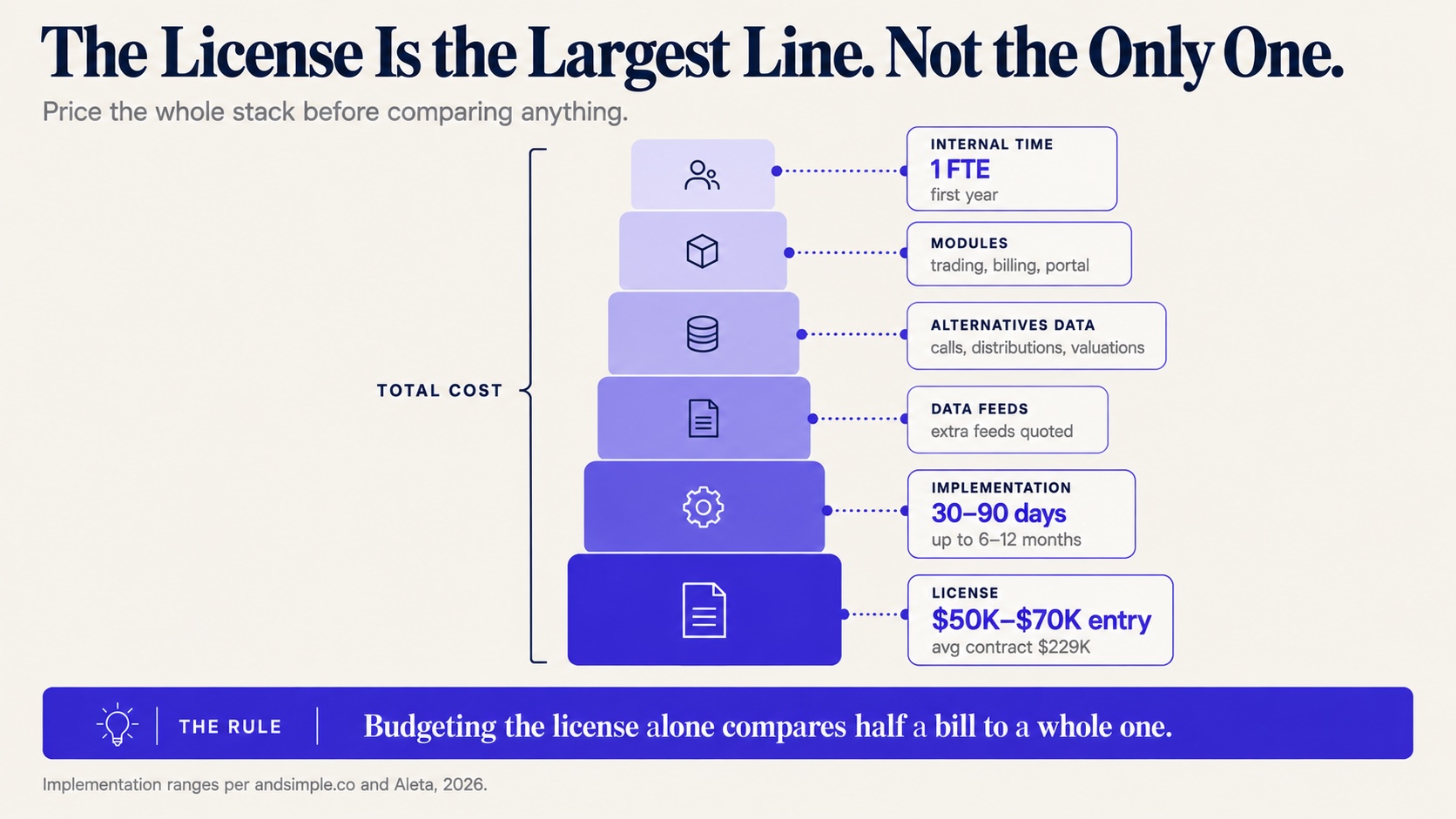
Cost lines beyond the platform license
A useful rule: take the quoted license, add the implementation project, and add one full-time-equivalent's worth of internal time for the first year. That is the cost of the decision, and it is the number to compare against alternatives. A firm that budgets the license alone is comparing half a bill to a whole one.
Who Addepar Is Built For
None of the above is an argument that Addepar is overpriced. It is an argument that Addepar is priced for a particular kind of firm, and the honest question is whether yours is one of them.
Addepar earns its cost where a firm has several of the following at once: dozens or hundreds of legal entities with layered ownership; multiple custodians and fund administrators whose feeds must be reconciled to the transaction; meaningful private equity, venture and hedge fund exposure with capital-call and distribution tracking; multiple generations and jurisdictions; and clients or investment committees who expect institutional performance attribution. andsimple.co describes the fit as organizations with "many entities, several custodians, meaningful alternatives exposure, multiple generations and jurisdictions," and that is right. A $3 billion multi-family office serving twelve families through eighty entities is the customer the platform was designed for.
It is also worth being clear about what Addepar is not. It is a reporting and analysis platform, not a general ledger, and not a financial planning suite. Family offices that need books, bill pay and partnership accounting pair it with an accounting system; advisors who need planning pair it with eMoney or RightCapital. The firm is buying one layer of a stack.
Where the Pricing Model Breaks Down
The same model that makes sense at $5 billion produces poor value for four kinds of firm.
- The $200 million to $1 billion RIA. Reporting needs are real but not institutional. The firm pays a rate designed for complexity it does not have, and a Sacra-reported premium on top for being small.
- The multi-family office with ten to fifty families. Hundreds of entities, but the families want a live balance sheet more than they want attribution. The office pays for a reconciliation engine to answer the question "what do we own and what is it worth today?"
- The advisor whose value is off the custodian feed. Founders with concentrated private stock, LP commitments, crypto wallets and property in two countries. The expensive part of Addepar is custodian reconciliation; the client's wealth is mostly somewhere else.
- The firm that keeps its system of record and needs a client-facing layer. Orion, Black Diamond or Tamarac already handles trading, billing and performance. Adding Addepar to get a portal the client will actually open is paying for the platform twice.
The question is not whether Addepar is worth $150,000. It is whether your firm has the $150,000 problem.
Addepar Pricing Compared With Alternatives
The comparison below covers the platforms most often shortlisted alongside Addepar, and the one that is usually shortlisted for a different reason. Prices are as reported by the sources linked in this article and by Kubera's Addepar competitors guide; only Kubera publishes its price.
Reporting platforms compared, September 2026
Addepar, Masttro, Eton, Black Diamond and Orion do not publish pricing. Figures are as reported by the third parties named above and will vary by firm. Kubera pricing as published, September 2026.
Is Addepar Worth It? A Decision Framework
Answer these in order. The platform decision should fall out of the answers rather than being made first and justified afterward.
Seven questions before signing an AUM-priced reporting contract
What Smaller Firms Pay Instead
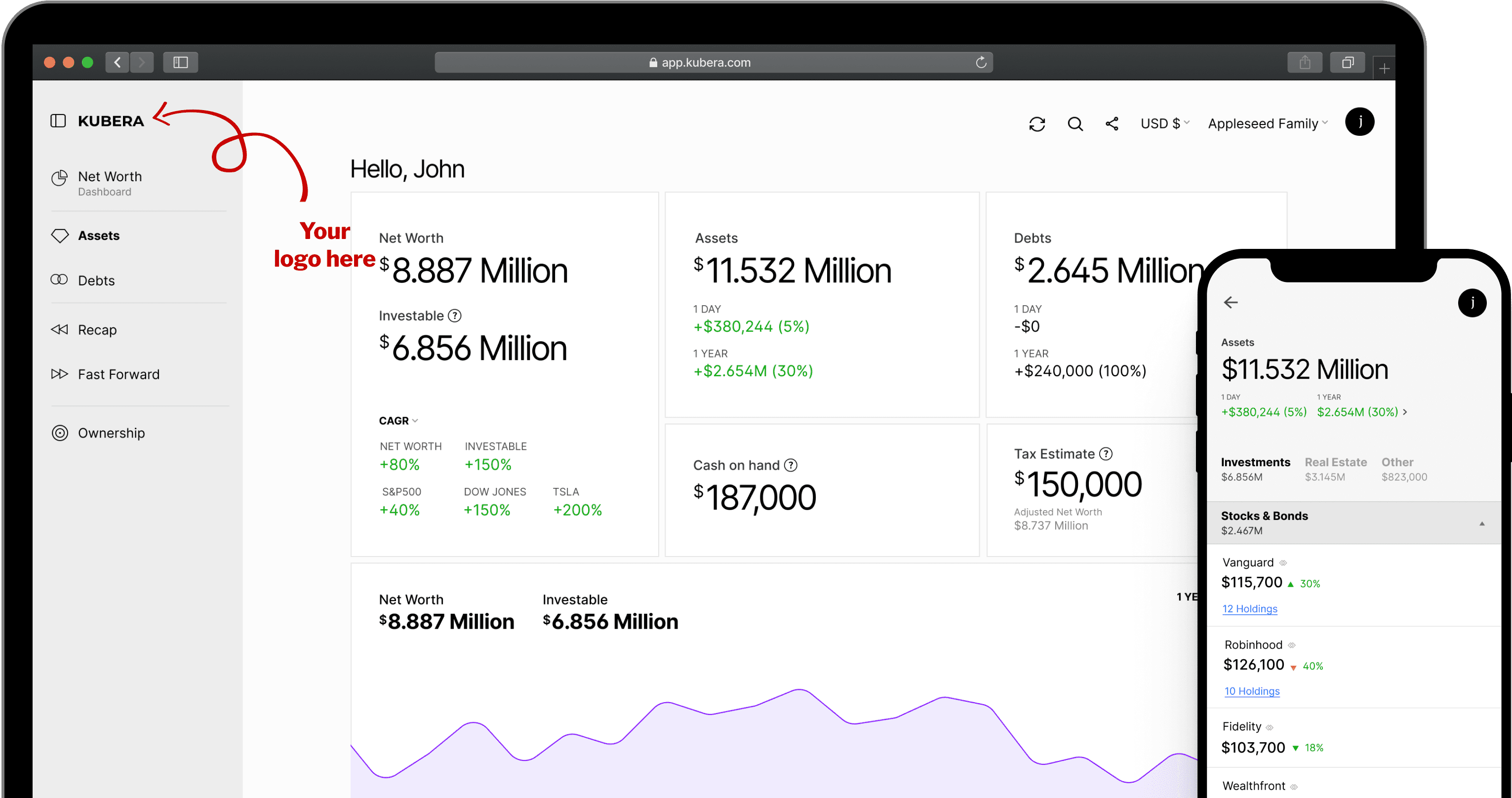
For the four kinds of firm described above, the alternative is usually not a cheaper Addepar. It is a different layer. Kubera White Label is the client-facing balance sheet under the firm's own brand and domain: every asset class, every currency, every entity, on web and mobile, with the same coverage the firm's best clients already use on their own.

The differences are concrete. Pricing starts at $300 a month and moves with the number of client portfolios, not with assets, so a client with $200 million costs the same as one with $2 million and the bill does not grow with the market. There is no implementation fee, and setup starts within 24 hours of signing rather than after a project plan. Coverage runs through every major aggregator (Plaid, Mastercard, MX, Yodlee, Akoya, SnapTrade, Lean, Akahu and Salt Edge), and extends to private stakes and LP positions with commitments, calls, distributions and IRR; crypto and DeFi by public address; homes, cars and collectibles; holding companies, trusts and partnerships with per-person access control; and any base currency. The firm's clients can connect the balance sheet to Claude, ChatGPT, Gemini, Grok, Perplexity or anything else that speaks MCP, and the firm can turn that off firm-wide. The SOC 2 Type II report is available under NDA before signing.
The boundary is worth stating as plainly as the price. Kubera is not custodian reconciliation, trade-date accounting, fee billing, trading, rebalancing, GIPS composites or a CRM. It is designed to run alongside Orion, Black Diamond, Tamarac, Addepar, eMoney and RightCapital, and to show the client the part of their wealth those systems cannot. A firm that needs the reconciliation engine should buy the reconciliation engine. A firm that needs the client to open the app should not pay for the engine to get the app.
Request a demo to see what your clients would see, or take the 14-day trial as a client first.
Frequently Asked Questions
How much does Addepar cost per year?
Addepar does not publish pricing. Third parties report entry points of roughly $50,000 to $70,000 a year for a single family office before implementation, an average contract value of about $229,000 (Sacra, 2024), and $100,000 to $300,000+ for larger books. Quotes scale with assets on the platform, entities, data feeds and modules.
Does Addepar charge basis points on AUM?
Yes, by most accounts. Sacra reports rates of 0.8 to 3 basis points and Aleta reports 1.2 to 1.5 basis points, with flat-fee options also available. At 1.5 bps, a $1 billion book implies about $150,000 a year for the platform license alone.
Is there an Addepar minimum?
Addepar does not publish a minimum, but reported entry points of $50,000 to $70,000 a year function as one in practice, and third parties position the platform for firms with $50 million or more in assets. Smaller firms typically find the per-dollar cost highest.
How long does Addepar implementation take?
Reports range from about 30 days on the expedited AddeparGO route and 60 to 90 days for a standard onboarding (andsimple.co) to 6 to 12 months for complex multi-entity, multi-custodian setups (Aleta). Implementation is a separate project from the license.
Is Addepar available for individual investors?
No. Addepar is sold to firms: RIAs, family offices, private banks and institutions. An individual wanting the same consolidated view uses a personal net worth tracker such as Kubera, which is what many advisors' clients already do before asking their firm to white-label it.
What is the cheapest alternative to Addepar?
It depends on which layer you need. For family office reporting without AUM pricing, Aleta and Asora publish entry points around $1,000 and $900 a month. For a client-facing balance sheet covering every asset class, entity and currency, Kubera White Label starts at $300 a month with no implementation fee. For a full RIA system of record, Orion and Black Diamond are quoted case by case.
Can a firm use Addepar and Kubera together?
Yes. Addepar is the reconciliation and performance engine; Kubera is the client-facing balance sheet that covers held-away, private, crypto, real assets, entities and currencies. Firms run Kubera alongside Addepar, Orion, Black Diamond, Tamarac, eMoney and RightCapital.
How does Addepar pricing compare with Black Diamond or Orion?
None of the three publishes prices, and all quote by firm. Addepar is the only one widely reported to price primarily on assets on the platform. Black Diamond and Orion are RIA systems of record with billing and trading built in, so the comparison is between different kinds of platform as much as between prices. See Addepar vs. Orion and Addepar vs. Black Diamond.
The Principle Worth Keeping
Price the whole stack, model the fee at the assets you plan to have rather than the assets you have now, and decide which layer you are actually buying. Addepar is excellent at reconciling complexity, and firms with that complexity should expect to pay six figures for it. Firms whose real need is a balance sheet the client will open should not.
Pricing information in this article is as reported by the named third parties in September 2026 and has not been confirmed by Addepar, Masttro, Eton Solutions, SS&C or Orion. Kubera pricing is as published on kubera.com. Verify current terms with each vendor before making a decision.


