Kubera vs Addepar
Institutional reporting sold by quote and implemented over months, against a balance sheet a person opens in a minute. Which side of the line you are on.


ASK AI
about kubera
about kubera
Addepar is the platform large wealth managers and family offices run their reporting on: $9 trillion across 1,400+ clients, deep alternatives data, priced by quote and implemented over months. Kubera is a net-worth tracker a person signs up for in a minute, and a white-label version an adviser can put in front of clients for a flat monthly fee per client portfolio, a small fraction of what the platforms charge, with no contract and no implementation project. They are rarely a real choice against each other, so this page is about which side of the line you are on.
Facts checked on 5 October 2026. Competitor prices and limits come from their own sites and help centres where they publish them; where they do not, the page says who reported the figure.
| Kubera | Addepar | |
|---|---|---|
| Who it is sold to | Individuals and families (Essentials, Black); advisers and family offices (White Label). | Wealth managers, banks, family offices, fund managers. Not sold to individuals. |
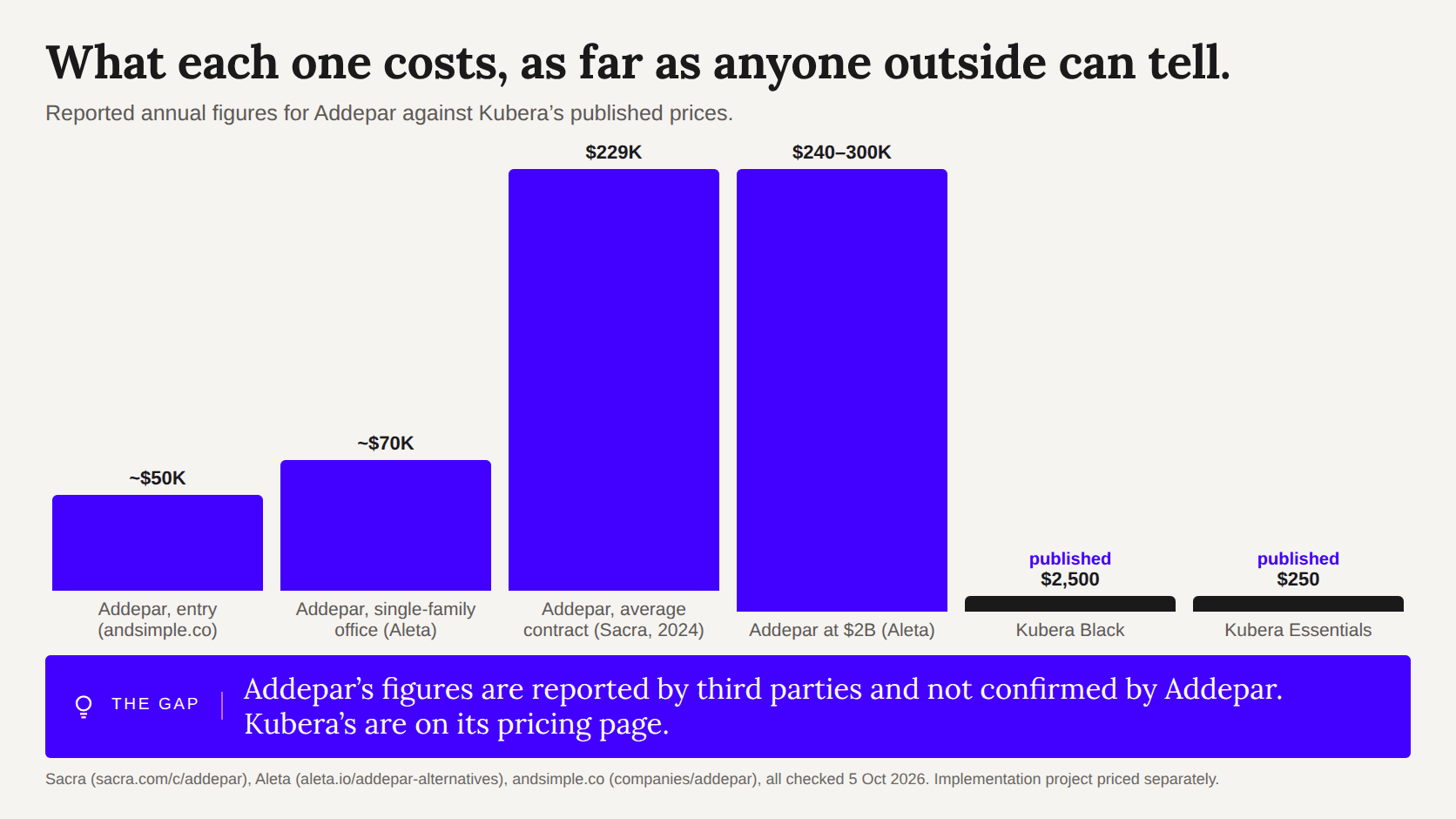
| Price | Essentials $250 a year; Black $2,500 a year. White Label: a flat monthly fee per client portfolio, not a percentage of assets, month to month, no implementation fee. A small fraction of the figures in the next column. | By quote. Reported at 0.8–3 basis points of assets (Sacra); about $70K a year for a single-family office and $240–300K at $2 billion (Aleta); entry commonly about $50K a year plus a separate implementation project (andsimple.co). Not confirmed by Addepar. |
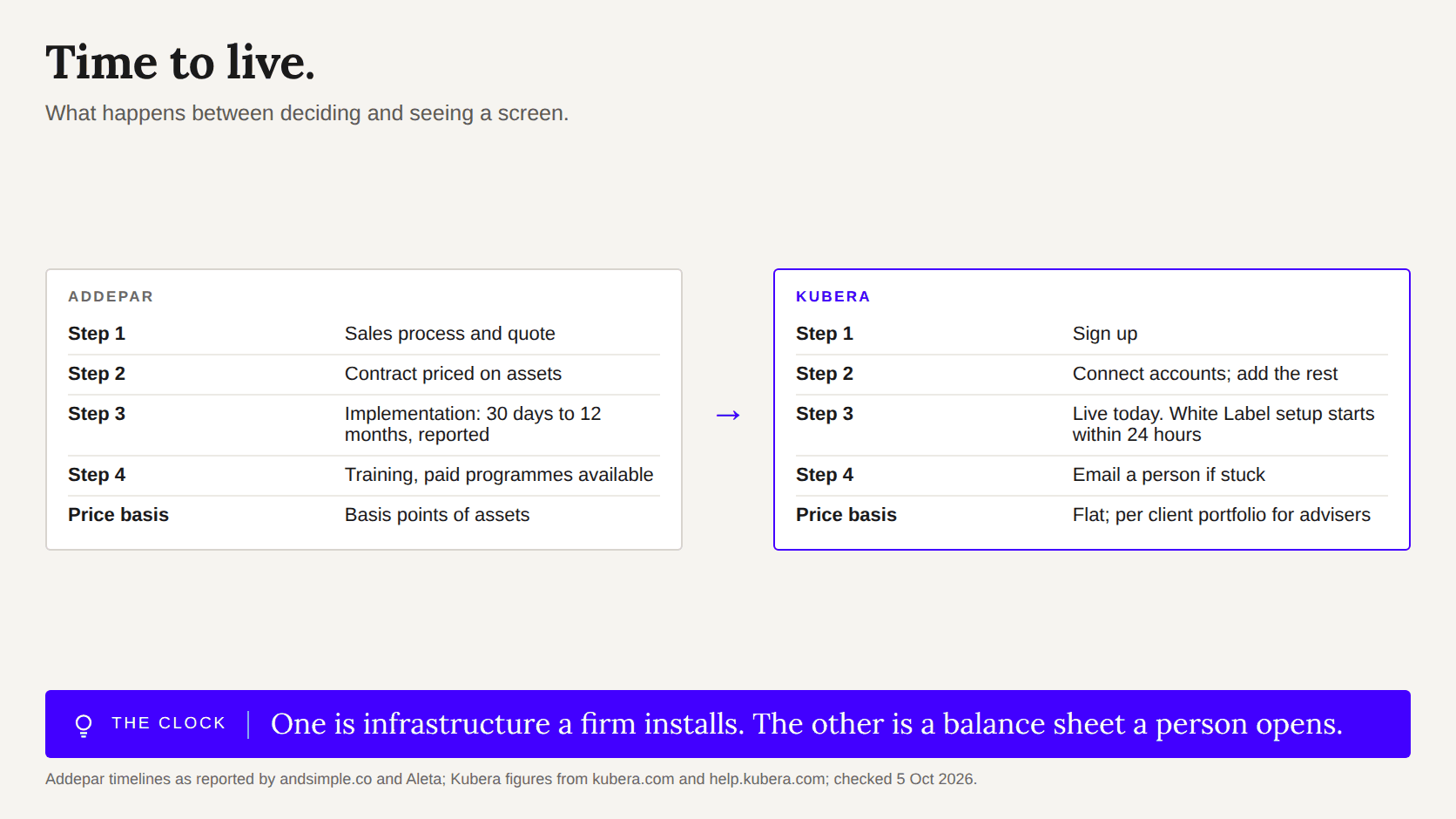
| Time to live | Minutes for an individual. White Label setup starts within 24 hours; no implementation fee. | Reported 60–90 days standard, about 30 days on the fast route, 6–12 months for complex setups (andsimple.co, Aleta). |
| Scale | Serious money: more than $160 billion in assets is tracked on Kubera. | $9 trillion across 1,400+ clients in 60+ countries, per Addepar. |
| Alternatives and private investments | Private stock, LP positions, commitments with a capital-call and distribution schedule, IRR per position, documents. | Deep: over 40% of assets on the platform are alternatives (Aleta); dedicated alternatives data management. |
| Everything the client owns | Banks, brokerages, crypto, property, vehicles, collectibles, loans; 40+ countries; any currency. | Custodian feeds and alternatives; built around the assets a firm manages or reports on. |
| Entities | Nested portfolios and ownership tags for trusts and LLCs (Black and White Label). | Institutional entity and partnership structures. |
| AI | Read-only connection to ChatGPT, Claude, Grok and other assistants; a firm can switch it off for all clients. | Addison, Addepar’s own AI inside the platform. |
| Security | SOC 2 Type II, report under NDA before signing. No stored credentials. Cannot move money. | Enterprise security program; details on request. |
| Support | Email from a person; 1:1 Zoom on Black and White Label. | Enterprise account teams; paid training programmes. |
Addepar is infrastructure. A firm buys it the way it buys a custodian relationship: a sales process, a contract priced on assets, an implementation that third parties put at anywhere from thirty days to a year, then a platform the operations team lives in. For a firm managing billions across many entities, that is what the job needs, and nothing in Kubera replaces it.
Kubera is a balance sheet. A person signs up and connects accounts. An adviser signs up for White Label, and within a day can give each client a branded login that shows that client everything they own, including the four-fifths an adviser typically does not manage. There is no implementation fee and the price does not move when the client’s assets do.
Addepar prices the way institutional software always has: by quote, on assets, with an implementation project on top, and nothing published. The best public figures: Sacra reports 0.8 to 3 basis points of assets, with higher rates for smaller firms and an average contract of $229,000 in 2024; Aleta reports about $70,000 a year for a single-family office and $240,000 to $300,000 at $2 billion; andsimple.co reports entry commonly around $50,000 a year plus a separate implementation project. None of these is confirmed by Addepar, and the number you are quoted will depend on assets, entities, feeds and modules.
Kubera White Label is priced the way modern software is: a flat monthly fee per client portfolio, not a percentage of assets, no contract, no implementation fee, and a quote that takes one email rather than a procurement cycle. A client with $2 million costs the same as one with $2 billion, and a whole practice costs a small fraction of a single Addepar seat. Kubera’s own Addepar pricing guide goes into the reported figures in more detail.
Attribution, partnership accounting, institutional benchmarking, custodian data at scale, and alternatives tooling: Addepar is built for these and Kubera is not. If your firm needs performance reporting that survives an audit committee, Addepar or one of its institutional rivals is the right category, and Kubera belongs beside it as the client-facing balance sheet, not instead of it. Several family offices run exactly that pair.
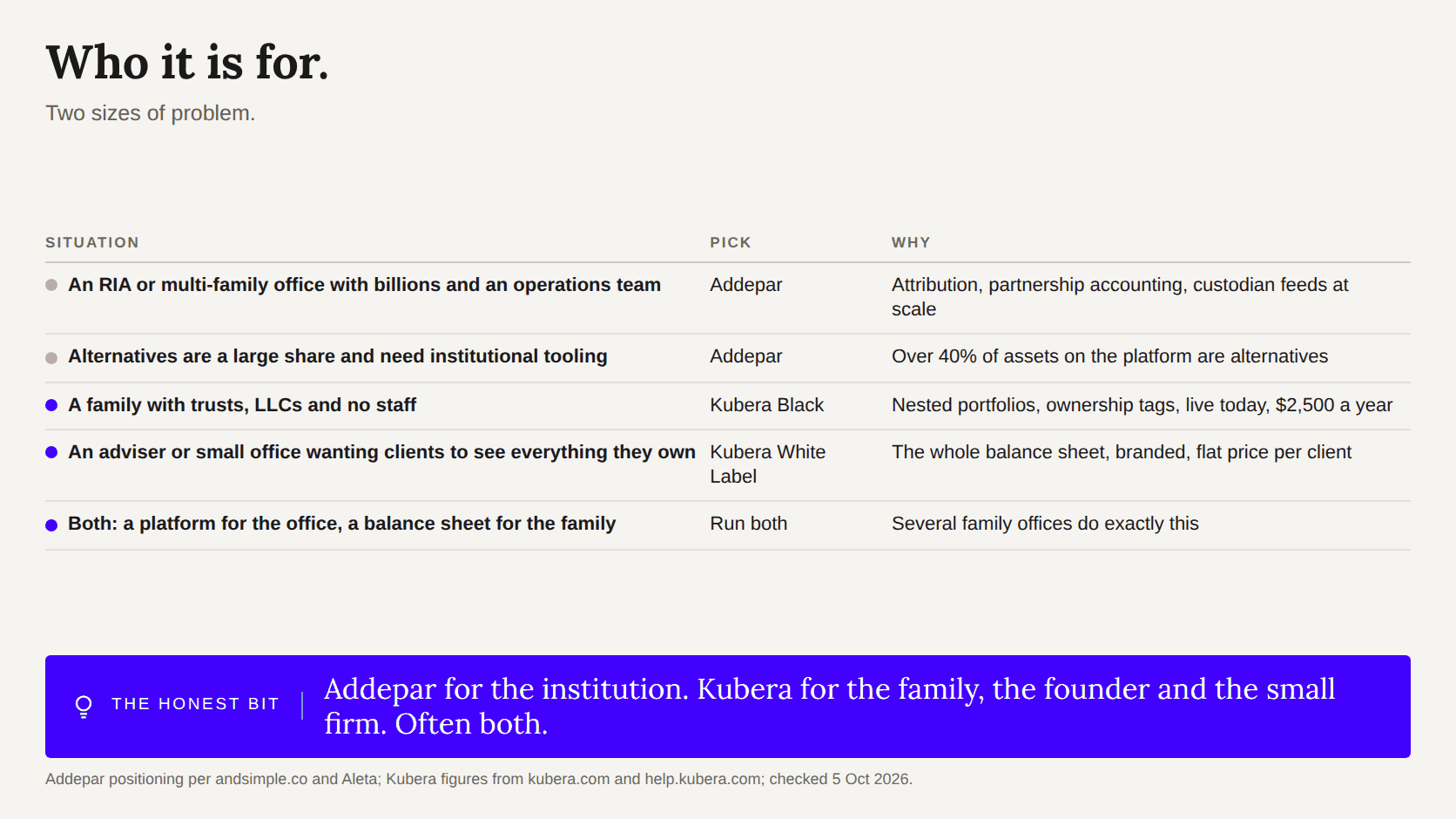
Speed, price and completeness for the client. Kubera shows the client everything, not just the managed sleeve: the house, the crypto, the angel investments, the accounts at the other adviser. It is live in a day, costs a flat monthly fee, and connects the whole picture, read-only, to the AI assistant the client already uses, which the firm can switch off for everyone if its compliance policy says so. For an individual or a family with a couple of trusts and an LLC, Kubera Black does the consolidation at $2,500 a year with nobody to implement it.
“I like it better than Addepar, which is the 800lb gorilla in the private wealth space.”
“I have a semi complex estate with various entities and have been very pleased with Kubera's features and ease of navigating.”
“I can track PE/VC fund commitments, drawdowns, real estate investments with rental income, and personal loans I've issued.”


