

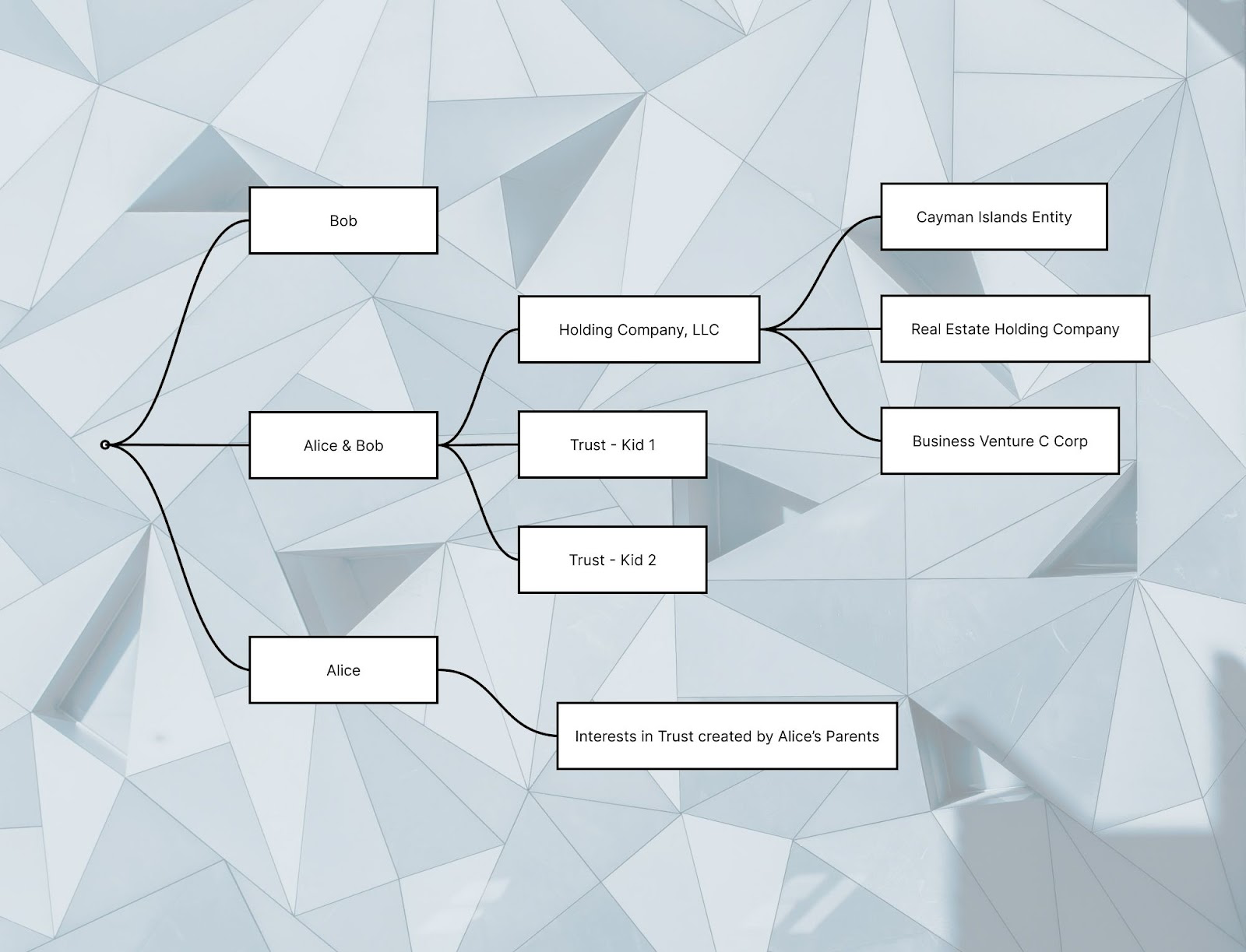
At some point a household stops being a household and becomes a structure. The house is in a revocable trust. The rentals sit in an LLC. There is a family partnership that holds the fund interests, a 529 for each child, a brokerage account in one spouse's name and a retirement plan in the other's, and a parent whose affairs one of you now manages. Each piece has a reason. Together they have a problem: nobody can answer the simple question, what are we worth, without an afternoon and a spreadsheet, and the spreadsheet is wrong by the time it is finished.
This guide covers why the usual fixes fail, the two ways to model multi-entity wealth so the whole is visible without double counting, how to decide between them, who in the family should see what, how to keep the structure current, how it survives the person who built it, and where the boundary sits between tracking a structure and running one.
Tracking Net Worth Across Entities at a Glance
- The goal is three views of one set of numbers: by person (what is mine, what is my spouse's, what is the children's), by entity (what the trust holds, what the LLC holds) and consolidated (what the family is worth), with every asset counted exactly once.
- There are two ways to build it. Ownership tags keep everything in one portfolio and tag each asset by owner, so the breakdown by person, trust or entity is a filter. Nested portfolios give each person, trust or entity its own portfolio and link them into a parent, where each linked portfolio appears as one asset row and one debt row, with money flows between them tracked and access controlled per portfolio. Both are Kubera Black features (help centre).
- Tags suit a family that wants one login and a breakdown. Nesting suits a family where different people should see different things, where entities transact with each other, or where an outsider such as a trustee, a bookkeeper or an adult child needs access to one part and not the rest.
- Access has layers: the account owner, full-access users, collaborators on a single portfolio, read-only links with a passcode and expiry, and an emergency contact who receives everything if you go silent (help centre).
- Kubera tracks the structure; it does not run it. Entity accounting, tax filings and legal formalities stay with the CPA and the attorney. See the Kubera wealth tracker.
Tags, nesting and who sees what, on one fictional family, in four minutes:
Why the Usual Fixes Fail
Families with entities usually try three things before they find something that works. The first is the master spreadsheet. It is accurate on the day it is built and decays from then on, because each of its forty cells is a value someone has to look up, and nobody does. Its second failure is subtler: it cannot show ownership. A rental that is 100% inside an LLC that is 50% each spouse's is one number in a spreadsheet and three facts in reality.
The second fix is one tracking app with every account connected under one login. This gives a total and loses the structure; the trust's brokerage and the personal one are indistinguishable, and the moment a second person needs to see only their part, the single login becomes the problem. The third fix is the opposite: a separate app or login per entity, which preserves the structure and loses the total, and which nobody reconciles.
What is wanted is one set of numbers with three views: by person, by entity, and consolidated. The rule that makes it work is that every asset is recorded once, in the place it is legally held, and that ownership is a property of the asset rather than a copy of it.
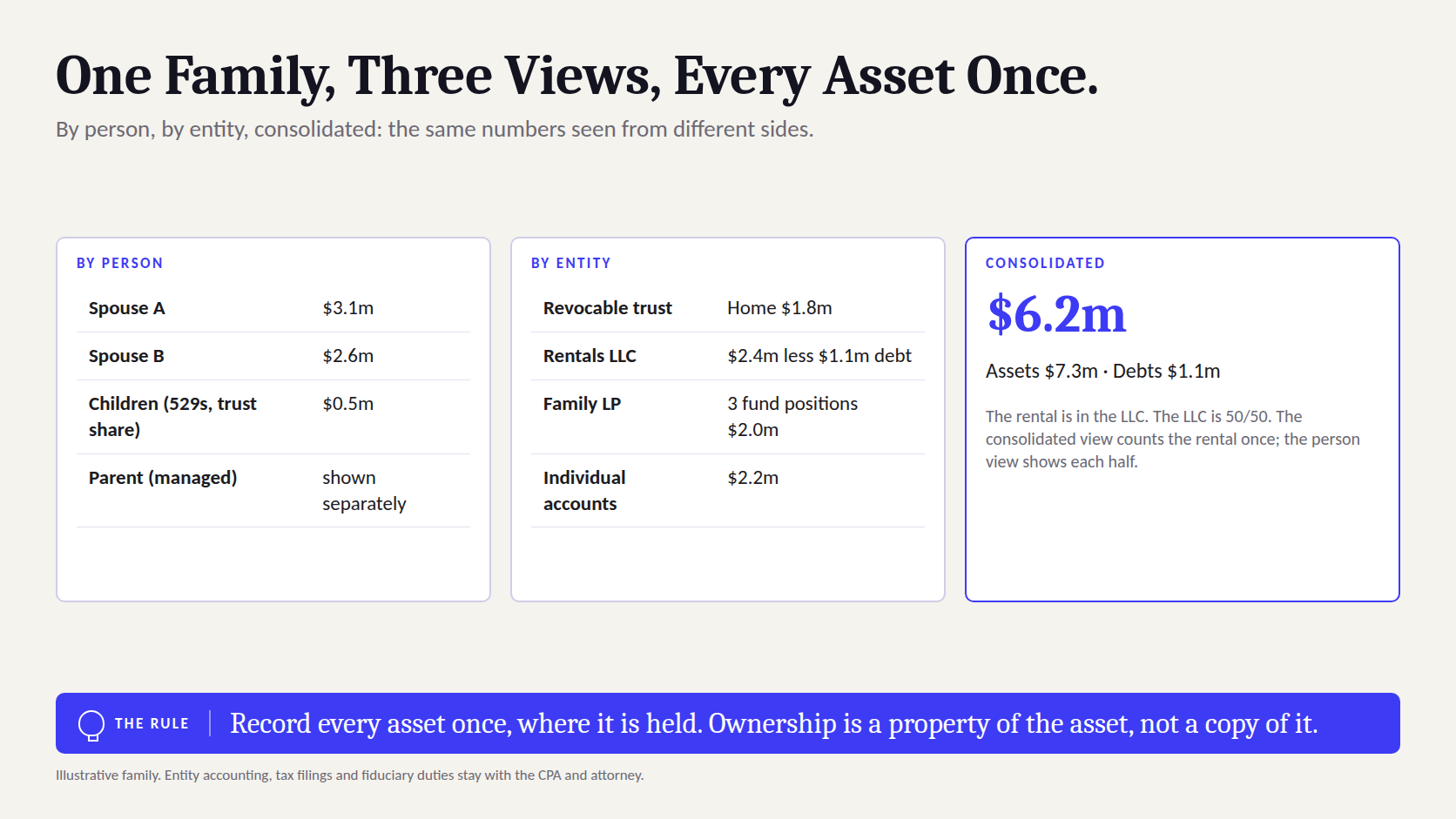
A family structure and where each asset actually lives (illustrative)
| Asset | Legal holder | Beneficial owners | Where it is recorded once |
|---|---|---|---|
| Primary home | Revocable living trust | Both spouses | In the trust's portfolio, or tagged to the trust |
| Two rental properties and their mortgages | Rentals LLC | 50% each spouse | In the LLC's portfolio, or tagged to the LLC |
| Fund commitments (three LP positions) | Family limited partnership | Spouses 90%, children's trust 10% | In the partnership's portfolio, or tagged to it |
| Brokerage account | Spouse A, individually | Spouse A | Tagged to A, or in A's portfolio |
| 401(k) and IRA | Spouse B, individually | Spouse B | Tagged to B, or in B's portfolio |
| 529 plans | Spouse A as owner | Each child as beneficiary | Tagged to each child, or in each child's portfolio |
| A parent's accounts, managed under a power of attorney | The parent | The parent | In the parent's own portfolio, shared with the child who manages it |
Two Ways to Model It: Tags or Nesting
Kubera offers both structures, and the choice between them is the main design decision. They are not exclusive; a family can nest portfolios and use tags inside each of them. But one of the two will carry the weight, and it is worth choosing deliberately.
Ownership tags: one portfolio, filtered by owner
With ownership tags everything stays in a single portfolio and each asset is tagged by its owner, whether a person, a trust or an entity. The help centre's description is the design: "Keep everything in a single portfolio while tagging assets by owner. Instantly see ownership breakdowns across people, trusts, and entities" without dividing the portfolio. The consolidated view is simply the whole portfolio; the by-person and by-entity views are filters on it. This is the lighter structure. It is right when one or two people run everything, when everyone who logs in may see everything, and when what is wanted is the breakdown rather than separation.
Nested portfolios: one portfolio per entity, linked into a parent
With nested portfolios each person, trust or entity gets its own portfolio, with its own views, and the portfolios are linked. When a portfolio is linked into another, its total assets and its total debts are added to the parent as two rows, one asset and one debt, so the parent's net worth includes the child's without any line being entered twice. Money flows between the linked portfolios can be tracked, which is what a family with entities that lend to, distribute to or capitalise each other needs, and each portfolio carries its own access control, so a person can be given the trust and not the rest (help centre). The help centre's use cases are the ones you would expect: holding companies with subsidiaries, trusts, businesses with shared ownership, assets managed under another party's control, and family offices with a portfolio per member.
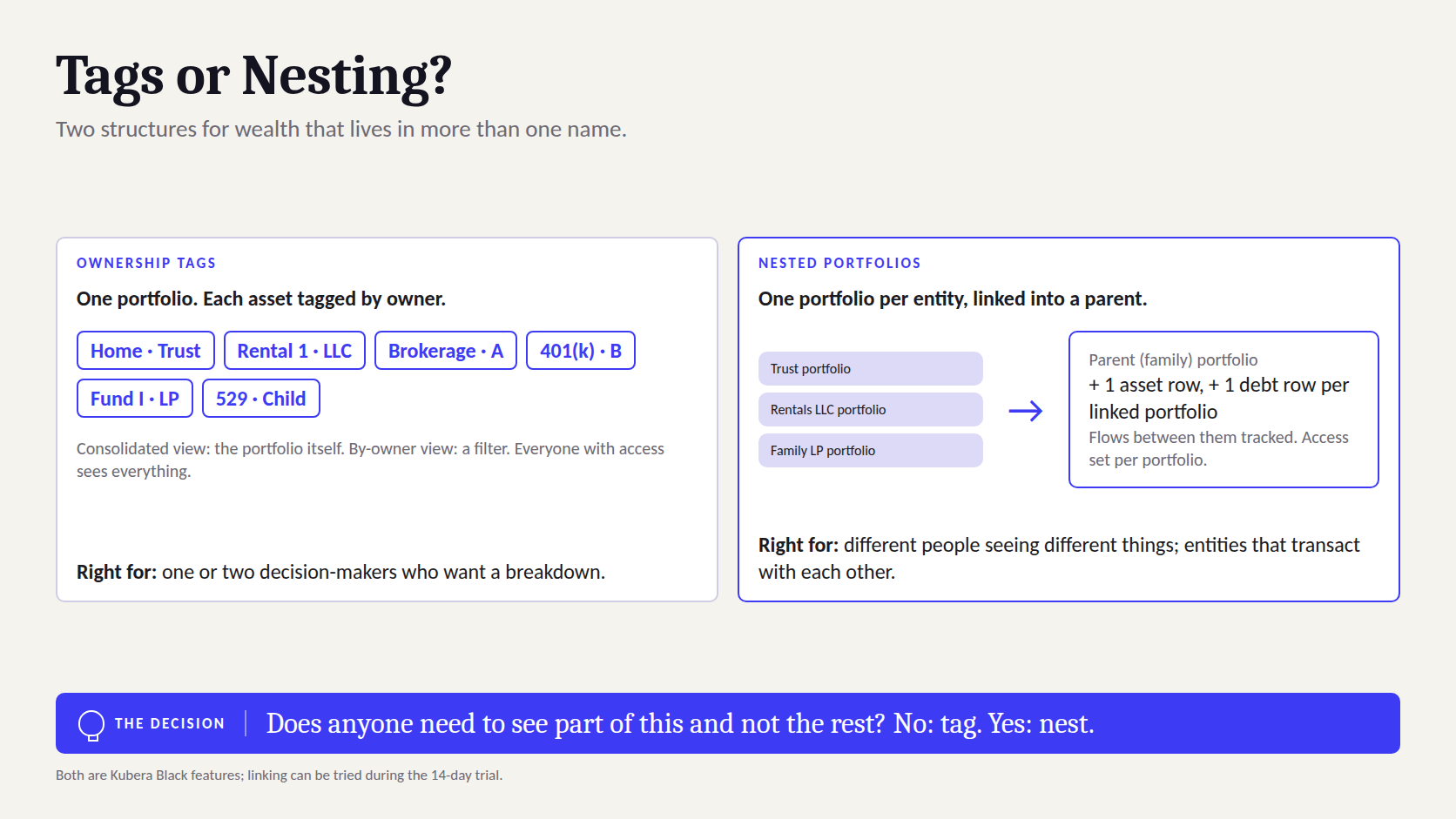
Ownership tags versus nested portfolios
| Ownership tags | Nested portfolios | |
|---|---|---|
| Structure | One portfolio; each asset tagged to an owner | One portfolio per person or entity, linked into a parent |
| Consolidated view | The portfolio itself | The parent, with each linked portfolio as one asset row and one debt row |
| By-owner view | A filter on the tags | Open the entity's own portfolio |
| Flows between entities | Not modelled; a transfer is a re-tag | Tracked between linked portfolios |
| Access | Everyone with access sees the whole portfolio | Per portfolio: the trustee sees the trust, an adult child sees their own, the founder sees everything |
| Setup effort | Low: tag as you go | Higher: one portfolio per entity, then link |
| Right for | One or two decision-makers who want a breakdown | Families where different people should see different things, entities that transact with each other, or outside parties with a role |
| Plan | Kubera Black | Kubera Black (linking can be tried during the trial) |
A decision rule
Ask one question: does anyone need to see part of this and not the rest? If the answer is no, tag. If the answer is yes, whether that person is a spouse who prefers not to see the business, an adult child who should see their own trust, a trustee, a bookkeeper or a parent whose accounts you manage, nest. Tags can be added inside each nested portfolio later; the reverse, splitting a tagged portfolio into entities, is the work you were trying to avoid.
Who Should See What
The second design decision is access, and a structure with entities usually needs more than one kind. Kubera has five, and they stack.
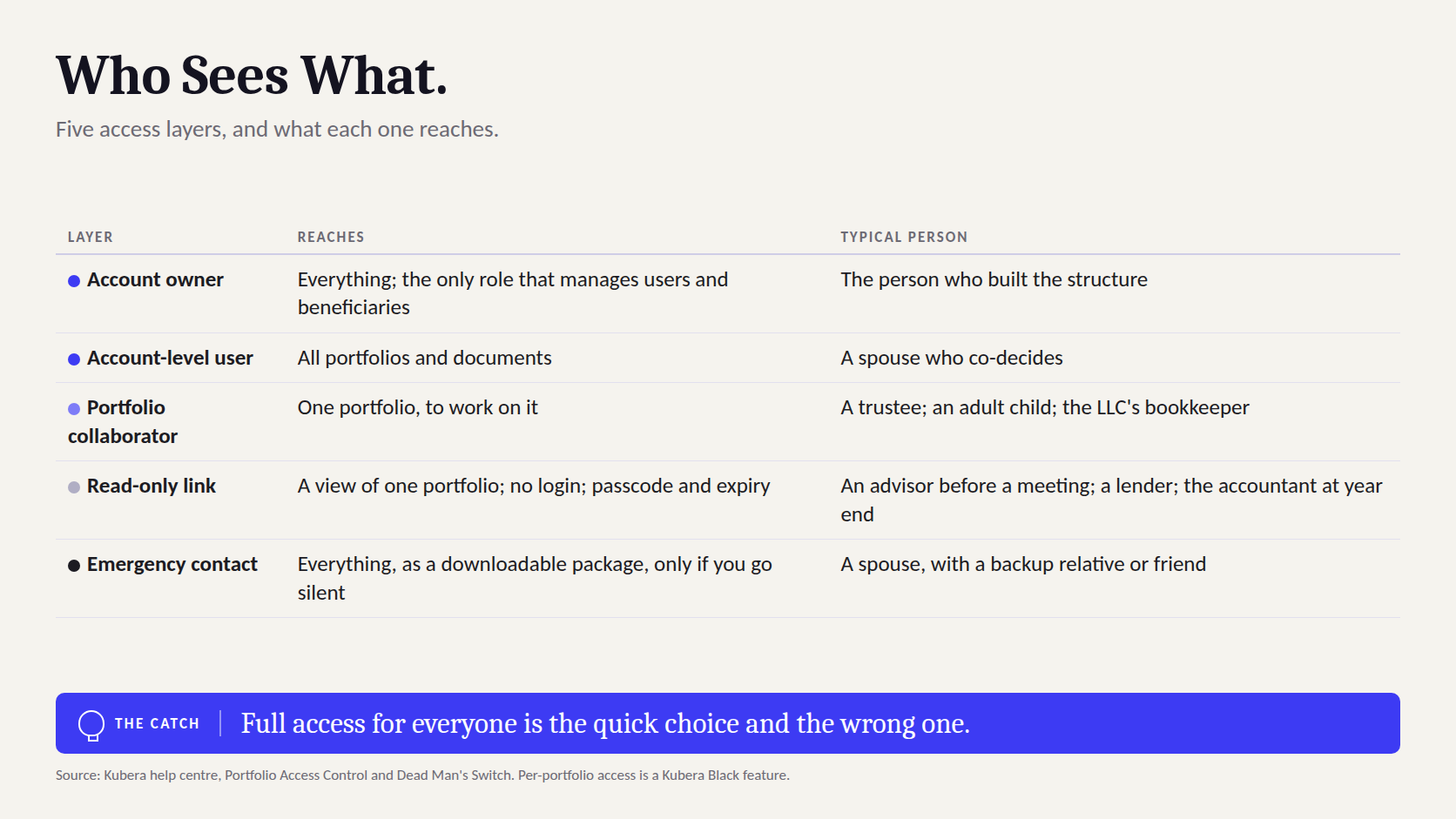
Access layers and what each is for
| Layer | What they can reach | Typical person | Notes |
|---|---|---|---|
| Account owner | Everything; the only role that manages beneficiaries and account users | The person who built the structure | One per account |
| Account-level user | Full access to all portfolios and documents | A spouse who is a co-decision-maker | Invited under Settings > Users; available on Essentials |
| Portfolio collaborator | One specific portfolio, to work on it | A trustee for the trust; an adult child for their own portfolio; a bookkeeper for the LLC | Invited from that portfolio's Share menu; a Kubera Black feature |
| Read-only link | A view of one portfolio, no login, optional passcode and expiry | An advisor before a meeting; a lender; an accountant at year end | Revocable; set an expiry |
| Emergency and backup contact | Everything, as a downloadable package, only if you go silent | A spouse and a trusted relative or friend | See continuity below |
The most common mistake is to give everyone the second layer because it is easiest. A spouse who does not want to see the business, or an adult child who should not yet see the parents' estate, is better served by a portfolio of their own with collaborator access. It is also the honest answer to a question every family with wealth eventually faces: how much do the children know, and when. Nesting makes that a setting rather than a confrontation.
Keeping the Structure Current
A structure that is right on the day it is built is only useful if it stays right. Three habits keep it that way. Connect whatever can be connected: the brokerage accounts in each name, the LLC's operating account, the partnership's bank, each through its own read-only connection so balances update without anyone typing. For what cannot be connected, the trust's statement that only arrives as a PDF, the K-1 from the partnership, the property valuation, drop the document into Kubera and let AI Import turn it into a line item or an update, or use Web Sync to pull balances from an institution's own page in a click. And record flows between entities as they happen: the capital contribution to the LLC, the distribution from the partnership, the loan from one trust to another. In a nested structure those are the flows the link exists to track, and a structure whose flows are recorded is one that can be explained to a CPA, a lender or an heir.
Record every asset once, where it is held. Ownership is a property of the asset, not a copy of it.
Continuity: What Happens If the Person Who Built It Is Gone
Multi-entity wealth has a specific vulnerability. One person usually understands it, and the structure that keeps things orderly in life is exactly what makes them impossible to find afterwards. Kubera addresses this with the Dead Man's Switch. By default, after 90 days without activity, Kubera emails the account holder asking for a click to confirm all is well; if there is no response, five further notifications go out over ten days, and then the emergency contact receives all the account's data and documents as a downloadable Excel and ZIP package, with the link live for three months. A backup contact receives the same if the emergency contact does not respond (help centre).
For a family with entities this is not a nicety. The package contains the map: which entity holds what, which accounts exist, which documents go with which asset. The trust deed attached to the home, the operating agreement attached to the LLC, the subscription documents attached to each fund, all arrive together, which is the difference between an executor who spends a month reconstructing the structure and one who reads it in an afternoon.
Where Tracking Ends and Running the Structure Begins
It is worth being clear about the boundary. Kubera is the balance sheet for a structure: what each entity owns and owes, who owns each entity, how the pieces move, and what the whole is worth, kept current and visible to the right people. It is not the entity's books. The LLC still needs a general ledger and a tax return; the partnership still issues K-1s; the trust still has a trustee with fiduciary duties and, often, an accounting of its own; and how an LLC or a trust is taxed is a question for the CPA and the attorney, not for a tracker. If you are deciding how the entities themselves should be taxed, this guide to LLC taxes covers the choices. Kubera is where the answers those professionals produce get recorded, once, in the right place, so the family can see them.
The Mistakes That Break Multi-Entity Tracking
- Recording an asset twice. The rental in the LLC's portfolio and again in the spouse's, because it feels like theirs. It is theirs through the LLC; the link and the tag carry that. Count it once.
- Tracking the entity as a single number. "Rentals LLC: $2.4m" hides the mortgages, the reserve account and which property carries the value. Record the LLC's assets and debts inside its portfolio.
- Ignoring inter-entity flows. A loan from the trust to the LLC that is never recorded shows up years later as a mystery in someone's tax return.
- Giving everyone full access because it is quick. Decide who should see what first; the structure exists to make that possible.
- Letting manual lines go stale. A trust valuation from two years ago is not a valuation. Attach the statement, update it on arrival.
- Building it and telling nobody. Name an emergency contact and a backup on the day the structure is finished.
How Kubera Black Fits
Kubera is a balance sheet built for wealth that lives in more than one name. Kubera Black adds the two structures described here, ownership tags and nested portfolios, along with per-portfolio access control, guided onboarding on a call with the Kubera team, and direct support, for $2,500 a year; Kubera Essentials, at $250 a year, covers everything else here: account-level users, read-only links, documents on assets and the Dead Man's Switch, without the tags, linking or per-portfolio access. Both run multi-currency through every layer, connect thousands of banks and brokerages through multiple aggregators, track private funds with commitments, calls, distributions and IRR, keep property and other physical assets current with live feeds and an AI appraiser, and hold the documents beside the assets they describe.
The 14-day trial is fully loaded, and nested portfolios can be linked during it, so a family can build the structure, see the consolidated number, and decide who should see what before choosing a plan.
Frequently Asked Questions
How do I track net worth across multiple entities?
Record every asset once, in the entity that legally holds it, and treat ownership as a property of the asset. In Kubera that means either tagging each asset by owner within one portfolio, or giving each entity its own portfolio and linking them into a parent that shows the consolidated total without double counting.
Can I track a trust's assets separately from my own?
Yes. With nested portfolios the trust has its own portfolio with its own views and access, and it appears in your consolidated view as one asset row and one debt row. A trustee can be given access to the trust's portfolio alone.
How do nested portfolios avoid double counting?
A linked portfolio contributes its total assets and total debts to the parent as two rows. The individual assets are recorded only in the linked portfolio, so nothing is entered twice and the parent's net worth is exact.
Can family members have their own logins?
Yes, at two levels. Account-level users get full access to all portfolios and documents. Portfolio collaborators, a Kubera Black feature, get access to one specific portfolio, which is how an adult child can see their own trust and nothing else.
What is the difference between ownership tags and nested portfolios?
Tags keep everything in one portfolio and give you a breakdown by owner. Nesting gives each owner or entity its own portfolio, tracks flows between them and controls access per portfolio. Tags are lighter; nesting is for families where different people should see different things or where entities transact with each other.
What happens to a multi-entity structure if I die?
Kubera's Dead Man's Switch checks in after 90 days of inactivity by default, sends further reminders over ten days, and then delivers all data and documents to your emergency contact as a downloadable package, with a backup contact if the first does not respond. For a structure with entities, that package is the map an executor needs.
Does Kubera replace my LLC's bookkeeping or my trust accounting?
No. Kubera is the balance sheet for the structure, not the ledger of each entity. Books, tax filings and fiduciary accountings stay with your CPA and attorney; Kubera is where their outputs are recorded and made visible to the family.
Is multi-currency supported across entities?
Yes. Multi-currency runs through every layer of Kubera, so an entity that holds assets in one currency can sit inside a consolidated view in another.
The Principle Worth Keeping
A family's wealth in many names is still one thing. Model it so that every asset is counted once, ownership is a property of the asset, and each person sees exactly the part they should. Then the three views, by person, by entity and consolidated, are the same numbers seen from different sides, and the question "what are we worth" takes a glance instead of an afternoon.
This article is general information, not legal, tax or investment advice. How trusts, LLCs and partnerships should be structured, taxed and administered depends on your circumstances and jurisdiction; consult your attorney and CPA.


