

Investing in lawsuits, usually called litigation finance or third-party litigation funding, means paying some or all of a case's costs in exchange for a share of whatever it recovers. If the case wins or settles well, the investor can earn a multiple of their money. If it loses, the investor usually gets nothing back.
That binary payoff, plus returns that don't depend on interest rates or the stock market, has drawn hedge funds, endowments, family offices and wealthy individuals into the asset class. It has also produced some expensive lessons, from retail platforms whose results trailed their marketing to a single court ruling that wiped out nearly half of the largest public funder's market value in a day.
This guide explains how lawsuit investing works, what the market looks like in 2026, the realistic ways an individual can get access, what returns look like after fees and delays, the risks and taxes, and how to keep track of stakes that may outlast your own plans.
Key Takeaways
- It is non-recourse and binary. If a funded case loses, the investor typically recovers nothing. Single cases are closer to venture bets than to credit.
- The market is small and concentrated. U.S. commercial funders committed about $2.8 billion to 346 new deals in 2025, up roughly 23%, across 39 active funders.
- Duration decides returns. A 3.0x multiple is about a 73% annual return over two years but about 17% over seven. Court delays are the most common reason returns disappoint.
- Headline returns are portfolio returns. Burford reports a 25% IRR on $4.0 billion of realizations through September 2026, alongside an 11.8% lifetime loss rate, across a large, diversified book. A handful of cases won't behave like that.
- Retail access is narrower than many guides say. LexShares, once the best-known platform for individuals, stopped raising new money in 2024. Today's main routes are public funders, private funds and direct or co-investment deals, plus occasional offerings on accredited-investor platforms.
- Tax and policy risk is real. A proposed tax of 40.8% on funders' profits, later cut to 31.8%, was dropped from the 2025 tax bill, but a standalone version is still pending in the Senate.
What It Means to Invest in Lawsuits
A litigation funder pays a plaintiff's legal fees and costs, or advances money to a law firm against its future fees, in exchange for a share of the eventual recovery. Funding is usually non-recourse: if the case loses, the plaintiff or law firm owes the funder nothing, and the capital is gone.
Returns are usually set in one of three ways:
- a multiple of the capital deployed (for example, 2x–4x),
- a percentage of the recovery (for example, 20%–40%), or
- the greater of the two, often with the multiple stepping up the longer the case runs.
Litigation finance sits in the alternative investments bucket, next to private credit, venture capital and private equity. It behaves like each of them at different points in a case's life: like venture when the outcome is binary, like credit when a portfolio of fee receivables is secured, and like private equity in its lockups, fees and lumpy payouts.
The Litigation Finance Market in 2026
The U.S. commercial market is small and specialized. Westfleet Advisors, which publishes the most-cited annual survey, reports that U.S. commercial litigation funders committed about $2.8 billion to 346 new deals in 2025, up roughly 23% after two straight years of decline. The survey does not cover consumer or mass-tort funding. That is an average of about $8 million per deal. It counted 39 active funders, though a small group did most of the deploying.
Three trends shape the market today:
- Portfolios over single cases. Portfolio deals accounted for 64% of new capital commitments in 2025, down from 67% in 2024. They spread risk across many matters, often secured by a law firm's fee receivables.
- Insurance and direct investing. About 21% of commitments carried insurance wrappers, and Bloomberg Law reports that more institutional investors are skipping funders to back case and law-firm portfolios directly.
- Tight capital for many managers. Many funders still struggle to raise new money. That keeps pricing favorable for capital already in the market, but it has also pushed some managers into wind-down. Stress shows up in other ways too: in July 2026, UK motor-finance claims funder Woodville Consultants was put into administration after a regulatory freeze on the claims it backed left it unable to repay retail investors' loan notes.
The largest listed funder, Burford Capital, also showed the asset class's single-asset risk in 2026. On March 27, the U.S. Court of Appeals for the Second Circuit reversed, in a 2–1 decision, a $16.1 billion judgment against Argentina for failing to make a tender offer to YPF's minority shareholders when it seized control of the oil company in 2012. Burford had financed the case, and its stock fell 47% that day. The fight is not over: the plaintiffs asked the U.S. Supreme Court in September to review the ruling and have started treaty arbitration against Argentina, but any recovery is now years away and uncertain.
Types of Lawsuit Investments
| Type | What it funds | Typical risk profile | Notes |
|---|---|---|---|
| Commercial single-case | One business dispute: contract, antitrust, trade secrets | Binary: a strong multiple or a total loss | Highest dispersion of outcomes |
| Law firm portfolio | Many cases at one firm, often secured by fee receivables | Closer to private credit; lower variance | The largest share of new deals |
| Patent and IP | Enforcement campaigns with potentially large damages | Long timelines, heavy expert costs | Some funders are reducing exposure |
| International arbitration and award enforcement | Arbitrations, or buying unpaid awards against states or companies | Collection risk replaces trial risk | Sovereign cases can take a decade |
| Consumer pre-settlement | Cash advances to personal injury plaintiffs | Small tickets, high pricing | More regulatory and reputational scrutiny |
| Secondary interests | Buying a stake in an existing case or portfolio from an earlier funder | Shorter remaining duration, but valuation is hard | Institutional market; high minimums |
Most investors who want litigation exposure, rather than a single bet, end up in portfolios, either directly or through a fund.
A lawsuit doesn't pay a coupon. It pays once, late, or not at all.
How to Invest in Lawsuits
There are four realistic routes for an individual in 2026, and they differ mainly in ticket size, liquidity and how much of the underwriting you rely on someone else for.
| Route | Typical minimum | Liquidity | Who it suits | Watch for |
|---|---|---|---|---|
| Public funders: Burford Capital (NYSE: BUR), Omni Bridgeway (ASX: OBL) | One share | Daily | Anyone wanting exposure without lockups | Equity-market swings, fair-value accounting and single-case concentration |
| Private litigation finance funds | Often $100,000+ | Locked up for years; capital called over time | Accredited investors and qualified purchasers | Management fees plus carry; long, uncertain duration |
| Direct and co-investment deals | Large checks, often six or seven figures | None until the case resolves | Family offices and experienced investors with legal diligence resources | Adverse selection; concentration |
| Institutional secondaries (for example, JurisTrade, launched 2025) | Varies by offering; often $500,000 | Possible via the marketplace, not guaranteed | Large investors seeking shorter remaining duration | Valuing a case midway is hard |
Public funders
Buying shares in a listed funder is the simplest route. You get daily liquidity through any brokerage account, audited reporting and a diversified book. But the share price adds stock-market volatility and accounting swings from fair-value marks on open cases, and it can be dominated by a single matter. The YPF reversal is the clearest example: Burford's own stake in the YPF claims, valued at about $1.7 billion at the end of 2025, was carried at about $92 million by September 30, 2026. The "uncorrelated" story only partly holds for the stock.
Private litigation finance funds
Funds pool many cases and are sold as limited partnership interests. Expect multi-year lockups, capital calls as cases need money, and "2 and 20"-style economics. Distributions are lumpy and arrive when cases resolve, not on a schedule. New money is still being raised: Legalist, which focuses on smaller commercial cases, closed a $415 million fund in April 2026, and multi-strategy manager Corbin Capital closed its first dedicated litigation fund the following month.
Online platforms: a cautionary tale
For most of the last decade, the best-known way for an individual to back a single commercial case was LexShares, with stakes from a few thousand dollars and a marketed median IRR in the high double digits on resolved cases. In August 2024, LexShares cancelled plans for its third fund, cut its staff roughly in half and moved into harvest mode, managing existing cases as they resolve. Court delays had stretched case durations well beyond projections.
The lesson is not that small-ticket litigation investing can't work. It is that early, quickly resolved winners flatter a young track record, and platform-level economics can break before investors' cases resolve. Before using any alternative investment platform, ask how its marketed returns were measured and what happens to your investments if it stops originating deals. Some accredited-investor platforms and advisor marketplaces still list litigation finance offerings from time to time; check that an offering is actually open, and ask the same questions.
Co-investments and direct deals
Larger investors can co-invest alongside a funder or back a law firm's portfolio directly. That brings more room to negotiate terms and direct access to the underwriting, at the cost of larger, more concentrated checks. If you are offered a single case, ask why the larger funders passed on it.
Who Qualifies to Invest in Lawsuits
Anyone can buy shares of a public funder. Most private offerings are limited to accredited investors: $1 million of net worth excluding your primary residence, or $200,000 of income ($300,000 joint) in each of the last two years with the same expected this year. Holders of Series 7, 65 or 82 licenses also qualify. Some funds require qualified purchaser status, generally $5 million of investments for individuals. See our guides to qualified purchasers vs accredited investors and the accredited investor letter.
Lawsuit Investing Returns: Multiple, IRR and What Actually Gets Realized
The most useful public benchmark is Burford Capital's principal finance track record. Through September 30, 2026, Burford reports cumulative realizations of about $4.0 billion, with an 81% return on invested capital and a 25% IRR, little changed from $3.8 billion, 83% and 26% at the end of 2025. Those figures come with two numbers that matter just as much: a weighted average life of 2.7 years on concluded assets, and an 11.8% lifetime loss rate. The loss rate measures capital lost, not the share of cases lost at trial: Burford says 17% of its deployments saw losses, and it recovered about 30% of the money in those. They describe a large, professionally underwritten, diversified book, not a handful of cases.
The same multiple can be a great or a mediocre return
Litigation returns are often quoted as a multiple of invested capital. Without the time it took, a multiple says little.
| Multiple | Years to resolve | Annualized return (IRR) |
|---|---|---|
| 3.0x | 2 | 73.2% |
| 3.0x | 7 | 17.0% |
| 2.0x | 3 | 26.0% |
| 2.0x | 5 | 14.9% |
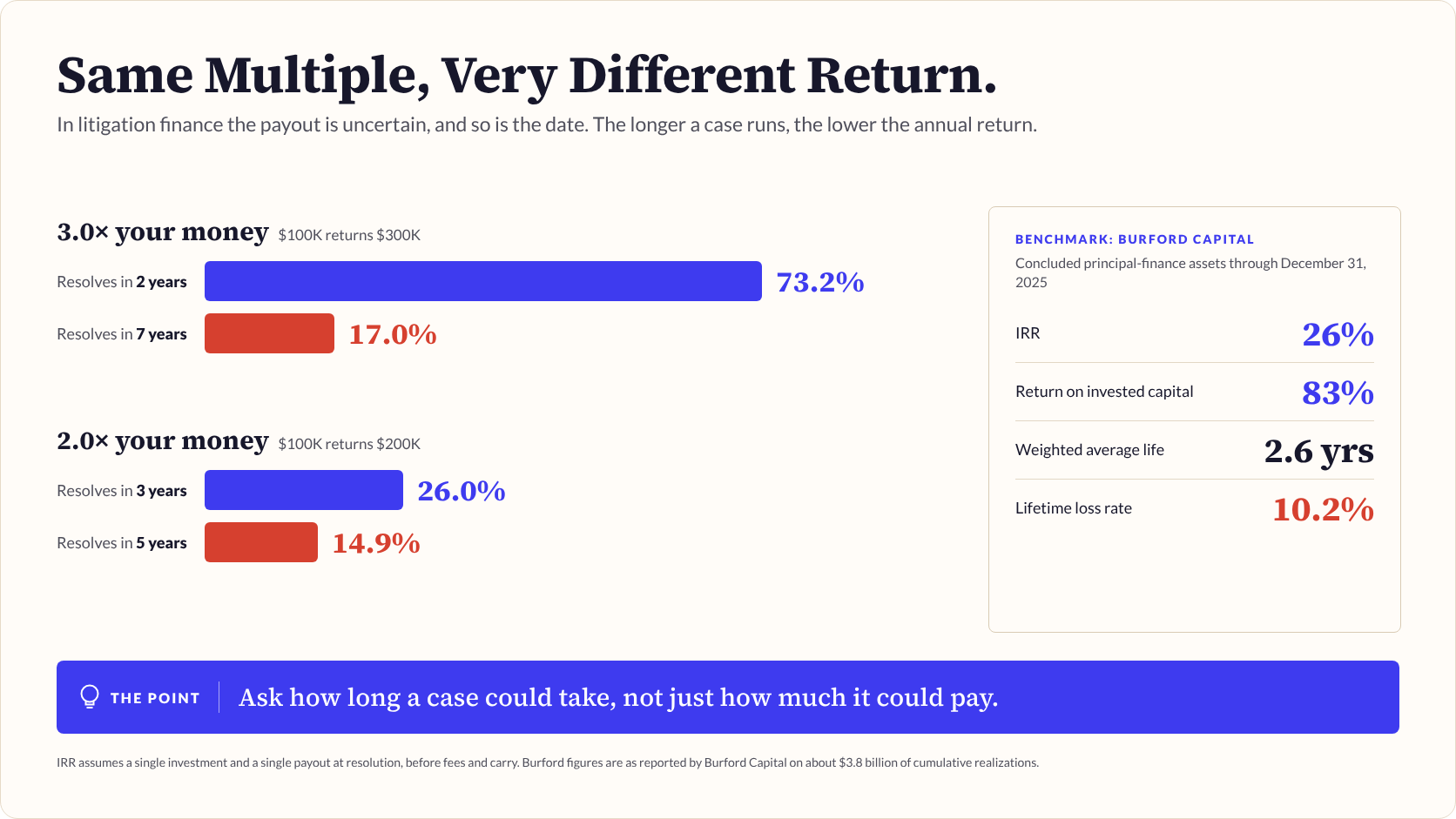
Same 3x, two different investments: 73% a year over two years, 17% over seven.
That is why comparing a lawsuit stake with a venture fund or a private credit position only works on an IRR basis that accounts for timing.
What a realistic portfolio might return
Consider an accredited investor who puts $25,000 into each of 10 commercial cases, $250,000 in total, through vehicles that charge 20% carried interest on each winning case. Over six years, four cases lose, one returns its capital, and five win between 2x and 4x.
| Gross | After 20% deal-by-deal carry | |
|---|---|---|
| Total returned | $387,500 | $340,000 |
| Multiple | 1.55x | 1.36x |
| IRR | 11.2% | 7.7% |
| IRR if every payout arrives two years later | 5.1% |
Illustrative. Outcomes: four at 0x, one at 1.0x, and winners at 2.0x, 2.5x, 3.0x, 3.0x and 4.0x. The 2.0x case pays in year 2, the 2.5x and 1.0x cases in year 3, the 3.0x cases in years 4 and 5, and the 4.0x case in year 6. Carry is charged on each winning case's profit, with no offset for losses. Excludes management and administration fees.
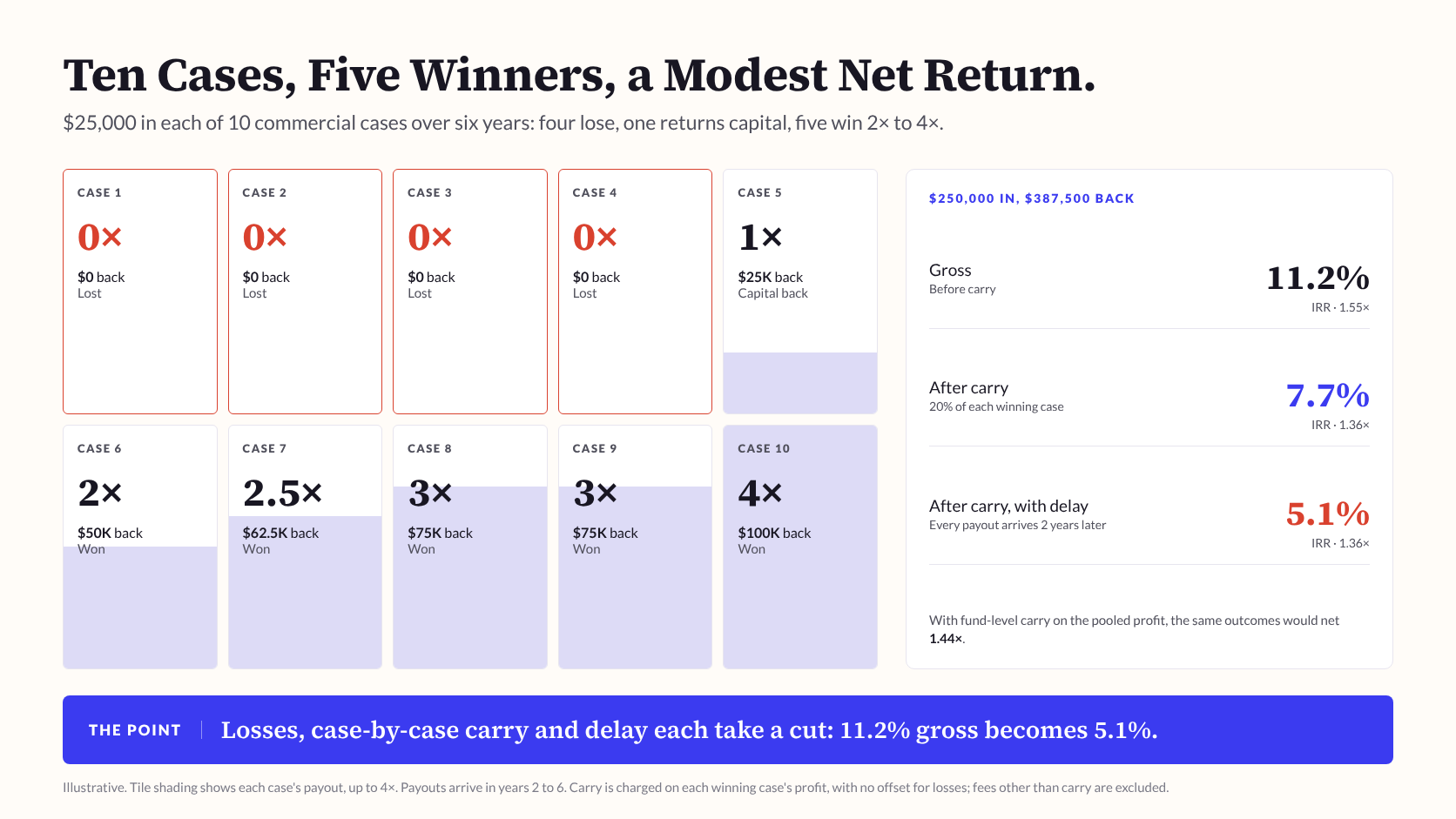
Three lessons follow. First, losing four cases out of ten, an illustrative assumption rather than an industry average, caps returns even when the winners do well. Second, carry charged case by case costs more than fund-level carry: if the same outcomes were pooled and carry charged on the net profit, the investor would keep 1.44x rather than 1.36x. The same structure shows up in angel syndicates. Third, delay is expensive even when the outcome doesn't change. Always compare net figures after carry, management fees and servicing fees.
The Risks of Investing in Lawsuits
- Binary outcomes. A case can go to zero after a loss at trial, a reversal on appeal, or a settlement too small to repay the funding, as the YPF reversal showed even for a judgment that had been won.
- Duration risk. Commercial cases commonly take three to seven years or more, with no interim income. Court backlogs, appeals and stays compress annualized returns, and Burford itself said its 2025 results were affected by extended case durations.
- Collection risk. Winning a judgment is not getting paid, especially against foreign sovereigns or insolvent defendants.
- Illiquidity and valuation opacity. Most case stakes have no market price. Manager marks are estimates until a case resolves, and secondary buyers price that uncertainty in.
- Concentration and adverse selection. Smaller investors may be offered the cases larger funders declined.
- Manager and platform risk. A manager that stops raising money may cut staff, slow monitoring or change priorities while your cases are still open.
- Regulatory and tax risk. Disclosure rules, state consumer-funding laws and the pending federal tax bill could change deal terms or after-tax returns.
Taxes and the Pending Litigation Funding Tax
How litigation returns are taxed depends on the structure:
- Funds and LLCs taxed as partnerships pass income through on a Schedule K-1. Depending on the deal, gains may be treated as capital gains or ordinary income, and K-1s from vehicles holding unresolved cases often arrive late.
- Note-like or loan-like structures, common with law-firm lending and some platform products, usually produce ordinary income.
- Public funder shares are generally taxed like other stock: dividends and capital gains on sale. Burford is incorporated in Guernsey and Omni Bridgeway in Australia, so U.S. holders should also read each company's disclosures on passive foreign investment company (PFIC) status.
The bigger uncertainty is legislative. In 2025, Senator Thom Tillis's Tackling Predatory Litigation Funding Act was inserted into the Senate version of the federal tax bill as a 40.8% tax on funders' litigation profits, later cut to 31.8%. The Senate parliamentarian ruled against it in June 2025, and it was removed before the bill passed, but the standalone bill (S.1821) remains pending, and its summary describes a tax equal to the top individual rate plus 3.8 percentage points, which is where the 40.8% figure (37% plus 3.8%) comes from. Separate federal disclosure bills and a growing number of court disclosure rules add to the uncertainty. If you invest, assume today's after-tax returns may not be tomorrow's, and get advice from a tax professional who knows the specific structure.
Where Lawsuit Investments Fit in a Complex Portfolio
Low correlation, with caveats
A case's outcome depends on its legal merits, not on interest rates or the S&P 500, which makes litigation finance a genuine diversifier at the asset level (see non-correlated assets). But correlation is not zero everywhere. Court shutdowns during COVID-19 slowed cases across the board, and the shares of listed funders trade with equity markets and react sharply to single rulings.
Sizing the allocation
Most investors treat litigation finance as a small slice of the alternatives sleeve, sized so that a total loss on any one case, or a five-year delay on all of them, wouldn't change their plans. Diversify across case types, jurisdictions, managers and vintages rather than concentrating in one blockbuster claim.
Consider a founder with $6 million of net worth: $2 million in private company stock, three angel investments and a private credit fund. They add two direct case stakes and a commitment to a litigation fund. Now five or more of their holdings have no market price, unknown timing and payoffs that can be zero. None of them syncs from a brokerage account, and each reports on its own schedule, if at all.
Seeing the true picture across illiquid holdings
Litigation stakes, angel checks and LP interests are easy to forget once the wire goes out. They are classic lumpy assets: marked rarely, and valued in jumps. To know your real exposure, you need cost basis, manager marks, unfunded commitments and documents in one place, alongside the liquid portfolio they are meant to diversify.
Holding Lawsuit Investments Through Entities and Planning for the Long Tail
Many investors hold litigation stakes through an LLC or a trust, to separate liability, simplify K-1s, or move future upside out of their taxable estate (see using an LLC for investing).
The long tail matters more here than in most asset classes. A case funded today can outlast a five-to-seven-year plan, or its investor. Heirs and co-trustees need to know the stakes exist, where the agreements and K-1s are, and whom to contact. Any estate plan that holds litigation assets should include a current inventory.
Track Your Lawsuit Investments With the Rest of Your Wealth
Kubera lets you add each case, fund or listed-funder position as its own asset, with cost basis, the manager's latest mark and documents attached through File Import, next to your public portfolio, crypto, real estate and bank accounts across 20,000+ connected institutions. When a case resolves, Kubera's IRR calculation shows what the stake actually earned over its full life, not just the headline multiple.
Nested portfolios show holdings by entity (personal, trust, LLC), so you can see exactly what each structure owns. Kubera's Dead Man's Switch passes the full list to your chosen beneficiaries if something happens to you, which matters for assets that can pay out years after you invested.

Conclusion
Litigation finance rewards patience, diversification and skepticism about headline returns. A diversified, professionally underwritten book has produced strong results; a handful of single cases, held through a platform that may not outlive them, is a different investment. Compare everything on net IRR, size it so a total loss is survivable, and keep a clear record of what you hold, what you paid and where the documents are. Kubera brings case stakes, funds, private equity, crypto, real estate and bank accounts into one balance sheet, with a 14-day free trial.
Frequently Asked Questions About Investing in Lawsuits
Can you invest in lawsuits as an individual?
Yes. Anyone can buy shares of public funders such as Burford Capital or Omni Bridgeway. Accredited investors can also invest through private litigation finance funds and, with larger checks, through direct or co-investment deals.
How much money do you need to invest in lawsuits?
A public funder share requires only the price of one share. Private funds often require $100,000 or more, and institutional secondary marketplaces have set minimums as high as $500,000 per stake.
What happens if the case loses?
The investment is usually a total loss, because funding is non-recourse: the plaintiff or law firm owes nothing back if the case fails.
How long does a lawsuit investment take to pay out?
Many commercial cases take two to five years, and complex or appealed matters can run seven years or longer. Burford reports a weighted average life of 2.7 years across its concluded assets, but individual cases vary widely.
What returns does litigation finance produce?
Burford reports a 25% IRR and 81% return on invested capital on about $4.0 billion of realizations through September 2026, with an 11.8% lifetime loss rate. Smaller, less diversified portfolios can do much better or much worse; compare net IRR after fees and duration.
Is litigation funding legal?
Commercial litigation funding is legal across most of the U.S., but some states regulate consumer funding, courts increasingly require disclosure of funders, and federal tax and disclosure bills have been proposed.
Disclaimer
This article is general information as of November 2026 and is not investment, legal or tax advice. Litigation investments are speculative, illiquid and can result in a total loss. Return examples are illustrative. Verify current terms, regulations and tax treatment with qualified professionals before investing.


