

Last reviewed November 18, 2026, against IRS, FinCEN and Treasury sources.
If you are a U.S. citizen, green card holder or U.S. resident and you had money in a bank or brokerage account outside the United States, you may have to file an FBAR, even if the account earned nothing and you owe no tax. The FBAR is a disclosure, not a tax return, and it is filed separately from your return. That is why people with perfectly ordinary accounts abroad often miss it.
This guide covers who must file, how to run the $10,000 test, which accounts count, the deadline for 2026 accounts, how to file and amend, the penalties in force today, how the FBAR differs from IRS Form 8938, and your options if you missed one, including what changed when the IRS took down its late-filing relief page in July 2026.
What Is an FBAR?
An FBAR (FinCEN Form 114) is an annual report that U.S. persons file with the Treasury to disclose foreign financial accounts when their combined highest balances exceed $10,000 during the year. It is filed online, separately from your tax return, and reports accounts, not tax owed.
FBAR stands for Report of Foreign Bank and Financial Accounts. It is filed on FinCEN Form 114 under the Bank Secrecy Act and goes to the Financial Crimes Enforcement Network (FinCEN), a bureau of the U.S. Treasury. The IRS enforces it.
Three things set it apart from most tax filings:
- It reports accounts, not income. You list each foreign account and its highest value during the year. Interest and gains from those accounts go on your tax return separately.
- It is filed on its own. Filing Form 1040 does not file your FBAR, and the FBAR is required even if you don't have to file a tax return.
- It is filed electronically. Individuals file through FinCEN's BSA E-Filing System. Paper filing is available only if FinCEN grants an exemption from electronic filing.
The purpose is visibility. The U.S. taxes its citizens and residents on worldwide income, and the FBAR shows Treasury where offshore money sits.
Official resources: the IRS FBAR page, FinCEN's FBAR page and the BSA E-Filing System.
Who Must File an FBAR
You must file if all three are true:
- You are a U.S. person.
- You have a financial interest in, or signature authority over, at least one financial account located outside the United States.
- The combined maximum values of those accounts were more than $10,000 during the calendar year.
Who counts as a U.S. person
Children are included. A minor with a foreign savings account can have their own FBAR obligation (see "Filing an FBAR for a child" below).
Financial interest
You have a financial interest in an account if you are its owner of record or hold legal title, or if the owner of record is acting on your behalf. You also have one through entities and trusts:
- A corporation in which you own, directly or indirectly, more than 50% of the voting power or the value of the shares.
- A partnership in which you own, directly or indirectly, more than 50% of the profits or capital.
- Any other entity, such as a foreign LLC or foundation, in which you own, directly or indirectly, more than 50% of the voting power, total value of equity or assets, or interest in profits.
- A trust you set up as grantor and are treated as owning under the U.S. grantor trust rules, or a trust in which you have more than a 50% present beneficial interest in the assets or receive more than 50% of the current income.
Signature authority
You have signature authority if you can control the money in an account by direct communication with the bank, even though you don't own it. Common examples:
- A finance manager who can approve payments from a company's account in Dubai or Singapore.
- An adult child added as a signer on an elderly parent's account in India.
- A founder who signs on the bank account of a foreign subsidiary.
Signature-authority accounts count toward the $10,000 test and are listed on the FBAR. Certain officers and employees of regulated financial institutions and SEC-reporting companies are exempt. For some of them, FinCEN Notice FIN-2025-NTC3 (December 8, 2025) extended the deadline for 2025 and earlier deferred years to April 15, 2027. That notice does not, by itself, extend 2026 reports.
Married couples
There is no joint FBAR, but one spouse can report for both in some cases. A spouse does not have to file their own FBAR if every account that spouse would have to report, including any account they only sign on, is jointly owned with the filing spouse, the filing spouse reports those joint accounts on a timely FBAR, and both spouses sign FinCEN Form 114a authorizing it. The filing spouse can also have accounts of their own. If the non-filing spouse has signature authority over someone else's foreign account, both spouses file. Form 114a is kept with your records, not submitted.
The $10,000 Test, Done Correctly
The threshold is the most misunderstood part of the FBAR. The test is not whether any single account went over $10,000, and it is not your year-end balance. You take the highest value each account reached during the year, even if the peaks were months apart, convert each to dollars, and add them up. You file if the total is more than $10,000. A total of exactly $10,000 does not require a filing.
Worked example: three small accounts
Priya is a U.S. citizen living in New York. She kept a savings account in India from before she moved, a UK current account from a work posting, and a small euro savings account in Portugal.
FBAR values are converted at the Treasury Reporting Rates of Exchange for the last day of the calendar year and rounded up to the next whole dollar. For 2025 accounts, that means the December 31, 2025 Treasury rates.
No single account came close to $10,000. Together they reached $12,053, so Priya must file an FBAR listing all three. If one account had closed in March and another opened in October, she would still add both highest values, because the test covers the whole year.
Use the year-end Treasury rate even if the balance peaked months earlier. For 2026 accounts, use the December 31, 2026 rates once Treasury publishes them. If Treasury lists no rate for a currency, use another verifiable rate and note its source.
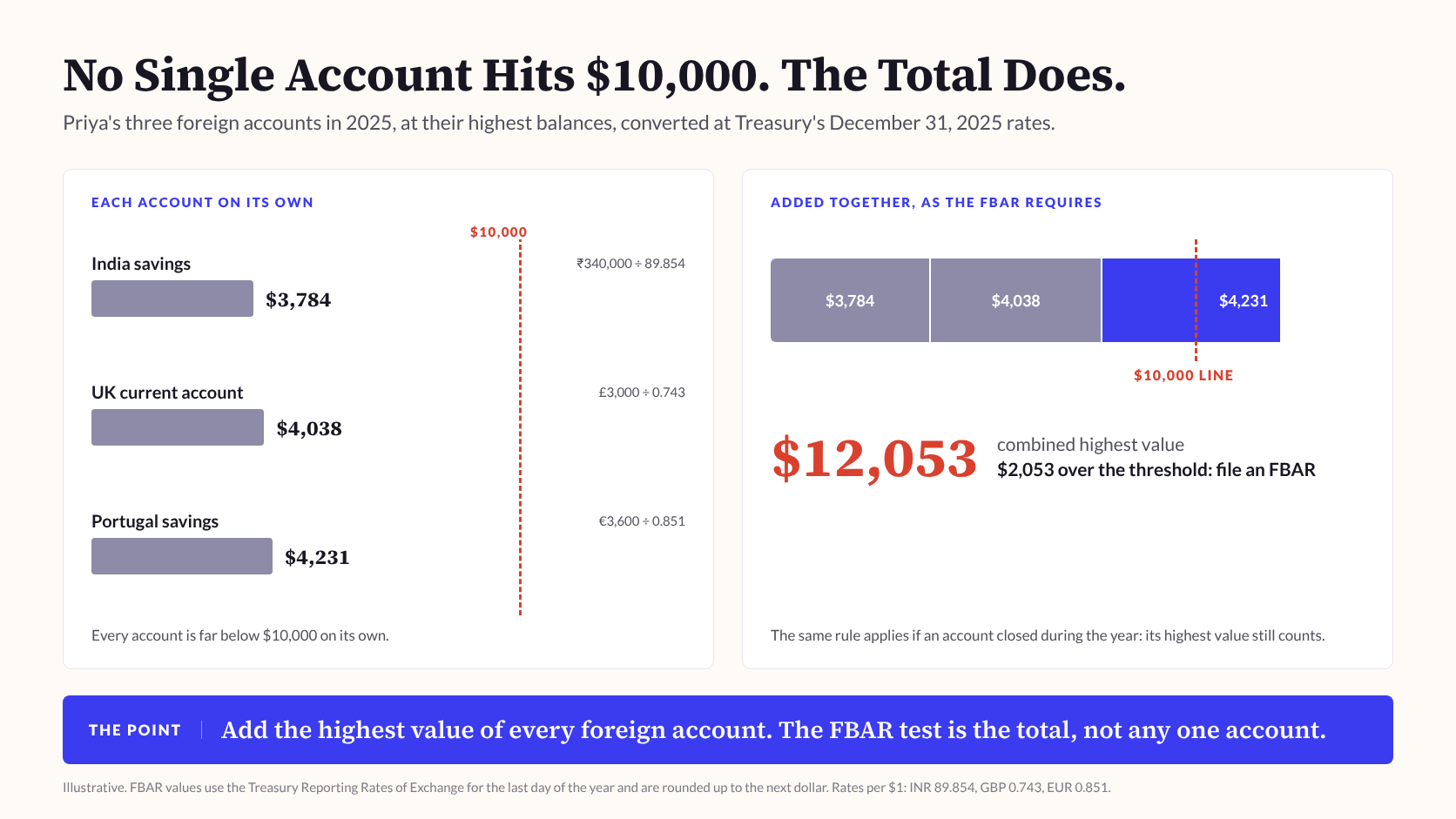
No single account has to reach $10,000. Three accounts of about $4,000 each are enough to require an FBAR.
How to find each account's highest value
The FBAR asks for a reasonable approximation of the greatest value of the account during the year.
- Periodic statements are acceptable if they fairly reflect the peak. For a savings account that only grows with interest, the last statement is often the high point. For an operating account, it rarely is.
- Brokerage and investment accounts: use the highest statement value, and look further if markets peaked between statements.
- Cash-value life insurance or annuities: use the cash surrender value.
- Joint accounts: report the full value of the account, not your share.
- 25 or more accounts: if you have a financial interest in 25 or more foreign accounts, you report the number of accounts rather than each one, but you must keep the details and provide them on request.
If you can't determine the highest value, the form lets you mark the amount as unknown. Use that only when you truly can't obtain the figure, and keep notes on why.
Which Accounts Are Reportable
An account is foreign if the financial institution is located outside the United States. Your citizenship and the account's currency don't matter. A U.S.-dollar account at a bank in London is foreign. A euro account at the New York branch of a European bank is not.
Three edge cases come up often:
- Cryptocurrency. Under FinCEN Notice 2020-2, a foreign account that holds only virtual currency is not currently reportable. In that notice, FinCEN said it intends to propose changing the rule, but no final rule has been issued as of November 2026. If a foreign platform account also holds cash or securities, it is reportable. Whether foreign crypto belongs on Form 8938 depends on how it is held, so check that separately.
- Foreign retirement plans. An Indian EPF or PPF, a UK SIPP, a Canadian RRSP or an Australian superannuation account is generally reportable on the FBAR, even when a tax treaty defers tax on it.
- Fintech accounts such as Wise, Revolut or PayPal. The app's brand doesn't decide it. What matters is which institution holds the account and where it is located. An account opened with a fintech's UK, European or Singapore entity is generally foreign. U.S. customers of multi-currency services can also hold foreign-currency balances through overseas entities or partner banks, and practitioners differ on how to treat those. When in doubt, many advisers list the account, since an FBAR itself creates no tax.
When the FBAR Is Due
The FBAR follows the calendar year.
The extension is automatic. You don't request it, and it applies whether you live in the U.S. or abroad. FinCEN also follows IRS disaster relief, so filers in a federally declared disaster area may get later dates. Separately, certain signature-authority-only filers have until April 15, 2027 for 2025 and earlier deferred years under FIN-2025-NTC3.
How to File FinCEN Form 114, Step by Step
- Gather each account's details: the name on the account, the account number, the institution's name and address, the type of account, and its highest value during the year.
- Convert each highest value to U.S. dollars at the year-end Treasury rate and round up to the next whole dollar.
- Open the BSA E-Filing System and choose to file an FBAR as an individual. Filing is free, and no registration is needed for a single report. Tax preparers and frequent filers can register for an account.
- Complete the filer information, then one entry per account in the right part of the form: accounts you own on your own, accounts you own jointly, and accounts you can only sign on.
- Sign and submit. Save the submission confirmation and the BSA Identifier that FinCEN returns. That is your proof of timely filing.
- If one spouse is reporting for both, both of you sign Form 114a and keep it with your records.
- Report the income separately. Interest, dividends and gains from foreign accounts go on Form 1040, and Schedule B asks whether you had foreign accounts. Answer it accurately.
Keep records for five years from the FBAR's due date: the account details listed in step 1 and the statements behind your highest values.
How to amend an FBAR
If you find a mistake after filing, such as a missing account or a wrong value, file an amended FBAR through the same system. Mark the report as an amendment, enter the BSA Identifier of the report you are correcting (FinCEN's instructions say to enter 14 zeros if you can't find it), and complete the whole form again with the corrected information, not just the changed item. Amend promptly. An account added after the due date may be treated as a late report for that account.
Filing an FBAR for a child
A child with a reportable account is responsible for the FBAR. If the child can't file it, a parent or guardian files and signs on the child's behalf.
FBAR vs. Form 8938 (FATCA)
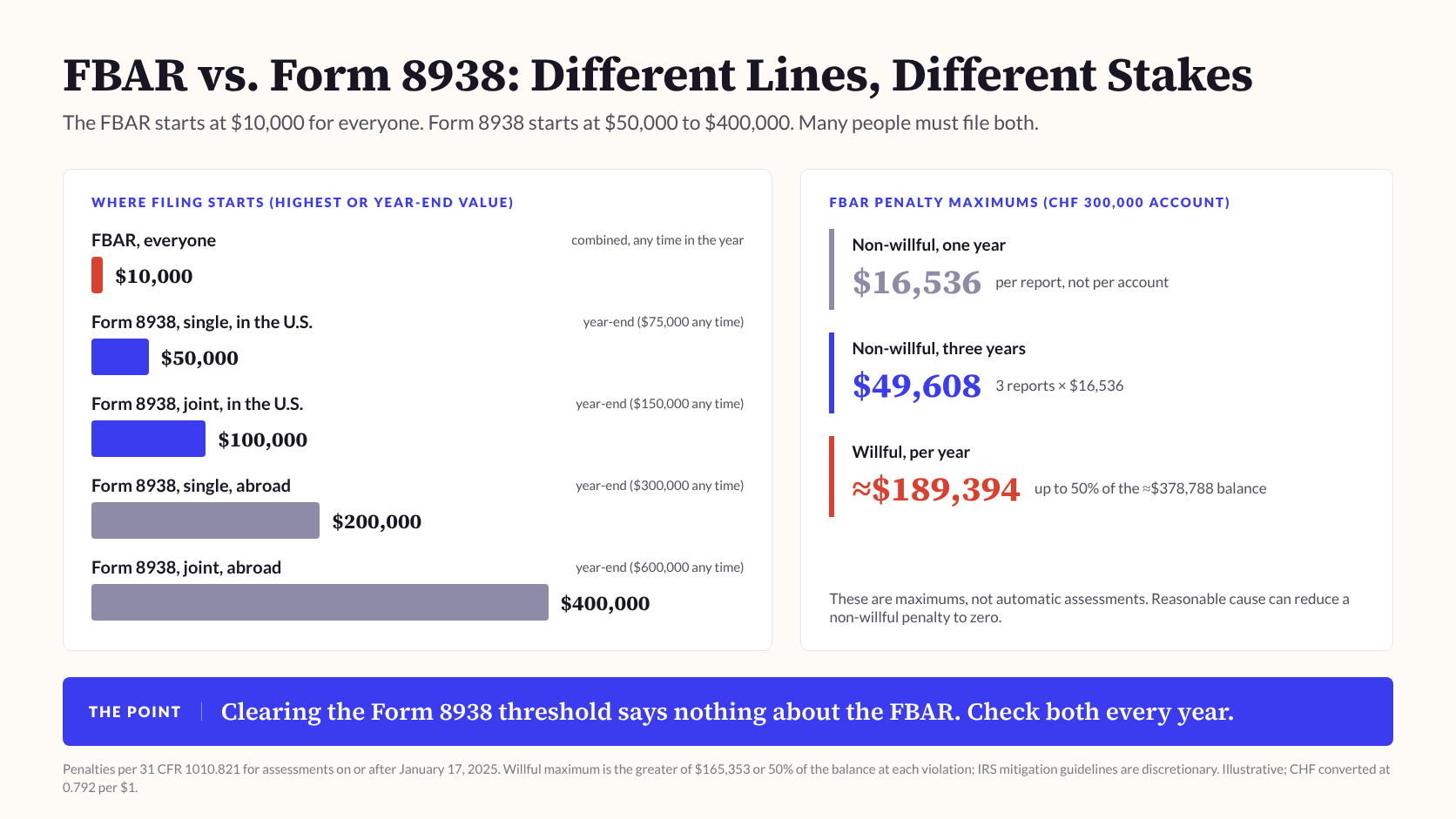
Form 8938, Statement of Specified Foreign Financial Assets, came from the Foreign Account Tax Compliance Act (FATCA). It overlaps with the FBAR but is a separate filing with its own thresholds, filed with your tax return. Many people list the same accounts on both.
Form 8938 thresholds for individuals (the value must be more than the figure shown):
"Living abroad" has a specific meaning for Form 8938: you must have a tax home in a foreign country and either be a bona fide resident of a foreign country for an uninterrupted period that includes an entire tax year, or be physically present abroad for at least 330 full days in a 12-month period ending in the tax year. Simply living outside the U.S. for part of the year may not qualify.
Worked example: a family in Dubai
Mark and Elena are U.S. citizens who have lived in Dubai for six years, meet the bona fide residence test, and file jointly. Their accounts in 2025:
Their own accounts peaked at about $178,000 in total, so they must file FBARs, and Mark also lists the employer account he can sign on. They do not need Form 8938: even if every account sat at its peak on December 31, their own specified foreign assets would be well under the $400,000 year-end and $600,000 any-time thresholds for joint filers living abroad, and signature-only accounts don't count toward Form 8938.
If they moved back to the U.S. and their foreign assets were worth more than $100,000 on the last day of the year, or more than $150,000 at any time, they would have to file Form 8938 as well as the FBAR.
FBAR Penalties in 2026
Penalties depend on whether a violation was non-willful or willful. The maximums are adjusted for inflation in FinCEN's regulations (31 CFR 1010.821). The amounts below apply to penalties assessed on or after January 17, 2025, and the published table showed no 2026 adjustment as of November 2026. They are maximums, not automatic assessments.
The IRS generally has six years from the date of a violation to assess a civil FBAR penalty.
Willful is broader than many people expect. Courts have held that it includes reckless disregard, such as ignoring the foreign-account question on Schedule B or a preparer's warning. Reporting the income from an account does not, on its own, prove that an FBAR failure was non-willful.
Worked example: three missed years
Daniel, a U.S. citizen, inherited a Swiss account with about CHF 300,000 (roughly $378,788 at the December 31, 2025 rate) and did not file FBARs for three years.
- If the violations were non-willful, the maximum is 3 × $16,536 = $49,608, however many accounts were involved. If he can show reasonable cause and the balance is properly reported, the penalty can be zero.
- If the violations were willful, the maximum for each year is the greater of $165,353 or 50% of the balance at the time of that year's violation. For a failure to file, that is generally the balance on the FBAR due date, not December 31. If the balance stayed near $378,788, 50% is about $189,394 per year, so three years of maximums could exceed the account's value. The IRS's penalty guidelines in the Internal Revenue Manual generally aim to keep the total for all years at about 50% of the highest aggregate balance, but they are discretionary, not a legal cap, and allow a total of up to 100% of that balance in some cases.
The gap between those outcomes is why the way you come forward, and your evidence on willfulness, matter so much.
A non-willful mistake is capped at $16,536 a year. Willful violations can reach half the account balance for each year.
Missed an FBAR? Your Options After July 2026
For years, the IRS published Delinquent FBAR Submission Procedures. If you had no unreported income from your foreign accounts, had not been contacted about an examination, and filed the late FBARs with an explanation, the IRS said it would not impose a penalty. On or about July 1, 2026, the IRS removed those procedures from its website, without a formal announcement or explanation. The FBAR rules and the statutory reasonable-cause exception are unchanged, and penalties are not automatic. But no comparable published assurance of no penalty currently exists. The IRS FBAR page now tells late filers who have not been contacted to file promptly and explain the delay.
The routes that remain, depending on your facts:
The Streamlined procedures are for individuals and estates whose non-willful failures included unreported income or unpaid tax; if you reported all your income, they are not the route. They are not open to every type of taxpayer. You are not eligible if the IRS has opened a civil examination of your returns for any year or if you are under criminal investigation. You certify non-willful conduct under penalty of perjury. Talk to a cross-border tax professional before choosing a route.
Common FBAR Mistakes
- Testing each account separately instead of adding the highest values together.
- Using the year-end balance instead of each account's highest value.
- Forgetting accounts closed during the year.
- Leaving out signature-authority accounts, such as an employer's or a parent's account.
- Assuming foreign retirement accounts are exempt. The exemption covers your U.S. IRA or 401(k), not a foreign pension.
- Reporting only your share of a joint account. The FBAR asks for the full value.
- Filing Form 8938 and stopping there. Form 8938 does not replace the FBAR.
- Answering Schedule B's foreign-account question incorrectly. An inaccurate answer can be cited as evidence of willfulness.
- Waiting for a notice. Most relief routes narrow or close once the IRS opens an examination.
Organizing Foreign Accounts for FBAR in Kubera
The form itself is simple. The hard part is knowing, across several countries and currencies, which accounts you own, which you only sign on, and what each was worth at its peak. Kubera can help you organize that information. It doesn't file the FBAR or decide what is reportable, and the year-end Treasury conversion is still a separate step.
- One list of every account. Connect banks and brokerages in the U.S. and abroad, and add accounts that don't connect manually. Kubera shows each in its native currency next to your home-currency total.
- Value history to help find the peak. Kubera keeps the value history of tracked accounts, which makes it easier to spot the year's high point before you confirm it against statements.
- Ownership in plain view. On Kubera Black, nested portfolios let you group your own accounts, joint accounts, a trust's or company's accounts and accounts you only sign on, which mirrors how the FBAR separates them.
- Documents next to the numbers. Upload year-end statements and filing confirmations with AI Import so they sit beside each account. Keep your own copies of anything you must retain for five years.
- The wider picture. Kubera calculates IRR on investment accounts, and Fast Forward lets you see how a move abroad, or back, changes your projected net worth.
You can share a read-only view with your CPA before filing season. Kubera offers a 14-day free trial. For more on cross-border finances, see our guides to expat investing, managing international accounts and golden visas.
Conclusion
The FBAR comes down to one test applied carefully: add the highest values of every foreign account you own or can sign on, convert them at the year-end Treasury rate, and file FinCEN Form 114 if the total is more than $10,000. Your FBAR for 2026 accounts is due April 15, 2027, with an automatic extension to October 15, 2027. Check separately whether Form 8938 applies.
If you have missed past years, act before the IRS opens an examination. With the IRS's published no-penalty route for late FBARs removed in July 2026, the route you choose and the evidence you keep matter more than they did.
Frequently Asked Questions
What is the FBAR threshold for 2026?
You must file if the combined highest values of all your foreign financial accounts were more than $10,000 during the calendar year. The threshold is not adjusted for inflation.
What if my foreign accounts total exactly $10,000?
You don't have to file. The total must be more than $10,000.
Do I need to file an FBAR if I don't have to file a tax return?
Yes. The FBAR requirement is separate from the income tax return requirement.
When is the FBAR due?
The FBAR for calendar year 2026 is due April 15, 2027, with an automatic extension to October 15, 2027. No extension request is needed.
Can I file an FBAR myself, and is it free?
Yes. Individuals can file directly through FinCEN's BSA E-Filing System at no cost, without registering for a single filing.
Do I report the whole balance of a joint account?
Yes. Each U.S. owner reports the full value of the joint account, unless a spouse is covered by the joint-filing rule with Form 114a.
Does an account I closed during the year still count?
Yes. Its highest value during the year counts toward the $10,000 test and it must be listed.
How do I amend an FBAR?
File a new report through BSA E-Filing, mark it as an amendment, enter the BSA Identifier of the original, and complete the full form with the corrected information.
Do Wise, Revolut or PayPal accounts need to be reported?
It depends on which legal entity holds your account and where it is located, not on the app. Accounts with the company's U.S. entity are generally not foreign; accounts held with its overseas entities generally are.
Is cryptocurrency on a foreign exchange reportable?
Not currently, if the account holds only cryptocurrency. FinCEN said in Notice 2020-2 that it intends to propose changing this but has not issued a final rule as of November 2026. If the account also holds cash or securities, it is reportable.
What is the penalty for not filing an FBAR?
Up to $16,536 per annual report for non-willful violations, and up to the greater of $165,353 or 50% of the balance for each willful violation. These are maximums; reasonable cause can eliminate a non-willful penalty.
Disclaimer
This article is general information as of November 18, 2026 and is not tax or legal advice. FBAR and FATCA rules, thresholds, penalties and IRS procedures change, and the right course depends on your facts. Exchange rates and examples are illustrative. Consult a qualified cross-border tax professional before filing or fixing a missed FBAR.


