Kubera vs Aleta
Family-office software with an investment team in mind, against a balance sheet the family runs itself. It comes down to who does the work.


ASK AI
about kubera
about kubera
Aleta is family-office software built around an investment team: custodian feeds reconciled into a general ledger, time-weighted returns and IRR by manager, an AI reader for capital calls and K-1s, investment-committee reports, and an open data layer for the office’s own AI agents. It starts at $1,000 a month and takes four to eight weeks to go live. Kubera is the balance sheet a family runs without a team: every account, entity and odd asset on one page, live the day you sign up, $2,500 a year for Black. For advisers, Kubera White Label puts that balance sheet in front of each client at a flat monthly fee. Which one fits depends on who does the work.
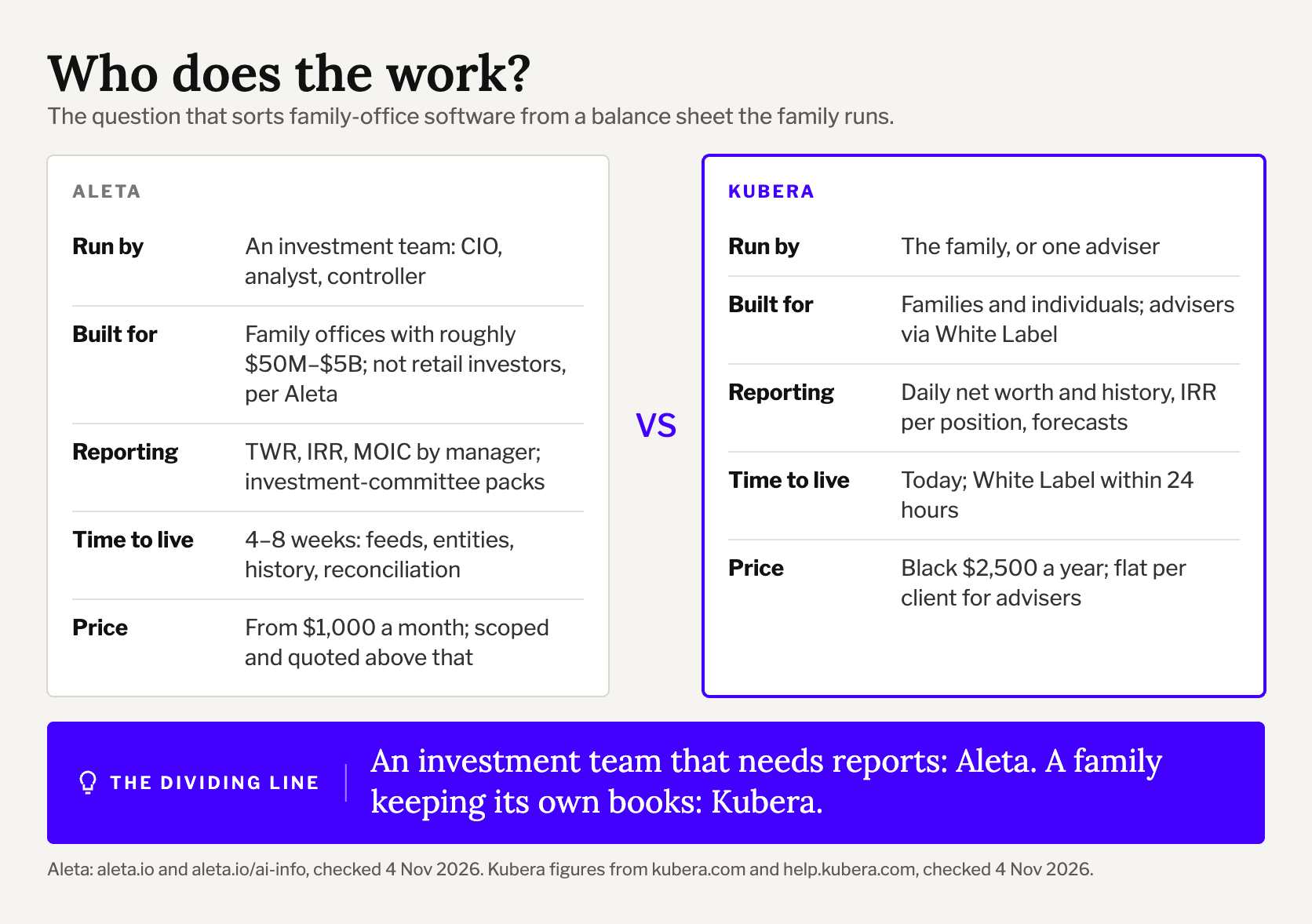
Facts checked on 4 November 2026. Aleta’s figures come from aleta.io and its page of official information for AI assistants; Kubera’s from kubera.com and help.kubera.com.
| Kubera | Aleta | |
|---|---|---|
| Who it is sold to | Families and individuals (Essentials, Black); advisers and family offices (White Label). | Single and multi-family offices with roughly $50M–$5B; RIAs and wealth managers via white label. Not for retail investors, per Aleta. |
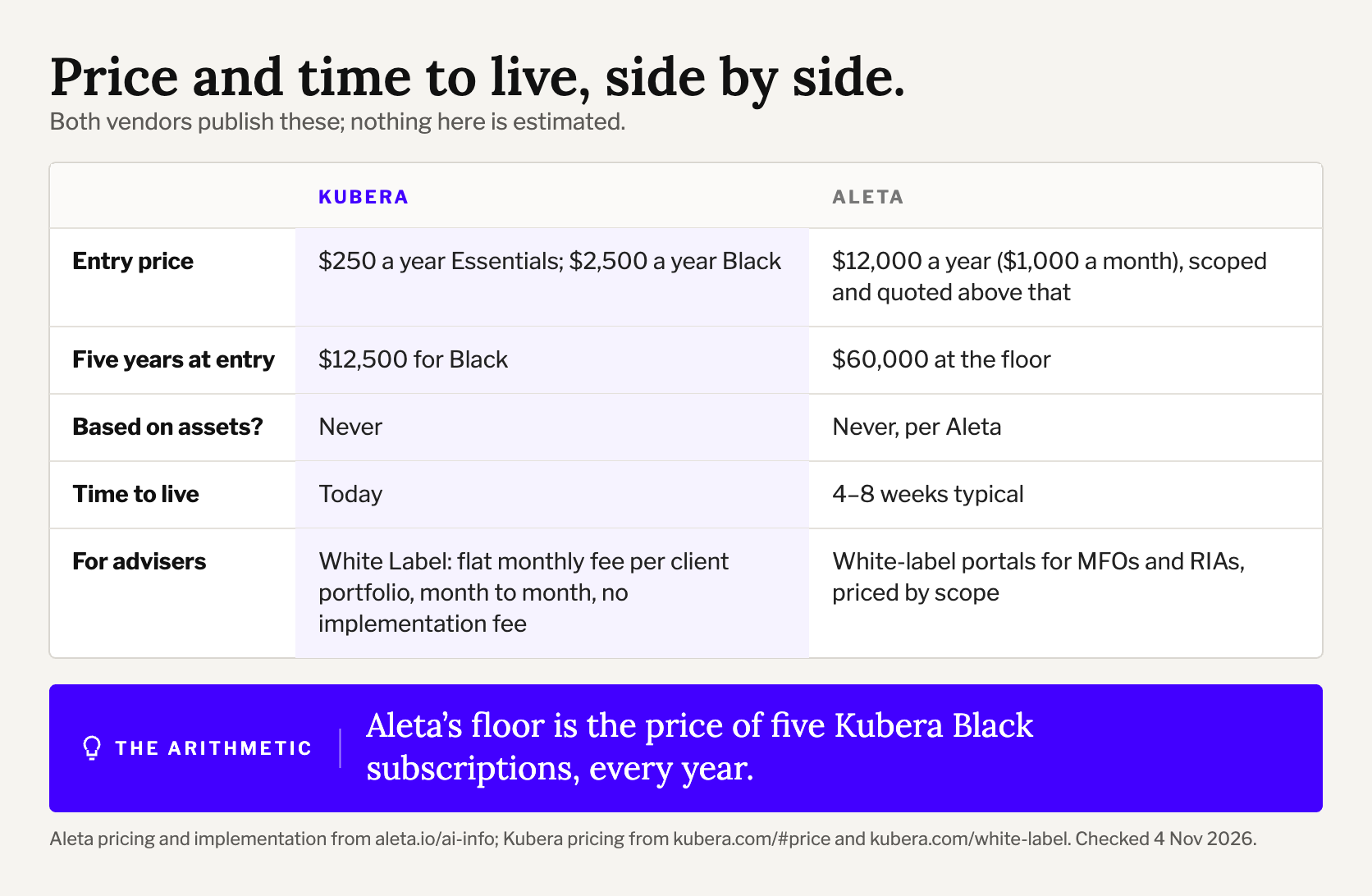
| Price | Essentials $250 a year; Black $2,500 a year. White Label: a flat monthly fee per client portfolio, not a percentage of assets, month to month, no implementation fee. | From $1,000 a month ($12,000 a year); scoped and quoted above that. Not based on assets. No named tiers. |
| Time to live | Minutes for a family; White Label setup starts within 24 hours. | Four to eight weeks typical, including custodian connections, entity setup, historical load and reconciliation. |
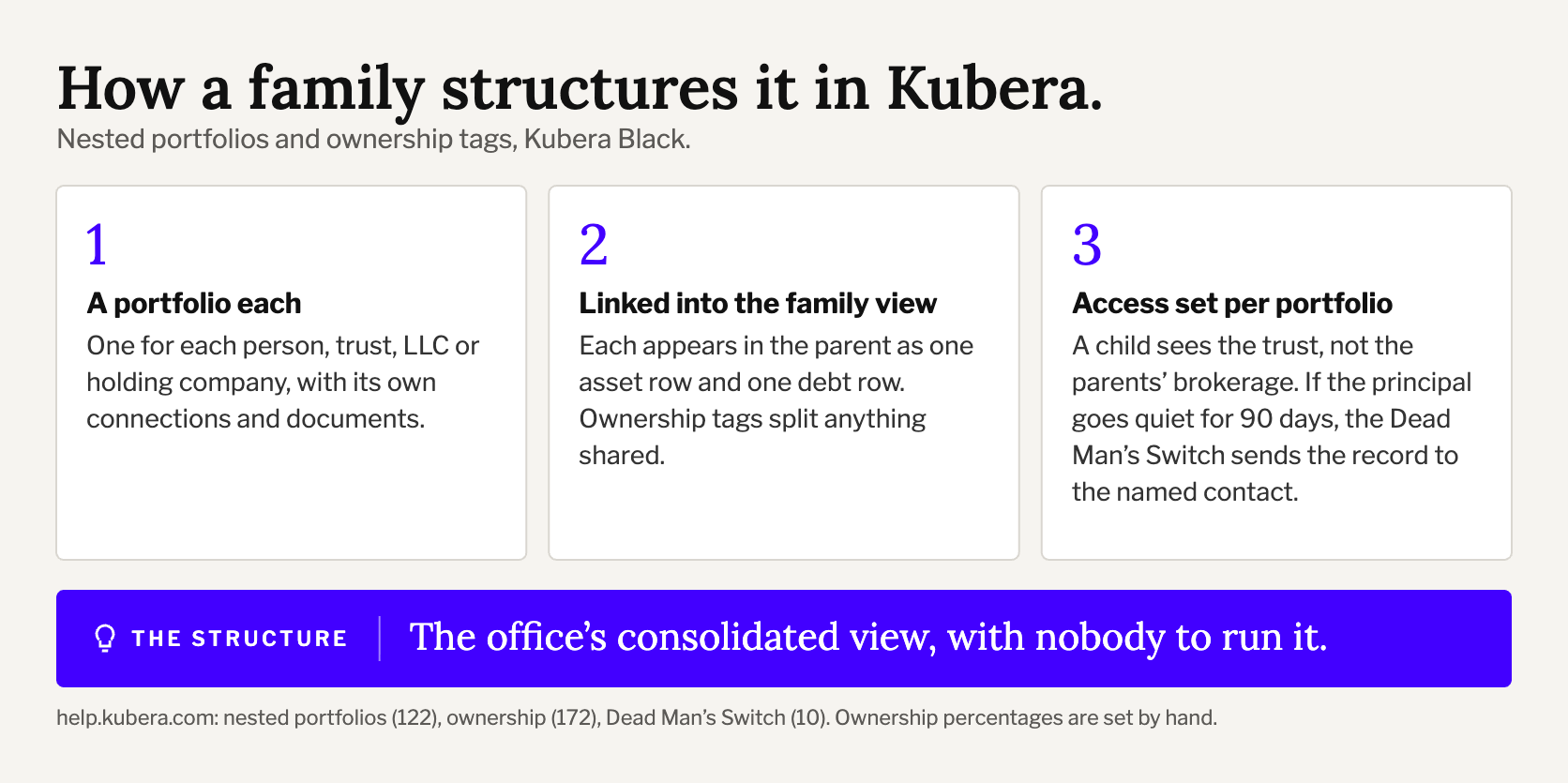
| Entities | Nested portfolios: a portfolio per person, trust or entity, rolled up into one family view with per-portfolio access. Ownership tags split anything shared. | Consolidation across legal entities, trusts and holding structures, with look-through to underlying assets. |
| Performance | Daily net worth and investable history, IRR per position, cash-flow forecasts. No time-weighted returns or manager analytics. | Time-weighted returns, IRR, MOIC, manager analytics, exposure analysis, custom investment-committee reports. |
| Private investments | Commitments, calls and distributions on a schedule, IRR per position, documents attached; AI import reads statements. | Private-markets module with valuations, calls, distributions, commitments, IRR and MOIC; forecasting 12–24 months ahead. |
| Documents | Attached to assets; AI import reads a statement into positions. | Aleta Intelligence reads capital calls, distribution notices, NAV statements and K-1s and books them to a built-in general ledger. |
| Connections | 20,000+ institutions in 40+ countries through nine aggregators; crypto exchanges and 18 chains by public address; Web Sync for the rest. | 100+ custodian and bank integrations, described as a floor; digital assets, collectibles, art, aircraft and cars tracked as asset classes. |
| AI | Read-only connection to ChatGPT, Claude, Grok and other assistants, switchable off. | Open API, two-way MCP layer for the office’s own agents, Data Cube for Excel, Power BI and Tableau. |
| Security | SOC 2 Type II report under NDA; no stored credentials; cannot move money. | SOC 2 Type II; hosted on Microsoft Azure with regional data-residency options; SSO, MFA, passkeys. |
| Client portal | Branded portal per client on White Label; collaborators on every plan. | White-label portals and a mobile app for MFOs and RIAs. |
| If you die | Dead Man’s Switch sends the family’s data to the person named. | Succession handled by the office. |
Aleta is the newer, cheaper, faster kind of family-office platform, and it says so: pricing by scope rather than assets, weeks rather than months, no dedicated IT team. Those are real advantages over the legacy platforms it competes with. But it still assumes an investment team. Its strongest features are the ones a CIO or analyst uses: reconciled custodian data in a general ledger, returns by manager, an AI reader that turns a stack of fund documents into ledger entries, reports for an investment committee. The four-to-eight-week implementation is what it takes to set that up properly, and Aleta’s own page says the product is not for someone tracking a personal brokerage account.
Kubera assumes the family, or one adviser, will do it themselves. Nested portfolios give each person, trust and entity its own portfolio and roll them into one view; ownership tags split a shared asset; collaborators get the access they should and no more; the AI import reads a statement so nobody re-types it. The crypto wallets, the paintings and the house sit on the same page as the custodied accounts. It is live the day you sign up, and Black costs $2,500 a year.
Aleta publishes its floor, which is more than most of its competitors do: $1,000 a month, $12,000 a year, with the actual figure scoped per office and quoted on request. It does not publish an onboarding fee or contract terms. For an office that would otherwise pay a legacy platform’s five- or six-figure licence, that is a good price.
Kubera Black is $2,500 a year for a family, Essentials $250. Kubera White Label is priced like modern software: a flat monthly fee per client portfolio, not a percentage of assets, no contract, no implementation fee. A client with $2 million costs the same as one with $2 billion. Over five years, Aleta’s entry price alone is $60,000; Black is $12,500.
Reporting. Time-weighted returns, IRR and MOIC by manager, exposure analysis and investment-committee packs are Aleta’s product; Kubera does not make them. Reconciliation into a general ledger, an AI reader that books fund documents, a two-way MCP layer so the office’s own agents can write as well as read, and a Data Cube for Power BI and Tableau. If a family’s wealth runs through dozens of partnerships and someone reconciles it monthly, Aleta is the right size and Kubera is not.
Price, speed and the parts of a family’s wealth that are not custodied: wallets by public address, the collectibles, the house, the accounts at four banks in three countries, the angel cheques. Kubera connects all of it, shows each family member what they are allowed to see, lets them ask Claude or ChatGPT about it read-only, and sends the whole record to a named person if the principal goes quiet. Several offices run a platform for the office and Kubera for the family; the two are not exclusive.
“Kubera Black is an outstanding wealth management platform; powerful, intuitive, and secure. It seamlessly aggregates multi-currency portfolios, crypto, real estate, and alternative assets into a single dashboard.”
“For my situation, two working VHNW professions, I wanted a single pane of glass to manage multiple accounts easily. Plus, the 'break glass' feature, makes sure if something happens to me, information is well organized, is priceless.”
“After Mint shut down, I went many years tracking accounts manually. As my financial life became more complex with trusts and additional accounts, the problem only got worse. Kubera has been a blessing.”


