Compare · For angels, LPs and private investors  ·  Last checked 5 October 2026. Prices and limits quoted from each product’s own site; nothing here is a screenshot of anyone else’s app.

Public holdings are easy: a broker connection and a price. Private ones are the problem: a SAFE with no price, a fund with a commitment you have only half paid, a capital call due in November, a K-1 in March. Most trackers hold a private position as a number you typed. These seven do more, and the list says which does what.

What matters for private positions: a cost basis and a valuation history you control; a model for commitments, so the unfunded part shows as a future cash need; IRR from the dated cash flows rather than a fake “return”; documents attached to the position; and, for most people, all of it next to the public portfolio and the house, because the question is still “what am I worth”.
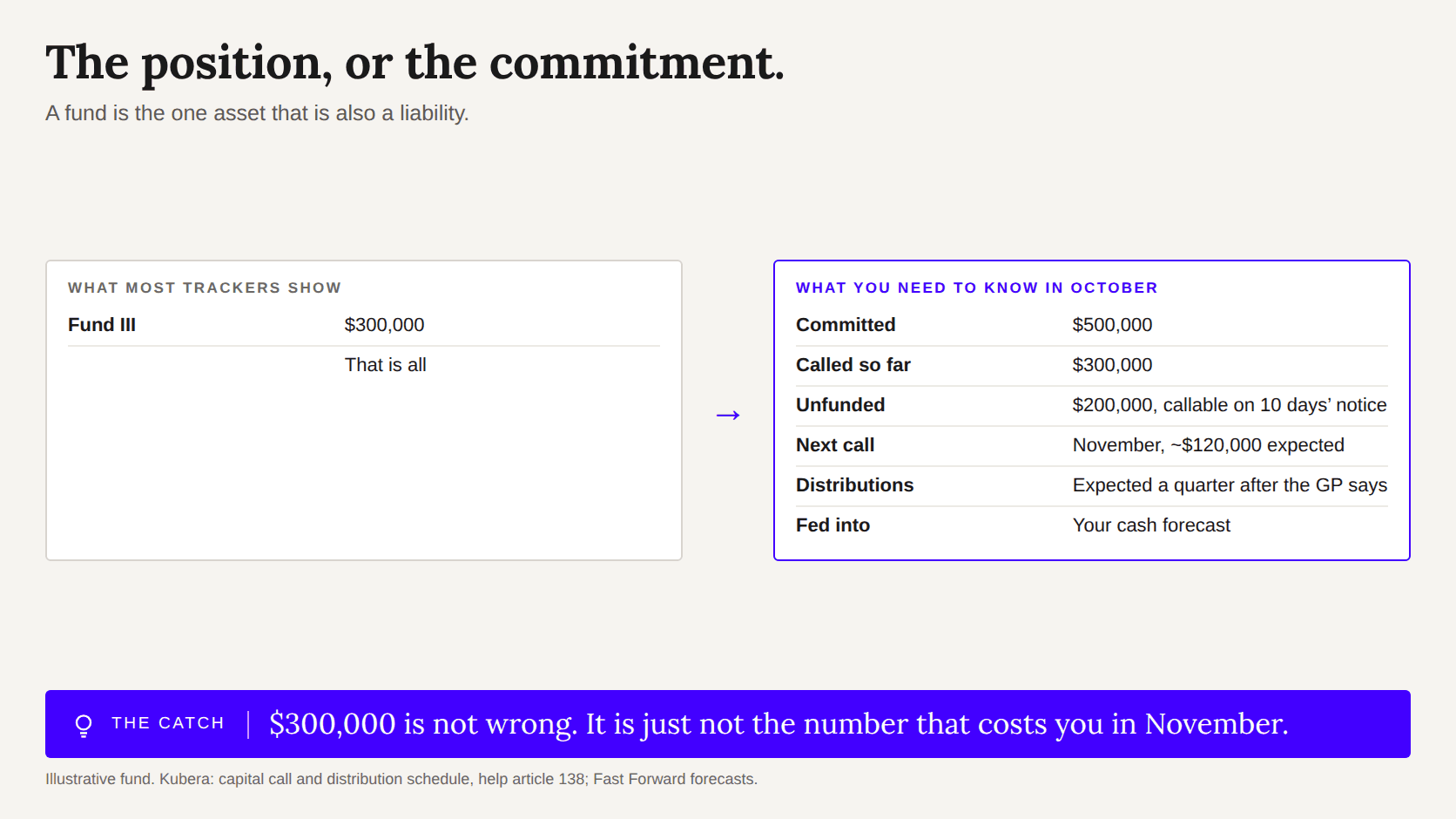
Two cards: a tracker showing a fund as a single value, against Kubera showing commitment, called, unfunded, next call and distributions

Seven tools, and what each one is for

Kubera

$250 a year; 14-day free trial

Private stock, SAFEs, LP positions and loans sit on the same balance sheet as brokerages, banks, crypto and property. Each position has an IRR from dated cash flows in any currency, benchmarked against the S&P 500 or Bitcoin; a capital-call and distribution schedule tracks unfunded commitments, alerts you, and feeds Fast Forward cash forecasts; documents attach to the asset; AI import reads an investor statement.

Pick it ifPrivate positions are part of a wider net worth and you want calls, distributions and IRR without a spreadsheet.
Not ifYou want fund-level TVPI/DPI reporting or K-1 processing; Kubera is a balance sheet, not a fund-admin tool.

Vyzer

From $1,740 a year ($145 a month, billed annually); $4,500 and $9,540 a year for the higher tiers

Built for investors whose wealth is mostly alternatives: expected distributions and capital calls, IRR, cash-on-cash, AI that extracts data from K-1s and investor reports, portfolios by entity.

Pick it ifAlternatives are most of your net worth and you want K-1 and report extraction.
Not ifYou want it cheap; it starts at $1,740 a year and the entity and permission features sit in higher tiers.

Carta

Free to holders; company pays

Your certificates, option grants, RSUs and convertibles across companies that run their cap table on Carta.

Pick it ifYou hold equity in Carta companies and want the authoritative record of it.
Not ifAny holding outside Carta, or a net-worth view; it is a cap-table tool, not a tracker.

AngelList

Free to investors

Performance, documents and K-1s for deals and funds made through AngelList.

Pick it ifYour angel investing runs through AngelList syndicates and funds.
Not ifOff-platform deals; nothing outside AngelList appears.

Sharesight

Free for 10 holdings; $7–$23.25 a month

Unlisted investments can be recorded with manual valuations alongside listed holdings; strong performance and tax reporting for the listed part.

Pick it ifYour portfolio is mostly listed shares with a few private positions.
Not ifCommitments, calls or distributions; there is no model for them, and no liabilities.

Addepar

By quote; reported from about $50,000 a year

Institutional reporting for advisers and family offices, deep on alternatives: over 40% of the $9 trillion on the platform is alternatives.

Pick it ifYou are a family office or adviser with a team and a budget.
Not ifAn individual; it is not sold to you.

A spreadsheet

Free

XIRR on a column of dated cash flows does the IRR well. Everything else, commitments, reminders, valuations and documents, is yours to maintain.

Pick it ifA handful of positions and you like the control.
Not ifA dozen funds with calls on different schedules.

Side by side

Facts checked on 5 October 2026. Competitor prices and limits come from their own sites where they publish them; where they do not, the page says who reported the figure.

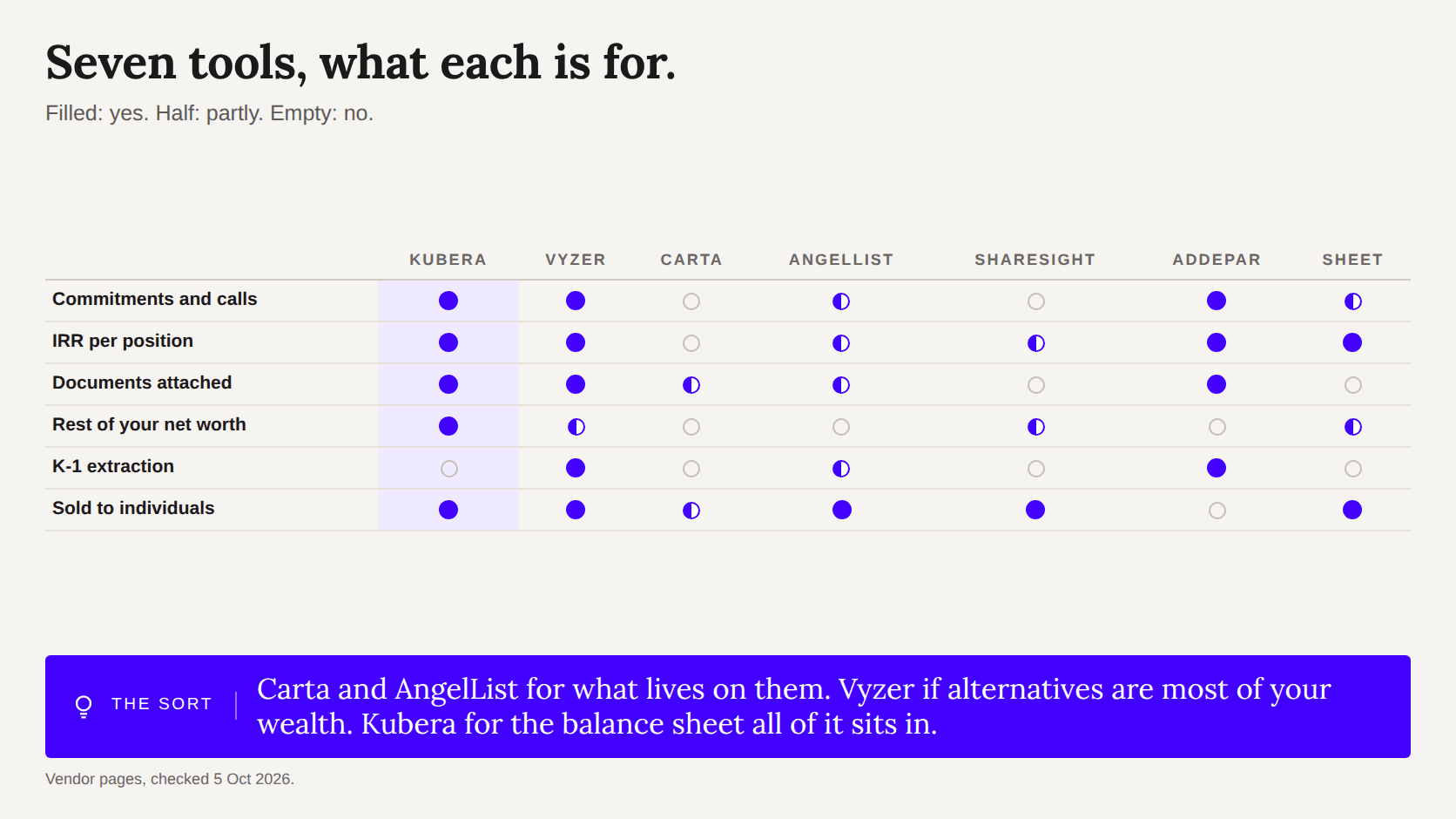
KuberaVyzerCartaAngelListSharesightAddeparSpreadsheet
Price$250 / yr$1,740–$9,540 / yrFree to holdersFree to investorsFree–$279 / yrQuote, ~$50K+ / yrFree
Commitments and callsSchedule, alerts, forecastYesNoOn-platformNoYesBy hand
IRRPer position, any currencyYesNoOn-platformListed onlyYesXIRR
DocumentsAttached to assetAI extractionCompany docsDeal docsNoYesElsewhere
Rest of your net worthYes, all of itPartlyNoNoAssets onlyFor the firmIf you build it
EntitiesNested portfolios (Black)By planNoNoPortfoliosYesTabs
Sold to individualsYesYesVia companyYesYesNo—
Matrix of seven tools for private investments against six criteria

The capital call problem

A fund commitment is the one asset that is also a liability. You committed $500,000, paid $300,000, and the remaining $200,000 can be called with ten days’ notice. A tracker that shows the position at $300,000 is not wrong, but it is not telling you the thing you need to know in October, which is that November might cost $120,000. Kubera holds the commitment, the schedule of expected calls and distributions, alerts you as they approach, and feeds the unfunded amount into Fast Forward so your cash forecast already knows. Vyzer does the same with more fund-admin depth. Everything else on this list leaves it to you.

Where the specialist tools win

Vyzer reads K-1s and investor reports with AI and is organised around the alternatives investor; if private deals are most of your wealth, it is worth its price. Carta and AngelList are free and authoritative for the holdings that live on them. Addepar is what the family office uses, and it is not for sale to you. Kubera’s place is the balance sheet all of them sit inside: the position, the schedule, the IRR and the documents, next to the brokerage, the house, the wallets and the mortgage.

Investors who track funds and private deals on Kubera

“I can track PE/VC fund commitments, drawdowns, real estate investments with rental income, and personal loans I've issued.”

Gintas, verified review

“I especially like the AI import feature and how well it works for private assets (PE/VC funds & investments).”

Robert A, verified review

“Kubera will then show you where you'll be financially in 1/5/10/20 years. You can setup various spending 'scenarios' and compare outcomes over time.”

Robert T, verified review
★★★★★ 4.8 out of 5 from 1,600+ verified reviews · Read them, including the critical ones

Questions people ask

How do I track a capital call in Kubera?
Add the fund as an asset with its commitment, then set up its capital-call and distribution schedule. Kubera alerts you ahead of each expected call, moves it to cash flow when it happens, and feeds the unfunded commitment into Fast Forward forecasts.
Does Kubera calculate IRR for private investments?
Yes. Each position’s IRR comes from its dated cash in and cash out, in any currency or crypto, and can be benchmarked against the S&P 500, Bitcoin or any ticker.
Can I attach documents to an investment?
Yes. Subscription agreements, statements and K-1s attach to the asset they describe, and AI import can read a statement to create or update the position.
What is the best free tool for angel investments?
Carta and AngelList are free for holdings that live on them. For a full picture across platforms and alongside the rest of your wealth, Kubera at $250 a year.
Sources and when they were checked
  1. Kubera help: IRR — https://help.kubera.com/article/79-irr-of-my-investment-in-kubera, checked 5 October 2026
  2. Kubera help: capital call and distribution schedule — https://help.kubera.com/article/138-capital-call-distribution-schedule, checked 5 October 2026
  3. Vyzer: pricing — https://vyzer.co/pricing, checked 5 October 2026
  4. Vyzer: features — https://vyzer.co, checked 5 October 2026
  5. Carta: portfolio — https://support.carta.com, checked 5 October 2026
  6. AngelList: investor portal — https://angellist.com/private-markets/investor-portal, checked 5 October 2026
  7. Sharesight: what can I track — https://help.sharesight.com/us/what-can-i-track-in-sharesight/, checked 5 October 2026
  8. Addepar — https://addepar.com, checked 5 October 2026
  9. Aleta: alternatives share on Addepar — https://aleta.io/addepar-alternatives, checked 5 October 2026
  10. andsimple.co: Addepar pricing — https://andsimple.co/companies/addepar/, checked 5 October 2026
I've used tons of net worth tracking apps. Kubera is my favorite by FAR. I have zero affiliation. I'm pretty sure it's a tiny team. But they've been launching so many cool features and are moving fast.
Sam Parr
Co Founder @ Hampton
Kubera has proved to be the best product we’ve found for expats — both those moving to the United States and Americans moving abroad — to manage their global investments and track them in the currency of their choice.
Keith Poniewaz, Ph.D.
Partner | Director of International Advisory Services @ Walkner Condon Financial Advisors
Two Prices
Not based on wealth. Based on complexity.
A wealth manager charges 1%. On $25 million, that's $250,000 a year. We kept the 250 and dropped the zeros.
kubera
Essentials
Everything except what's listed under Black
$250/year
kubera
Black
For complex multi-entity wealth.
Kubera Black customers get the Essentials plus...
  • Ownership tags: tag assets by owner across people, trusts, and entities. Details
  • Nested Portfolios: independent portfolios per person, trust, or entity, track money flowing between them and granular access control. Details
  • Guided Onboarding: get help fine-tuning your setup.
  • VIP Support: priority Email support and 1:1 Zoom calls
$2500/year
Try it fully loaded. Choose the subscription plan after the trial.
Try for 14 days
Try the fully loaded version.
Choose the subscription plan after the trial.
for firms
Kubera White Label
A Kubera balance sheet for every client, branded as yours.
Learn More