

Most people forecast cash the way they forecast weather: they look outside. The balance is fine today, so it will be fine. That works until you own a private fund. A fund with $500,000 committed and $200,000 called has a $300,000 claim on your cash that can arrive with ten business days' notice, on the fund's schedule rather than yours, and a second fund doubles the problem. A cash forecast that leaves out unfunded commitments is not a forecast. It is a hope.
This guide covers what makes private-fund cash flows different from every other bill, how to build a twelve-month cash ladder that includes expected calls and distributions, how much reserve to hold against unfunded commitments, how to fund a call when the reserve is short, and how to model all of it in Kubera so the next notice is a line you already had in the plan. It assumes you know what a capital call is; if not, this explainer covers the mechanics.
Forecasting Cash Needs With Private Funds at a Glance
- An unfunded commitment is a liability with an uncertain date. It does not appear on a bank balance, it does not show in a brokerage account, and the fund decides when to collect it, typically with one to two weeks' notice.
- The forecast that works is a cash ladder: cash on hand today, then month by month, what leaves (living costs, tax, known purchases, scheduled calls) and what arrives (income, expected distributions, maturities). The output is the first month the reserve runs thin, which is the number that matters.
- A working rule for the reserve: hold enough liquid cash to meet every call you expect in the next twelve months plus the largest single call any one fund could make, since calls cluster and distributions slip.
- Kubera tracks each private investment's committed capital, calls, distributions and IRR, lets you enter the expected call and distribution schedule under Committed Capital, rolls the upcoming amounts across all funds into the Cash on Hand card, and can carry the schedule into a monthly forecast of future cash flows in Fast Forward (help centre).
- Funding a call from a forced sale is the most expensive option and the one people default to. The cheaper options, a reserve or a line against the portfolio, only exist if they were arranged before the notice. See the Kubera portfolio tracker.
The whole method, on a demo balance sheet with two funds, in under three minutes:
Why Private-Fund Cash Flows Break an Ordinary Forecast
Every other claim on your cash has a date. The mortgage is due on the first. Estimated tax is due four times a year. Tuition arrives in August. A private fund is the exception: the commitment is fixed, the timing is not. The general partner calls capital when a deal closes, which depends on the market, on sellers, and on other investors, none of which you control. The result is a liability that is real, large and undated.
Three features of these funds make the forecasting problem worse than it first looks. Calls cluster. A fund in its investment period may call nothing for four months and then call twice in six weeks. Distributions slip. The return of capital that was going to fund the next call is subject to the same deal timing on the exit side, and exit markets close for years at a time. And commitments compound. A second fund, then a third, each in a different stage, turns one undated liability into an overlapping schedule of them.
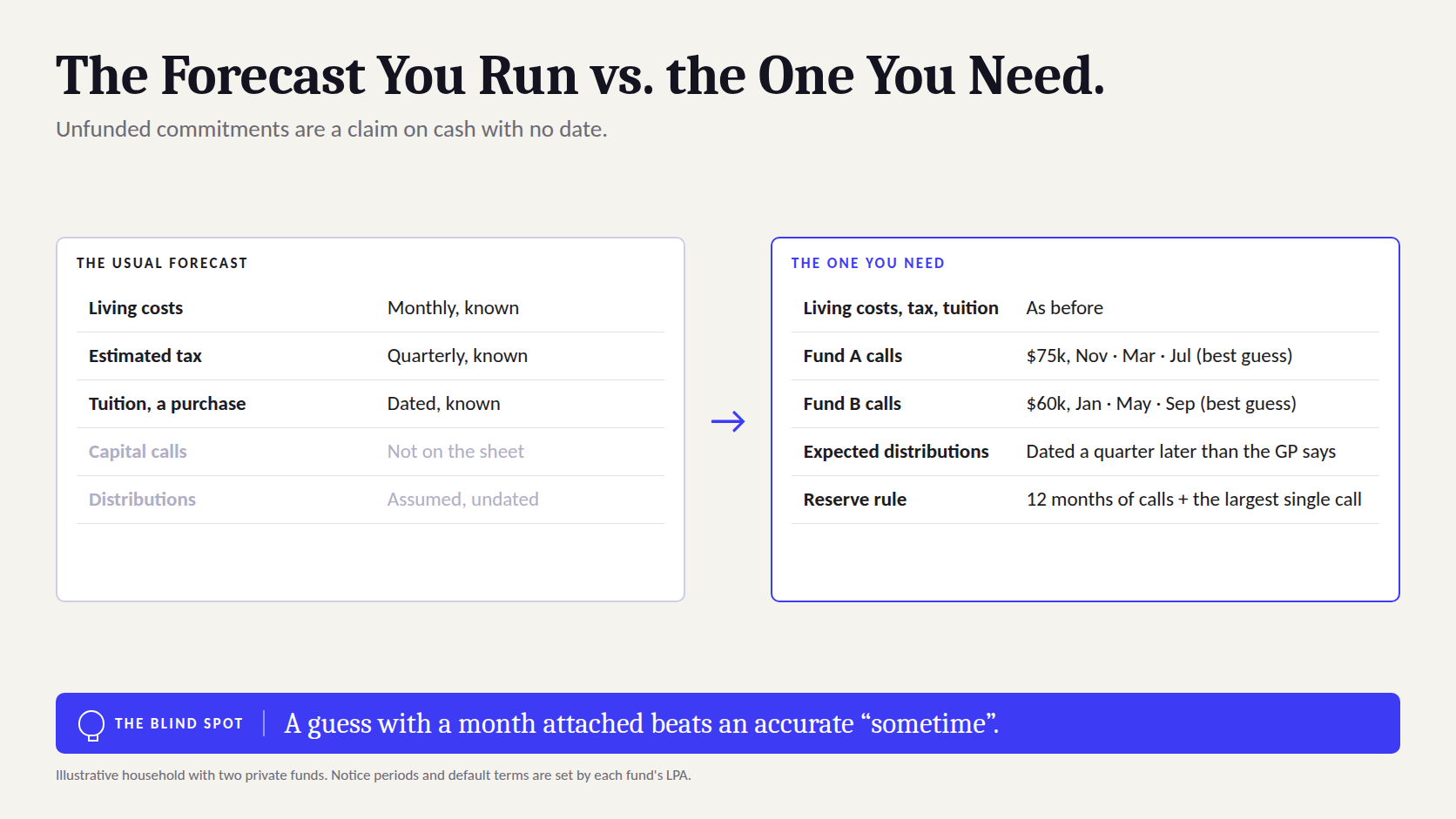
How the usual claims on cash compare with a capital call
| Claim on cash | Amount | Date | Notice | Penalty for missing it |
|---|---|---|---|---|
| Mortgage, living costs | Known | Known | Continuous | Late fees; credit |
| Estimated tax | Estimable | Known | Months | Interest and penalties |
| Tuition, a planned purchase | Known | Known | Months | Deferred or lost |
| Insurance premiums, property tax | Known | Known | Weeks | Lapse; penalties |
| Capital call on a private fund | Bounded by the unfunded commitment; the size of each call is the GP's choice | Unknown | Typically 10 to 15 business days | Default provisions in the LPA, which can include interest, forfeiture of part of the position or a forced sale of the interest |
The last row is why a private-fund investor's forecast has to be built differently. Missing a mortgage payment costs a fee. Defaulting on a capital call can cost a meaningful share of everything already invested in that fund, under terms you agreed to in the limited partnership agreement and probably have not read since.
The Cash Ladder: A Twelve-Month Forecast That Includes Commitments
The tool is old and simple. A cash ladder starts with liquid cash today and steps forward one month at a time, subtracting what leaves and adding what arrives, until it reaches a horizon, usually twelve months. Its single most useful output is not the ending balance. It is the month in which the balance is lowest, because that is the month a capital-call notice becomes a problem.
What makes it work for private funds is putting expected calls on the ladder even though their dates are guesses. A guess with a month attached is far more useful than an accurate "sometime". The convention that works: for each fund, place the expected calls in the months you think most likely, using the fund's pace so far and anything the GP has said about the pipeline, and place expected distributions one or two quarters later than the fund suggests, because that is how it tends to go.
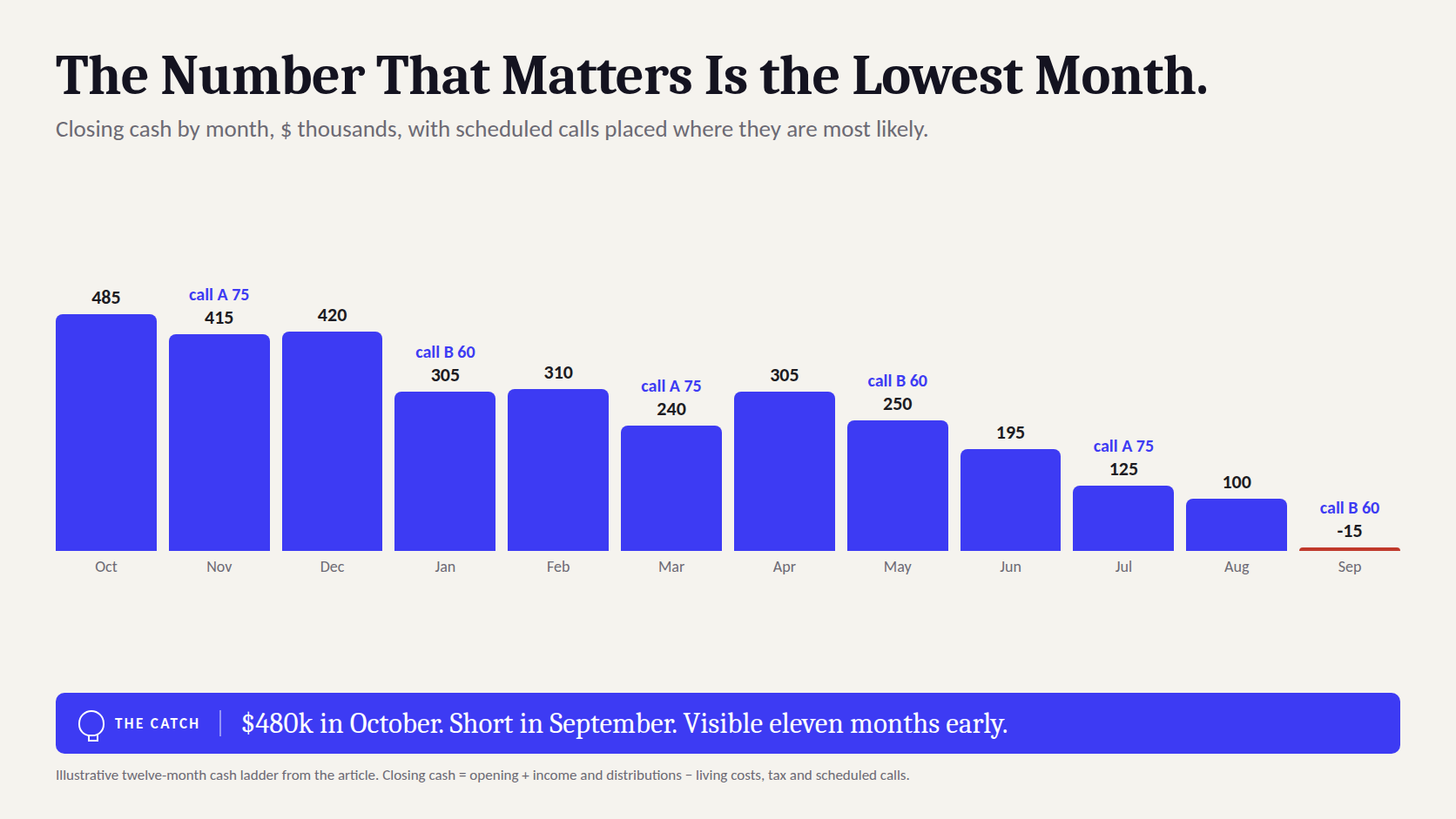
A twelve-month cash ladder for a household with two private funds (illustrative, $ thousands)
| Month | Opening cash | Living costs and tax | Scheduled calls | Expected distributions and income | Closing cash |
|---|---|---|---|---|---|
| Oct | 480 | (35) | 0 | 40 | 485 |
| Nov | 485 | (35) | (75) Fund A | 40 | 415 |
| Dec | 415 | (35) | 0 | 40 | 420 |
| Jan | 420 | (95) incl. tax | (60) Fund B | 40 | 305 |
| Feb | 305 | (35) | 0 | 40 | 310 |
| Mar | 310 | (35) | (75) Fund A | 40 | 240 |
| Apr | 240 | (95) incl. tax | 0 | 40 + 120 Fund A dist. | 305 |
| May | 305 | (35) | (60) Fund B | 40 | 250 |
| Jun | 250 | (95) incl. tax | 0 | 40 | 195 |
| Jul | 195 | (35) | (75) Fund A | 40 | 125 |
| Aug | 125 | (65) incl. tuition | 0 | 40 | 100 |
| Sep | 100 | (95) incl. tax | (60) Fund B | 40 | (15) |
The household above looks comfortable in October with $480,000 in cash. The ladder says it is short in September, and that a single unscheduled call from either fund in the summer would bring the problem forward to July. That is the entire value of the exercise: the shortfall is visible eleven months early, when there are many cheap ways to fix it, rather than at ten days' notice, when there is one expensive way.
The reserve rule
How much liquid cash to hold against unfunded commitments is a judgement, but a defensible rule of thumb is this: hold the sum of every call you expect in the next twelve months, plus the largest single call any one of your funds could make. The first part covers the plan. The second covers the fact that calls cluster and distributions slip, and that the fund's right to call the whole unfunded balance does not wait for your ladder. For the household above, with $405,000 of calls expected in the year and $150,000 as the largest plausible single call, the reserve is $555,000, against the $480,000 it holds in October. The ladder and the rule agree: the household is short, and the October balance was never the comfortable margin it looked like.
Two questions to ask each fund manager
What is the expected pace of the remaining commitment? Most GPs will say roughly how much of the fund they expect to deploy in the coming year, and whether the pipeline is front- or back-loaded. That answer is the basis for the months you put calls on the ladder.
What is the maximum notice period in the LPA, and what are the default provisions? The first tells you how much warning you get. The second tells you what a shortfall costs. Both are in documents you signed; ask for the page numbers.
Modelling It in Kubera
Kubera treats a private fund as what it is: a position with committed capital, calls to date, distributions to date, an unfunded balance and an IRR on the actual cash flows. Under Committed Capital on each investment, the Enter Capital Call & Distribution Schedule option lets you record the calls and distributions you expect, each with a date and an amount. When a scheduled call actually arrives, it moves into the fund's cash-flow table as money in; overdue items on the schedule carry a Move to Cash flow button that does this in one step (help centre).
Two things happen once the schedules are in. The Cash on Hand card on the dashboard shows the upcoming scheduled amounts across every fund, so the twelve-month claim on your cash sits next to the cash you actually have. And Fast Forward, Kubera's scenario tool, can include the capital call and distribution schedule through a rule under Assets, which folds the expected calls and distributions into what the help centre describes as "a comprehensive monthly summary of your future cash flows", alongside everything else the projection contains (help centre).
Building the forecast in Kubera, step by step
| Step | Where | What to enter | What you get |
|---|---|---|---|
| 1. Record each fund correctly | The investment's details | Committed capital; calls and distributions to date with dates | Unfunded balance and IRR per fund |
| 2. Schedule what you expect | Below Committed Capital > Enter Capital Call & Distribution Schedule | Expected calls and distributions, each with a date and amount | A per-fund schedule; upcoming amounts rolled into the Cash on Hand card across all funds |
| 3. Add the rest of life | Fast Forward rules | Living costs, tax dates, known purchases, income, growth assumptions; the inflation and contribution rules | A projection of net worth that includes the ordinary claims on cash |
| 4. Fold in the commitments | Fast Forward > Assets > the capital call and distribution schedule rule | Switch the rule on | A monthly view of future cash flows with calls and distributions included; click any point for the breakdown |
| 5. Keep it honest | The fund's schedule, as notices arrive | Move called items to the cash-flow table; re-date what slipped | A forecast that stays current with the funds' actual pace |
Fast Forward is built for exactly this kind of conditional planning. Its rules can express things such as investments growing at a chosen rate, debts repaid over a set number of years, a windfall in a particular year, a large outflow such as education, and event-triggered conditions of the form "when this asset reaches this value". Clicking a point on the projected chart shows the breakdown behind it. Combined with the call and distribution schedule, that turns "will I be short next summer?" into a question with a visible answer.
A capital-call notice should confirm the forecast, not create it.
Funding a Call When the Reserve Is Short
Even a good ladder runs thin sometimes. The question then is which source of cash to use, and the ranking is clear once you count the full cost.
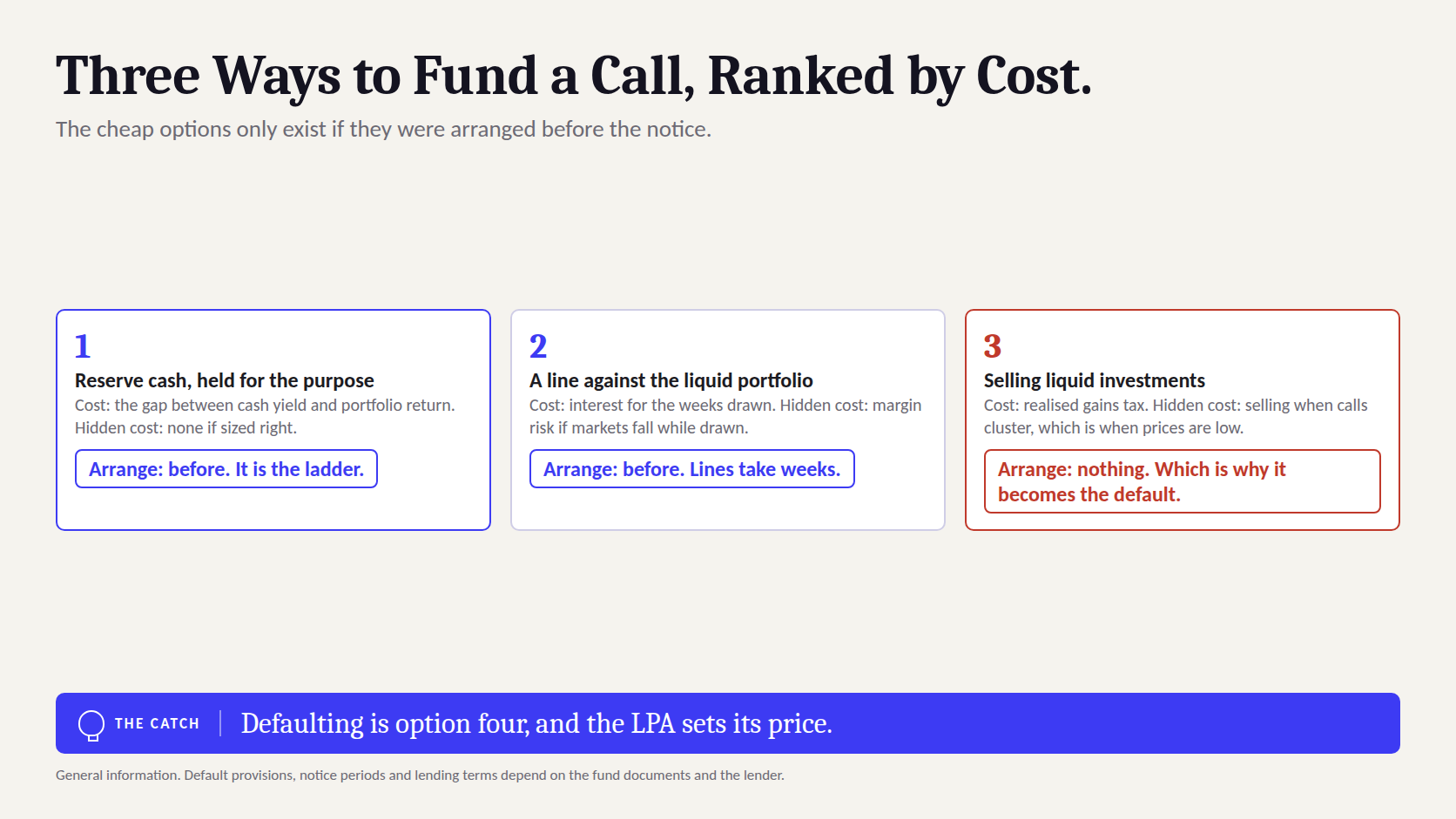
Ways to fund a capital call, ranked by cost
| Source | Direct cost | Hidden cost | Must be arranged |
|---|---|---|---|
| Reserve cash held for the purpose | Foregone return on the cash, typically the gap between cash yield and portfolio return | None, if sized correctly | Before: it is the ladder |
| Expected distribution from another fund | None | Timing risk; distributions slip more often than calls do | Cannot be arranged; can only be planned around |
| A line of credit against the liquid portfolio | Interest for the weeks or months it is drawn | Requires a pledged portfolio and a lender; margin risk if markets fall while drawn | Before: lines take weeks to set up and lenders do not hurry for a ten-day deadline |
| Selling liquid investments | Realised capital gains tax; transaction costs | Selling at the wrong time, which is when calls tend to cluster, since GPs buy when prices are low | Not required, which is why it becomes the default |
| Defaulting | Whatever the LPA says: interest, dilution, forfeiture | Reputation with the GP and with the next fund | — |
The pattern is that the cheap options require preparation and the expensive one does not. A household that runs the ladder in October has time to set up a line against the portfolio before the summer squeeze. A household that first thinks about it when the notice arrives will sell something, often at a poor moment, and pay tax for the privilege.
The Mistakes That Make Calls a Surprise
- Counting committed capital as invested. The unfunded balance is a claim on your cash, not an asset. Net worth is unaffected by a call; liquidity is transformed by it.
- Counting expected distributions as cash. Until the wire lands, a distribution is a forecast. Never let a scheduled call depend on one.
- Forgetting the second fund. Two funds with unrelated schedules will, at some point, call in the same month. Model them together, never one at a time.
- Reading the ending balance instead of the minimum. A ladder that ends the year comfortable can still be underwater in July.
- Holding the reserve in the wrong place. Cash for a call due in ten business days has to be somewhere it can move in two. A term deposit or an account across a border does not qualify.
- Never updating the schedule. A schedule set once and never re-dated is worse than none, because it produces confident, wrong answers. Re-date on every notice.
How Kubera Fits
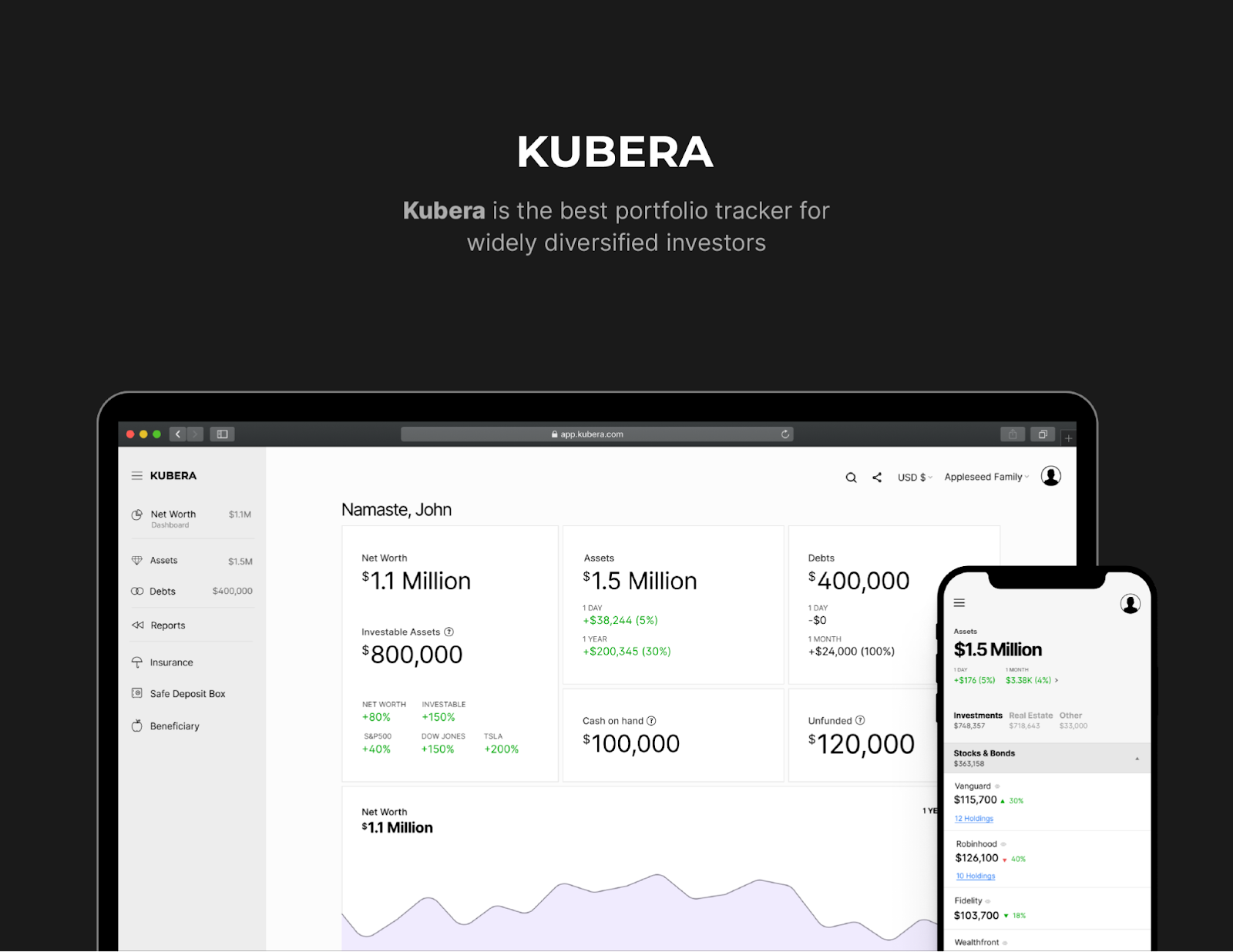
The Kubera portfolio tracker is built for a balance sheet that includes private funds. Each fund carries its committed capital, calls, distributions, unfunded balance and IRR; the expected schedule of calls and distributions lives on the investment itself; the Cash on Hand card shows the upcoming amounts across all funds beside the cash you hold; and Fast Forward folds the schedule into a monthly projection of future cash flows alongside living costs, tax, income and growth. Capital-call notices and fund statements dropped into Kubera become line items through AI Import, and the liquid side of the balance sheet, the part that would fund a call, is connected live through multiple aggregators.
The 14-day trial includes everything, so the first thing to do is enter each fund's commitment and expected schedule and look at the Cash on Hand card. If the number surprises you, that is the forecast doing its job early.
Frequently Asked Questions
How much notice do you get for a capital call?
It is set by the fund's limited partnership agreement. Ten to fifteen business days is common, and some agreements allow less. The notice period is the reason the reserve has to exist before the notice arrives; nothing useful can be arranged in ten days.
How much cash should I keep for capital calls?
A defensible rule is the sum of all calls you expect in the next twelve months plus the largest single call any one fund could make. The second part matters because calls cluster and distributions arrive later than planned. Adjust for how easily you could borrow against the liquid portfolio if you had to.
What happens if I miss a capital call?
The limited partnership agreement's default provisions apply. Depending on the fund these can include interest on the late amount, forfeiture of part of the existing interest, dilution, or a forced sale of the position, and a defaulting investor is unlikely to be welcome in the manager's next fund. Read the default clause before the first call, not after.
Can I forecast capital calls in Kubera?
Yes. On each private investment, below Committed Capital, you can enter the expected schedule of calls and distributions with dates and amounts. The upcoming amounts across all funds appear on the Cash on Hand card, and a rule in Fast Forward includes the schedule in a monthly projection of future cash flows.
Should expected distributions be part of the cash forecast?
Put them on the ladder, dated later than the fund suggests, and never let a scheduled call depend on one. Distributions are subject to exit timing, which slips more than call timing does.
Is a line of credit a good way to fund capital calls?
It can be the cheapest option for a short gap, since interest for a few weeks is usually less than the tax and timing cost of a forced sale. It must be set up in advance, it requires pledging liquid investments, and it carries margin risk if markets fall while it is drawn.
Does a capital call change my net worth?
No. Cash goes down and the value of the fund position goes up by the same amount on the day of the call. What changes is liquidity: the same wealth, less of it available. That is why the forecast is about cash, not net worth.
The Principle Worth Keeping
A commitment is a promise to pay on someone else's schedule. The only way to keep such a promise comfortably is to have already imagined the month it comes due. Put every expected call on a ladder, date the distributions pessimistically, hold a reserve sized to the plan plus one bad surprise, and arrange the cheap sources of cash before you need them. Do that and the next notice is a line you already had in the forecast.
This article is general information, not investment, legal or tax advice. Notice periods, default provisions and the treatment of borrowing against a portfolio depend on the fund documents and your circumstances; read the LPA and consult your advisers.


