

A hotel is real estate and an operating business sold as one: a building, its furnishings, and a business that re-prices its rooms every night. That makes hotel valuation different from valuing an office or an apartment block. The rent roll does not tell you much. The value comes from a forecast of rooms, food and beverage, and fees, run through a P&L and capitalized at a rate that moves with interest rates and investor appetite.
This guide walks through how professionals value a hotel, using one 150-room hotel through every method so you can see where they agree and where they don't. It then answers the question most guides skip: once you own a slice of a hotel through a syndication, fund, co-investment or REIT, what is your stake actually worth?
Key Takeaways
- Value comes from NOI, not bricks. Most hotel values start with net operating income after a management fee and an FF&E reserve. A seller's NOI that leaves those out can overstate value by 25% or more.
- Cap rates are near 8% and may rise. HVS reported a 7.7% average cap rate in Q2 2026, 8.2% for first-half deals and 8.4% for third-quarter deals through mid-September. Brokers now expect cap rates to drift up after the Fed's September 2026 rate hike.
- DCF is the method professionals trust most, and the easiest to bend. On our model hotel, moving the discount rate and exit cap rate by one point each swings value from about $20.7M to $25.7M.
- Price per key and rules of thumb are checks, not answers. The "$1 of ADR per $1,000 of value" rule overvalues our hotel by about $4M.
- Leverage magnifies every mark. With a 60% loan, a 0.5-point rise in the cap rate cuts the hotel's value 5.9% but the owners' equity 13.5%.
- Your stake is not the hotel. Debt, fees, the waterfall and a stale sponsor NAV all sit between the hotel's value and what an LP unit is worth.
Why Hotels Are Valued Differently From Other Real Estate
An apartment building is valued mostly on leases that run a year. An office building can have leases that run a decade. A hotel has no long-term tenants for its rooms. Every room is repriced and offered for sale each night, so income reacts to the economy within weeks, not years.
That makes a hotel part real estate and part operating business. Its value depends on occupancy, room rates, staffing, the brand on the door, the operator running it, and the conference and group business already booked. Hotels typically carry higher cap rates than apartments or industrial property because that income is more volatile and more expensive to produce.
Three layers of value inside one price
| Layer | What it includes | Why it matters to a buyer |
|---|---|---|
| Real property | Land and building | The durable part of value; financed like real estate |
| FF&E | Furniture, fixtures and equipment, typically replaced every 5–10 years | A wasting asset; must be reserved for or it shows up later as a capital call |
| Business value | Brand affiliation, management contract, booking channels, group business on the books | Can add or subtract value: a strong flag lifts rates, a hard-to-exit contract limits buyers |
Appraisers under the RICS Red Book treat hotels as trading-related property and often separate the going-concern value from the bricks-and-mortar value. For an investor, the practical point is simpler: a hotel's price pays for a business, and the business has to keep earning.
The Metrics Every Hotel Valuation Starts From
Every hotel valuation is built from a handful of operating numbers.
| Metric | What it measures | Our model hotel |
|---|---|---|
| Occupancy | Share of available rooms sold | 72% |
| ADR (average daily rate) | Room revenue ÷ rooms sold | $180 |
| RevPAR | ADR × occupancy; the headline top-line measure | $129.60 |
| TRevPAR | Total revenue per available room, including food, beverage and other income | $162.00 |
| GOP / GOPPAR | Gross operating profit, and that profit per available room | $3.19M / $58.32 |
| RevPAR index | RevPAR against a competitive set; above 100 means the hotel earns more than its fair share | Not modeled |
For context, U.S. hotels are having a strong 2026. CoStar and Tourism Economics now forecast RevPAR growth of 4.4% for the year, with occupancy near 63.1%, after a 0.3% decline in 2025. New supply is growing only 0.4% this year, well below the long-run average. The same forecasters expect growth to slow in 2027: RevPAR up 2.1%, room rates up 1.6%, and gross operating profit per room up only about 1%. Strong top-line numbers support value, but only if they reach NOI.
From the Hotel P&L to Net Operating Income
Hotels commonly report on the Uniform System of Accounts for the Lodging Industry (USALI), which runs revenue down to profit in a fixed order; its 12th Revised Edition applies from January 1, 2026. Here is our model: a 150-key upscale select-service hotel. The ratios are illustrative assumptions, not market benchmarks, and franchise royalties, loyalty and distribution costs are assumed to sit inside operating expenses.
| Line | Basis | Amount |
|---|---|---|
| Rooms revenue | $129.60 RevPAR × 150 rooms × 365 nights | $7.10M |
| Total revenue | Rooms at 80% of total | $8.87M |
| Gross operating profit (GOP) | 36% of total revenue, after departmental and undistributed expenses | $3.19M |
| Base management fee | 3% of total revenue | ($0.27M) |
| Fixed charges | Property tax and insurance, about 7% of revenue | ($0.62M) |
| FF&E reserve | 4% of total revenue | ($0.35M) |
| Net operating income (NOI) | 22% of revenue | $1.95M |
Illustrative model. Management fees of about 3% and FF&E reserves of about 4% of total revenue are common appraisal conventions; a franchise agreement may require a higher reserve.
The normalization trap
NOI is the number every income method capitalizes or discounts, so its definition matters more than any multiple. A seller, or an owner-operator who manages the hotel personally, may present NOI without a market management fee or a full FF&E reserve.
In our model, that "seller's NOI" is $2.57M instead of $1.95M. At an 8.5% cap rate, the difference is $30.3M versus $23.0M: a $7.3M overstatement from two missing expense lines. Always rebuild NOI to include a market management fee and a full reserve before applying any multiple, whether you are buying a hotel or checking a sponsor's model.
A hotel's price buys a building and a business that re-prices its rooms every night.
Method 1: Direct Capitalization (the Cap Rate Method)
Direct capitalization divides one year of stabilized NOI by a capitalization rate:
Hotel value = stabilized NOI ÷ cap rate
The cap rate is one year's NOI divided by the price: the initial income yield buyers accept for a hotel like this. It is not the same as the total return they expect. It is set by interest rates, the hotel's risk, its location and segment, and how many buyers are chasing similar assets.
What cap rates look like in 2026
HVS, which tracks closed U.S. hotel sales, reports an average transaction cap rate of 7.7% in the second quarter of 2026 and 8.2% for the twelve months ending June. Its September update put the first half of 2026 at 8.2% and third-quarter deals through mid-September at 8.4%. It puts a "normal" cap rate for a stabilized hotel near 8.0% to 8.5%, with exit cap rates about 1 percentage point higher. That direction may now change. The Federal Reserve raised its policy rate to 3.75%–4.00% on September 16, 2026, its first increase since 2023, and held it there on October 28, with two officials preferring another increase. The brokers in HVS's fall survey expect hotel cap rates to rise, mainly because of higher interest rates.
On our model hotel's $1.95M NOI, small changes in the cap rate produce large changes in value:
| Cap rate | Indicated value | Value per key |
|---|---|---|
| 7.7% | $25.3M | $169,000 |
| 8.0% | $24.4M | $163,000 |
| 8.5% | $23.0M | $153,000 |
| 9.0% | $21.7M | $145,000 |
| 9.5% | $20.5M | $137,000 |
When it works and when it misleads
Direct capitalization works best for a stabilized hotel: one with steady occupancy, no major renovation pending and a full year of representative NOI. It misleads for a hotel in ramp-up, mid-renovation, coming out of a brand change, or recovering from a disaster year, because one year of NOI does not represent the future. Sophisticated hotel buyers rarely set a price from a single cap rate on a single year. They use it as a quick read and a cross-check on the DCF.
Method 2: Discounted Cash Flow (DCF)
A DCF projects the hotel's cash flow over a holding period, usually 5 to 10 years, estimates a sale price at the end, and discounts everything back to today at the investor's required return.
- Project NOI for each year from assumptions about occupancy, ADR growth, other revenue and expense margins.
- Estimate the exit value by capitalizing the year after the hold at an exit (terminal) cap rate, less selling costs.
- Discount each year's NOI and the net sale proceeds back to today at the discount rate.
Our model hotel
Assume NOI grows 3% a year from today's stabilized $1.95M (so year one is $2.01M), a 5-year hold, a 9.5% exit cap rate (1 point above the 8.5% going-in rate, as HVS suggests), 2% selling costs and a 10% discount rate.
| Component | Amount |
|---|---|
| NOI, years 1–5 | $2.01M rising to $2.26M |
| Present value of five years of NOI | $8.04M |
| Sale at end of year 5 ($2.33M year-6 NOI ÷ 9.5%, less 2% costs) | $24.04M |
| Present value of the sale | $14.92M |
| DCF value | $22.97M |
The DCF lands almost exactly on the direct-cap value of $23.0M. That is the point of using both: when they land close together, it is a useful cross-check, though not proof that the inputs are right. When they don't, the gap tells you where to look.
Why professionals trust it, and why you should stress-test it
The DCF can capture what a cap rate can't: a renovation and the dip in income during it, a property improvement plan (PIP) required by the brand, or a ramp-up after reopening. A leveraged (equity) DCF can also model debt, including a refinancing. It is also the easiest method to bend. Here is how value moves with just two inputs:
| Discount rate ↓ / Exit cap rate → | 8.5% | 9.5% | 10.5% |
|---|---|---|---|
| 9% | $25.7M | $23.9M | $22.4M |
| 10% | $24.7M | $23.0M | $21.6M |
| 11% | $23.8M | $22.1M | $20.7M |
A $5M range, from inputs that are each one percentage point apart, on a hotel with no change in its operations. HVS cautions that an exit cap rate in the 6% to 7% range for a typical limited-, select- or full-service hotel in an easy-to-build market "should flash yellow lights". If you are an LP, ask the sponsor for the base, downside and upside cases, and check the exit cap rate before anything else. To compare the result with other private holdings, translate the sponsor's projected cash flows into an IRR rather than relying on a multiple.
Method 3: Sales Comparison and Price Per Key
Price per key is the sale price divided by the number of rooms. It is the number brokers quote and newspapers print.
National averages are a starting point only. JLL reports that U.S. hotel deal volume reached $24 billion in 2025, up 17.5%, and $22.2 billion through the third quarter of 2026, up 37% year over year. Through September 2026, full-service hotels averaged about $334,000 per key and select-service hotels about $108,000. Our upscale select-service hotel, at $153,000 per key, sits between them. Whether that is right depends on comparable upscale select-service sales in its market, not on the averages.
The method works best for branded select-service hotels, which follow uniform standards and trade often enough to produce comparables. It is weak for unique resorts and independent hotels, and it has a structural flaw: two hotels with the same key count can earn very different NOI. Hotel sale data is also often confidential. Other comparison metrics include price per square foot and the room revenue multiplier (price as a multiple of annual rooms revenue). Our hotel's $23.0M value is about 3.2 times its rooms revenue.
Method 4: The Cost Approach
The cost approach asks what it would cost to build an equivalent hotel today: land, plus construction, plus soft costs, minus depreciation on the existing building and FF&E.
It is most useful for new or recently renovated hotels, and as a test of whether a purchase price beats building new. That test is central to the 2026 market. JLL noted the "historic discount to replacement costs" as one reason private buyers returned in 2025, and HVS says buyers are leaning on replacement-cost comparisons and post-renovation upside. If building a comparable 150-key select-service hotel would cost $250,000 a key including land (an assumption; local construction costs vary widely), our $153,000-a-key value is about 39% below replacement cost. That can support the investment case, but it is not a margin of safety on its own: the income still has to justify the price, after any renovation the hotel needs.
Quick Rules of Thumb for a First Screen
The oldest rule in hotel investing says a hotel should earn $1 of ADR for every $1,000 of value per room. Turned around, value per room ≈ ADR × 1,000. Our hotel's $180 ADR screens at $180,000 a key, or $27.0M.
That is about $4M above the income methods. A Cornell study by John O'Neill, published in 2003 and covering 327 hotel sales from 1990 to 2002, found the rule held for small, new hotels with high ADRs and high occupancy, but the full sample averaged $1 of ADR per $800 of value, with midscale hotels near $600 and economy hotels near $700. At $800, our hotel screens at $21.6M, much closer to the income approach. Treat these ratios as historical findings, not current multiples.
Use rules of thumb to decide whether a deal deserves a closer look, never to decide what it is worth.
One Hotel, Four Answers
Here is the same hotel through every method:
| Method | Value | Per key | What it tells you |
|---|---|---|---|
| Direct capitalization (8.5%) | $23.0M | $153,000 | Today's market yield on stabilized NOI |
| DCF (10% discount, 9.5% exit cap) | $23.0M | $153,000 | Consistent with the cap rate; most sensitive to exit cap |
| Comparable sales ($140K–$170K per key) | $21.0M–$25.5M | $140K–$170K | A range, not a point; depends on the comps |
| ADR rule ($1 per $1,000) | $27.0M | $180,000 | Overstates for a hotel of this type |
| Seller's unadjusted NOI at 8.5% | $30.3M | $202,000 | What the number looks like before normalization |
Illustrative model hotel. Comparable range is hypothetical.
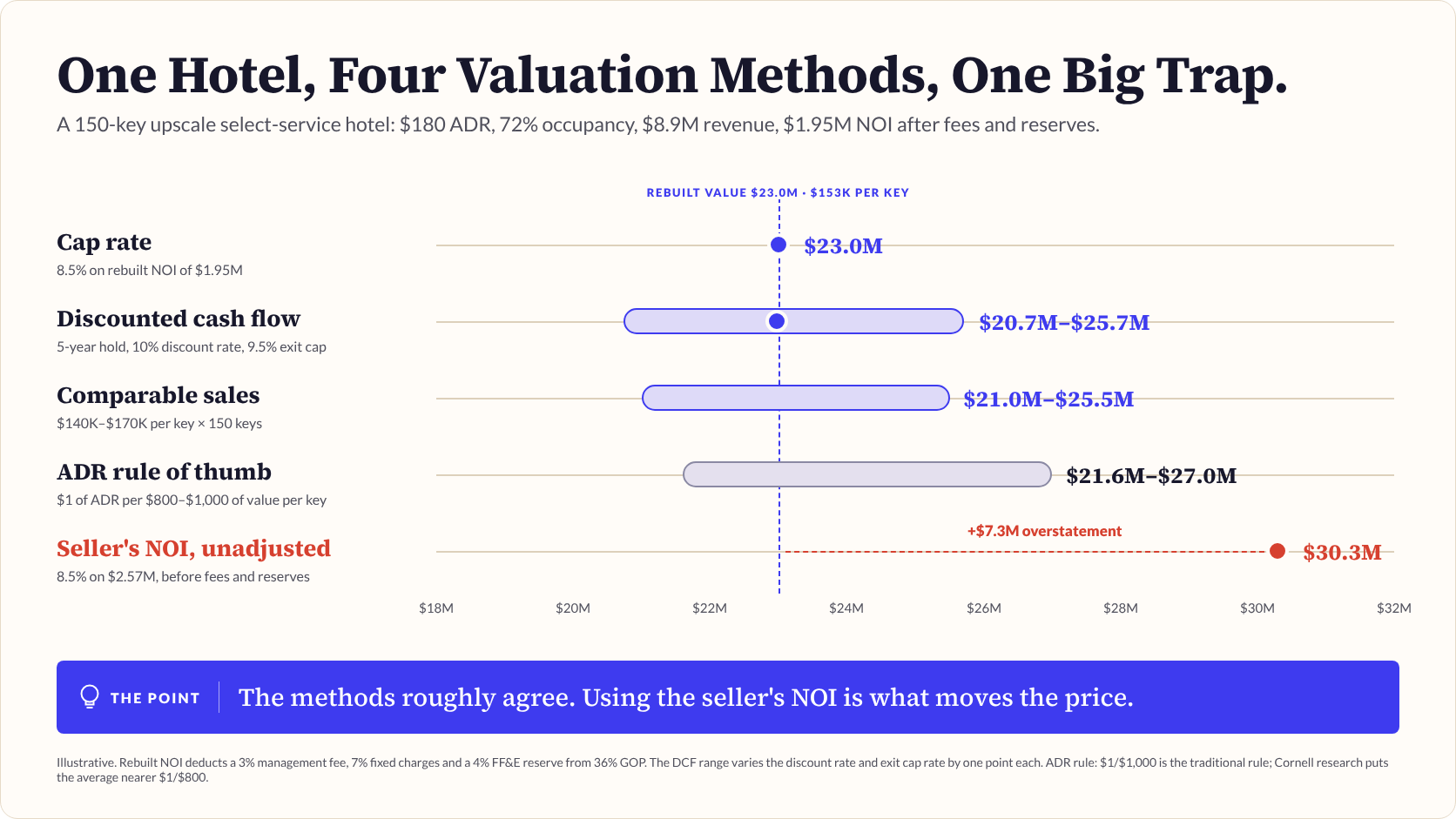
The lesson is not that one method is right. It is that the income approach, built on a normalized NOI, is the anchor. The others either confirm it or tell you which assumption to challenge.
What Moves a Hotel's Value Up or Down
- Location and demand drivers. Airports, convention centers, corporate offices, hospitals, universities and leisure draws. One-off events help, but only briefly. Before the 2026 World Cup, CoStar and Tourism Economics forecast host-market RevPAR up 12.7% in June and July but only 3.8% for the full year. During the tournament's final full week, host markets posted a combined 23.8% RevPAR gain, according to CoStar.
- Brand and franchise agreement. A suitable brand can lift occupancy and rates through loyalty programs and booking channels, though royalties, loyalty and marketing fees offset part of the gain. A property improvement plan (PIP) required at sale or franchise renewal can cost millions, and buyers typically deduct much of it from the price.
- Management contract terms. A long, hard-to-terminate management agreement can lower value to a buyer who wants to bring in its own operator.
- Seasonality. A short peak season that must carry the whole year adds risk and changes cash-flow timing, so value depends on full-year income, not just peak rates.
- New supply. U.S. supply is growing just 0.4% in 2026, against a long-run average of 1.6%, which supports existing hotels. A single new hotel next door can matter more than the national figure.
- Interest rates and debt markets. Cap rates move with borrowing costs. About $84 billion of hotel loans to known lenders mature through 2027, according to JLL ($33.7 billion in 2026 and $50.1 billion in 2027), so refinancing terms will shape values, recapitalizations and sales.
- Physical condition and deferred capital spending. Every year the FF&E reserve is underfunded becomes a renovation bill later.
Valuing Your Stake, Not Just the Hotel
Most private investors don't own a hotel outright. They hold an LP unit in a syndication or fund, a co-investment alongside a sponsor, or lodging REIT shares. High-net-worth buyers are a growing part of the market: JLL reports that private equity and high-net-worth individuals together accounted for 42% of U.S. hotel transaction volume through September 2026. For each route, the hotel's value is only the starting point.
Direct ownership through an LLC
Your equity value is the hotel's value minus the loan balance, adjusted for reserves and other assets or liabilities held at the entity. Most owners hold the property in an LLC or holding company to separate liability (see how real estate holding companies are structured).
Leverage magnifies every mark
Suppose our hotel was bought for $23.0M with a fixed $13.8M loan, 60% of the purchase price. If the market cap rate moves from 8.0% to 8.5%, the hotel's value falls from $24.4M to $23.0M, a 5.9% drop. The equity, what's left after the loan, falls from $10.6M to $9.2M: a 13.5% drop. Every point of movement in the hotel's value lands on the owners more than twice over.
With a 60% loan, a half-point move in the cap rate is a 13.5% move in your equity.
LP interests in a syndication or fund
Sponsors usually report a net asset value (NAV) quarterly or annually, often from their own model rather than a fresh appraisal. Check whether that NAV is the hotel's value or your equity after debt, so you don't subtract the loan twice. What an LP unit is worth depends on the hotel's value, the debt, and the waterfall: how sale proceeds are split between investors and the sponsor after a preferred return.
Assume the hotel is bought for $23.0M plus $1.0M of closing costs and reserves, with a $13.8M interest-only loan at 7%. That leaves $10.2M of equity, of which you contribute $250,000 (about 2.5%). NOI grows 3% a year. Each year, cash after interest first pays investors an 8% preferred return, and anything left is split 70/30 between investors and the sponsor. When the hotel is sold after five years, the loan is repaid, investors get their capital back, and the profit is split 70/30. An amortizing loan would leave less cash to distribute each year.
| Exit cap rate | Net sale price | Your total distributions | Multiple | IRR |
|---|---|---|---|---|
| 8.5% | $26.9M | about $429,000 | 1.72x | 13.3% |
| 9.5% | $24.0M | about $381,000 | 1.52x | 10.4% |
| 10.5% | $21.7M | about $325,000 | 1.30x | 6.5% |
Illustrative model with the waterfall described above. Excludes asset management fees, capital spending beyond the FF&E reserve, and taxes. An 8% preferred return is a priority in the waterfall, not a guaranteed return.
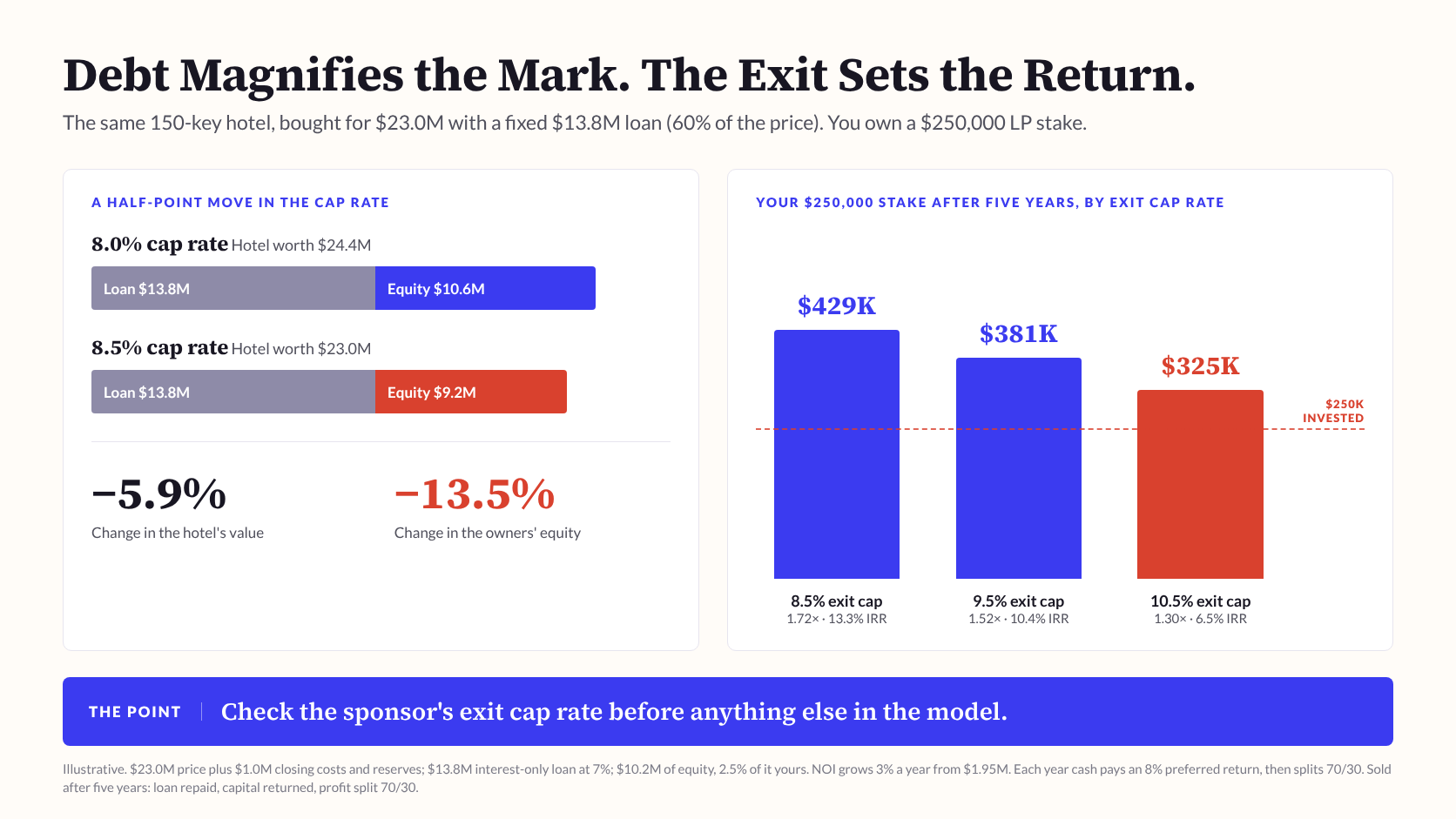
Two more claims on your cash sit outside this table. Unfunded commitments and capital calls, for a PIP, a renovation overrun or a refinancing shortfall, can create real obligations even before the hotel is sold. Plan for them as you would any other call on liquidity (see forecasting cash needs and capital calls).
Lodging REIT shares
REIT shares have a live price, but that price can disagree sharply with the value of the hotels underneath. In January 2026, S&P Global Market Intelligence measured hotel REITs at a median 33.5% discount to consensus NAV, among the steepest of any REIT sector. For a private investor, that gap is a useful reality check. If public investors will pay only two-thirds of NAV for diversified, liquid hotel portfolios, a sponsor's private NAV for a single hotel deserves scrutiny.
Illiquidity and marks that go stale
A hotel LP stake marked at last year's NAV can sit on a balance sheet long after cap rates or RevPAR have moved. Private stakes are classic lumpy assets: valued rarely, and in jumps. Between sponsor reports, you can sanity-check a mark yourself by applying a current cap rate to the hotel's trailing NOI and subtracting the loan.
How a Hotel Investment Fits Your Total Net Worth
A single hotel deal can be a large slice of a real estate allocation that already includes a primary home, rentals and REITs. Check the concentration before you invest, not after (see how much of your net worth should be in real estate and our guide to alternative real estate investments).
Hotel stakes also rarely live in one place. A founder might hold an LP unit in a resort syndication through a personal LLC, lodging REIT shares at a brokerage, and a co-investment in a European hotel denominated in euros. Each reports on a different schedule, in a different format, and sometimes in a different currency.
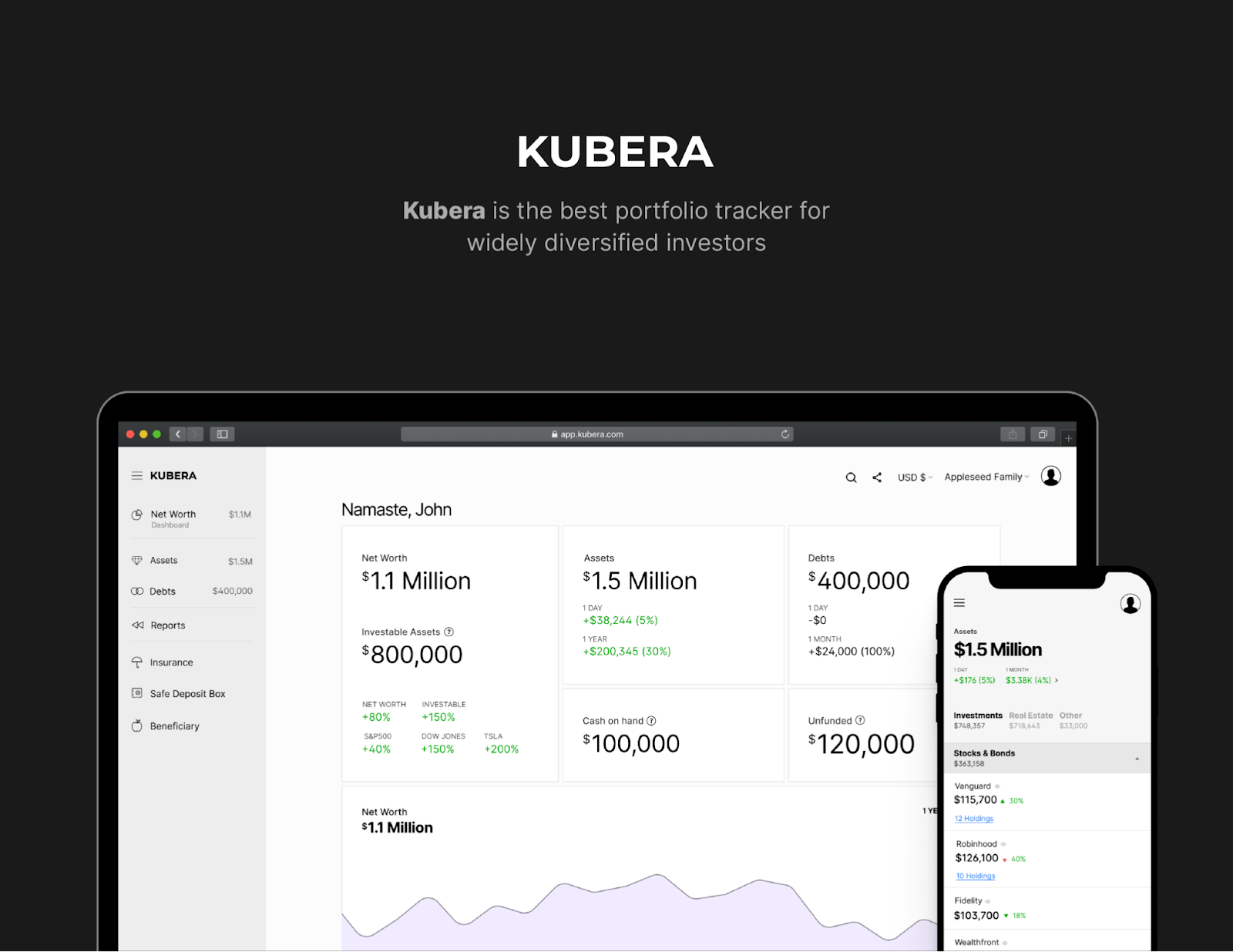
Tracking Hotel Stakes in Kubera
Kubera is built for holdings like these. You can add a hotel LP stake or a directly owned hotel as a manual asset, then upload the sponsor's quarterly report or the appraisal with File Import so the value and the documents sit together. On Kubera Black, nested portfolios let you group the hotel, its loan and the owning LLC or trust, so equity shows net of debt at each entity level (see tracking net worth across trusts, LLCs and family).
Once cash flows are recorded, Kubera calculates IRR on the stake, and foreign-currency hotel investments show in their native currency alongside your home currency. Fast Forward lets you test how a planned sale, a refinancing or a capital call changes projected net worth. When tax time comes, you can share a read-only view with your CPA or advisor.
Conclusion
Use the cap rate for a quick read, the DCF for the real decision, and price per key and replacement cost as checks. Rebuild NOI before applying any multiple. Then remember that the number that matters to an investor is not the hotel's value but the value of your own stake after debt, fees and the waterfall. That number only helps if it sits next to everything else you own and gets updated when the sponsor reports. Kubera brings hotel stakes, the rest of your real estate, private investments, brokerage accounts and crypto into one balance sheet, with a 14-day free trial.
Frequently Asked Questions
What is the most common way to value a hotel?
The income approach: a cap rate applied to stabilized NOI, or a DCF of projected cash flows and a sale price. Price per key and replacement cost are used as cross-checks.
What is a good cap rate for a hotel?
It depends on the asset and market. HVS reported an average U.S. transaction cap rate of 7.7% in Q2 2026, rising to 8.4% for third-quarter deals through mid-September, and puts a normal cap rate for a stabilized hotel near 8.0%–8.5%, with exit cap rates about 1 point higher. Luxury urban assets usually trade lower and value-add deals higher.
How is a hotel valued per room?
Divide the sale price by the number of rooms (keys). Through September 2026, JLL reported average U.S. prices of about $334,000 per key for full-service hotels and $108,000 for select-service hotels.
Why do hotels have higher cap rates than apartments?
Room rates reset every night and operating costs are high, so hotel income swings more with the economy. Investors demand a higher yield for that volatility.
What is the $1 per $1,000 rule for hotels?
A rule of thumb that a hotel should earn $1 of ADR for every $1,000 of value per room. It is a screening tool only; research found many hotels average closer to $1 per $800.
How do I value my LP share in a hotel deal?
Start from the hotel's value: check the sponsor's NAV against a current cap rate on trailing NOI, subtract the loan (unless the NAV is already net of debt), and apply the waterfall in the operating agreement. Remember that leverage magnifies any change in the hotel's value.
Disclaimer
This article is general information as of November 2026 and is not investment, tax, legal or appraisal advice. Figures for the model hotel and LP stake are illustrative. Market data comes from third-party sources and changes frequently; confirm current figures and consult qualified professionals before investing.


