

Last reviewed November 20, 2026, against S&P Dow Jones Indices, Morningstar, Vanguard, the SEC and IRS Rev. Procs. 2025-32 and 2026-35.
Portfolio management is the ongoing work of deciding what to own, in what proportions, and when to change it, so that a set of investments meets a goal at a level of risk you can live with. A professional portfolio manager does it for a fee. Many investors do it themselves, often without calling it that. Portfolio management is narrower than wealth management or financial planning, which add tax, estate, insurance and cash-flow advice on top.
The job has a definite structure. You set goals and limits, choose an asset allocation, pick investments, put them in the right accounts, then monitor, rebalance and measure. This guide covers the main types of portfolio management, seven common strategies, each step of the process, what professional management costs in 2026, and how to run the process yourself when your money is spread across many accounts.
What Is Portfolio Management?
Portfolio management means choosing and overseeing a group of investments, such as stocks, bonds, cash, real estate and private assets, so the whole portfolio serves a purpose. The purpose might be retirement income, a house purchase in five years, or growing wealth for the next generation. The portfolio is judged as a whole, not one holding at a time.
The modern version starts with Harry Markowitz's 1952 paper "Portfolio Selection." He showed that what matters is how investments move together, not just how risky each one is alone. Combining assets that don't move in lockstep can lower risk for the same expected return. That idea, modern portfolio theory, won him a share of the 1990 Nobel Prize in economics and still underpins how most portfolios are built.
A portfolio manager is the person or firm responsible for those decisions. That might be a mutual fund manager running billions, a registered investment adviser running a family's accounts, a robo-advisor's algorithm, or you.
Note: "portfolio management" also describes project portfolio management, where companies choose which projects to fund. This article is about investment portfolios.
Types of Portfolio Management
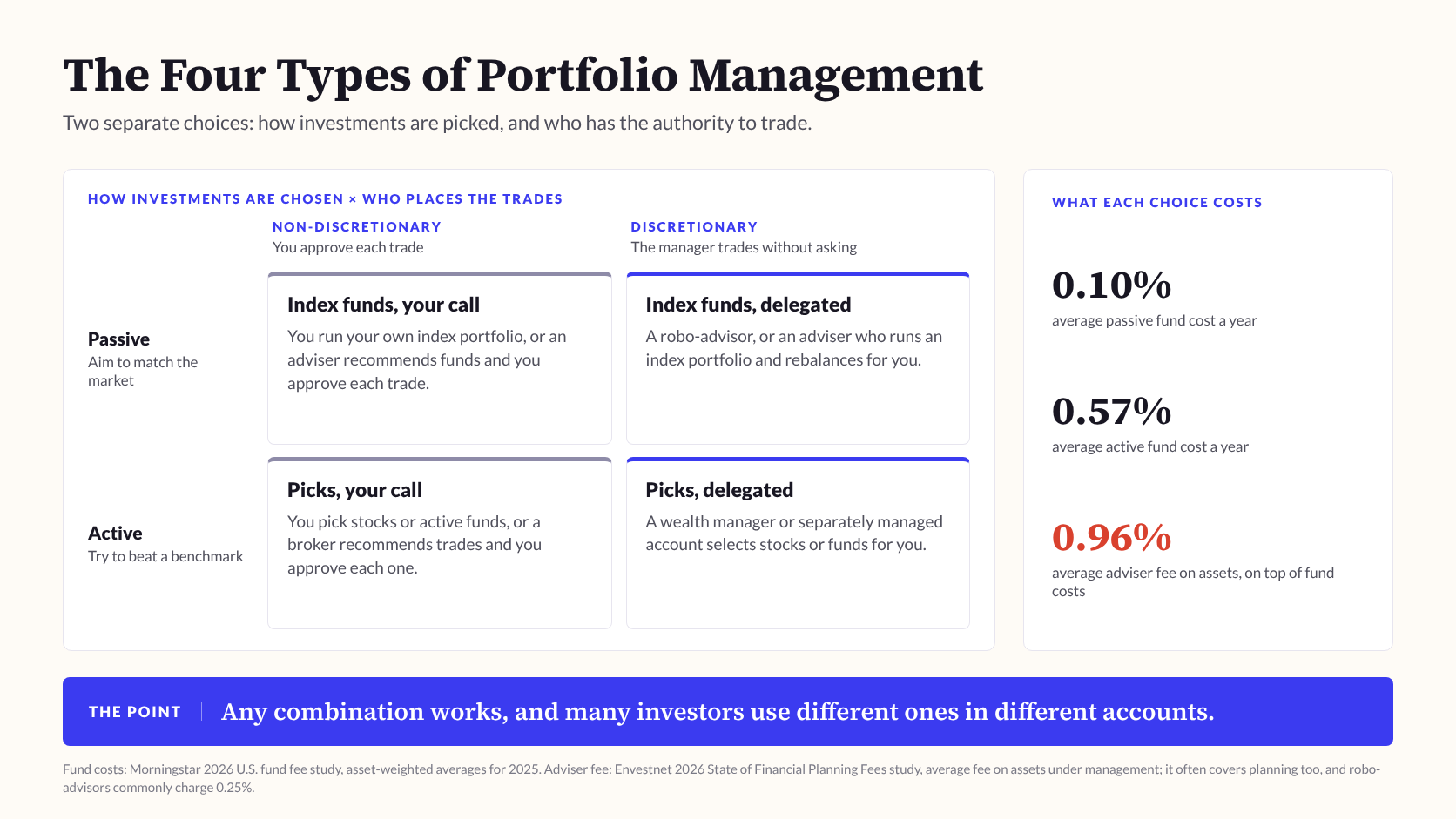
Two choices define the type of management you have: how investments are picked (active or passive) and who has authority to trade (discretionary or non-discretionary). Any combination is possible. A discretionary manager can run a passive index portfolio, for example.
Active vs. passive management
Passive management assumes that markets price securities reasonably well, so the most reliable edge is low cost. It usually means index funds or ETFs held for years, with occasional rebalancing.
Active management tries to beat a benchmark through security selection, sector bets or market timing. Some active managers do outperform, but few do it consistently after fees. In S&P Dow Jones Indices' SPIVA scorecard, 79% of active large-cap U.S. equity funds underperformed the S&P 500 in 2025, and 67% did in the first half of 2026. Morningstar's Active/Passive Barometer found that only 13% of U.S. large-cap active funds survived and beat their average passive rival over the decade through June 2026.
Investors have noticed. Passive funds held $19.4 trillion, or 55% of the U.S. fund market, at the end of 2025, according to Morningstar. Average fund costs were 0.57% for active funds and 0.10% for passive funds in 2025, according to Morningstar's 2026 fee study. Active management may still earn its place in less efficient corners, such as some bond categories and private markets, and for goals an index can't meet.
Discretionary vs. non-discretionary management
The difference is authority. With discretionary management, you sign an agreement giving the manager power to buy and sell within your investment policy, without asking you first. That speeds up rebalancing and tax-loss harvesting, and it means you are trusting the manager's judgment.
With non-discretionary management, the adviser recommends and you decide. You keep control, but trades wait for your sign-off, which can mean missed rebalancing windows.
Both arrangements are available to individuals as well as institutions. What matters as much as the authority is the legal standard. Registered investment advisers owe clients a fiduciary duty of care and loyalty under the Investment Advisers Act. Broker-dealers recommending investments to retail customers must meet Regulation Best Interest, a different standard that doesn't require ongoing monitoring unless the broker agrees to it. Ask which applies, and read the firm's Form CRS, a short summary of services, fees and conflicts, and its Form ADV Part 2 brochure. You can look up an adviser's registration and disciplinary history on the SEC's Investment Adviser Public Disclosure site and a broker's on FINRA's BrokerCheck.
Who Uses Portfolio Management?
Individual investors manage portfolios for retirement, a home, education or financial independence. Their risk tolerance, tax situation and knowledge vary widely, and so do their tools: some use a robo-advisor, some hire an adviser, and many run their own accounts.
Institutional investors, such as pension funds, endowments, foundations, insurers and banks, manage money against long-term obligations. They work under regulation and written investment policies, and they often care more about meeting future liabilities than beating a market index in any one year.
High-net-worth families sit between the two. They often have institutional-style complexity, with trusts, private investments and several advisers, but no investment committee to hold it together.
Portfolio Management Strategies
A strategy sets the overall risk level and what the portfolio is meant to do. The allocations below are illustrative starting points, not recommendations.
These labels describe different things: a risk level (aggressive, moderate, conservative), an objective (income), a method (active or passive) and a tax approach. Most real portfolios combine one of each, such as a moderate, mostly passive, tax-efficient portfolio. A common approach is core and satellite: a low-cost passive core holds most of the money, and smaller active or thematic positions sit around it.
In retirement, the job shifts from building to drawing down. Keeping a year or two of spending in cash or short-term bonds reduces the risk of selling stocks after a fall, and the order in which you draw from taxable, tax-deferred and Roth accounts affects your taxes.
The Portfolio Management Process, Step by Step
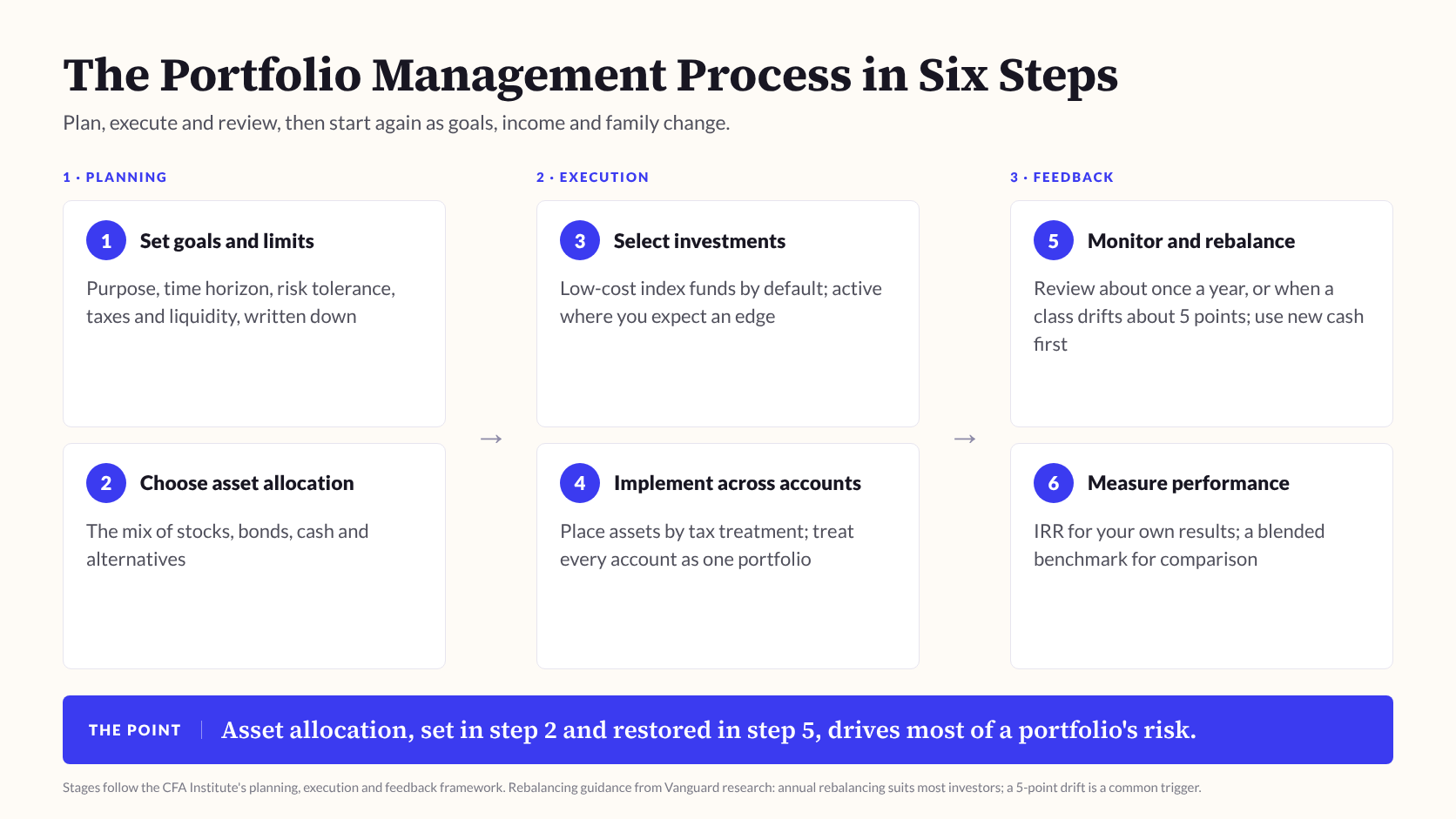
The CFA Institute describes portfolio management in three stages: planning, execution and feedback. In practice, that is six steps, repeated for as long as you invest.
Step 1: Set goals, risk tolerance and constraints
Write down what the money is for, when you will need it, how much loss you can tolerate without changing course, and any constraints such as taxes, liquidity needs, concentrated stock or ethical preferences. Professionals put this in an investment policy statement (IPS). A one-page version works for individuals and is the best defense against panic decisions in a downturn.
Step 2: Choose an asset allocation
Decide how much goes into each broad asset class: stocks (U.S. and international), bonds, cash and alternatives such as real estate or private equity. This is the decision that most shapes your returns and how much the portfolio swings. Weigh two things: how much risk you're willing to take, and how much you can afford to take given your time horizon, income stability, debts and other assets. Money needed within a few years shouldn't depend on the stock market. The long-term target is your strategic allocation. Some managers also make short-term tactical shifts away from it to manage risk or exploit valuations. These add trading costs and, for most individual investors, haven't reliably paid off.
Step 3: Select investments
Choose how to fill each slot. For most asset classes, broad, low-cost index funds are the default. Active funds, individual stocks or private investments make sense where you have a reason to expect an edge or need something an index can't offer. Diversify within each class across sectors, regions and issuers, and check that funds don't overlap. When comparing funds, look at total cost, what index or strategy they follow, tax efficiency and, for a target-date fund, how its allocation changes over time. Larger taxable accounts sometimes use separately managed accounts or direct indexing, which hold the individual stocks and make it easier to harvest losses.
Step 4: Implement across accounts
Place investments where they are taxed least (see "Tax-efficient portfolio management" below), keep trading costs low, and phase in a large sum if that helps you stick with the plan. Vanguard's research has found that investing a lump sum at once has usually come out ahead, because money waiting in cash tends to earn less. Implementation is where a portfolio spread across a 401(k), IRAs, a brokerage account and a trust needs to be treated as one portfolio, not five.
Step 5: Monitor and rebalance
Markets move allocations away from target. A 60/40 portfolio can drift to 70/30 after a strong stock market, carrying more risk than you chose. Rebalancing brings it back by selling what has grown overweight and adding to what is underweight.
There is no single best schedule. Vanguard's 2022 rebalancing research found annual rebalancing optimal for most investors who don't harvest tax losses or track a benchmark closely. Its earlier work suggested monitoring once or twice a year and acting when an allocation drifts about 5 percentage points. Buying underweight assets with new contributions or dividends, or trading inside an IRA or 401(k), avoids realizing capital gains. Selling appreciated holdings in a taxable account to rebalance or fund a withdrawal does not.
Here is what that looks like for a $2 million household portfolio with a 60/40 target, after a year in which stocks rise 25% and bonds fall 2%:
Doing that trade inside a 401(k) or IRA realizes no gain. If the stock is in a taxable account, redirecting a year of new savings to bonds may close part of the gap without selling.
Step 6: Measure performance
Compare results with a benchmark that matches your allocation, not with the S&P 500 alone. Use a money-weighted return, such as IRR, to see how your own deposits and withdrawals worked out. Use a time-weighted return to judge a manager, because it removes the effect of cash flows the manager didn't control. Look at risk too: standard deviation (how much returns swing), maximum drawdown (the worst fall), and the Sharpe ratio (return earned per unit of risk). Then go back to step 1. Goals change with age, income and family.
A 60/40 portfolio left alone can drift to 70/30 after a strong stock market. That is more risk than you chose.
What a Portfolio Manager Is Responsible For
Whether you hire one or do it yourself, the core responsibilities are the same. Tax and estate coordination depend on what the adviser has agreed to provide.
- Aligning the portfolio with goals. The allocation and investments should follow from the client's objectives, time horizon and risk tolerance.
- Managing risk. That includes market risk, but also concentration in one stock or employer, liquidity, currency and inflation.
- Asset allocation. Setting and maintaining the mix of stocks, bonds, cash and alternatives.
- Diversification. Spreading money across asset classes, sectors and regions so that no single holding or sector sinks the plan. It reduces company-specific risk but doesn't prevent market-wide losses. See portfolio diversification.
- Rebalancing. Restoring the target mix as markets move. See portfolio rebalancing.
- Tax efficiency. Minimizing the tax drag on returns.
- Reporting. Showing what the portfolio earned, what it cost and whether it is on track. See portfolio performance evaluation.
Tax-Efficient Portfolio Management
For taxable investors, what you keep matters more than what you earn. Four tools do most of the work.
1. Asset location. Put tax-inefficient assets in tax-advantaged accounts and tax-efficient ones in taxable accounts. The table shows common starting points, not rules; the best placement depends on your current and future tax rates and account sizes.
2. Holding periods. Most gains on assets held more than a year are taxed at long-term rates of 0%, 15% or 20%, based on taxable income including the gain. Collectibles can be taxed at up to 28%, and depreciation recaptured on real estate at up to 25%. A 3.8% net investment income tax applies to the smaller of your net investment income or the amount by which modified AGI exceeds $200,000 ($250,000 married filing jointly, $125,000 married filing separately). Short-term gains are taxed as ordinary income, up to 37%.
Sources: taxable income thresholds from IRS Rev. Proc. 2025-32 (2026) and Rev. Proc. 2026-35 (2027).
3. Tax-loss harvesting. Selling an investment at a loss and buying a similar but not substantially identical one lets you use the loss against gains and up to $3,000 of ordinary income a year ($1,500 if married filing separately), carrying any excess forward. Harvesting mostly defers tax rather than eliminating it, because the replacement investment has a lower cost basis, unless you hold it until death or donate it. The wash-sale rule disallows the loss if you, or your spouse, buy the same or a substantially identical security within 30 days before or after the sale, including through dividend reinvestment. Buying it in an IRA is worse: the loss is disallowed and doesn't add to the IRA's basis, so it is lost for good. There's no bright-line test for "substantially identical"; swapping one S&P 500 fund for another is riskier than swapping it for a total-market fund.
4. Rebalancing with cash flows. Directing new contributions, dividends and withdrawals toward underweight assets often rebalances the portfolio without selling anything.
Direct Roth IRA contributions phase out between $153,000 and $168,000 of modified AGI for single filers in 2026 ($242,000–$252,000 married filing jointly). For 2027, the ranges rise to $158,000–$173,000 and $250,000–$260,000 under IRS Notice 2026-66. Above them, many investors use a backdoor Roth. The conversion is partly taxable under the pro-rata rule if they hold other pre-tax traditional, SEP or SIMPLE IRA money at year-end. See also capital gains tax.
What Portfolio Management Costs in 2026
Professional management is usually priced as a percentage of assets under management (AUM). Envestnet's 2026 State of Financial Planning Fees study found the average AUM fee was 0.96%, down from 1.05% in its 2023 survey, according to Money. That fee often covers financial planning as well as investment management. Most advisers use tiered schedules that start around 1% and step down above $1 million. Fund expenses come on top.
Small differences add up. The chart below assumes $1 million earning 7% a year before costs for 25 years.
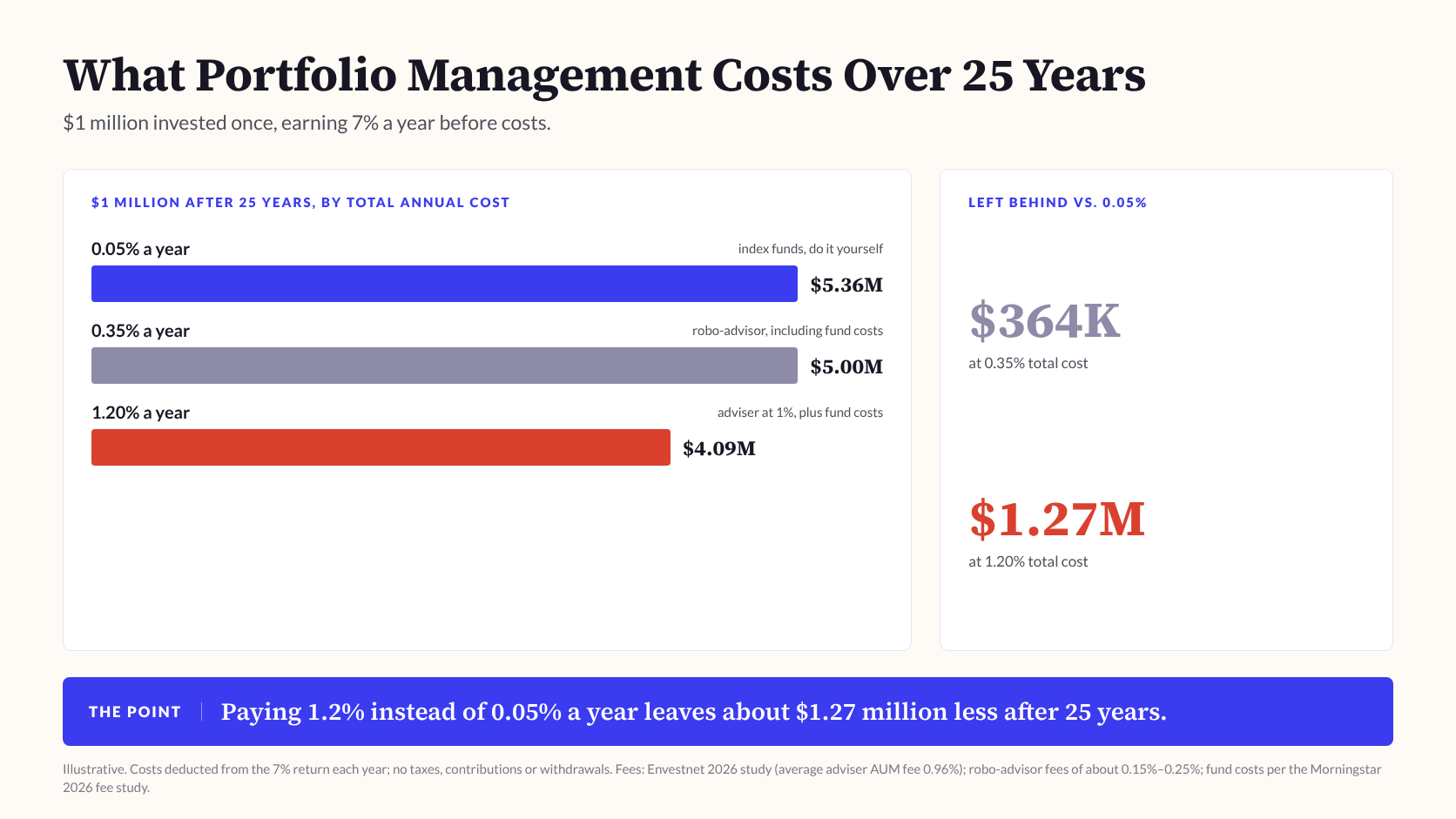
Assumptions: $1 million invested once; 7% annual return before costs; costs deducted from the return each year; no taxes or withdrawals. Illustrative only.
A fee is worth paying when it buys something you value and wouldn't otherwise do: tax planning, estate coordination, behavioral coaching in a crash, or simply your time. Ask for the all-in cost, including fund expenses. Kubera's guides to choosing a financial advisor and whether a wealth manager is worth it go further.
How to Manage Your Own Portfolio
Many investors manage their own portfolios successfully. The ones who do it well tend to follow a written process:
- Write a one-page plan. Goals, time horizon, target allocation and the rules for rebalancing.
- Count everything. Include workplace plans, IRAs, HSAs, a spouse's accounts, trusts, cash, and private or illiquid holdings. An allocation that ignores half your assets isn't your allocation.
- Use low-cost core funds. A handful of broad index funds can cover most of a portfolio.
- Place assets by tax treatment. Follow the asset-location table above.
- Rebalance on a schedule. For example, review once a year, or sooner if an asset class drifts about 5 points, using new cash first.
- Measure returns properly. Track contributions and withdrawals so you can compute IRR, and compare with a blended benchmark.
- Write down who to call. Make sure a spouse or heir knows where the accounts are and how they're organized.
For high-net-worth investors, step 2 is often the hardest. Money is spread across several brokers, retirement plans, real estate, private funds and startup stakes, and no single statement shows the whole picture.
Managing Your Portfolio in Kubera
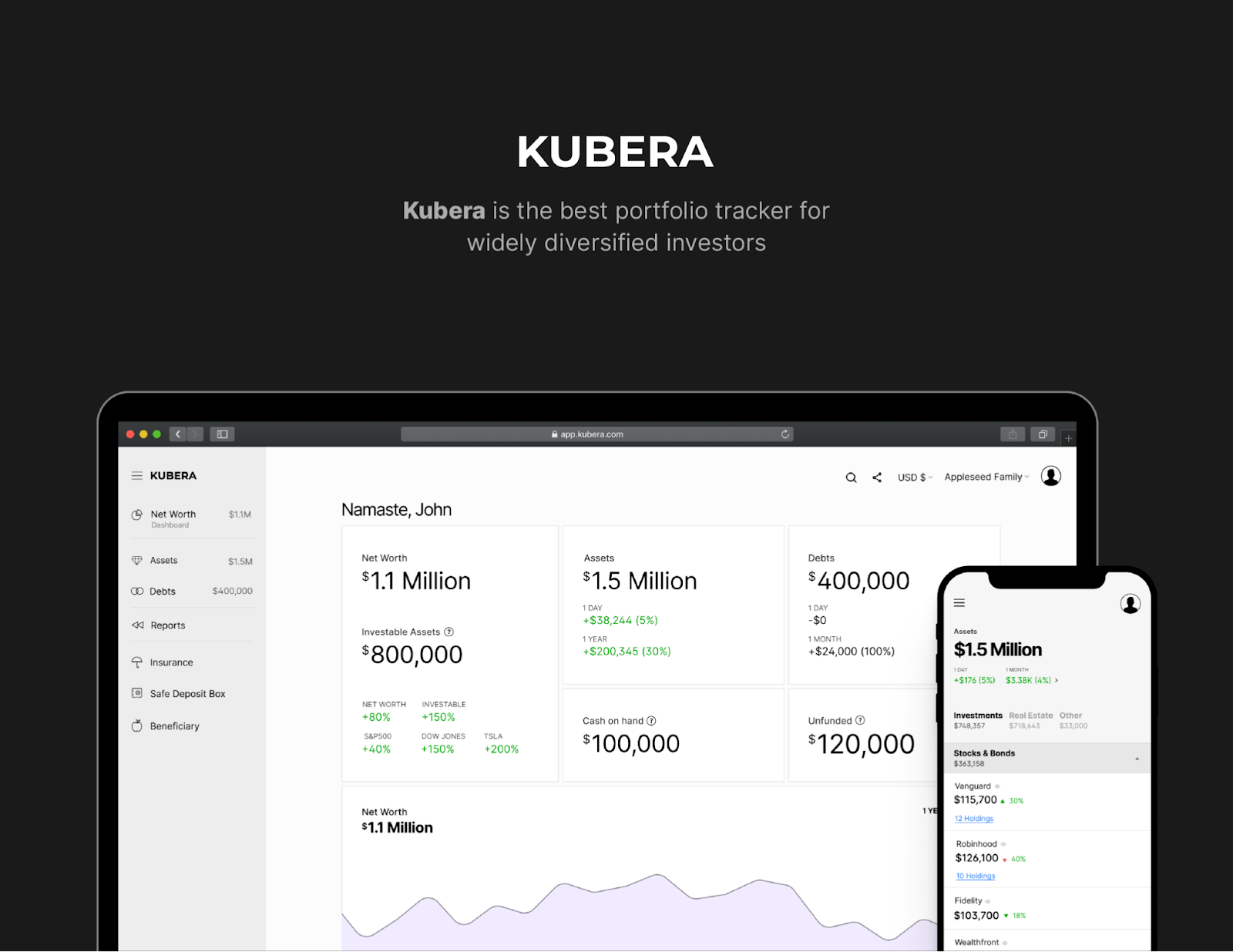
Kubera is a portfolio and net worth tracker. It doesn't manage money or place trades. It gives you, or your adviser, one view of everything you own, which is what portfolio management needs.
- See the whole portfolio. Connect bank, brokerage, retirement and crypto accounts across institutions, and add real estate, private investments, startup equity and collectibles. Loans and mortgages sit next to the assets they finance.
- Check your allocation. Recap reports show how assets, debts and net worth changed over time, and your allocation by asset class across every account.
- Measure real returns. Record cash flows and Kubera calculates IRR on each investment held longer than a year, and ROI for newer holdings.
- Add statements quickly. File Import adds and updates assets from statements and screenshots, for accounts that don't connect.
- Organize by owner and entity. On Kubera Black, ownership tags show what belongs to each person, trust or company, and nested portfolios give each entity its own balance sheet.
- Model what's next. Fast Forward projects how your net worth could change with contributions, withdrawals and planned purchases.
- Plan for your family. The Dead Man's Switch sends your portfolio to people you choose if you go silent for too long.
Kubera Essentials costs $250 a year for two portfolios and two users. Kubera Black, $2,500 a year, adds unlimited portfolios and users, nested portfolios and ownership tags, help setting up AI agents, and 1:1 calls with a dedicated expert. See Kubera Black. Kubera is a tracking tool, not an adviser.
Try it with a 14-day free trial.
Conclusion
Good portfolio management is mostly a few decisions made well and then maintained: a clear goal, an allocation that fits it, low-cost investments, sensible account placement, and the discipline to rebalance and measure. Most investors are better served by a passive core than by paying to try to beat the market. If you hire help, know whether it is discretionary, what standard of care applies, and what it costs in total.
Whoever does the work, the portfolio has to be seen whole. Measure allocation and performance on your investable assets, but see them alongside the home, business and private holdings that shape how much risk you can actually take.
Frequently Asked Questions
What is portfolio management in simple terms?
It is deciding what to invest in, how much of each, and when to adjust, so a collection of investments meets a goal at an acceptable level of risk. It includes setting an asset allocation, choosing investments, rebalancing and measuring results.
What are the four types of portfolio management?
Active, passive, discretionary and non-discretionary. The first two describe how investments are chosen, and the second two describe who has authority to trade. An account is usually one of each pair, such as passive and discretionary, though many investors mix approaches across accounts.
What does a portfolio manager do?
A portfolio manager sets the asset allocation, selects investments, manages risk and diversification, rebalances, handles tax efficiency and reports on performance. A discretionary manager also places the trades without asking first.
Is active or passive portfolio management better?
For U.S. large-cap stocks, passive has usually been better after costs. In 2025, 79% of active large-cap U.S. funds underperformed the S&P 500 (S&P's SPIVA), and only 13% survived and beat their average passive peer over the 10 years to June 2026 (Morningstar). Results vary by asset class, so check the data for the category you're considering.
How often should I rebalance my portfolio?
Vanguard's research finds that rebalancing about once a year is optimal for most investors who don't harvest tax losses. A common trigger is an asset class drifting about 5 percentage points from target. Rebalance with new cash where you can, to avoid realizing gains.
How much does portfolio management cost?
Do-it-yourself index portfolios can cost under 0.10% a year. Robo-advisors charge from 0% to about 0.35%, with 0.25% common, plus fund costs. Human advisers often charge about 1% on the first $1 million, stepping down above that; Envestnet's 2026 study put the average AUM fee at 0.96%.
What is the difference between discretionary and non-discretionary portfolio management?
With discretionary management, the manager can buy and sell within your agreed policy without asking you first. With non-discretionary management, the adviser recommends and you approve each trade.
Can I manage my own investment portfolio?
Yes. Write a short plan, count every account, use low-cost core funds, place assets by tax treatment, rebalance on a set schedule and measure returns. A single view of all your accounts makes each of those steps easier.
Are portfolio management fees tax-deductible?
Generally not for individuals. Investment advisory fees were a miscellaneous itemized deduction, which has been suspended since 2018 and was made permanent by the 2025 tax law. Fees paid from inside a traditional IRA reduce the account rather than your taxable income.
Disclaimer
This article is general information as of November 20, 2026 and is not investment, tax or legal advice. Fund performance figures are historical and don't predict future results. Tax thresholds and rules change, and the right strategy depends on your circumstances. Examples are illustrative. Consider speaking with a qualified financial adviser or tax professional before making investment decisions.


