

Last reviewed November 18, 2026, against IRS Notices 2025-67 and 2026-66, Form 8606 and Publications 590-A and 590-B.
A backdoor Roth IRA is how people who earn too much to contribute to a Roth IRA directly still get money into one. You make a nondeductible contribution to a traditional IRA, then convert it to a Roth IRA. Done cleanly, it costs little or no tax, and it has been possible since income limits on Roth conversions were removed in 2010.
The steps are simple. The reporting is where people go wrong, usually because of an old rollover IRA, or because the contribution and the conversion fall in different tax years. This guide covers the 2026 and newly announced 2027 limits, the exact steps, the pro-rata rule with real numbers, Form 8606 line by line, how to fix mistakes, and what the strategy is worth over time.
What Is a Backdoor Roth IRA?
A backdoor Roth is not a special account. It is two ordinary transactions done in sequence:
- A nondeductible contribution to a traditional IRA. Anyone with eligible taxable compensation can contribute to a traditional IRA at any income. High earners covered by a workplace plan usually can't deduct the contribution, which is fine here.
- A Roth conversion of that money. Since 2010, anyone can convert a traditional IRA to a Roth IRA, whatever their income.
Because the contribution was made with after-tax dollars, converting it creates little or no new taxable income. The money then grows inside a Roth IRA, and qualified withdrawals are tax-free. The long-term result is similar to a direct Roth contribution, although converted amounts follow their own withdrawal ordering and five-year rules (see below).
Is a backdoor Roth legal?
Yes. Each step is expressly permitted. When Congress rewrote the IRA rules in the 2017 tax law, its conference report described this sequence as allowed. That isn't a formal IRS safe harbor, but proposals to shut the strategy down, including one in the 2021 Build Back Better bill, did not become law. The real risk is doing the steps in a way that creates tax you didn't expect.
Who Needs a Backdoor Roth: 2026 and 2027 Limits
You need the backdoor if your modified adjusted gross income (MAGI) is above the top of the Roth phase-out range for your filing status. Within the range, you can make a reduced direct contribution. Below it, contribute directly and skip the backdoor.
Sources: IRS Notice 2025-67 (2026) and Notice 2026-66 (2027), released November 12, 2026.
Other conditions:
- You need eligible compensation at least equal to your contribution. The $7,500 limit is shared across your traditional and Roth IRAs. A spouse with little or no income can contribute based on the working spouse's compensation, but only if the couple files jointly and their combined compensation covers both contributions.
- Contributions for a year are due by the tax deadline, without extensions. You can make a 2026 contribution until April 15, 2027. A conversion, however, counts in the calendar year it happens (see "Contribution year vs. conversion year" below).
- Married filing separately: the $0–$10,000 range applies if you lived with your spouse at any time during the year. If you lived apart all year, use the single-filer range.
How to Do a Backdoor Roth, Step by Step
Step 1: Check for pre-tax IRA money first
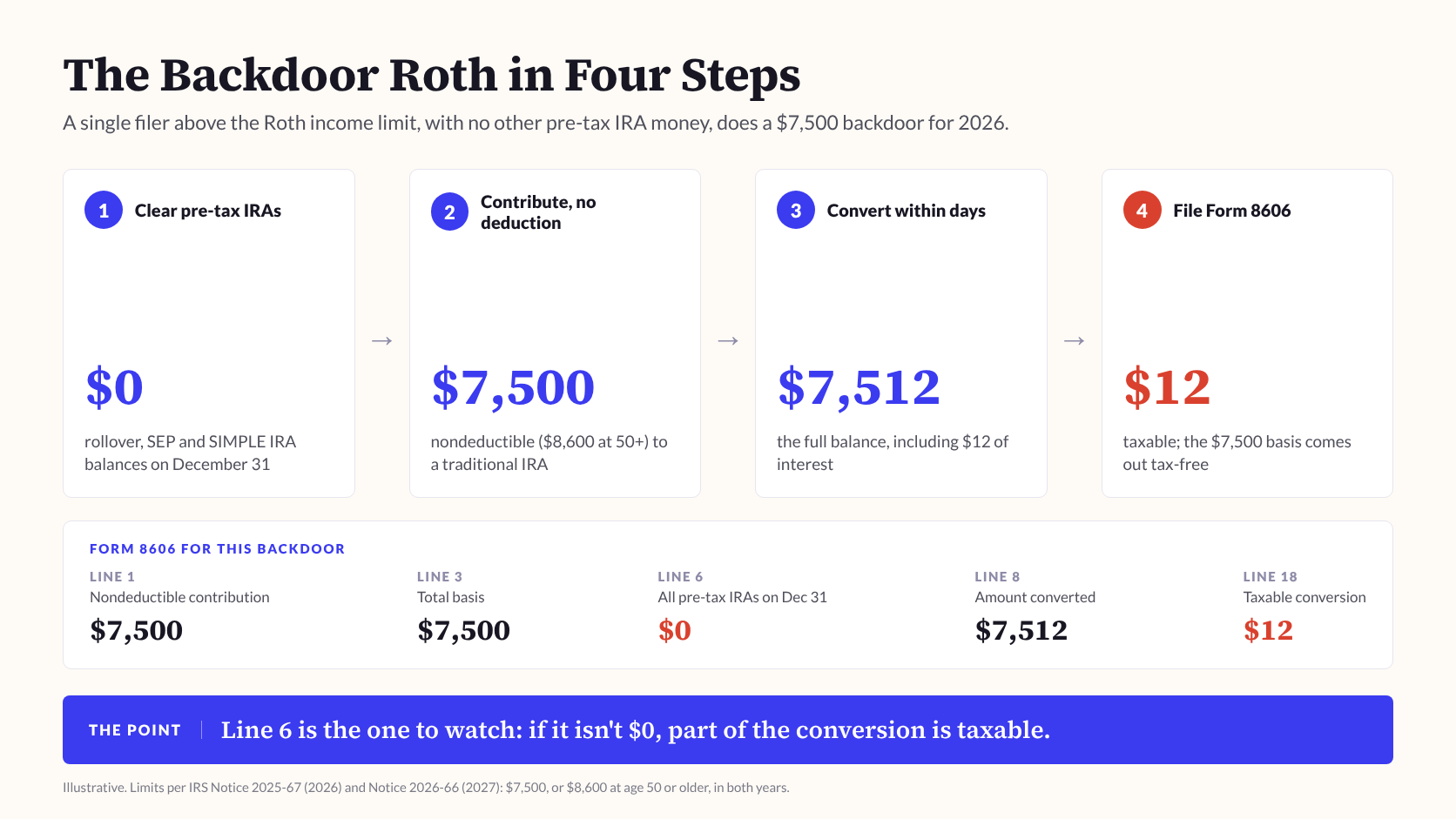
Before contributing, check whether you have any money in a traditional IRA, rollover IRA, SEP IRA or SIMPLE IRA. If you do, plan how to deal with it (see the pro-rata section). Clearing it first is simplest, but what the IRS tests is the balance on December 31 of the year you convert, so a rollover into a 401(k) that settles by December 31 also works.
Step 2: Make a nondeductible traditional IRA contribution
Contribute up to $7,500 ($8,600 if 50 or older) to a traditional IRA, and don't deduct it. Many people leave the cash in a settlement or money-market position until the conversion to keep earnings small.
Step 3: Convert to a Roth IRA
Once the contribution has settled, convert the full balance. Most large brokerages, including Fidelity, Schwab and Vanguard, let you do this online. There is no waiting period in the tax code. Converting within days keeps earnings, and therefore tax, close to zero. If a few cents of interest post after you convert, you can convert them too. Anything left in the traditional IRA on December 31 counts in the pro-rata calculation.
Step 4: Report it on Form 8606
File Form 8606 with your tax return to report the nondeductible contribution (Part I) and the conversion (Part II). Your brokerage sends Form 1099-R for the conversion early in the year after it happens. Form 5498, which confirms the contribution, often arrives in May, after the filing deadline, so use your own records rather than waiting for it.
The Pro-Rata Rule: Why an Old Rollover IRA Can Cost You
The IRS doesn't let you choose which dollars you convert. Under the pro-rata rule (Internal Revenue Code section 408(d)(2)), all of your traditional, SEP and SIMPLE IRAs are treated as one pool. Each conversion is tax-free only in proportion to your after-tax basis in that pool.
On Form 8606, the pool is measured as your year-end balance in all those IRAs plus what you converted or withdrew during the year. That has three consequences:
- Year end is what counts. Rolling a 401(k) into an IRA in November can make a conversion you did in February partly taxable.
- It covers every IRA in your name, at every institution, including SEP IRAs from consulting income.
- It is per person. Your spouse's IRAs don't count against you.
What counts in the pro-rata calculation
Worked example: the rollover IRA trap
Jordan is single and earns $260,000, so she can't contribute to a Roth directly. She has a $92,500 rollover IRA from a previous employer, all pre-tax, and no earlier nondeductible contributions. In 2026 she contributes $7,500 nondeductible to a new traditional IRA and converts $7,500 to a Roth. Her rollover IRA is still worth $92,500 on December 31.
She expected a tax-free conversion and instead added about $6,900 to her taxable income. The unused $6,937.50 of basis isn't lost: it carries forward on Form 8606 and reduces the tax on her future IRA distributions or conversions, which are taxed pro-rata in the same way.
Run your own numbers:
Three ways to avoid the pro-rata rule
- Roll the pre-tax IRA into a 401(k). If your current employer's plan accepts roll-ins, move the pre-tax IRA balance into it before December 31. Only pre-tax money can roll into a 401(k), which conveniently leaves your after-tax basis behind. Self-employed people can do the same with a solo 401(k), if they are eligible and the plan accepts rollovers. Allow several weeks in December: the plan has to be set up and the rollover completed by December 31. A SIMPLE IRA generally can't be moved to a non-SIMPLE plan during its first two years.
- Convert everything and pay the tax. If the pre-tax balance is small, or you are in an unusually low-income year, converting the whole pool may make sense.
- Skip the IRA backdoor this year. A mega backdoor Roth through your 401(k), if your plan allows it, isn't subject to the IRA pro-rata rule.
If Jordan rolls her $92,500 into her 401(k) before December 31, her pool is just her $7,500 of basis, and the conversion is tax-free apart from any small earnings.
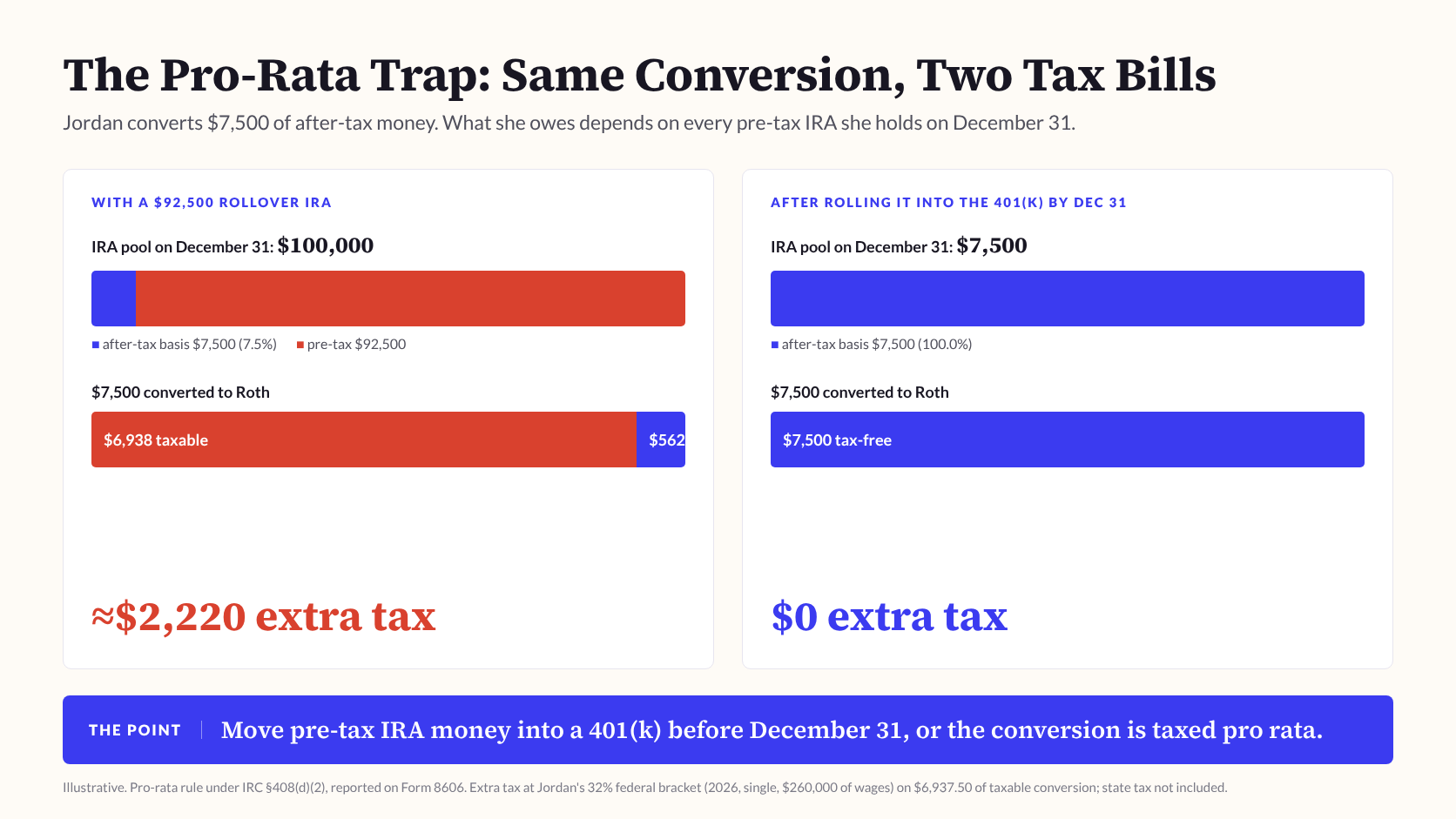
The pro-rata rule looks at year end, not the day you convert. A rollover in November can make a February conversion taxable.
Form 8606, Line by Line
Form 8606 is how the IRS knows your contribution was after-tax. Here is how it works for a clean backdoor where $7,500 was contributed and the account earned $12 of interest before the conversion, so $7,512 was converted, and for Jordan's pro-rata case:
Line 10 must be carried to at least three decimal places. Here three aren't enough: 0.998 × $7,512 gives $7,497, so use 0.9984 to reproduce the $7,500.
Before you file:
- Line 1 matches your contribution, and you didn't also deduct it.
- Line 6 is your true December 31 balance across every pre-tax IRA. If it isn't zero, expect some tax.
- The 1099-R shows the conversion. It often marks the taxable amount as "not determined." Form 8606 settles it.
- Keep every Form 8606. Your basis history lives on them, and you may need them decades later.
Contribution Year vs. Conversion Year
This trips up many people. Contributions can be made for a tax year until April 15 of the next year. Conversions are reported in the calendar year they happen.
Example: you make your 2026 nondeductible contribution of $7,500 in March 2027 and convert it the same week.
- 2026 Form 8606: line 1 and line 3 show $7,500. Because you made no conversion or distribution in 2026, you answer "No" to the question after line 3, skip lines 4 to 13, and enter $7,500 on line 14 as basis carried forward. There is no 2026 Form 1099-R for it. (Line 4 is only used if you also converted or took a distribution in 2026.)
- 2027 Form 8606: line 2 picks up the $7,500 of basis. If you also make your 2027 contribution, line 1 shows another $7,500 and line 3 totals $15,000. Line 8 shows the conversions, and line 6 must be your December 31, 2027 balance. Your 2027 Form 1099-R reports the conversions.
That means you can do two years' backdoors in one calendar year: the 2026 contribution in early 2027 and the 2027 contribution later in 2027, each converted soon after. Both conversions appear on the 2027 Form 8606.
Other questions about the steps
- Can I convert more than $7,500? Yes. There is no limit on conversions. The $7,500 limit applies to contributions. Converting pre-tax money is taxable, though.
- What if the money earns interest before I convert? The earnings are taxable when converted, usually a few dollars.
- What if it falls in value first? You convert less than your basis. The unused basis carries forward on Form 8606.
How to Fix a Backdoor Roth Mistake
Withdrawals and the Two Five-Year Rules
Roth IRA withdrawals come out in a fixed order: your regular contributions first, then converted amounts (oldest first, taxable portion before nontaxable), then earnings.
- Earnings are tax-free in a "qualified distribution," which requires that your first Roth IRA has been open five tax years and that you are 59½, disabled, or using up to $10,000 for a first home, or that the money is paid after death.
- Each conversion has its own five-year period for the 10% early-withdrawal penalty if you are under 59½, unless an exception such as disability applies. The penalty applies only to the part of that conversion that was taxable, which for a clean backdoor is just the few dollars of earnings converted.
In practice, the $7,500 you converted through a clean backdoor can come back out at any age without tax or penalty, as long as no earlier taxable conversions are ahead of it in the withdrawal order. Only the earnings must wait for a qualified distribution.
Backdoor Roth vs. Other Options
Notes for Couples, High Earners and the Self-Employed
- Couples: each spouse can do their own backdoor, up to $15,000 a year combined ($17,200 if both are 50 or older). The pro-rata rule is applied to each spouse separately.
- 401(k) Roth catch-ups: starting in 2026, employees whose prior-year FICA wages from the employer sponsoring the plan exceeded $150,000 must make 401(k) catch-up contributions as Roth. For 2027, the threshold applied to 2026 wages is $155,000. This applies to workplace plans, not IRAs, and doesn't affect the backdoor.
- Mega backdoor details: the §415(c) limit counts your deferrals, employer contributions and after-tax contributions together. Age-based catch-up contributions sit outside it. Our mega backdoor Roth guide covers it in depth.
- Self-employed: a SEP IRA counts in the pro-rata pool. If you plan to do backdoor Roths every year, a solo 401(k) is usually a better home for self-employment savings. See our guide to self-employed retirement plans.
- State taxes: state treatment of conversions varies. Check your state's rules.
What a Backdoor Roth Is Worth Over Time
The annual amount looks small next to a high income. The value is in decades of tax-free growth. We compared $7,500 a year for 20 years in a Roth IRA and in a taxable brokerage account holding the same investments:
The difference is about $46,000 per person, or about $92,000 for a couple doing two backdoors, and it widens the longer the money compounds. Roth IRAs also have no required minimum distributions during the owner's lifetime. Heirs generally receive Roth IRA money income-tax-free once the account has met its five-year requirement, though most non-spouse beneficiaries must empty it within ten years.
Assumptions: contributions at the start of each year; the 20% qualified dividend and long-term capital gains rate plus the 3.8% net investment income tax, which apply to many high earners; the taxable account is sold in one year; no state tax. Selling gradually at lower capital gains rates, or holding until death when heirs get a step-up in basis, would narrow the gap. Illustrative only.
Common Backdoor Roth Mistakes
Tracking Your Retirement Accounts in Kubera
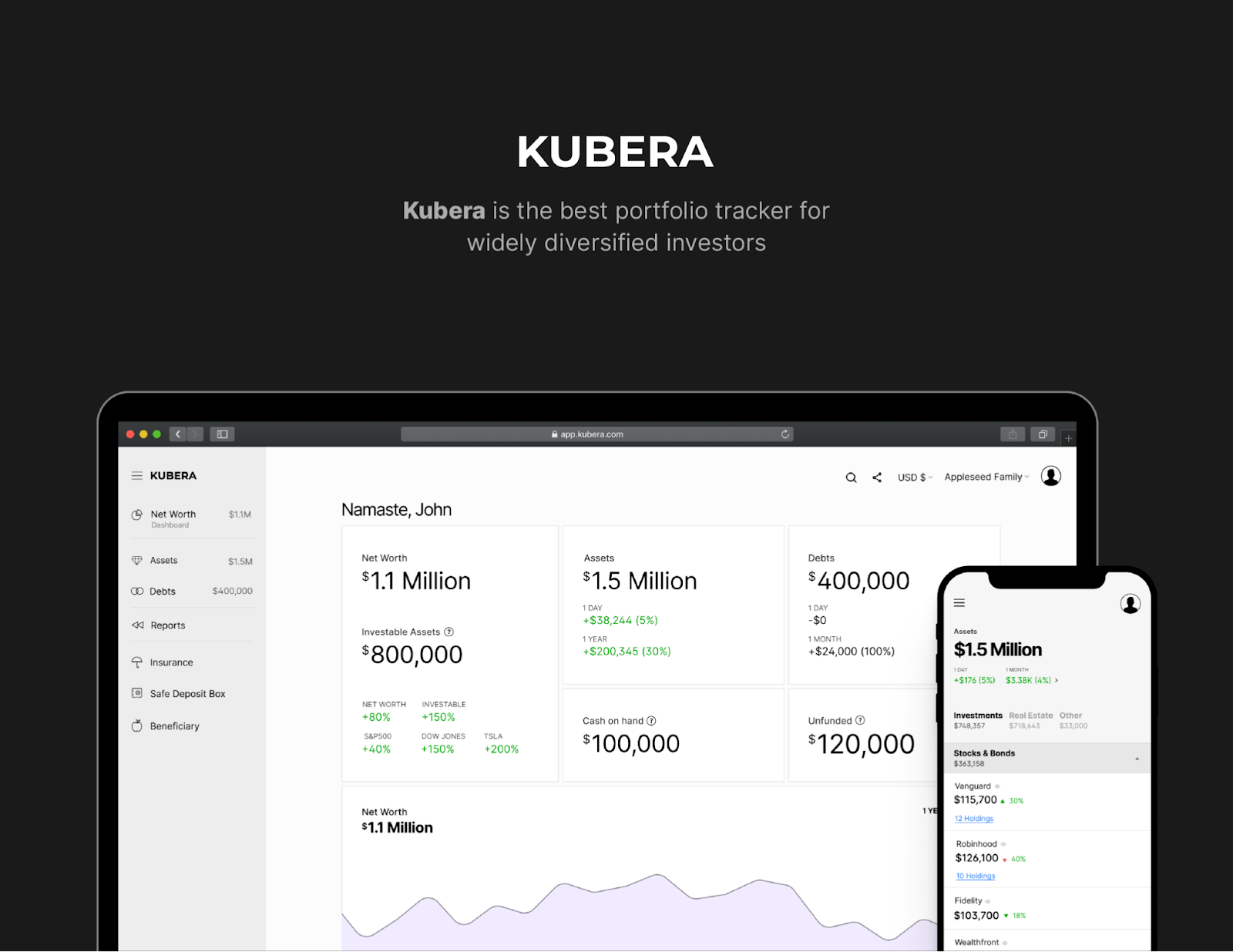
A backdoor Roth works best when you can see every retirement account at once, especially the pre-tax IRAs that trigger the pro-rata rule. Kubera brings them onto one balance sheet. It doesn't prepare Form 8606 or track IRS basis for you.
- See every IRA before December 31. Connect brokerage, IRA and 401(k) accounts across institutions, so a forgotten rollover or SEP IRA shows up before it affects a conversion.
- Bring in statements quickly. Use AI Import to add balances from statements for accounts that don't connect, and keep your tax forms with the accounts they relate to.
- Group accounts by person and tax treatment. On Kubera Black, nested portfolios separate each spouse's pre-tax, Roth and taxable accounts, which matches how the pro-rata rule is applied.
- Measure returns. Once contributions are recorded as cash flows, Kubera calculates IRR on each account.
- Model the decades ahead. Fast Forward lets you test how ongoing contributions change your projected net worth. It is scenario modeling, not a tax calculator.
Try it with a 14-day free trial.
Conclusion
If your income is above the Roth limit, a backdoor Roth IRA is the standard way in: contribute $7,500 (or $8,600 if 50 or older) to a traditional IRA without deducting it, convert it within days, and file Form 8606 for the right years. The IRA limits are the same for 2026 and 2027, and each spouse can do one.
Before you start, check every traditional, rollover, SEP and SIMPLE IRA you own. If any hold pre-tax money at year end, move it into a 401(k) or expect part of the conversion to be taxed. Keep your Forms 8606. Get those steps right and the backdoor is one of the simplest long-term tax advantages available to high earners.
Frequently Asked Questions
What is the income limit for a backdoor Roth IRA?
There isn't one. Traditional IRA contributions and Roth conversions have no income limits. The backdoor exists because direct Roth contributions phase out between $153,000 and $168,000 (single) and $242,000 and $252,000 (married filing jointly) in 2026.
How much can I put in a backdoor Roth in 2026 and 2027?
Up to $7,500, or $8,600 if you are 50 or older, limited to your eligible compensation. The IRS confirmed on November 12, 2026, that the limits are unchanged for 2027.
Can I still do a 2026 backdoor Roth in 2027?
Yes. You can make a 2026 contribution until April 15, 2027. Report the contribution on your 2026 Form 8606 so the basis carries forward. The conversion, if done in 2027, is reported on your 2027 Form 8606 and return.
Do I pay tax on a backdoor Roth conversion?
Only on earnings before the conversion and on any pre-tax IRA money pulled in by the pro-rata rule. With no other pre-tax IRAs and a quick conversion, the tax is usually a few dollars.
What if I already have a traditional or rollover IRA?
Roll the pre-tax balance into a 401(k) or solo 401(k) before December 31 if the plan accepts it, convert the whole balance and pay the tax, or skip the IRA backdoor and use a mega backdoor Roth if your plan offers one.
Does my 401(k) count for the pro-rata rule?
No. Only traditional, SEP and SIMPLE IRAs count. That is why rolling a pre-tax IRA into a 401(k) is the usual fix.
What happens if I forget to file Form 8606?
File it late for the year it was due. The penalty is $50 unless you show reasonable cause. Without it, your nondeductible contributions may be treated as deductible, which can lead to paying tax on the same money twice.
Can my spouse do a backdoor Roth too?
Yes, as long as the couple has enough eligible compensation for both contributions and, if one spouse has little income, files jointly. Each spouse has their own pro-rata calculation.
Disclaimer
This article is general information as of November 18, 2026 and is not tax, legal or investment advice. Contribution limits, income ranges and tax rules change, and the right approach depends on your full tax picture, including state taxes. Figures in the examples are illustrative. Consult a qualified tax professional before making contributions or conversions.


