

Quick Answer: What Is a Liquidity Event?
- Definition: A liquidity event converts illiquid ownership (e.g. private company stock) into cash or publicly traded shares. It is the primary exit strategy for founders, employees, and investors.
- Most common types: Acquisitions, IPOs, secondary sales, SPACs, and direct listings.
- Key stat: In 2024, just 3% of VC exits were IPOs — while 71% were secondary transactions.
- Timeline: Most VC investors expect a liquidity event within 5 to 10 years of initial investment.
What Is a Liquidity Event?
A liquidity event is a transaction that lets founders and investors convert equity into cash or publicly tradable shares. It turns an illiquid asset - private company stock you cannot easily sell - into a liquid asset you can use, invest, or spend.
Think of it this way: owning 10% of a fast-growing startup is valuable on paper. But paper wealth does not pay your mortgage. A liquidity event changes that.
Do not confuse a liquidity event with liquidation. Liquidation means closing a company and selling its assets to pay debts. A liquidity event, by contrast, reflects success - founders and investors cashing out of a thriving business.
For private equity firms and venture capital investors, the liquidity event is the end game. It is the moment that turns years of risk into realized returns.
Types of Liquidity Events
Initial Public Offering (IPO)
An IPO is the process where a private company issues new shares to the public on a stock exchange. The company hires underwriters, files with the SEC, and prices its shares before trading begins.
The IPO process typically takes 6 to 18 months of preparation. Existing shareholders face a lock-up period of 90 to 180 days, during which they cannot sell their shares.
Facebook's 2012 IPO raised $16 billion - one of the largest in tech history at the time. For post-IPO financial planning, founders must navigate both the lock-up period and the tax implications of newly liquid shares.
Current market note: In 2024, IPO volume remained at historically low levels, representing only a small fraction of total exit value. The public market remains selective, making alternative exit paths increasingly important.
Direct Listing
A direct listing lets a company list its existing shares on an exchange without hiring underwriters or issuing new shares. Spotify and Palantir used this path to go public.
This method traditionally does not raise new capital. It simply creates a public market for shares that already exist.
Special Purpose Acquisition Company (SPAC) Merger
A SPAC is a shell company already listed on a public exchange. It raises capital through its own IPO with the sole purpose of merging with a private company.
When the SPAC merges with a target, the private company becomes publicly traded. SPAC mergers offer a faster path to public markets than traditional IPOs, but carry complexity around dilution and valuation.
Mergers and Acquisitions (M&A)
Acquisitions remain the most common liquidity event for venture-backed startups. Two primary deal structures exist:
- Stock Sale: The acquirer buys shares directly from shareholders. The target company often becomes a subsidiary or gets absorbed entirely.
- Asset Sale: The acquirer purchases specific assets. The original company is typically dissolved, and proceeds flow to shareholders.
Facebook's $21.8 billion acquisition of WhatsApp in 2014 illustrates the scale possible through M&A. Sequoia Capital turned a $60M stake into $3 billion - a 50x return.
In 2024, venture-backed companies generated $149.2 billion in total exit value, with M&A dominating the landscape.
Secondary Market Transactions
Secondary transactions involve one existing shareholder selling shares to another investor. The company itself does not issue new shares and may not change hands at all.
In 2024, secondary transactions represented 71% of all VC exit value --- a dramatic shift from historical norms. Secondary funds raised a record $101.6 billion in 2024.
Three main formats exist in the secondary market:
- Tender Offer: The company or an investor offers to buy shares from multiple shareholders at a set price. OpenAI ran a $1.5 billion tender offer in late 2024 at a $157 billion valuation.
- Auction: Share price is determined by supply and demand, with buyers placing competitive bids.
- Direct Secondary Sale: A private transaction between buyer and seller, with no direct company involvement.
Business Sale or Partnership Buyout
Private business owners often sell to other private entities, individuals, or strategic buyers. This route suits closely-held businesses that lack venture backing.
Partnership buyouts let one co-owner exit while the remaining partners continue operating the business.
Stock Option Exercise and Vesting Events
Employees with stock options gain liquidity when they exercise those options and sell the resulting shares. Vesting schedules determine when employees can access their equity.
Real Estate Portfolio Liquidation
High-net-worth individuals sometimes generate liquidity by selling real estate investments. Rental properties, commercial holdings, and development assets all qualify as potential liquidity events.
This approach can fund reallocation into more diversified portfolios.
Inheritance or Trust Distribution
Beneficiaries receive liquid assets through inheritance or scheduled trust distributions. These events can significantly alter a person's financial picture almost overnight - creating many of the same planning challenges as a startup exit.
Timing of a Liquidity Event
Most venture capital investors expect a liquidity event within 5 to 10 years of their initial investment. VC funds typically have a 10-year lifespan, with investments made in the first 3 to 5 years.
According to Statista data,, the median time between a VC's initial investment and a company going public in the United States was 5.3 years in 2020. However, recent market conditions and a sluggish IPO market from 2022 to 2024 have stretched this timeline considerably, with many startups now remaining private for 7 to 8 years or more, pushing them to pursue secondary transactions instead.
Financial Implications of a Liquidity Event
Liquidity Event Tax Implications
Liquidity events trigger capital gains tax at both federal and state levels. Understanding your liquidity event tax implications before the deal closes is the single most important financial step you can take.
The rate you pay depends on how long you held the asset.
| Holding Period | Tax Treatment | 2024 / 2025 Federal Rate |
|---|---|---|
| Less than 1 year | Short-term capital gains | Taxed as ordinary income (up to 37%) |
| More than 1 year | Long-term capital gains | 0%, 15%, or 20% based on income * |
| ISOs exercised | May trigger AMT | Complex - consult a CPA |
* Note: High earners may also be subject to an additional 3.8% Net Investment Income Tax (NIIT).
The Alternative Minimum Tax (AMT) can hit hard after certain equity transactions. Exercising Incentive Stock Options before a liquidity event often triggers AMT, even if no cash changes hands. Tax planning well before your liquidity event is not optional - it is essential.
Impact on Net Worth and Asset Allocation
A liquidity event can multiply your net worth overnight. One day you hold illiquid equity. Next, you hold cash or publicly traded shares worth millions.
This sudden shift creates an urgent need to rethink your entire financial strategy. The decisions you make in the first 12 months after a liquidity event often shape your financial life for decades.
Reasons for Pursuing a Liquidity Event
Founder Exit Planning
Founder exit planning is the process of defining your goals, timeline, and financial strategy well before a liquidity event occurs. Without a clear plan, founders often make reactive decisions that cost them significantly in taxes, equity dilution, and post-exit wealth management.
Strong founder exit planning addresses three questions: When do you want to exit? How much control are you willing to give up? And what will you do with the proceeds?
Founders, investors, and business owners pursue liquidity events for different reasons beyond simply cashing out. Common motivations include:
- Investor returns: For VC firms and angel investors, the liquidity event is the primary mechanism for realizing gains.
- Founder diversification: Founders may want to convert concentrated equity risk into a diversified portfolio. Learn about rollover equity.
- Profit targets: Reaching a specific financial milestone triggers a planned exit.
- Loss prevention: Founders may exit a struggling company to prevent further value destruction.
- Legal or regulatory requirements: Certain structures mandate liquidity events after specific milestones.
- Market conditions: A strong M&A environment or an open IPO window creates the right moment to exit.
Wealth Management Challenges After a Liquidity Event
Sudden Wealth Syndrome
Sudden wealth syndrome describes the emotional and psychological challenges that follow rapid, large wealth gains. The pressure to make fast investment decisions often leads to costly mistakes, anxiety, and identity confusion.
Founders who spent years building a company often feel lost when the work suddenly stops. Taking a deliberate pause before deploying capital is smart - not lazy.
Fragmented Asset Management
Liquidity proceeds rarely land in one place. Funds flow across multiple brokerage accounts, bank accounts, and investment platforms.
Multi-currency holdings, international assets, and alternative investments add layers of complexity.
Coordination and Security Concerns
After a major liquidity event, you work with financial planners, CPAs, estate attorneys, and possibly family office staff. Sharing financial data securely across all of them is harder than it sounds. Security risks also increase with consolidated wealth data.
Strategic Financial Planning After a Liquidity Event
Diversification Strategies
The most urgent financial task after a liquidity event is reducing concentration risk. If you built your wealth in one company, you now need to spread it across many and diversify.
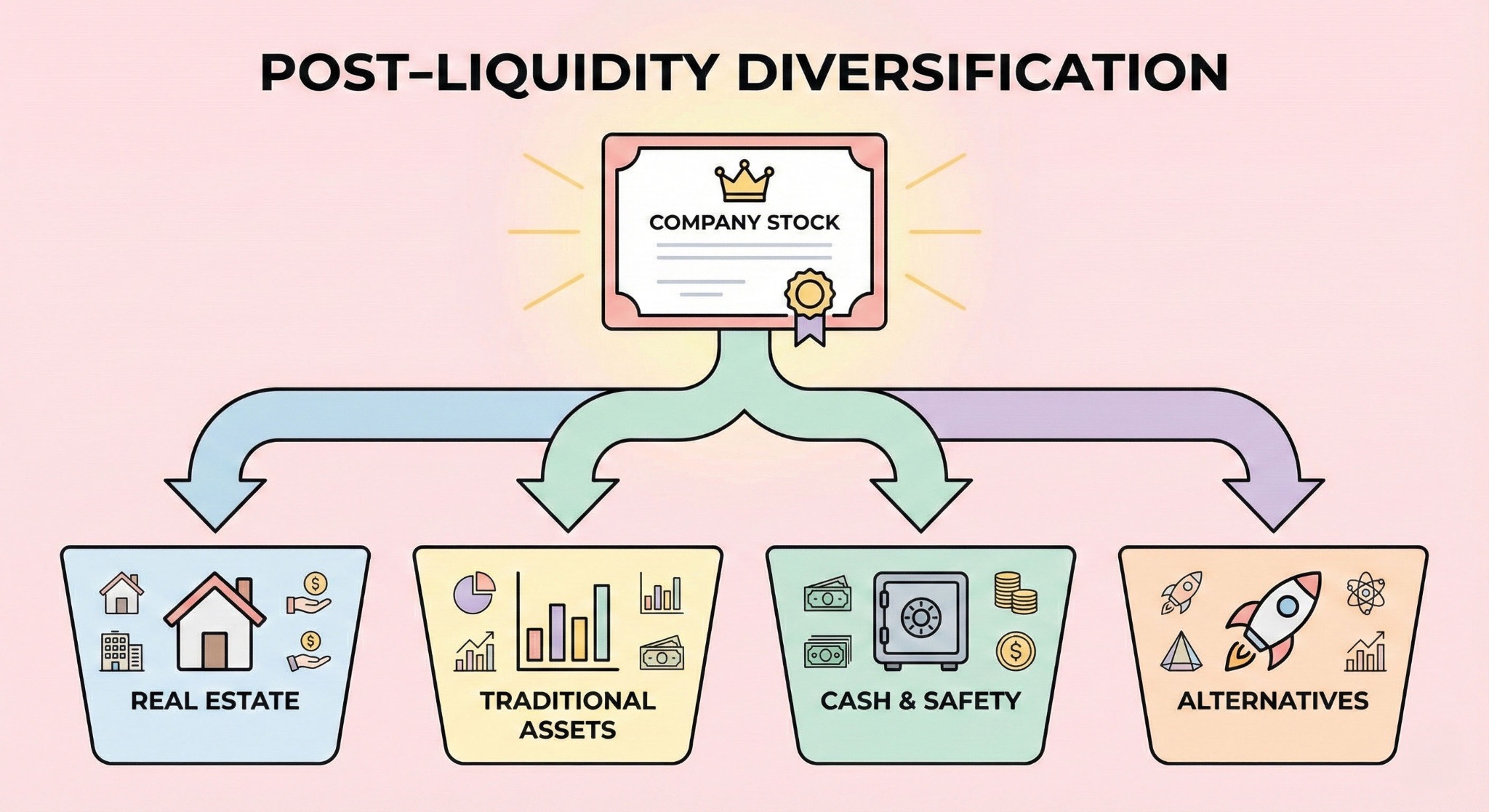
Consider allocating across these core categories:
- Traditional assets: stocks, bonds, index funds
- Real estate: direct property, REITs, real estate crowdfunding, and other non-correlated assets
- Alternative investments: private equity, venture capital, hedge funds
- Cash equivalents: high-yield savings, money market funds, short-term treasuries
Cash Management and Liquidity Preservation
Determine how much cash you need for near-term spending, opportunities, and emergencies before you invest. Many financial advisors recommend keeping 12 to 24 months of expenses in immediately accessible accounts.
High-yield savings accounts, money market funds, and short-term U.S. Treasuries serve as safe parking spots while you build your long-term investment plan.
Investment Allocation Framework
Build your investment strategy around three core questions:
- What are my goals? Retirement, wealth transfer, philanthropy, or continued entrepreneurship?
- What is my time horizon? Short-term needs require conservative allocations. Long-term goals can absorb more volatility.
- What is my true risk tolerance? Not the tolerance you claim, but the one you feel at 3am when markets drop 30%.
Segment your portfolio into buckets: growth assets (equities, venture), income assets (bonds, real estate), and capital preservation (cash, treasuries).
Alternative Investment Options
Accredited investors - a status most liquidity event recipients now qualify for - can access asset classes unavailable to the general public:
- Private equity and venture capital
- Rental properties and REITs
- Art, Watch and other collectible investing
- Farmland investments
Estate Planning Considerations
A major liquidity event changes your estate picture dramatically. Update your will, trusts, and beneficiary designations immediately.
Consider irrevocable trusts, spousal lifetime access trusts (SLATs), and gifting strategies to transfer wealth efficiently. Your estate plan from five years ago almost certainly does not reflect your current net worth.
Charitable Giving and Tax Optimization
Strategic charitable giving can reduce your tax burden while creating lasting impact. Donor-advised funds let you take an immediate tax deduction while deciding later which charities to support.
Charitable remainder trusts provide income to you or your family for a term, with the remainder going to charity. Gifting appreciated shares - rather than cash - avoids capital gains while maximizing the charitable deduction.
Risk Management and Insurance
Significant wealth creates new risks alongside new opportunities. Three insurance categories deserve immediate review:
- Life insurance: Reassess coverage amounts to align with new estate planning goals.
- Umbrella liability insurance: Protect against lawsuits that could target your new wealth.
- Disability and long-term care insurance: Protect your income and assets against health events.
Key Considerations for Stakeholders
Founders and investors frequently have misaligned motivations around liquidity events. A VC fund approaching the end of its 10-year life needs an exit. A founder building a generational company may want to stay private for decades longer.
Deal terms matter enormously for payout outcomes. Liquidation preferences determine who gets paid first and how much. Drag-along rights can force minority shareholders to sell when majority investors choose to exit.
Market conditions and the regulatory environment shape both timing and deal structure. The tight M&A regulatory environment of 2022 to 2024 , driven by increased antitrust scrutiny, directly suppressed exit values for many companies.
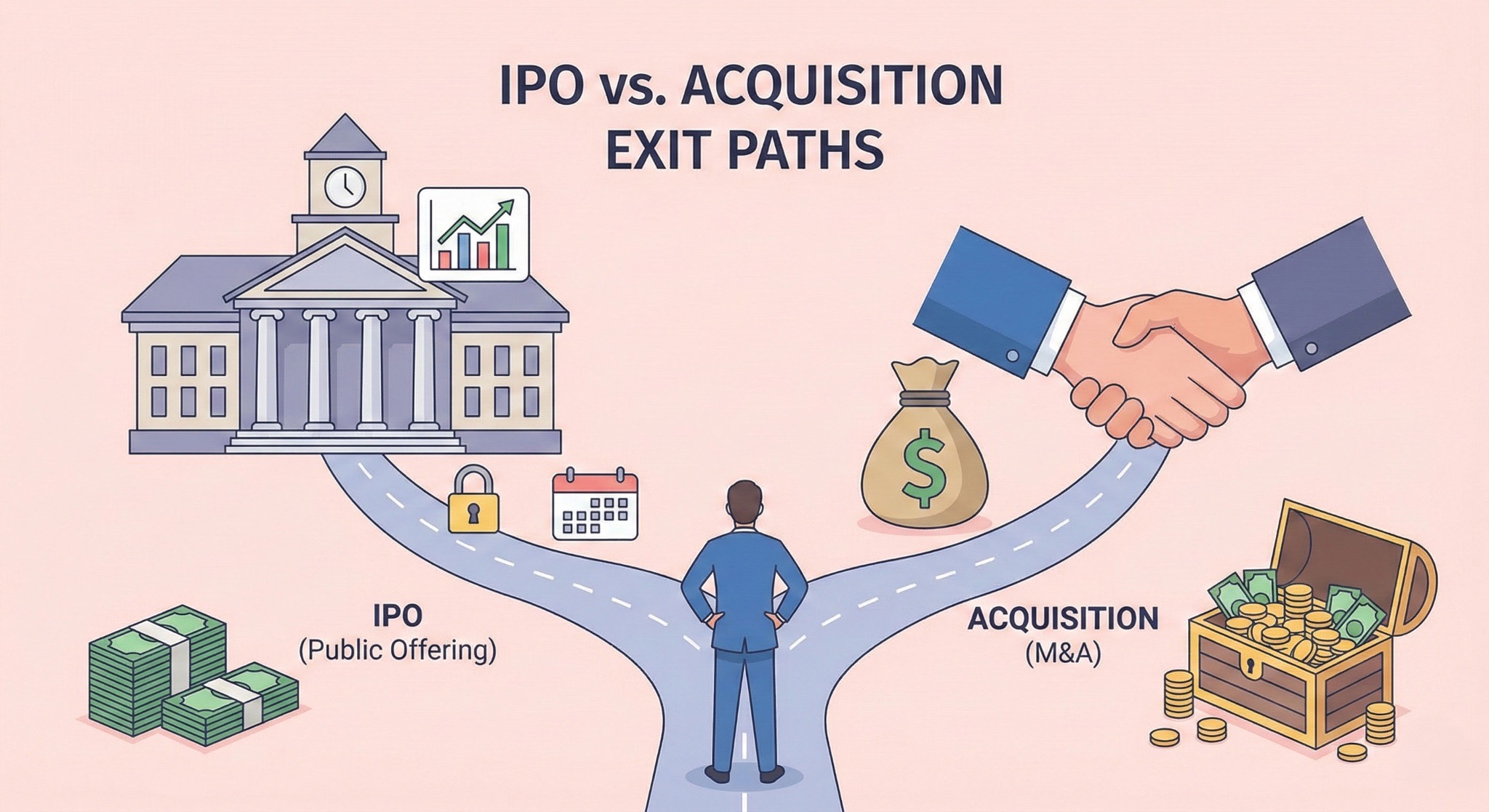
IPO vs Acquisition Exit: Comparing Your Options
| Factor | IPO | Acquisition |
|---|---|---|
| Liquidity timeline | 90-180 day lock-up post-IPO | Often immediate at close |
| Control post-exit | Partial (public shareholders) | Usually lost or constrained |
| Valuation certainty | Market-dependent | Negotiated, more predictable |
| Tax complexity | High (lock-up + AMT risk) | Variable by deal structure |
| Process duration | 6-18 months of preparation | 6-18 months typically |
| Common for | Late-stage, profitable companies | All stages; most VC exits |
For most venture-backed startups, an acquisition offers more certainty. For companies with strong public market narratives and growth profiles, an IPO may maximize valuation - but requires patience and public market cooperation.
Managing Your Portfolio with Kubera
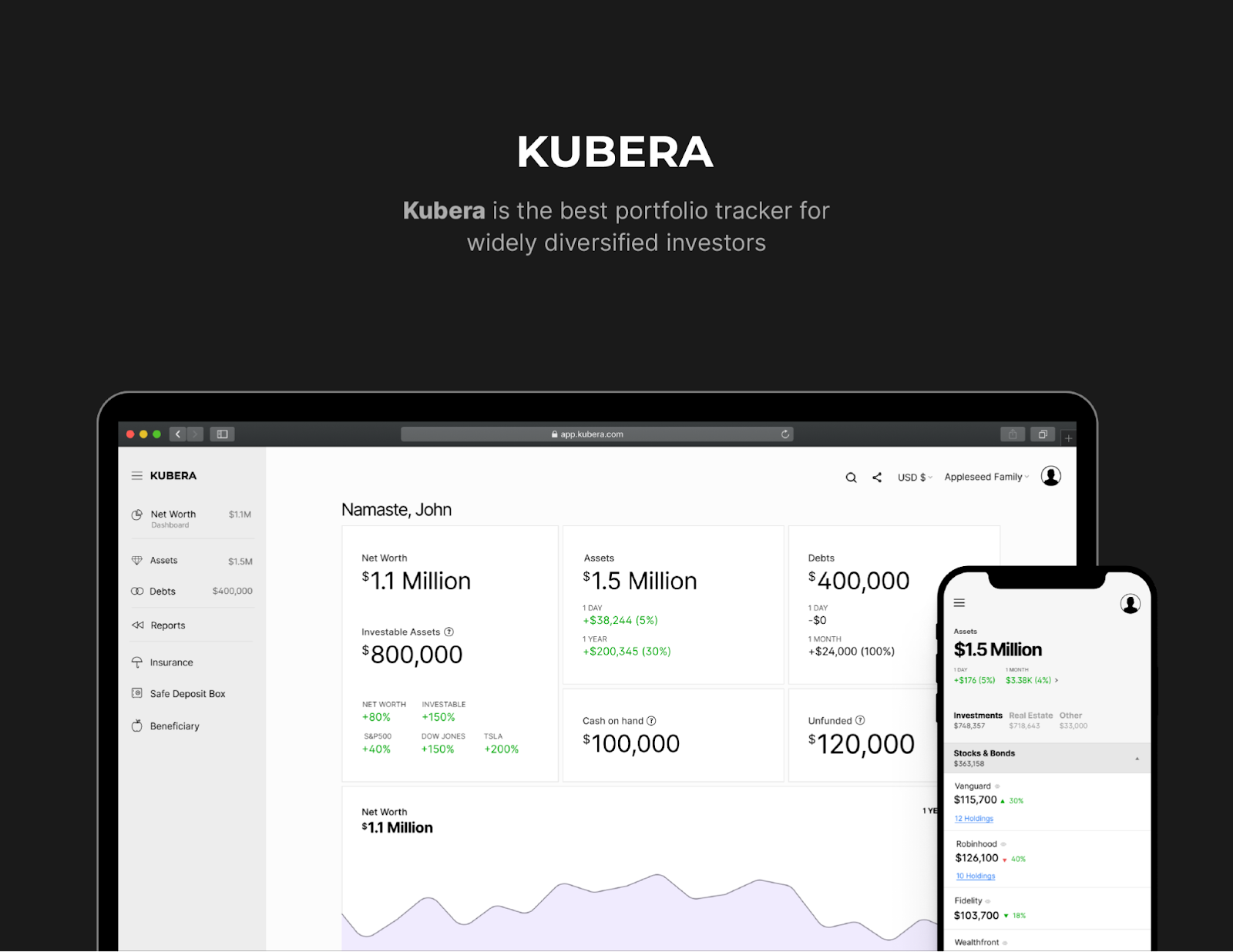
Comprehensive Net Worth Tracking
Kubera automatically aggregates bank accounts, investment accounts, retirement accounts, and alternative assets across multiple countries. You get a real-time, complete picture of your financial life before, during, and after your liquidity event.
Real-time portfolio analytics inform every post-event investment decision you make.
Support for All Asset Types
Kubera supports cryptocurrency and DeFi assets on 20+ chains. It also tracks traditional investments alongside private equity, real estate, and collectibles - everything in one centralized platform, regardless of currency or country.
Secure Collaboration and Document Storage
Kubera's purpose-built sharing controls let you collaborate with financial advisors, CPAs, and family members without exposing your full financial picture. Secure document storage keeps transaction records, tax forms, and legal agreements organized and accessible.
Evaluate Investment Performance
Monitor performance across every asset class from one dashboard. Track whether your post-event portfolio is actually meeting its goals - not just looking active.
Take Control of Your Wealth After Your Liquidity Event
A liquidity event transforms your financial life. Managing sudden wealth across multiple accounts, asset classes, and currencies creates complexity that spreadsheets simply cannot handle. Kubera provides comprehensive net worth tracking - automatically aggregating traditional investments, cryptocurrency, real estate, private equity, and alternative assets in one secure dashboard. The wealth tracker adds the trust, the holding company and the beneficiaries that usually follow an exit.
Frequently Asked Questions
What triggers a liquidity event?
A liquidity event is triggered when founders, investors, or shareholders convert illiquid ownership into cash or publicly traded shares. Common triggers include an IPO, a merger or acquisition, a secondary share sale, or a SPAC merger.
How long does a liquidity event take?
It depends on the type. An IPO takes 6 to 18 months of preparation. A merger or acquisition typically takes 6 to 18 months. Secondary sales can close in weeks. Most VC investors expect a liquidity event within 5 to 10 years of their initial investment, though recent market trends have pushed that timeline closer to 7 or 8 years.
What are the tax implications of a liquidity event?
Liquidity events trigger capital gains taxes at both federal and state levels. Long-term gains (assets held over one year) receive preferential rates of 0%, 15%, or 20%, plus a potential 3.8% Net Investment Income Tax for high earners. Short-term gains are taxed as ordinary income. Stock option exercises may trigger the Alternative Minimum Tax (AMT). Work with a CPA experienced in liquidity event tax planning well before your exit.
What is the difference between an IPO and an acquisition for founders?
An IPO takes a company public, giving founders liquidity over time through public share sales - but subject to lock-up periods and public market scrutiny. An acquisition offers faster and often more certain liquidity, but founders typically lose operational control. Each has distinct tax implications and structural trade-offs.
What should I do with money after a liquidity event?
Take a deliberate pause before making major decisions. Then build a diversified investment plan aligned with your goals, time horizon, and risk tolerance. Address tax planning first, update your estate plan, build appropriate cash reserves, and consider a range of asset classes including traditional investments, real estate, and alternatives.
What is sudden wealth syndrome?
Sudden wealth syndrome describes the emotional, psychological, and relational challenges that follow rapid, significant wealth gains. Feelings of anxiety, isolation, guilt, and decision paralysis are common. Working with a financial advisor experienced in post-liquidity planning helps navigate this transition.
What is a secondary liquidity event?
A secondary transaction lets one existing shareholder sell shares to another buyer --- without the company going public or being acquired. In 2024, secondary transactions represented 71% of all VC exits, making them the dominant form of liquidity in the current market.


