

Most private households do not need professional security until net worth approaches roughly $30 million, the threshold the wealth industry commonly uses to define ultra-high-net-worth individuals. But that figure is a benchmark, not a rule. Many people well below it need protection because of visibility, credible threats, travel, or a public wealth event such as an IPO or acquisition. Many above it live quietly and safely with disciplined privacy habits. So at what net worth do you need security? The honest answer is that exposure drives the decision more than the balance sheet does. The question is not only how much money you have. It is how visible, accessible, and predictable you are.
This article covers the risk signals that matter more than a dollar figure, the types of personal security available to high net worth individuals (HNWIs, generally those with $1 million or more in investable assets), realistic costs, and a tiered framework for right-sizing protection.
At What Net Worth Do You Need Security? The $30 Million Benchmark and Its Limits
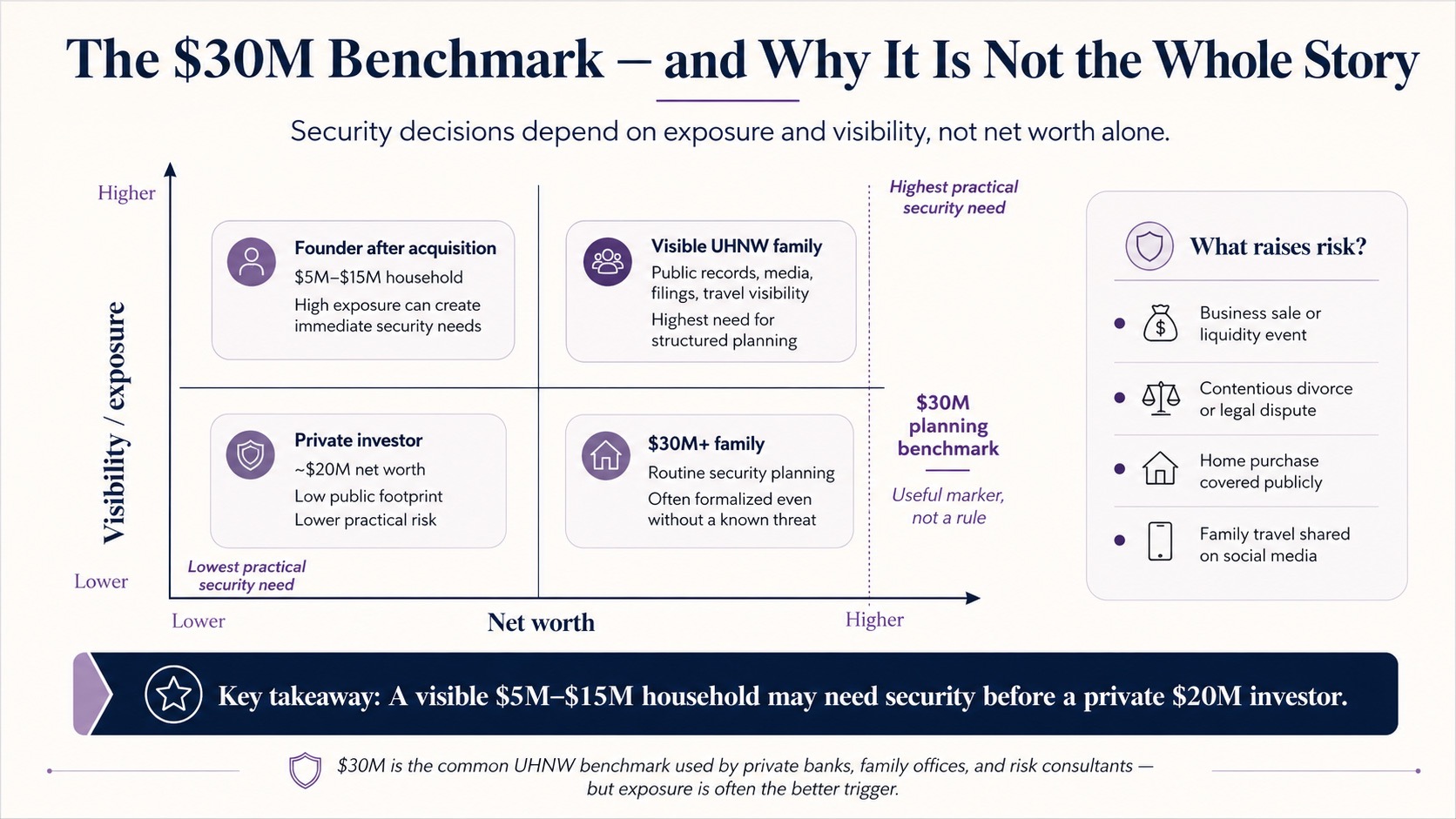
The $30 million figure is cited so often because it is the standard industry definition of an ultra-high-net-worth individual, the point at which private banks, family offices, and risk consultants generally treat formal security planning as routine. At that level, wealth also tends to become publicly inferable whether or not the family wants it to be: property records, business filings, charitable disclosures, and media coverage sketch a picture strangers can piece together.
It is a useful planning marker, not a rule. Net worth security decisions made on the number alone will overprotect some families and underprotect others. A $5 million to $15 million household may need meaningful support after a company sale makes the business press, a contentious divorce filing, or a credible threat. Meanwhile, a private investor worth $20 million whose name appears nowhere and who posts nothing online may face less practical risk than a visible founder worth a fraction of that.
Consider this hypothetical: a founder with a modest net worth on paper announces an acquisition, closes on a home covered by a real estate blog, and documents family travel on social media. That person likely needs a risk assessment before a far wealthier investor with no public footprint does.
Risk Signals That Matter More Than a Dollar Figure
A good risk assessment spends less time on the balance sheet and more on five categories of exposure. If several apply at once, your effective risk is higher than your net worth suggests.
Public wealth events
Anything that publicly connects your name to money changes your profile overnight: an IPO or funding announcement, an acquisition, a lawsuit or inheritance dispute, a divorce filing, a reported real estate purchase, a major charitable gift, a media profile, or a viral social post. These events tell strangers who you are, that you have money, and often where to find you. Security needs frequently spike in the months afterward, then settle as attention fades.
Lifestyle and profile factors
Visible homes and vehicles, frequent luxury travel, public social media accounts, children at well-known schools, board memberships, speaking engagements, and charitable prominence all raise your profile without any single event. High profile individuals, including executives and founders recognizable in their industry or city, often warrant security planning well before ultra-high-net-worth status because their exposure runs ahead of their wealth.
Direct threat indicators
Explicit threats, stalking, harassment, break-in attempts, aggression from a former employee or business partner, extortion attempts, doxxing, custody or divorce conflict, and signs of surveillance around your home belong in a different category. These are not visibility factors to weigh; they indicate risk has already materialized, and they justify engaging law enforcement and professional security regardless of net worth.
Geographic and travel risk
Travel to higher-risk regions, repeated routes and predictable schedules, publicly posted itineraries, and vacations documented in real time all increase exposure, as do local crime trends around a residence. The U.S. State Department’s travel advisories are a sensible reference; destinations rated Level 3 or 4 generally justify professional travel security planning for affluent travelers.
Digital exposure
Home addresses on data broker sites, personal information exposed in breaches, compromised email accounts, SIM-swap vulnerability, social engineering aimed at assistants and family members, oversharing on children’s accounts, and poorly secured smart-home devices form the modern front door to physical risk. Criminals increasingly begin with online reconnaissance, and a person’s digital footprint often determines whether they are worth targeting at all.
Types of Personal Security for High Net Worth Individuals

Effective personal security for high net worth individuals is layered rather than monolithic. Few families need every layer; the right combination comes from a risk assessment, not from what a vendor happens to sell.
Executive protection
Executive protection is broader and usually far more discreet than the word bodyguard implies: close protection, secure transportation, advance work at events, and travel coverage, delivered by a single agent or a multi-agent detail depending on the threat. Good practitioners favor low-profile protection, a capable person who reads the environment and manages routes and logistics rather than a visible deterrent at your shoulder. Visible protection has its place during an active threat, but for most clients discretion reduces friction and avoids advertising that there is something worth protecting.
Residential and estate security
Residential security starts with a professional assessment of the property, then layers perimeter design, access control, monitored alarms, cameras, gate and visitor protocols, and clear emergency response plans. Larger properties may add a hardened room and staff access controls. Households employing full-time house staff should fold background checks and access procedures into the same plan; staff and vendors are a common unintentional source of information leaks.
Digital executive protection
Digital executive protection is the fastest-growing layer and often the most cost-effective. It typically combines data broker removal, dark web monitoring, device security, password and multi-factor authentication hardening, email and cloud protection, social media hygiene, digital footprint monitoring, and defense against impersonation and social engineering. Coverage should extend to family members, whose accounts are often the softest entry point, and to assistants. One caution: data removal is never permanent. A 2024 Consumer Reports study found only about a third of exposed profiles were actually removed by major services within four months, and brokers republish data, so this is an ongoing discipline, not a one-time cleanup.
Travel security
Travel security scales with the destination. For most trips it means varying routines, limiting real-time posting, and reviewing hotel arrangements. For higher-risk destinations it means a formal risk assessment, vetted drivers and secure transportation, route planning, a communication plan, local support, and, where relevant, medical evacuation coverage. A single well-planned trip with professional support is often money better spent than a standing retainer a family rarely uses.
Family office security
In wealthier households, family office security is less a product than a coordination function: staff background checks, vendor access, residential procedures, family-wide cyber hygiene, travel coordination, insurance including kidnap and ransom coverage, emergency contacts, and communication among security, legal, and financial advisors. Centralizing this prevents each residence, assistant, and vendor from operating on different assumptions.
What Personal Security Actually Costs
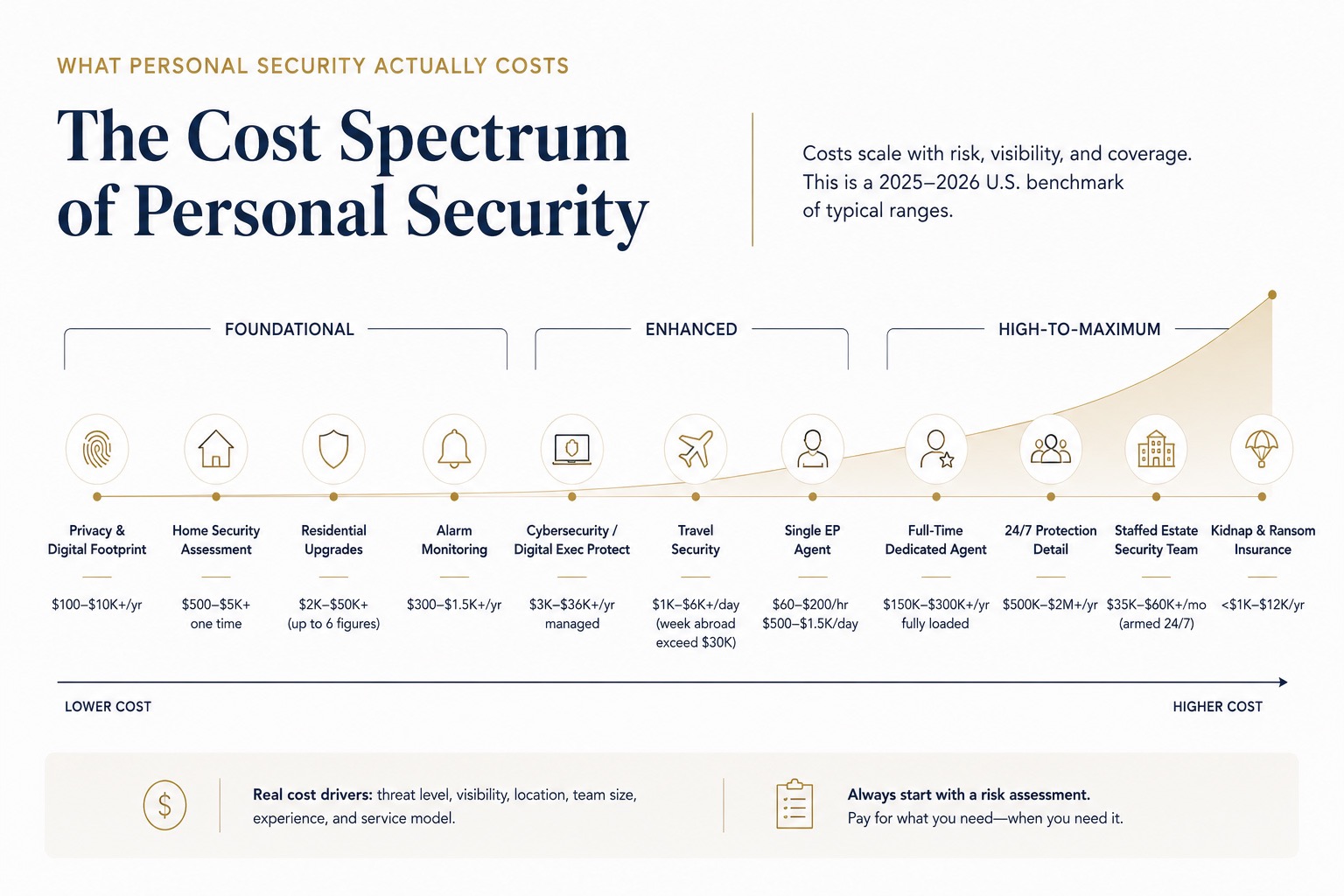
How much does personal security cost? Meaningful protection starts at a few hundred dollars a year for privacy tools and monitored home security; a comprehensive program with round-the-clock staffing runs well past $1 million annually. The table shows illustrative U.S. ranges from published industry pricing guides as of 2025 and 2026; actual quotes depend on location, threat level, and provider.
On executive protection cost specifically, industry pricing surveys put qualified agents at roughly $60 to $175 per hour, elite specialists above $200, and comprehensive full-time programs at $600,000 to $2 million per year. Retainers and salaried agents pay off only when protection is needed most days; hourly and daily engagement fits events and travel.
A 24/7 detail is not one person working around the clock. Continuous coverage requires roughly four to six agents once you account for shifts, relief, leave, and supervision, plus management and transport. That staffing math pushes full coverage into seven figures, and it is why a risk assessment should precede any open-ended retainer. Many families find that event-based and travel-based protection, layered on residential and digital measures, addresses their actual risk at a tenth of the cost.
Kidnap and ransom insurance is the outlier in the other direction: inexpensive relative to what it covers. Broker-published figures show individual policies for non-hazardous international travel starting under $1,000 to $2,000 per year, and family programs typically between about $500 and $12,000 annually. Premiums are driven more by geography and travel frequency than by policy limits, and the crisis response team that comes with the policy is often worth more than the reimbursement. Coverage is not right for every HNWI, and confidentiality is a policy condition.
CEO Security Spending Disclosure and Public Benchmarks
Public companies disclose security provided to executives as a perquisite in proxy statements, and this CEO security spending disclosure offers a rare window into what sustained professional protection costs. Equilar’s review of 208 S&P 500 proxies filed for fiscal 2024 found 31.3 percent granted a security perk to at least one named executive, up from 24.5 percent the prior year, with the median value rising to $94,276. At the extreme, a Financial Times analysis reported Meta spent more than $27 million on Mark Zuckerberg’s protection in 2024, while Alphabet spent $6.8 million on Sundar Pichai and Apple $1.4 million on Tim Cook.

Use these numbers carefully. Corporate figures often bundle residential systems, travel, aircraft, event coverage, and family protection, and they reflect board judgment, company policy, and reputational concerns as much as personal risk. They are not a template for a private family. The directional takeaways: even among protected public-company executives, the median spend sits in the tens of thousands, not millions, and boards size protection to visibility and threat history rather than personal net worth. A private household should think the same way.
Security Cost as a Percentage of Net Worth
Some advisors frame HNWI security cost as a percentage of net worth, and a heuristic of roughly 0.5 to 1 percent sometimes circulates in the industry. Treat it as a loose sanity check at best. Many costs are fixed: an alarm system or a travel detail costs the same whether you are worth $8 million or $80 million, so the percentage naturally falls as wealth rises. And risk does not scale with wealth: $100,000 a year would be excessive for a quiet $10 million household and insufficient for a high-profile founder facing a credible threat.
Risk-based budgeting works better than wealth-based budgeting. A practical way to frame it, as part of a broader wealth protection plan:
- Baseline privacy and digital hygiene: a small annual spend, often under a few thousand dollars, at almost any asset level.
- Formal risk assessment and residential upgrades: episodic costs in the four to low five figures, triggered by a move, liquidity event, or rising visibility.
- Ongoing executive protection: a high recurring cost in the low-to-mid six figures, justified only by sustained exposure or credible threats.
- 24/7 details and multi-residence programs: family-office-level budgets, typically high six to seven figures, for sustained, documented risk.
A Practical Net-Worth Security Framework
The tiers below combine wealth and exposure, describing where most households land rather than where every household must be. Read the last row first: a direct threat overrides everything above it.
In the first two bands, the highest-value moves are cheap and mostly behavioral: clean up the digital footprint, harden accounts, avoid advertising wealth. In the $15 million to $30 million band, formalizing the process matters more than adding hardware, because records, filings, and press begin to make wealth inferable. Above $30 million, coordination becomes the challenge: properties, staff, advisors, and travel create seams, and family office security exists to close them. Above $100 million, most families retain professional security in some form, though quiet ones still spend far less than visible ones.
The caveat that anchors the framework: a credible threat, public wealth event, custody dispute, or doxxing incident can move a household up several tiers overnight, regardless of net worth. The tiers are baselines, not ceilings.
The Stealth Wealth Approach
The highest-return security investment for many families is simply becoming less visible. Stealth wealth is sometimes framed as a lifestyle aesthetic, but from a risk standpoint it is exposure reduction: limiting real-time travel posts, avoiding repeated displays of homes, vehicles, and routines, removing personal information from data broker listings, declining location tagging, and limiting charity and school-community publicity. Where legally appropriate, some families use privacy-conscious ownership structures so a home purchase does not map directly to a family name, though structures reduce visibility rather than guarantee anonymity and should be set up with qualified counsel.
Training matters as much as tooling. Family members, teenagers especially, and household staff should understand what not to post, what not to confirm to callers, and how social engineering works; one enthusiastic vacation post can undo a year of footprint management. Stealth wealth does not eliminate risk, and it is no substitute for professional measures where a real threat exists. But over the long term it reduces the probability of being selected as a target at all, which is the cheapest kind of security there is.
When to Escalate Immediately
Some situations are not calibration questions. Escalate promptly after credible threats, stalking, extortion or doxxing, suspicious surveillance, a break-in or attempted break-in, an aggressive dispute with a former employee or partner, a restraining-order situation, high-profile litigation, an IPO or sale disclosure that names you, a contentious custody battle, or upcoming travel to a high-risk destination.
The response pattern is consistent. Contact law enforcement for urgent threats or anything criminal; private security supplements law enforcement, it does not replace it. Document every incident with dates, screenshots, and details, since documentation drives both police response and any later legal action. Do not engage with threatening individuals directly. Engage a reputable professional security firm or legal counsel for ongoing risk, and coordinate quietly with schools, household staff, and workplaces where family members could be affected. The goal is distance and a documented record, not confrontation.
Knowing Your Actual Net Worth Is the First Step
You cannot right-size a security budget without knowing what you are protecting. Many HNWIs underestimate or misclassify their wealth because it is scattered across brokerage and retirement accounts, business entities, real estate, private investments, crypto, and physical assets. A security plan built on one brokerage statement misses the picture; a proper risk assessment weighs the full balance sheet and how visible each part of it is.

Kubera helps with the financial half of that equation. It consolidates bank, brokerage, and retirement accounts alongside real estate, private investments, crypto, and manually tracked assets into a single balance sheet, with multi-currency support and separate portfolios for entities such as trusts and holding companies. That consolidated view makes it easier to benchmark security spending against actual wealth and to see which assets create public exposure. It clarifies what you are protecting; it does not replace a professional security risk assessment or an emergency response plan.
Decision Framework: How to Right-Size Security
- Calculate total net worth and liquid net worth so the budget reflects reality.
- Map public exposure: media mentions, real estate records, social media, business filings, charitable visibility.
- Identify family vulnerabilities: children and schools, household staff, travel, predictable routines.
- Review digital exposure: data broker listings, breached credentials, leaked personal information.
- Assess direct threats or unusual behavior honestly, without minimizing or catastrophizing.
- Categorize risk as low, moderate, elevated, or urgent.
- Start with privacy and digital hygiene; it is cheap and helps at every tier.
- Add residential and travel upgrades if exposure warrants them.
- Use executive protection for specific events, travel, or credible risk before committing to standing coverage.
- Reassess annually and after any triggering event.
The principle underneath all ten steps: security should match exposure, not ego. Protection sized to actual risk buys peace of mind; protection sized to status buys friction and, sometimes, attention you did not want.
Frequently Asked Questions
At what net worth do you need security?
There is no universal trigger. Around $30 million, the standard ultra-high-net-worth threshold, formal security planning becomes common practice. But visibility matters more than the number: a public liquidity event, credible threat, or media profile can justify professional security at $2 million, while a private $25 million household may need only strong privacy hygiene, a monitored home, and sensible travel habits. Start with a risk assessment, not a headcount of agents.
Is $10 million enough net worth to need personal security?
Usually not full-time protection. At $10 million, most households are well served by privacy and digital footprint cleanup, hardened accounts, an assessed and monitored home, and travel planning for riskier destinations. The exceptions are exposure-driven: if your wealth became public through a sale, lawsuit, or press coverage, or if you have received threats, a risk assessment and event-based protection are reasonable.
How much does executive protection cost?
Published industry ranges put qualified agents at roughly $60 to $200 per hour, or about $500 to $1,500 per day. A full-time dedicated agent typically costs $150,000 to $300,000 or more per year, and genuine 24/7 coverage generally runs $500,000 to over $1 million annually because it requires a rotating team of four to six agents plus management and transport. Event-based engagement is far cheaper and fits most needs.
What is digital executive protection?
Digital executive protection applies executive-protection thinking to a person’s online life: data broker removal, dark web monitoring, device and account hardening, email and cloud protection, social media hygiene, impersonation defense, and coverage for family members and assistants. It matters because attackers begin with online reconnaissance, and a leaked address or compromised inbox can create physical as well as financial risk. Managed programs commonly run from a few thousand to tens of thousands of dollars per year.
Do HNWIs need bodyguards?
Most do not. Full-time close protection is justified by credible threats or sustained public visibility, not wealth alone, and professional executive protection is broader and more discreet than the bodyguard stereotype: planning, secure transport, and advance work matter more than a visible presence. Many families get more risk reduction per dollar from privacy work, residential security, and digital protection.
How much should I spend on security as a percentage of net worth?
Percentage rules are a weak guide. Heuristics like 0.5 to 1 percent of net worth circulate in the industry, but many security costs are fixed regardless of wealth, and risk tracks exposure rather than assets. Budget from a risk assessment instead: baseline privacy and digital hygiene at almost any level, episodic assessments and residential upgrades as visibility rises, and recurring protection only where sustained exposure or credible threats justify it.
Do family offices manage personal security?
Increasingly, yes. Family offices commonly coordinate staff background checks, vendor access controls, residential procedures, family-wide cyber hygiene, travel security, kidnap and ransom insurance, and emergency response planning, often with a retained security firm. The family office rarely delivers protection itself; its value is coordination, keeping residences, staff, advisors, and travel under one consistent plan.
What is kidnap and ransom insurance?
Kidnap and ransom (K&R) insurance reimburses ransom payments and related costs and, critically, provides immediate access to professional crisis response and negotiation teams during a kidnapping, extortion, or wrongful detention event. Individual and family policies typically cost from under $1,000 to roughly $12,000 per year depending on travel geography and profile. Policies require strict confidentiality; coverage makes the most sense with international exposure or prominent wealth.
The Bottom Line
So, at what net worth do you need security? Treat $30 million as a benchmark for when formal security planning becomes standard, not a rule for when protection begins. Visibility, threat exposure, travel, public wealth events, and family routines matter more than the balance-sheet number, and the sequence matters too: privacy and digital protection first, residential and travel measures as exposure grows, professional protection matched to documented risk rather than status. Get clear on what you own, get honest about how visible you are, and buy the security your actual exposure requires. That is how protection delivers peace of mind.


