
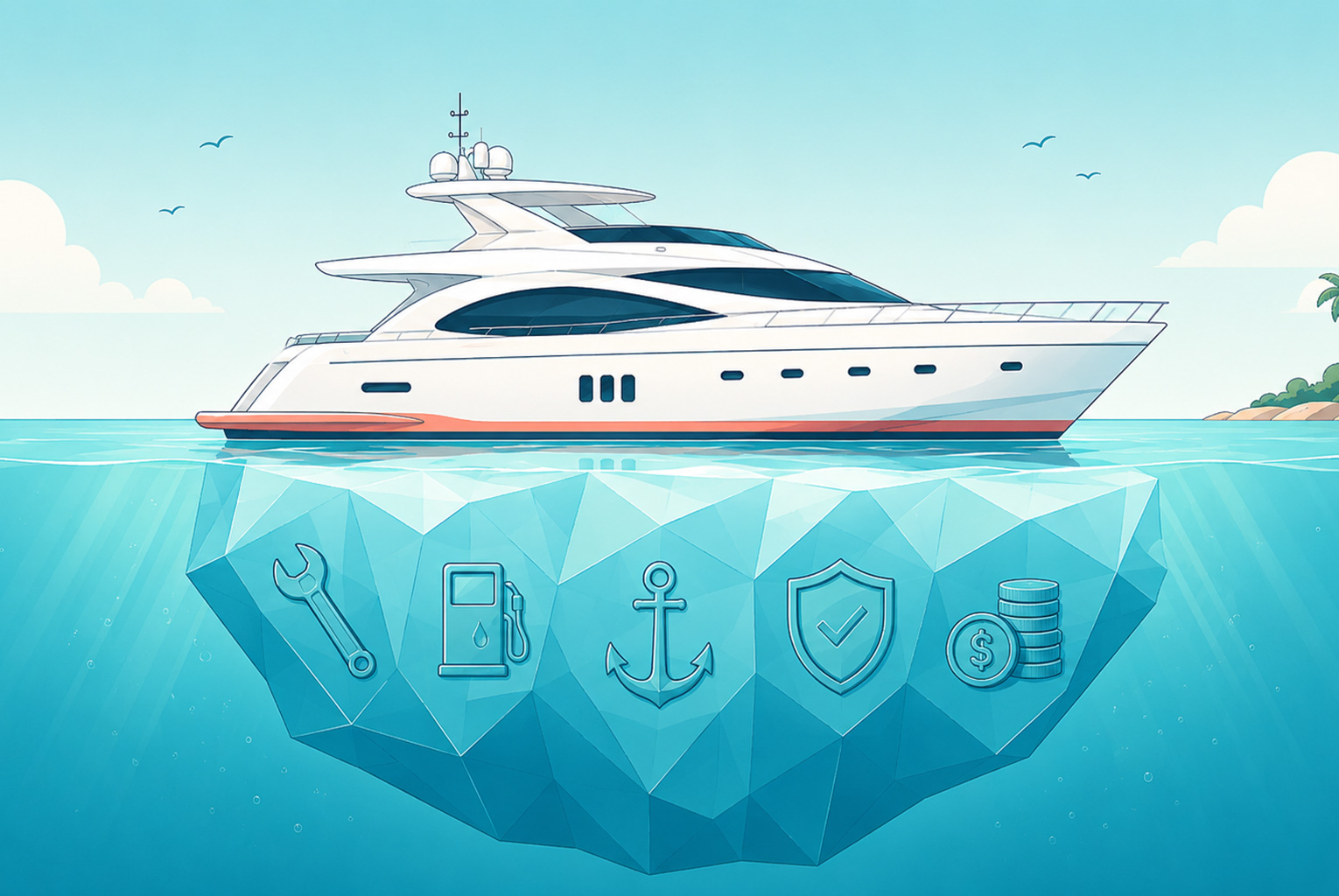
The purchase price is only the entry point to yacht ownership. Annual operating costs commonly run between 10% and 20% of the vessel’s value once crew, maintenance, dockage, insurance, fuel, management, and refits are included. Add depreciation, taxes, and eventual selling costs, and the true financial commitment rises further. A yacht may be affordable to buy but uncomfortable to own. The recurring burden, not the sticker price, determines whether ownership remains enjoyable.
For a high-net-worth individual (HNWI) buyer, the sharper question is not "what does the boat cost" but "what does five years of cash flow and balance-sheet exposure look like." A yacht sits on the family balance sheet as a large, illiquid, depreciating lifestyle asset that draws down cash in every year you hold it. This article works through what a yacht costs to buy, the annual cost of owning a yacht, the hidden expenses buyers routinely miss, depreciation, the buy-versus-charter decision, fractional ownership, 2026 tax treatment, and how to hold the vessel sensibly inside a complete portfolio.
What Does a Yacht Actually Cost to Buy?
Purchase price scales with size, but not neatly. As a broad orientation from current brokerage listings and market reports: production boats under 50 feet often range from roughly $300,000 to $2 million; 50-to-70-foot yachts commonly run $1 million to $5 million; 70-to-100-foot vessels frequently sit between $4 million and $20 million; and yachts over 100 feet begin around $10 million and reach into the hundreds of millions for large custom builds. Treat these as illustrative bands, not quotes.
Two yachts with the same length can carry very different price tags and running budgets. Displacement, gross tonnage, engine package, equipment complexity, and the crew the vessel requires often matter more than a few extra feet. A heavy, systems-dense motor yacht is a different economic animal from a lighter sailing yacht of similar length, and a sailing yacht generally costs less to run because it burns less fuel and often carries fewer crew. New builds command a premium over comparable used boats, custom vessels cost more than production models, and brand, shipyard reputation, age, and refit condition all move the number materially.
The asking price is also not the outlay. Before a yacht operates normally, expect costs for a survey, haul-out, sea trial, legal review, title and lien search, registration and flagging, and any import duty, VAT, or sales and use tax that applies where the boat is bought or used. Add delivery and repositioning, an insurance survey, immediate repairs or a commissioning refit, initial safety and communications equipment, and the owner's own fit-out: tenders, water toys, linens, tableware, and provisions. On some transactions these items are modest; on others, particularly older boats needing correction of deferred maintenance, they are large. Model them explicitly rather than assuming a fixed percentage over asking.
Annual Cost of Owning a Yacht
How much does it cost to own a yacht?
Plan for annual running costs of roughly 10% to 20% of the yacht's value, and understand why the range is so wide. The widely quoted 10% rule holds that yearly operating costs run about 10% of purchase price, so a $2 million yacht costs around $200,000 a year. It is a useful starting heuristic, and it can be broadly accurate for a relatively new, lightly used, well-managed boat with predictable needs. But it is a rule of thumb, not physics.
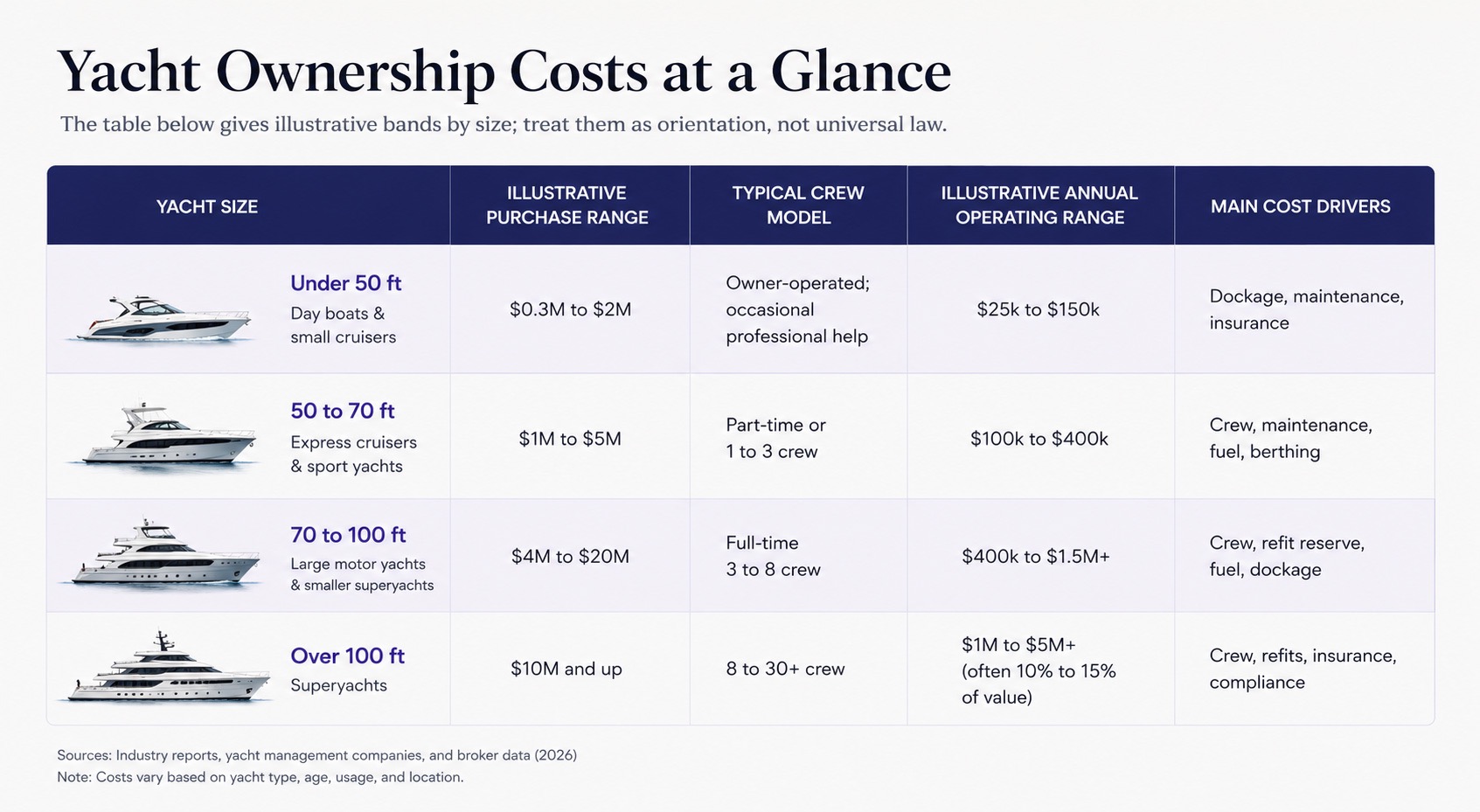
The moment you add salaried crew, the tidy 10% figure tends to break. For fully crewed vessels, older boats, heavily used boats, or a yacht bought recently at a high valuation, annual budgets can reach 15% to 25% of value in some years. Experienced managers put it plainly: you can run a yacht below 10%, but you cannot run it well below 10%, because costs held down that far usually signal deferred maintenance, thin insurance, or an aging systems package. A refit year can exceed normal ranges by a wide margin. The table below gives illustrative bands by size; treat them as orientation, not universal law.
Crew and yacht-management costs
On crewed yachts, crew is usually the single largest line item. A full team can include a captain, deck and engineering crew, interior stewards, and a chef, plus payroll taxes, benefits, health insurance, recruitment, travel, uniforms, training and certification, accommodation, and provisioning. Yacht crew costs vary sharply by role, region, experience, and vessel size, so no single global rate applies. As a rough illustration from industry surveys, a captain's salary may start around $50,000 on a smaller boat and run well into six figures on a large yacht, and a full crew on a big vessel can exceed $200,000 a year, reaching far higher on superyachts. Turnover adds recruitment fees, repatriation, and the disruption of replacing key crew. Most owners also pay a yacht manager or management company, flat or as a percentage, to handle payroll, compliance, budgeting, and reporting.
Yacht maintenance cost and repairs
Maintenance continues whether or not the boat leaves the dock. Routine work covers engine and generator servicing, haul-outs, bottom paint, hull cleaning, stabilizers, air-conditioning and water systems, navigation and communications equipment, safety inspections, and the upkeep of paint, teak, upholstery, and interior finishes. Industry estimates commonly put routine maintenance around 5% to 10% of purchase price per year, rising for larger and older vessels. Distinguish this recurring spend from a refit reserve: every few years a boat needs a yard period for repaints, machinery overhauls, class or compliance work, and correction of corrosion or failures. An annual average can hide years with unusually large bills, which is why a reserve matters. This is also why a bargain hull can become expensive; deferred maintenance eventually surfaces, and the new owner pays for it.
Berthing, dockage, storage, and repositioning
Berth costs depend on length, beam, location, and season. Marina rates are often quoted per foot per month and vary widely; premium Mediterranean berths can cost several times a comparable slip elsewhere, while some US marinas are far cheaper. Add shore power and utilities, winter storage or haul-out, hurricane-season relocation, and the canal, port, customs, and agency fees incurred while cruising. Moving the boat between grounds means either delivery crew or transport-ship costs. A yacht that follows the seasons pays for that mobility.
Fuel and cruising profile
Fuel is the most visible cost and often not the largest. It depends on whether the yacht is a fast motor yacht or a displacement-speed or sailing vessel, on engine size and generator usage, on cruising hours, and on regional fuel prices. Consumption rises steeply with speed, so a lighter hand on the throttle changes the bill considerably, and sailing yachts burn far less. Tenders and water toys add their own fuel and upkeep. For most private owners who cruise moderately, crew and maintenance outweigh fuel; heavy, long-distance motor cruising is the case where fuel becomes a headline number.
Insurance
Marine insurance typically combines hull and machinery cover with protection and indemnity liability, plus crew cover and, where relevant, charter coverage. Premiums are commonly cited around 0.5% to 2.5% of value, but the figure depends on the vessel, cruising region, storm exposure, owner and crew experience, survey findings, claims history, deductibles, and exclusions. Worldwide and hurricane-zone cruising raise premiums; coastal, benign-region use lowers them. Do not assume a fixed percentage; get a quote against the actual cruising plan.
Administration and compliance
Ownership carries a steady administrative load: registration and flag-state fees, classification or survey requirements, legal and accounting support, safety certification, communications and software subscriptions, and management reporting. A yacht in charter adds charter compliance on top. No single item is large, but together they form a recurring cost owners forget when budgeting only for crew, fuel, and dockage.
Hidden Costs of Owning a Yacht
The budget that surprises owners is rarely the one they wrote down. The hidden costs of owning a yacht are the lumpy, irregular items that fall outside the tidy annual estimate: the post-purchase commissioning refit; crew recruitment and turnover; replacement tenders and toys; stabilization, electronics, and connectivity upgrades, including satellite systems that have become near-essential; and unplanned yard time when something fails at the wrong moment.
Then come the cyclical items: paint cycles, teak replacement, winterization, and storm preparation. Add customs and cruising permits, repositioning between seasons, charter wear and tear if the boat earns income, guest provisioning, security in some regions, and the owner's own travel to reach the vessel. The exit has its own costs too: brokerage commission at sale, legal costs, and months of continued carrying cost while the boat sits listed. Put plainly, the most expensive ownership year may be the first year, a major refit year, or the year the owner decides to sell.
A Five-Year Cost of Ownership Example
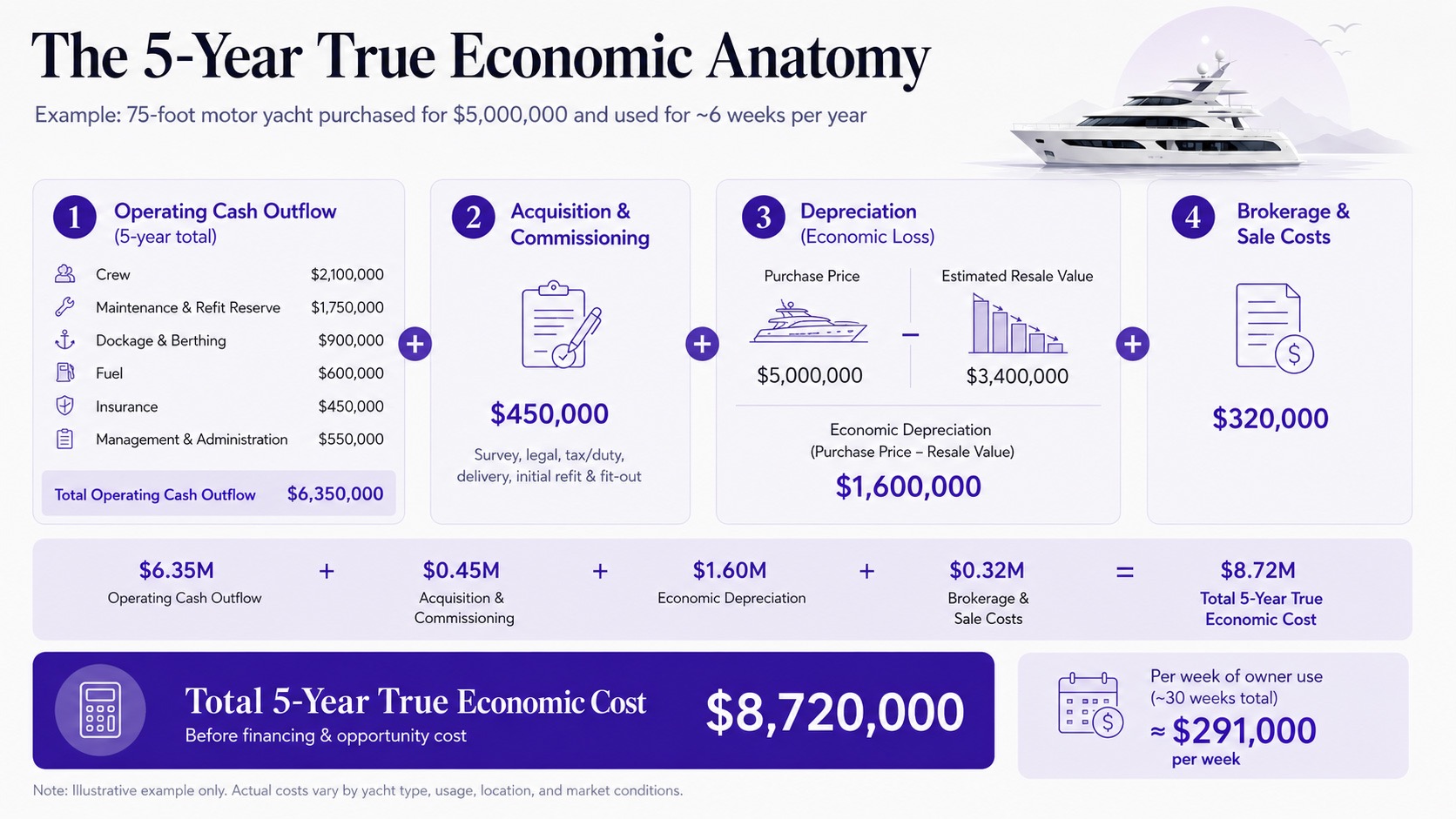
Consider a hypothetical, transparently stated case: a used 75-foot motor yacht bought for $5,000,000, kept fully crewed with a small team, cruised moderately in the Mediterranean and Caribbean, and used by the owner about six weeks a year. Every figure below is an assumption for illustration, chosen to be neither optimistic nor alarmist, and real outcomes will differ.
Reading this correctly matters. The five-year cash operating cost is about $6.35 million. The economic cost of ownership is different: it combines operating cash outflow, the commissioning capital, depreciation of roughly $1.6 million, and about $320,000 in sale costs, totaling close to $8.7 million over five years before financing. Spread across roughly 30 weeks of actual owner use, that is on the order of $290,000 per week of enjoyment. Separately, and not shown as an invoice, is opportunity cost: the capital and annual cash could have earned a return elsewhere, and that forgone return is a real, if uncharged, part of the picture. The point is not to discourage the purchase but to price it honestly.
Yacht Depreciation and Resale Value
A yacht is generally a depreciating lifestyle asset rather than an investment. The first owner usually absorbs the steepest decline, much as with a luxury car. Broad market observation suggests meaningful loss in the early years followed by a gentler annual decline, but rates are not uniform, so avoid treating any single percentage as a law that applies to every vessel.
What drives yacht depreciation and resale value is a familiar list: brand and shipyard reputation, maintenance history and refit quality, engine hours, technology obsolescence, and where the market sits in its cycle. Currency effects matter for cross-border sales, and a long listing time itself carries cost. Survey findings at sale can reduce the achievable price, and brokerage commission takes a further slice. A well-documented boat from a respected yard holds value better and sells faster than a neglected one, which is one reason disciplined maintenance is partly an investment in resale. For net-worth reporting, the yacht's carrying value should reflect realistic resale, not the original purchase price, because the gap between the two is a genuine reduction in wealth.
Yacht Charter vs Ownership
For many buyers the honest first question is whether to own at all. The right comparison is not purchase price versus a weekly charter rate; it is the five-year cost of ownership versus the cost of chartering the number of weeks you will realistically use. The table sets out the trade-offs across full ownership, chartering, and fractional ownership.
Is it cheaper to buy or charter a yacht?
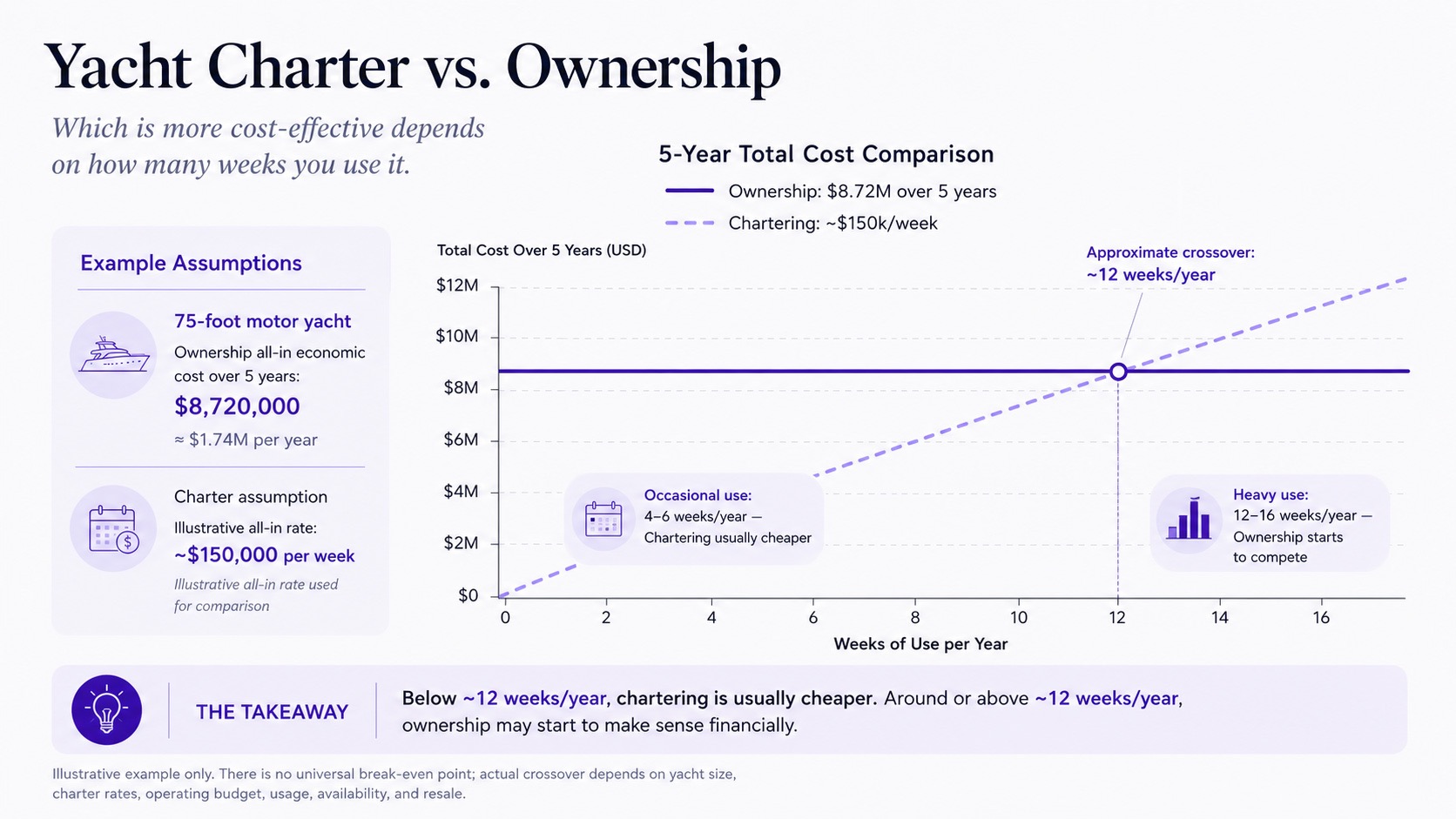
Work an example on the $5 million yacht above, whose all-in economic cost averages roughly $1.7 million a year across five years. Suppose a comparable boat costs approximately $150,000 per week on an illustrative all-in basis. An occasional user wanting four to six weeks a year would spend on the order of $600,000 to $900,000 chartering, well below the ownership burden, with no capital, no depreciation, and no operational responsibility. Chartering wins clearly. A heavy user wanting twelve to sixteen weeks would spend roughly $1.8 million to $2.4 million, which approaches or exceeds the ownership figure, and now the non-financial benefits of ownership start to earn their keep.
There is no universal break-even week count. Any crossover depends on yacht size, charter rate, the annual ownership budget, actual usage, availability in the season and location you want, the crew standard you expect, how much personalization you value, and resale. So "is owning a yacht worth it" is not only a spreadsheet result. For a buyer who values guaranteed availability, a boat set up exactly to taste, privacy, and crew continuity, ownership can be worth a premium over the pure charter math. For everyone else, chartering the weeks you will actually use is usually cheaper and simpler.
Can Charter Income Offset Yacht Ownership Costs?
Placing a yacht with a central agent or charter-management company can bring in revenue, but the economics are more modest than headline weekly rates suggest. Charters typically run on a plus-expenses basis: the guest pays a base fee, then covers variable trip costs through an Advance Provisioning Allowance, commonly around a quarter to a third of the fee. From the base fee, broker and central-agency commissions are deducted, often around 20% in total, and after commissions and agreed deductions many owners net roughly half of gross charter revenue. A privately owned boat commonly achieves something like eight to ten charter weeks a year, not a full calendar.
Then there are the costs that charter creates. It adds crew and provisioning demands, marketing, calendar restrictions that limit owner use, maintenance and cleaning between trips, charter licensing and compliance, more engine hours and wear, and potential VAT or local charter taxes. Charter income is taxable, and a genuine operation means business records and often different insurance. The net effect is that you can charter a yacht to offset costs, and revenue can meaningfully reduce annual carrying cost, but for a single vessel it usually does not cover the full economic cost once commissions, incremental maintenance, depreciation, and financing are counted. Owners of very large, scarce superyachts sometimes come closer, but even there depreciation makes overall profit unlikely. Treat chartering as cost mitigation, not as turning a personal yacht into a profitable investment.
Yacht Tax Deductions and Bonus Depreciation in 2026
US federal tax law changed in 2025 in a way that is widely discussed among yacht buyers. The One Big Beautiful Bill restored permanent 100% additional first-year depreciation (bonus depreciation) for qualifying business property acquired and placed in service after January 19, 2025. This is a genuine change in the tax law, and it can matter for a yacht used in a real business. It is not a write-off available to every yacht owner, and the details decide everything.
Start with the threshold question. A yacht held primarily for personal recreation is not depreciable as business property, and no amount of structuring changes that. Placing a yacht with a charter manager does not automatically establish a genuine trade or business. Only the qualifying business-use portion of a vessel may be depreciable, so mixed personal and charter use requires careful allocation and contemporaneous documentation of charter activity, personal use, expenses, and business purpose. Acquisition date and placed-in-service date both matter, and the vessel's tax classification and recovery period must be confirmed for the asset to qualify at all.
Several provisions and limits interact. Bonus depreciation under Section 168(k) and Section 179 expensing are separate provisions; Section 179 has its own dollar limits (raised to $2.5 million with a $4 million phaseout for property placed in service after December 31, 2024), a more-than-50% business-use requirement, and a taxable-income constraint. Passive-activity, at-risk, hobby-loss, related-party, and material-participation rules can all limit or defer deductions, especially for an owner not actively running the charter activity. Deductions taken now can create depreciation recapture later, converting part of the earlier benefit into taxable income on sale. Personal use above modest thresholds can reduce the deduction and change loss treatment.
There is also a layer beyond federal income tax. Sales tax, use tax, VAT, import duties, registration, and flag-state rules are separate from federal depreciation, and state treatment may differ from federal. Offshore flagging does not eliminate tax, and registration choices do not always avoid sales or use tax where the boat is actually used. The warning worth repeating: a charter agreement or an LLC does not, by itself, convert a personal yacht into a deductible business asset. Bonus depreciation also shifts the timing of deductions more than it creates permanent savings equal to the deduction, because recapture and the time value of money offset part of the benefit. None of this is individualized tax advice; anyone considering it should retain a tax professional who understands charter operations and maritime assets before relying on these provisions.
Fractional Yacht Ownership
Fractional ownership sits between chartering and full ownership, in two broad forms: shared title, where several owners hold real ownership of a specific vessel, and membership or usage-right structures, where you buy access rather than the boat itself. A typical arrangement involves a capital contribution for the share, a recurring management fee, and an allocation of usage days, often with peak-period restrictions. Operating costs are shared according to the program's formula, and refit or major-repair assessments are shared too, which can produce unexpected capital calls.
The trade-offs mirror those in fractional jet ownership: lower capital and shared operating burden in exchange for less control, scheduling constraints, and dependence on the program's solvency and its counterparty. Depreciation still applies to your share, and exit is governed by the program's transfer and sale rules, which vary widely. Fractional ownership does not guarantee easier resale, so read the exit mechanics before committing. For a buyer who wants more than charter flexibility but cannot justify a whole boat, it can be a sensible third option, provided the program is financially sound and transparent.
What Net Worth Do You Need to Own a Yacht?
There is no universal wealth threshold, and any figure quoted as one should be treated skeptically. A more useful approach applies three affordability tests, all anchored in liquid net worth and recurring cash flow rather than headline wealth.
Purchase concentration
How much of your liquid net worth would the yacht consume? A conservative heuristic keeps the purchase below about 10% of liquid net worth, so a distress event never forces a sale of the boat at the worst possible time. It is a heuristic, not a rule.
Annual carrying burden
What share of recurring after-tax cash flow, or of total investable assets, would the annual costs consume? If the yearly budget is a small and comfortable fraction, the boat fits; if it competes with essential commitments, it does not.
Liquidity resilience
Could you keep paying through a market decline, a business downturn, an extended refit, an insurance dispute, a delayed sale, or an unexpected family liquidity event? A yacht should survive a bad year without distorting the rest of the plan.
Illustrative profiles help. A smaller owner-operated yacht suits a buyer with meaningful liquid assets who does most of the work personally. A crewed 60-to-80-foot yacht implies a substantially larger liquid base and stable cash flow to carry six-figure annual costs. A superyacht implies wealth and income at a different order of magnitude, and a globally operated megayacht implies resources well beyond that. In every case, the emphasis belongs on liquid net worth and dependable cash flow, not a single headline number.
Tracking a Yacht in Your Net-Worth Portfolio
A yacht is a classic lumpy asset: no daily market price, few comparable transactions, value that swings with condition and refit history, wide brokerage spreads, steady depreciation, and long sale periods. That makes it easy to misstate on the family balance sheet. Sensible practice is to review market value at least annually, obtain a periodic professional appraisal, update the figure after any major refit, keep estimated market value separate from historical purchase cost, and track related debt and annual cash outflow on their own.
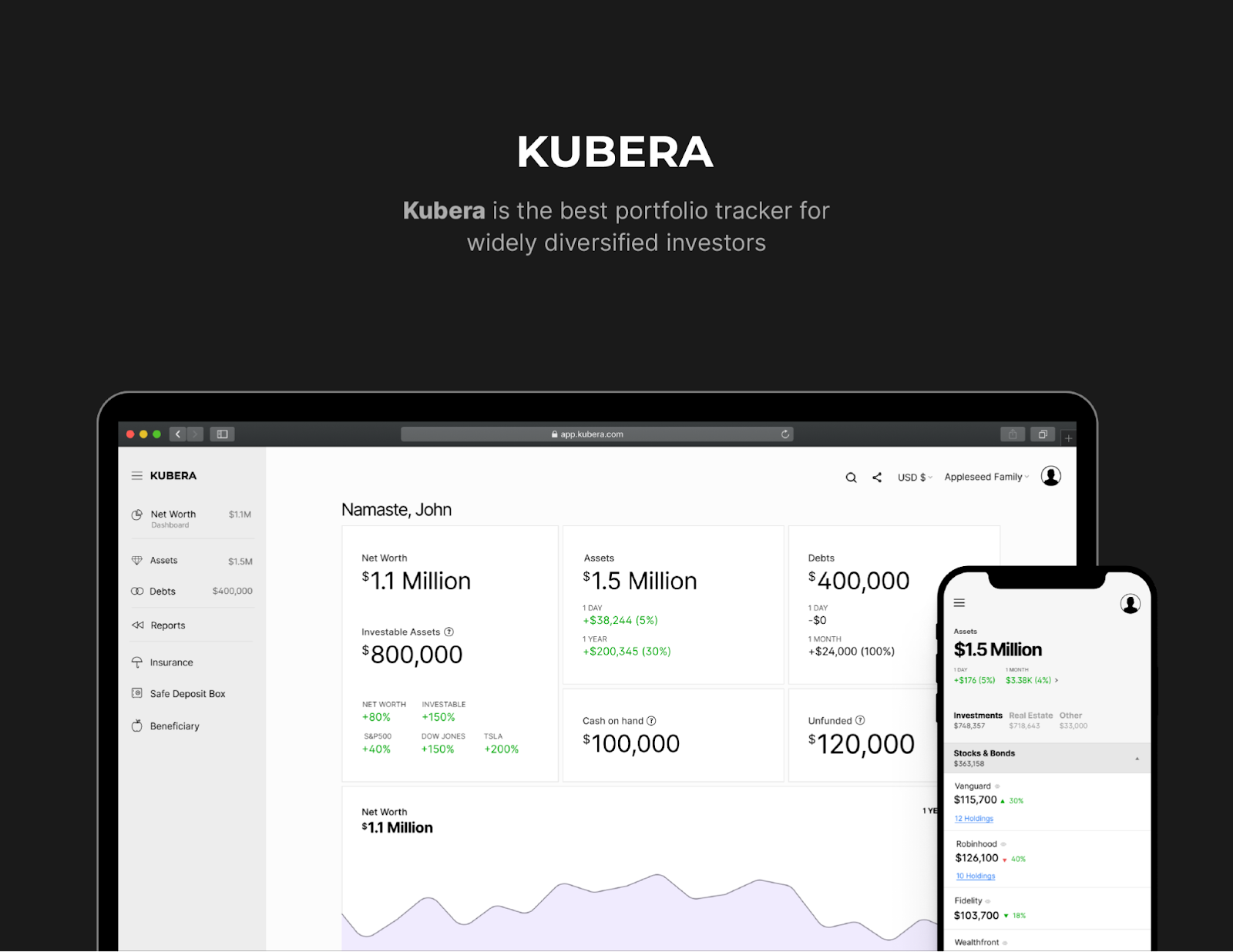
A tracker such as Kubera lets you add a yacht manually as an asset, record a current estimated value, and log any associated debt, then view the vessel alongside investments, real estate, businesses, and other holdings to see its share of total net worth. Because there is no live price feed for a specific boat, the asset value will generally need manual updates supported by comparable-market evidence or a professional appraisal. Used that way, the yacht stays visible in a realistic family balance sheet rather than hiding as an untracked drain of time and cash.
A Financial Decision Framework for Prospective Yacht Owners
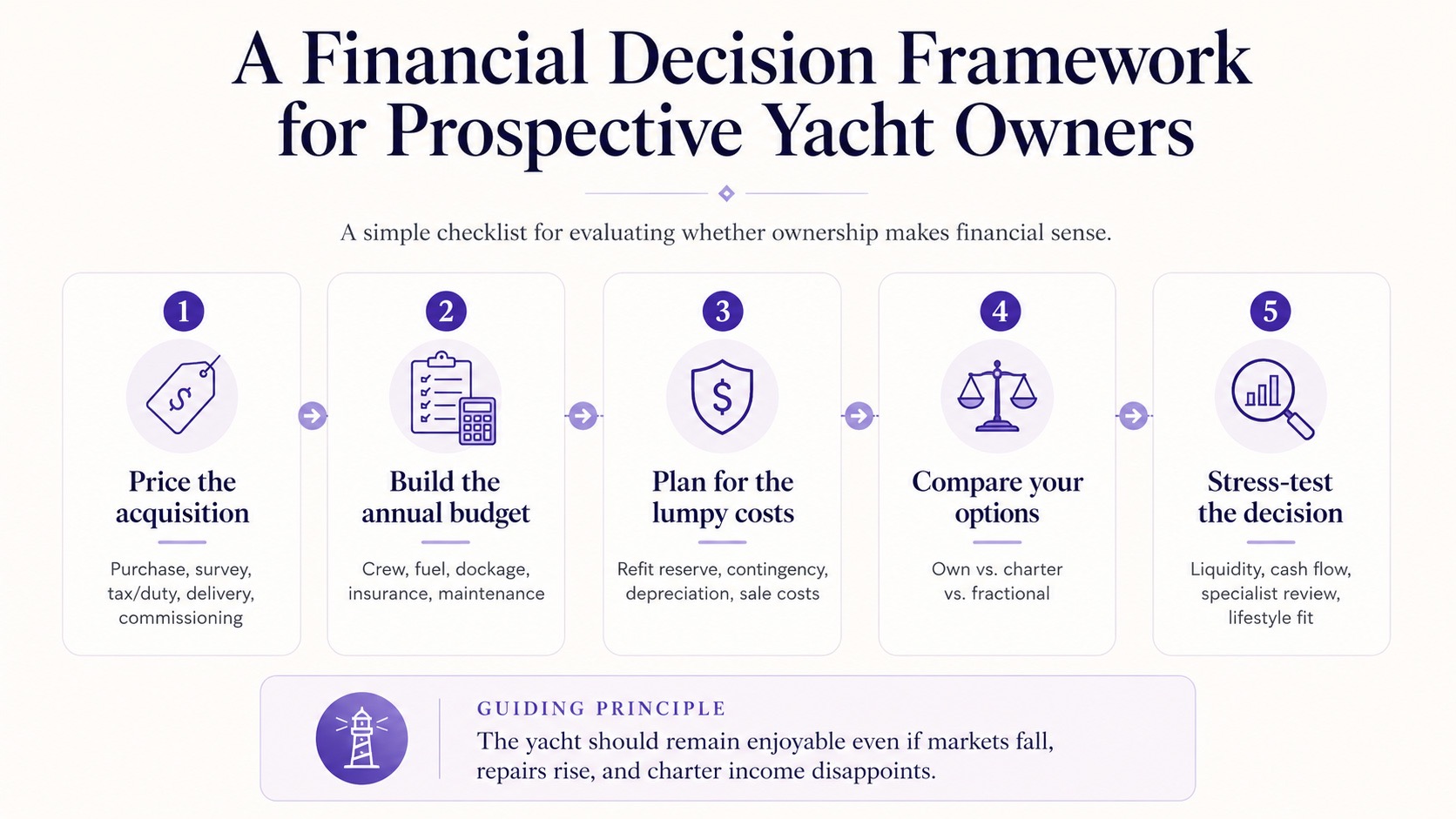
- Estimate the total acquisition outlay, including survey, tax or duty, delivery, and commissioning.
- Build a realistic annual operating budget by line item, not a single percentage.
- Add a refit and contingency reserve for the lumpy years.
- Model depreciation and expected sale costs, using realistic resale values.
- Calculate total three-year and five-year economic cost, separating cash, capital, and depreciation.
- Compare that cost with the cost of chartering the weeks you will realistically use.
- Test full, fractional, and charter alternatives side by side.
- Stress-test the purchase against liquid net worth and recurring cash flow.
- Review tax, ownership, flag, and charter structure with specialists who know maritime assets.
- Decide whether the lifestyle value justifies the capital commitment.
One principle holds the framework together: the yacht should remain enjoyable even in a year when markets fall, repairs rise, and charter income disappoints.
Frequently Asked Questions
How much does it cost to own a yacht?
Plan for annual running costs of roughly 10% to 20% of the yacht's value in a normal year, and 15% to 25% in a heavy-use or refit year. Smaller boats can run from tens of thousands a year, mid-size crewed yachts commonly cost several hundred thousand, and vessels over 100 feet often exceed $1 million. The purchase price is separate from, and only the start of, this commitment.
What is the annual cost of owning a yacht?
It is the sum of crew, maintenance and refit reserve, dockage, fuel, insurance, and administration, plus the non-cash cost of depreciation. On crewed yachts, crew is usually the largest item, followed by maintenance and berthing. Fuel is highly visible but often not the biggest expense. Budgets vary widely with size, age, region, usage, and the standard of service expected.
What percentage of a yacht's value should I budget each year?
The 10% rule is a common starting point, and 10% to 15% is a reasonable baseline for a well-run boat. Treat it as a planning shortcut, not a quote. Newer, lightly used vessels may sit near or below it, while older, crewed, or heavily used yachts can run 15% to 25% in some years, and a refit year can exceed even that.
Is owning a yacht worth it?
That depends on how much you value guaranteed availability, a boat set up to your taste, privacy, and crew continuity, and on how many weeks you will actually use it. Occasional users usually do better chartering. Ownership can still make sense for frequent users who want control, provided the purchase and annual costs fit comfortably within liquid net worth and cash flow.
Is it cheaper to buy or charter a yacht?
For occasional use, chartering is almost always cheaper because you avoid capital, depreciation, and fixed operating costs. Compare the five-year economic cost of ownership against the cost of chartering the weeks you will realistically use. There is no universal break-even week count; the crossover depends on yacht size, charter rates, your budget, usage, availability, and resale.
Can charter income cover yacht ownership costs?
Rarely in full for a single boat. After commissions of around 20%, an owner often nets roughly half of gross revenue, and a private yacht typically achieves only eight to ten charter weeks a year. Chartering also adds wear, compliance, and taxable income. Revenue can meaningfully reduce annual carrying cost but usually does not cover the full economic cost after depreciation.
Can I claim a yacht tax deduction, and does a yacht qualify for bonus depreciation in 2026?
Only if the yacht is used in a genuine trade or business with real profit motive and proper documentation. The One, Big, Beautiful Bill restored permanent 100% bonus depreciation for qualifying business property acquired and placed in service after January 19, 2025, but a personally used yacht is not depreciable, and a charter agreement or LLC does not by itself create a deduction. Deductions can trigger recapture later. Consult a maritime tax professional.
How quickly do yachts depreciate, and what are typical crew salary costs?
Most yachts lose value fastest in the early years, then decline more gradually, though rates vary by brand, condition, and market. On crew, costs vary sharply by role, region, and size: a captain's pay can start near $50,000 on a small boat and reach well into six figures on a large yacht, and a full crew on a big vessel can exceed $200,000 a year. There is no uniform global rate.
Conclusion
The case for owning a yacht rarely turns on the purchase price. Operating cost, depreciation, refits, and the eventual sale determine the real economic burden, and the annual commitment continues whether the boat is used for four weeks or forty. For occasional use, chartering usually wins on cost and simplicity. Ownership may still make sense for buyers who genuinely value availability, customization, privacy, and continuity, and who can carry the costs without straining the rest of their finances. Affordability depends on liquidity and recurring cash flow, not headline net worth. Approached with honest numbers, owning a yacht can support a life well lived on the water without distorting the plan that pays for it.


